Varieties of Human Experience: Recent Documentaries

In the last ten to twenty years, in addition to informing us in a journalistic sense, the best documentaries have been artistic expressions in their own right. The ones I’ve seen lately have been outstanding, uplifting, deeply moving, and extremely well made. Here they are:

Eva Hesse (Marcie Begleiter, director)  I’d never heard of Eva Hesse before seeing this film, but despite my ignorance, it turns out she’s an important figure in the art world. In the photographs and archival footage we see, she seems unassuming, smaller than life, yet she created amazing work. This film makes me want to know about her and her art.

_____________________________________________________________
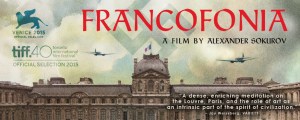
Francofonia-poster3Francofonia (Alexander Sokurov, director)  Sokurov is probably best known in this country for Russian Ark (2002), a time-travelling wonder set in the Hermitage Museum in St. Petersburg, famously shot in a single, 99-minute take. It’s amazing. But the first of his films I saw was Mother and Son (1997), a slow-moving but far from boring film comprised of long takes in which virtually nothing happens on screen, but it’s mesmerizing all the same. Francofonia isn’t easy to pin down; it’s a mix of fact and fiction, history and imagination, with the Nazi occupation of Paris during World War II and art works from the Louvre at the center. There’s something very moving about it that’s hard to describe.

_____________________________________________________________

The Music of Strangers: Yo-Yo Ma and the Silk Road Ensemble (Morgan Neville, director)  Neville has a strong resumé; his previous films include Best of Enemies (2015) and the Oscar-winning 20 Feet from Stardom (2013). The Music of Strangers is just wonderful. The music is rapturous and transporting. The musicians profiled in the film come off as genuinely solid, firmly grounded people. They include Kayhan Kalhor of Iran, Wu Man of China, the awesome Cristina Pato of Galicia in Spain, and Kinan Azmeh of Syria. As Wu Man says at one point, “There’s no East or West, it’s just a globe.” The Music of Strangers opens in New York and Los Angeles on June 10; nationwide in June/July.

______________________________________________________________

Nothing Left Unsaid: Gloria Vanderbilt and Anderson Cooper (Liz Garbus, director)  Garbus has had a long, impressive career. Last year she gave us the extraordinary What Happened, Miss Simone?, and years before the equally strong The Farm: Inside Angola Prison (1997), both of which are available for streaming on Netflix. Nothing Left Unsaid (great title) is sharp, witty, and powerful. Gloria Vanderbilt, who I knew little about other than her name and her line of jeans, has had an amazing life. She was married to Leopold Stokowski (!) and Sidney Lumet (news to me). Her last husband, Wyatt Emory Cooper, who died in 1978, was Anderson’s father. Gloria is 92 and sharp as a tack. Her relationship with Anderson is beautiful to see. Besides being mother and son, they seem to be really good friends. My friend Judith Trojan wrote perceptively about the film on her blog, FrontRowCenter, when it was first shown on HBO this past April. You can read that here.

_____________________________________________________________

Presenting Princess Shaw (Ido Haar, director)  This film is a rush of positive energy. Samantha Montgomery, aka Princess Shaw, lives in New Orleans where she cares for the elderly at an assisted living facility during the day and posts her songs on YouTube at night. Ophir Kutiel, aka Kutiman, is a musician who lives in Israel and creates new compositions from musical clips he finds on YouTube. The film shows how he uses Princess Shaw’s music and the profound impact this has on her life when he releases it on the Internet. Presenting Princess Shaw is available for streaming on Amazon.

Director Ido Haar, Princess Shaw, Kutiman

Director Ido Haar, Princess Shaw, Kutiman

____________________________________________________________
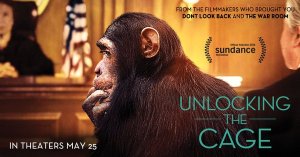
Unlocking the Cage-poster2Unlocking the Cage (Chris Hegedus & D.A. Pennebaker, directors)  We saw this at Film Forum last weekend. Hegedus, Pennebaker, and animal-rights lawyer Steven Wise, founder of the Nonhuman Rights Project, were there for a Q&A. Wise has been working for years to get chimpanzees legally recognized as persons. Per a description at Film Forum’s website, “It’s Wise’s unorthodox position that cognitively complex animals (e.g. chimpanzees, whales, dolphins, elephants) should be granted personhood rights that would protect them from abuse.” The film is extremely dramatic. It feels like it’s happening in the moment.
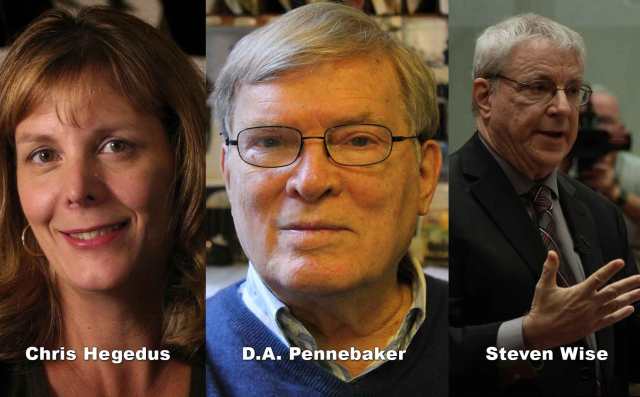
Hegedus-Pennebaker-WiseThree years ago I posted a piece on my blog about Pennebaker and Bob Dylan, which you can access here.

_____________________________________________________________
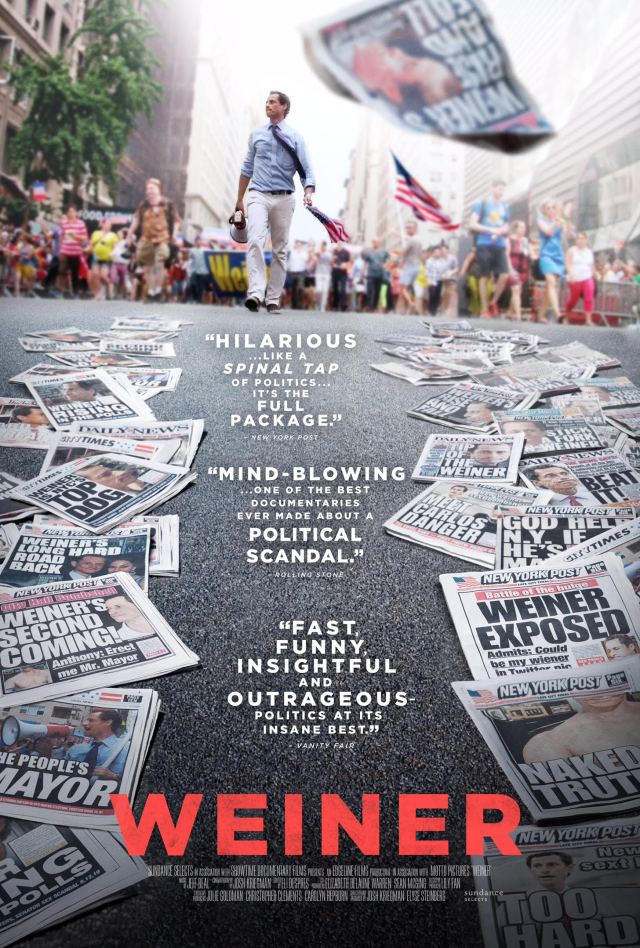
Weiner-poster2Weiner (Josh Kriegman & Elyse Steinberg, directors)  I suspect that Anthony Weiner now regrets giving Kriegman and Steinberg as much access as he did for the making of this film. I’ve read that Weiner still hasn’t seen it, which is too bad, because he might learn something about himself. Weiner is an extraordinary film, stunning at times. The tragedy of it is that if Weiner didn’t have a weird sex addiction — albeit one that doesn’t involve actual physical contact with another person — he could have been a strong politician, an impassioned guy fighting for the right causes. Throughout we see his wife, a mainly silent Huma Abedin, who does not look amused, standing by his side. It’s hard not to think of Alicia Florrick on The Good Wife. Seeing Weiner is like watching a trainwreck at times. He makes one bad decision after another, but just keeps plowing forward. In spite of everything, I find it hard not to like Anthony Weiner. I’m just glad I’m not him.

_____________________________________________________________
Witness-posterThe Witness (James Solomon, director)  After Kitty Genovese was murdered on a New York street in her neighborhood in 1964, the story by A. M. Rosenthal that appeared in the New York Times stated that thirty-eight residents had witnessed the multiple attacks on Kitty from their apartments and did nothing, despite her screams for help. This quickly became the accepted version, written in stone. Rosenthal, interviewed in the film, sticks by the story. Kitty Genovese became the symbol of urban apathy, specifically in New York City. This extraordinary film follows Kitty’s younger brother, Bill Genovese, in his efforts to learn more about who his sister was and what really happened that night, a quest that consumed him for years. What emerges is a major revision of the original story. Bill tracks down and interviews as many of the original witnesses as he can. He lost his legs in Vietnam, and if anything, this makes Bill seem that much more determined. The film plays out like a thriller of the highest order. Near the end, Bill hires a young actress to go on the street late one night where the original attack occurred and scream as Kitty did that night. This will have you clawing the armrests. The Witness is a gripping detective story. I think Bill Genovese is the true witness of the title.

_____________________________________________________________

From This Day Forward (Sharon Shattuck, director)  We saw this film last year at the Full Frame Documentary Film Festival in Durham, North Carolina. It was subsequently shown at eight film festivals in 2015 but I couldn’t understand why it didn’t get either a theatrical or television release, because its transgender subject matter couldn’t be more topical. So I was happy to learn that From This Day Forward will open at the IFC Center in New York and elsewhere on June 24. It will then air on the PBS series POV this October 10. I included From This Day Forward on my list of favorite documentaries for 2015. You can access that post here.

____________________________________________________________
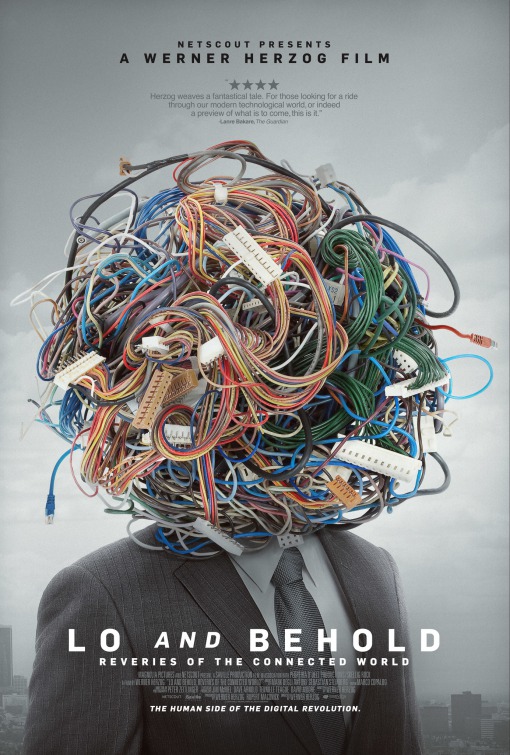
Lo and Behold-poster Lo and Behold: Reveries of the Connected World (Werner Herzog, director)  The latest film from Werner Herzog is a fascinating look at the pervasive world of the Internet, from its beginnings to what it might become. Herzog brings the same sense of inquiry and wonder to Lo and Behold that he has to his previous films, which include Grizzly Man (2005) and Cave of Forgotten Dreams (2010). While I love many of his narrative films, especially Aguirre, The Wrath of God (1972), I think overall his best work has been done in documentaries. Lo and Behold has its New York premiere at the BAM CinemaFest in Brooklyn on June 19, and opens in theaters and on demand on August 19. I plan to write more about it then.

Here is a clip of Werner Herzog and executive producer Jim McNiel interviewed by Steve Zeitchik of the Los Angeles Times at the Sundance Film Festival, where Lo and Behold had its world premiere in January . Herzog, an original thinker if there ever was one, is such a kick to listen to.

____________________________________________________________

Finally, here’s a link to an IMDB listing of the top 100 documentaries from 2000 to 2014. I didn’t see Frederick Wiseman, D.A. Pennebaker, or Al Maysles on this list — major omissions — but these are excellent choices for the most part. It gives you an idea of how many terrific documentaries are out there. – Ted Hicks
Posted in Art, Books, Film, Home Video, Music, TV & Cable | Tagged , , , , , , , , , , , , , , , , , , , , , , | 4 Comments

The Supercharged Art of Walter Molino

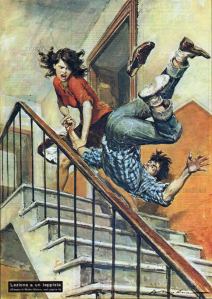
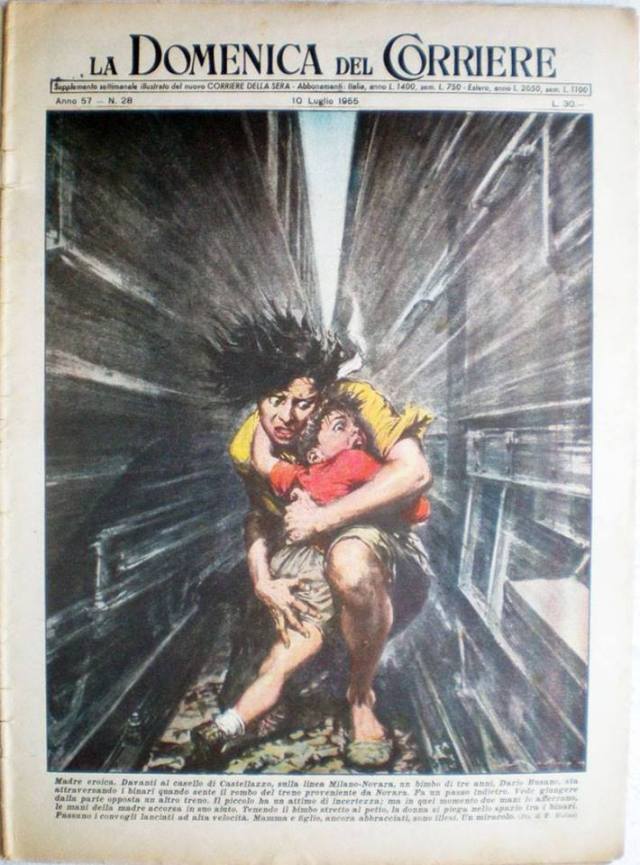
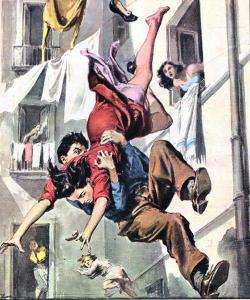
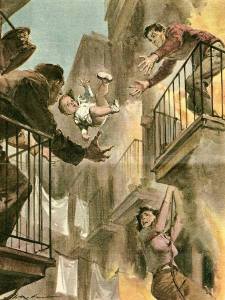
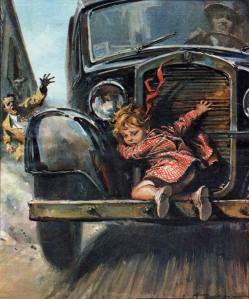
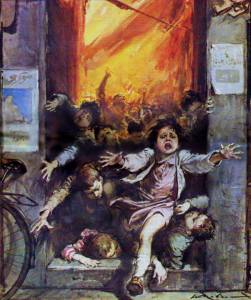
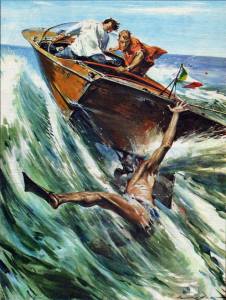
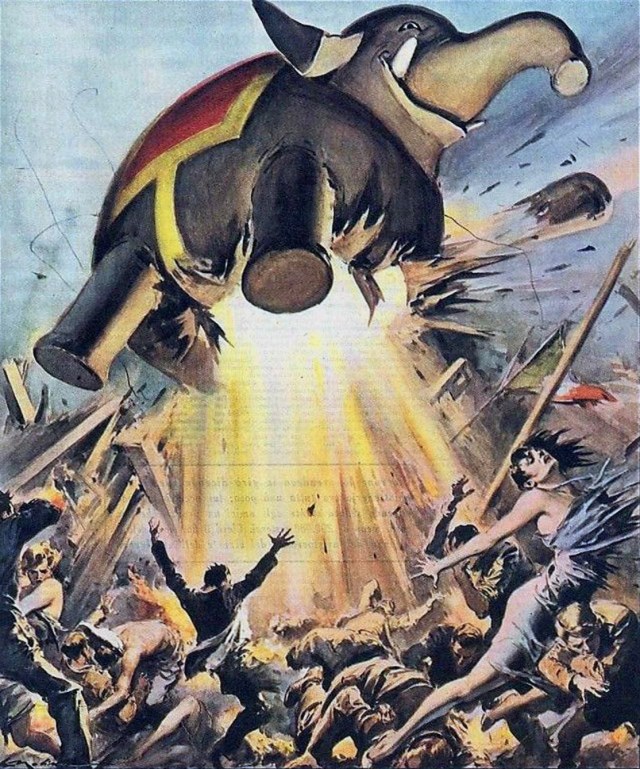
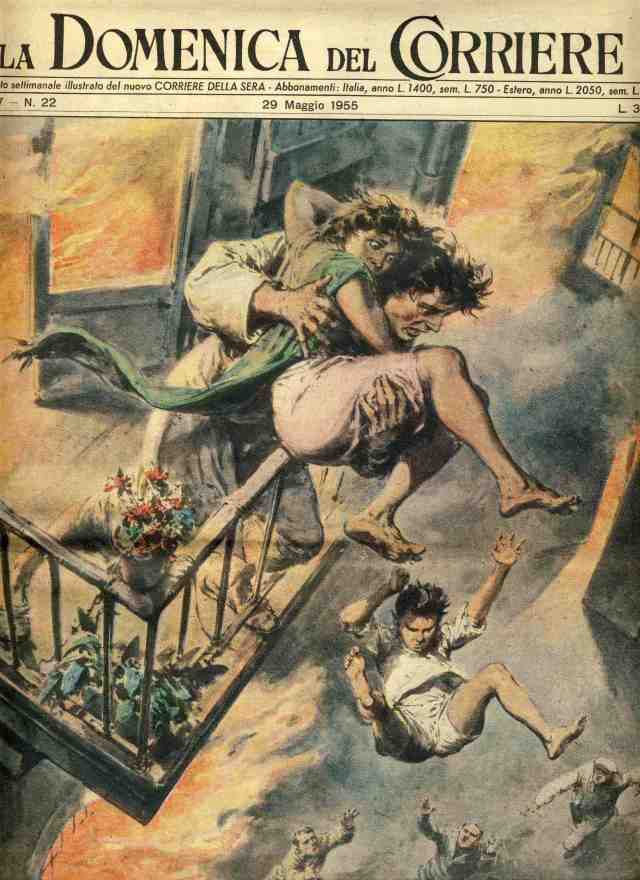
Last week a friend of mine in Minneapolis, Mark Ryan, sent me a series of illustrations by Walter Molino, an Italian comics artist and illustrator. I’d never heard of this guy, but was totally blown away by his work. I’ve been able to find only the briefest biographical information about him. Walter Molino was born in 1915 and died in 1997 at age 82. He began working professionally as an illustrator and caricaturist in 1935 for a newspaper and two children’s magazines, followed by a satirical magazine and several comic strip series. In 1941 Molino became the chief cover illustrator for La Domenica del Corriere, an Italian weekly newspaper. His work for this paper supplies most of the incredible scenes in this post. One can only imagine the stories behind these images. Almost all of them depict life and death situations. They’re like freeze frames in the midst of extreme action. And they move. His style is kinetic and electric, vivid and cinematic. You can feel the energy. Many depict women and children at risk, fires, explosions, and calamitous crashes. He seems to have a thing about falling, usually from great heights. Norman Rockwell he’s not. I haven’t found any indication that Molino ever did film posters, but if not, he should have.

Walter Molino-jumping from fireWalter Molno-child fallingWalter Molino-throwing guy down stairs


Walter Molino-between speeding trainsWalter Molino-catching falling womanWalter Molino-tossing baby from fire


Walter Molino-train hits car '58Walter Molino-race car hits crowd '57


Walter Molino-child on front bumper

Walter Molino-kids running from fire___________________________________________________________

Walter Molino-guy hit by speedboatWalter Molino-capsized lifeboat '59


Walter Molino-woman hanging out airplaneWalter Molino-jet hits train

_________________________________________________________

And whatever the hell this is.

Walter Molino-exploding elephant '57_________________________________________________________

Okay, maybe he had some stuff to work out. In any event, this wasn’t his only subject matter. He occasionally took a break from mayhem and turned out works like the smoking satire below, and somewhat strangely, a portrait of JFK and Pope John XXIII from 1963 titled “The Peace Sowers.”

Walter Molino-smokingWalter Molino-Peace Sowers '63

_________________________________________________________

You can find many more examples of Molino’s amazing work online. – Ted Hicks

Walter Molino

Walter Molino

Posted in Art, Comics | Tagged , | 4 Comments

“Tale of Tales” Pt. 2 – Supplemental Material

This may be a deeper dive than anyone who hasn’t already seen Tale of Tales will want to take, but here it is for those who do. First is more information about the work of Giambattista Basile, author of the film’s source material. Following that is a statement by the director, Matteo Garrone, concerning the film’s intentions and aspects of production. Both of these are from the press notes for Tale of Tales.

___________________________________________________

Tale of Tales by Giambattista Basile

Tale of Tales-paperback coverIn Tale of Tales by Giambattista Basile, Italy possesses the oldest, richest, and most accomplished of popular fairytale books.

Basile, Count of Torrone (cir. 1570-1632) was an academic, courtier and soldier to various Italian princes, including the Doge of Venice. He drew inspiration from popular oral traditions in Crete, and especially Venice.

A seminal narrative monument, Basile’s work comprises 50 tales. The first tale acts as a framework in which a group of people tell each other 49 stories over five days. In delightful language, using a style that blends eroticism and violence, the elegant and the grotesque, codes of honour and bawdiness, the author depicts with consummate skill and extraordinary vigour an incredible gallery of moral portraits and social mores. Yet the sorcerers and ogres, kings and princesses, dragons and enchanted animals in these stories have a naturalistic appearance, and Basile moves them through an accessible world, at once rich and poverty-stricken, one that is very physical and visceral. The backdrop for the tales is the everyday life of fully-fleshed men and women, in which extraordinary elements; the magical, the monstrous or miraculous, burst in.

Whilst other works written after the Decameron were made up of stories that could be called fairytales, such as The Canterbury Tales by Chaucer, Tale of Tales is the first in which all the stories are fairytales. Moreover, Basile was the first writer to succeed in perfectly reproducing oral intonations. Tale of Tales inspired the Brothers Grimm two centuries later, for some of their most famous works including Cinderella, Puss in Boots, Donkeyskin, Sleeping Beauty and Hansel and Gretel. Through his taste for fantasy, Basile’s work, with its comic and sentimental aspects and frequent touches of horror, is several centuries ahead of authors like Hans Christian Andersen, J.R.R. Tolkien, or even the Harry Potter saga. But the Neapolitan dialect in which Basile’s tales were written explains why they remained virtually unknown to the wider world for some 200 years.

“This collection was for long the best and richest found in a nation. The author had a special talent for collecting them, and what’s more, an intimate knowledge of the dialect. The stories are told almost without a break, and the tone, at least in the Neapolitan tales, is captured to perfection. We can, then, regard this collection of 50 tales as the basis for many others.” -Wilhelm Grimm (1837)

“The Tale of Tales is the dream of a Neapolitan Shakespeare, obsessed with all that is gruesome, with an insatiable appetite for sorcerers and ogres, fascinated by convoluted and grotesque images, in which crudeness merges with the sublime.” -Italo Calvino

___________________________________________________

DIRECTOR’S NOTES by Matteo Garrone

The Choice of Basile –

 I chose to tackle the universe of Basile because in his tales, I found that they blend between the real and fantastic which has always characterized my artistic endeavors.

The stories recounted in The Tale of Tales cover all of life’s opposites: the ordinary and the extraordinary, the magical and the everyday, the regal and the obscene, the straightforward and the artificial, the sublime and the filthy, the terrible and the tender, scraps of mythology and torrents of popular wisdom. The tales recount human feelings pushed to the extreme.

The approach to the tales: the real and the fantastical –

From the first reading of the 50 tales which make up the book, me and my fellow screenwriters faced numerous choices in choosing the stories that we liked most and then making them credible, concrete, as if we were seeing them take place before our eyes. Our approach was to search for something powerful, physical, shared and authentic, even in the stories in which the imagination was the most fired-up. In Basile’s work, there’s a great pleasure in the narrative, and that should also be a prerogative of cinema.

My previous films have been based on true stories, which I transformed to the limits of an almost fantasy dimension. Here, we did the journey in the opposite direction. We were inspired by fabulous situations that were brought on to a realistic basis through a process of subtraction, so the spectator can at each moment feel involved in the story, and become immersed in the adventures of our characters.

Modernity of the tales –

This process of subtraction had no effect whatsoever on the themes and the fundamental sentiments in the book, which still show all their surprising modernity. We were the first to be amazed by this. The horror, for example, is all there in Basile’s work; we really didn’t add anything. At the end of a long selection process, once we had chosen and created the connections between the tales, we realized to our great surprise that we had followed an invisible but very strong thread that linked them. Actually, it involved three stories about women, each at a different age in life. But what struck us even more was the capacity of these tales to capture some contemporary obsessions: the powerful desire for youth and beauty (which Basile even describes in a hyper-realistic manner, offering a satire on today’s cosmetic surgery, four centuries ahead of his time), the obsession of a mother who would do anything to have a son, the conflict between the generations, and the violence that a girl must deal with to become adult.

The language of the film –

We chose English, beyond mere production reasons (given that it’s a film with an international cast), but because that language is the way to make The Tale of Tales, this book on which some of the most famous fairytales in the world are based, accessible to the widest possible audience. The imagination of these tales goes beyond any limit, and in that respect Basile is a universal author. What’s more, the use of English means you don’t immediately identify the landscapes which form the backdrop of our story, and that avoids fixing the characters in a particular dialectal tone.

Faithfulness and betrayal –

Using English was not the only “betrayal”; we took some other liberties. But the rest is in the very nature of the fairytale, which is continually translated and reinterpreted. We found so many versions of the same stories. You can never be faithful to a tale: each time you tell it to a child so they go off to sleep, something changes. What we absolutely didn’t want to betray, what we tried to keep intact, was the spirit, that evocative power of the Tales, which has fed the universal imagination through the centuries, influencing writers like Perrault and the Brothers Grimm. And the language in which we wanted to transpose it was above all the cinematographic language – a language which can have its own specific richness, like that which we find in Basile’s work. If there can be a fantastic version of Shakespeare’s Tempest rewritten in Neapolitan by Eduardo de Filippo, we thought perhaps there could be a Basile in English. And let’s not forget that anyone who reads Basile today, even in Italy, reads the dual version, with the original text opposite the translation. It would a great thing if the film made people curious and encouraged them to read the book.

The special effects –

Like all the artistic decisions, whether the cinematography sets or costumes, the special effects were designed to give the film as much verisimilitude as possible, to lend it physical and emotional credibility. In particular, the work on the special effects was characterized by a purely artisanal creative path. We physically tried to create the fantastical creatures like the dragon and the giant flea, and to keep the digital intervention solely for touch-ups. It’s a way of working that allowed the actors to perform in close contact with these fantastic creatures and to get fully inside the skin of the character during takes.

Painting and cinema –

From a visual point of view, some of the film’s major inspirations come from Los Caprichos, the series of engravings by Francisco Goya. His marvelous illustrations really capture the soul which bursts forth from Basile’s work, and the atmosphere of the film: they provide a representation of grotesque humanity, at once realistic and fantastic, spiced up with many comic and macabre elements. As far as cinema is concerned, among the key references, I’d cite Black Sunday by Mario Bava, Comencini’s Pinocchio, Fellini’s Casanova, and Brancaleone’s Army by Monicelli.

A fantasy book with some incursions into horror –

I would define The Tale of Tales as a fantasy book with some touches of horror. In an indirect yet palpable way, these two genres – fantasy and horror – come through and can already be felt in my previous work: in The Embalmer and in First Love, the horror notes can already be clearly heard; in Reality, the fairytale mood inspires the stories as much as the style; and even in Gomorrah, beyond the realism of the situations, the tone of some episodes is that of a genuine dark fable. When you think about it, The Embalmer – which also has some grotesque and poignant aspects – actually resemble one of Basile’s tales: “Once upon a time there was a dwarf who stuffed big animals and who fell in love with a beautiful young man.”

The filming locations –

Our aim was to seek out real places that could nonetheless look like they were recreated in the studio. As such, we discovered some genuine natural locations that turned out to be perfectly adapted to the multiple reconstructions presented in the film. These are buildings and panoramas which appear to be the fruit of the most fervent imagination, but which really exist, and bear within them the signs of the period and the weirdness of those who designed them, or else the unpredictable work of nature with its materials, rocks, water, and plants. Besides some wonderful chateaus, I’m thinking of the Alcantara gorge, the Vie Cave, and the Bosco del Sasseto, which looks like a pre Raphaelite set.

The costumes –

 Regarding the costumes, the film is inspired by the first Baroque period, when Basile wrote the book, but since this is not a film of historical reconstruction. We felt free to reinvent a fantasy world, while at the same time being careful not to appear “extravagant”. If we allowed ourselves some license, it’s because the Baroque is a varied and sumptuous style, which allows a lot of liberties and in itself sums up the previous periods, including the Gothic, the style with which the fairytale genre has always been associated.

______________________________________________________

Here are three variant posters that present the film in different ways.

Tale of Tales-poster2Tale of Tales-posterTale of Tales-Italian poster___________________________________________________

Finally, here is a press conference for Tale of Tales when it was shown at last year’s  Cannes Film Festival. It’s conducted mostly in French, with English translation in voice-over. The film received a divided response from critics there. This is understandable; it’s not for everyone. As instructor Richard Brown told a film class I was in years ago, sometimes you get on the ride and sometimes you don’t. If you’re willing to let Tale of Tales take you where it will, it can be quite a trip, believe me. – Ted Hicks


Posted in Books, Fiction, Film, Home Video | Tagged , | 1 Comment

“Tale of Tales” – Once Upon a Time…

Tale of Tales-woodsTale of Tales presents three dark and bloody fairy tales — truly fantastic and quite wonderful flights of the imagination — yet it feels very real. Directed by Matteo Garrone, this is a lucid dream of a movie, an elaborately detailed period piece rendered in very physical and realistic terms.

The three episodes are taken from Pentamerone (aka The Tale of Tales, or Entertainment for Little Ones), a collection of fifty stories written by Giambattista Basile (1570-1632), which was posthumously published in two volumes in 1634 and 1636 (available from Amazon in a fine edition published by Penguin Classics). The collection contains the earliest known versions of fairy tales such as Rapunzel, Cinderella, and Sleeping Beauty, predating the Brothers Grimm by 200 years. This was news to me.

The following two trailers give a sense of the film in different ways, and I think it’s worth including both of them here.

In the press notes for the film, Matteo Garrone says “I chose to tackle the universe of Basile because in his tales, I found that they blend between the real and fantastic which has always characterized my artistic endeavors. The stories covered in The Tale of Tales cover all of life’s opposites: the ordinary and the extraordinary, the magical and the everyday, the regal and the obscene, the straightforward and the artificial, the sublime and the filthy, the terrible and the tender, scraps of mythology and torrents of popular wisdom. The tales recount human feelings pushed to the extreme. From the first reading of the 50 tales which make up the book, me and my fellow screenwriters faced numerous choices in choosing the stories that we liked most and then making them credible, concrete, as if we were seeing them for the first time.”

In the first tale, the King and Queen of Longtrellis (John C. Reilly and Salma Hayek) are childless. The Queen is distraught and deeply depressed. They are told by an ominous visitor in the middle of the night that if the Queen eats the heart of a sea monster cooked by a virgin, she will become instantly pregnant, but that a sacrifice will be involved. The King, who only wants to please his wife, dons a diving suit and descends to the bottom of a nearby lake, where he encounters and slays a sleeping sea monster. Remember, all of this looks very real. So what if the suit has no visible means of supplying him with oxygen. It doesn’t tale of tales elias jonah.jpgmatter. After consuming the sea monster’s heart in a highly visceral scene, the Queen becomes pregnant overnight and gives birth to a son the next day. The virgin who cooked the heart also gives birth. The two boys, Elias and Jonah (played by identical twins Christian and Jonah Lees), one rich and one poor, become close companions, though the Queen forbids it. Complications ensue.

In the second tale, the King of Highhills (Toby Jones) becomes obsessed with a flea that grows to the size of a large hog. He keeps it hidden in his chambers, feeding it chunks of meat. His only daughter Violet (Bebe Cave) has grown tired of her cloistered life with her father in their remotely located castle, and wants to leave. She begs her father to find her a handsome prince to marry, though she probably doesn’t anticipate an ogre (the real deal — nothing like Shrek), who drags her to a cave strewn with bones, or being temporarily rescued by a family of jugglers and tightrope walkers. There’s a kind of happy resolution, but Disney this is not.

The following clip shows how Violet ends up with the ogre. The King’s pet flea has died. He has it skinned and the hide hung in the great hall. He then announces a competition: anyone who correctly guesses the origin of the hide will win his daughter’s hand in marriage. He doesn’t want his daughter to leave, and assumes no one will get the right answer. Cue the ogre (Guillaume Delaunay).

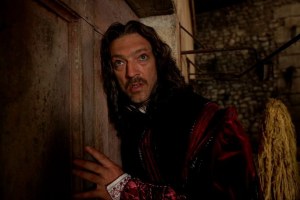
In the third tale, the lecherous King of Stronghold (Vincent Cassel) hears a woman’sTale of Tales-Vincent Cassel2 ethereal singing in the distance and is determined to learn her identity and seduce her, imagining that she is as beautiful as her voice. He doesn’t know she is one of two elderly sisters, Imma (Shirley Henderson) and the singer Dora (Hayley Carmichael). Thanks to a witch’s spell, Dora finds herself transformed into a beautiful young woman (played by Stacy Martin). The King decides to marry her. After the wedding, Imma appears and refuses to leave, demanding to know the secret of Dora’s youthful appearance. This does not end well.

Tale of Tales-Vincent Cassel3Matteo Garrone2In his first English language film, Italian director Matteo Garrone has succeeded admirably. I’ve seen two of his previous films, Gomorrah (2008), a fact-based gangster story, and Reality (2012), in which a Naples fishmonger becomes obsessed with appearing on Grand Fratello, an Italian reality television show based on Big Brother. Both are excellent. An important aspect of Tale of Tales is that it’s all done very seriously; there’s nothing tongue in cheek about it. Given the material, this could have been ridiculous if not handled right. But it was, and it works. It’s all in the telling.

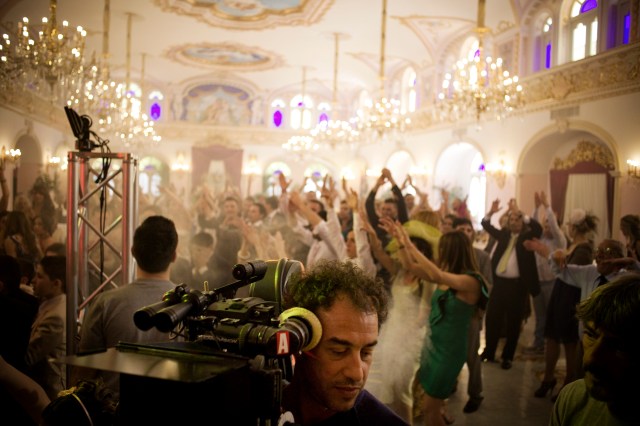
Matteo Garrone (foreground) shooting "Reality"

Matteo Garrone (foreground) shooting “Reality”

The look of Tale of Tales is particularly rich and deeply textured, with a color palette suggestive of classical paintings. Peter Suschitzky was the cinematographer. His work includes Star Wars: The Empire Strikes Back (director: Irvin Kirshner, 1980), The Rocky Horror Picture Show (director: Jim Sharman, 1975), Mars Attacks! (director: Tim Burton, 1996), 11 films directed by David Cronenberg, and films directed by John Boorman and Ken Russell. The excellently scored music was composed by Alexandre Desplat, whose previous work includes his Oscar-winning score for The Grand Budapest Hotel (director: Wes Anderson, 2014) and The Curious Case of Benjamin Button (director: David Fincher, 2008).

Here is a sampler of Desplat’s music for Tale of Tales.

Tale of Tales was shown at numerous international film festivals last year and is currently in limited theatrical release in the U.S. It is also available on demand from DIRECTV. — Ted Hicks

Tale of Tales-poster3


Posted in Books, Fiction, Film, Home Video, Music | Tagged , , , , , , , , | 1 Comment

“Anomalisa” – Behind the Scenes

Anomalisa was included in my Best Feature Films of 2015 last month, but I’d originally intended to devote a separate blog post to the film. In preparation for that piece — which I didn’t write — I accumulated a variety of material that I think might be interesting to anyone who has either seen Anomalisa, or intends to. Below is the opening paragraph of what was to have been the longer piece.

_______________________________________________________

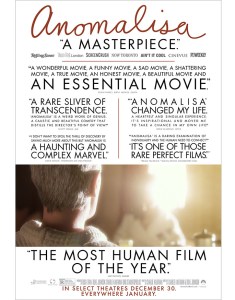
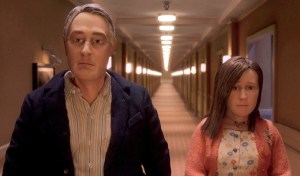
Anomalisa-posterEarlier this month (December 2015), we attended a screening of Anomalisa, a stop-motion animated feature written by Charlie Kaufman and co-directed with Duke Johnson. Like previous films written by Kaufman – Being John Malkovich (1999), Adaptation(2002), Eternal Sunshine of the Spotless Mind (2004) — Anomalisa reflects an extremely original sensibility, a way of seeing the world that seems to drift up from the unconscious — childlike, weirdly magical, and oddly disturbing. Recent films using stop-motion include Aardman Animations’ Chicken Run (2000) and the great Wallace and Gromit series (1990-2005), The Fantastic Mr. Fox (Wes Anderson, 2009), and Coraline (Henry Selick, 2009). These films and others like them depict cartoon characters in cartoon worlds. Anomalisa is something else entirely. This is the first stop-motion film I can think of that concerns ostensibly real people set in the real world. The effect is somewhat dislocating.

_________________________________________________________

Here is a selection of video and print interviews, clips on the making of the film, reviews, and photographs.

Two videos about the making of Anomalisa:

A video interview with Charlie Kaufman, Duke Johnson, and David Thewlis at the BFI London Film Festival:

A video interview with Tom Noonan at the Film Society of Lincoln Center following the screening we saw last December. Noonan has been in many films, but I remember him most vividly as the serial killer in Michael Mann’s terrific Manhunter (1986).

Click on the links to access the following:

A Film Comment interview with Charlie Kaufman and Duke Johnson

A Film Comment review of Anomalisa

A Variety review from last year’s Telluride Film Festival

A New York Times article discussing the making of Anomalisa

Charlie Kaufman discusses Anomalisa in a New York Times article

_____________________________________________________

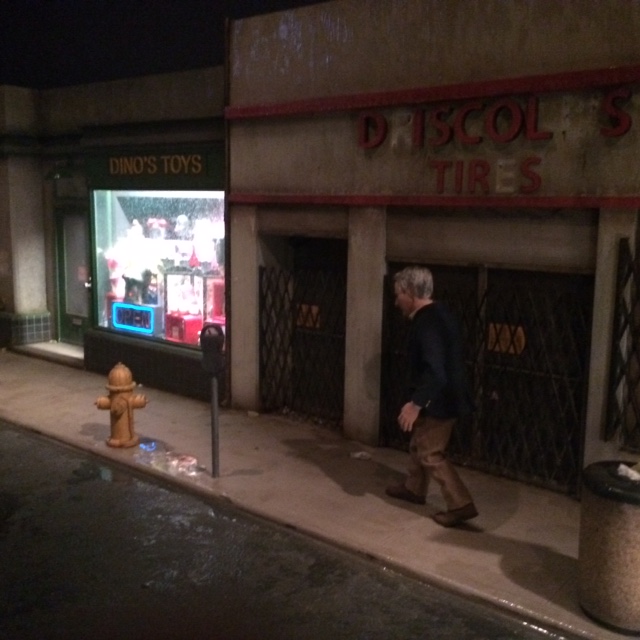
The Museum of the Moving Image in Astoria, Queens, currently has an exhibit called “The World of Anomalisa.” On display through March 27 are two sets used in the making of the film — a hotel room and a Cleveland city street. Per the exhibit description: “Photography took nearly two years, from May 2013 to December 2014, in a studio in Burbank, California. Much of the film takes place in a hotel room. Eight identical hotel room sets were built, so that filming of different scenes could take place simultaneously during the long production period. The Cleveland street set was used for just one scene in the film, and was on screen for about 30 seconds.”

Below are photographs I took of the sets. There’s something fascinating about things in miniature, and these are amazing.

Hotel room3Hotel room4Street scene5Street scene2______________________________________________________

Release dates for video discs and streaming have yet to be announced. Anomalisa is currently showing in theaters in limited release. — Ted Hicks

Anomalisa-Michael running in hall

Posted in Film, Home Video | Tagged , , , , , | 1 Comment

What I Watched Last Year: Best TV 2015

Mozart in the Jungle-poster2Better Call Saul-poster2 _____________________________________________________________

The following shows were new to me last year. I should note that I have somehow not yet seen Jessica Jones (Netflix) or the second season of Fargo (FX), both of which I’m sure would be on this list.

Better Call Saul (AMC)  This prequel to the hugely successful Breaking Bad (2008-2013) had an eager audience of fans primed and ready, and it certainly delivered. The first season shows us Bob Odenkirk’s Jimmy McGill on his way to becoming Saul Goodman. By the end of the last episode, Jimmy still hasn’t taken that name, but he’s getting there. A pleasure of this series is seeing more of Jonathan Banks as Mike Ehrmantraut, one of the strongest characters in Breaking Bad. The second season of Better Call Saul begins on February 15.

Bloodline (Netflix)  If you’ve seen this series, you know how good it is. Set in the Florida Keys, Bloodline concerns the Rayburn family and the snake pit of secrets and lies that threatens to destroy them. Flash forwards reveal a little more each time and give warnings of what’s to come. The excellent cast includes Sam Shepard, Sissy Spacek, Kyle Chandler, Linda Cardellini, Norbert Leo Butz, Chloë Sevigny, and Ben Mendelsohn. Australian actor Mendelsohn is amazing as Danny Rayburn, the black sheep of the family who periodically returns to charm and threaten and screw things up. Bloodline has been renewed for a second season.

Daredevil-posterDaredevil (Netflix) This superhero series is for people who wouldn’t normally watch anything with superheros in it. Based on a Marvel Comics character who first appeared in 1964, Daredevil is darker, grittier, and more reality-based than you might expect. The first season is a 13-episode origin story of how Matt Murdoch, a blind lawyer in Manhattan’s Hell’s Kitchen neighborhood, becomes the crime-fighting Daredevil. It’s a long, bloody, bone-crunching process. Matt is far from invulnerable — not even close. Despite enhanced hearing and martial arts skills, he frequently staggers away from encounters badly beaten and in need of stitches. The cast is excellent, including Charlie Cox (Boardwalk Empire) as Matt Murdoch/Daredevil; Rosario Dawson as a nurse who finds Matt near death in a dumpster and patches him up; Deborah Ann Woll (True Blood) as the secretary in Matt’s small law office; and especially Vincent D’Onofrio, truly frightening as Wilson Fisk, the villain of the piece — it’s a powerhouse performance. The second season begins streaming on March 18.

In the following clip from the second episode, Matt fights his way down the length of a hallway in one continuous shot. The camera stays in the hallway, even though much of the action takes place off-screen in rooms to the side. It takes a long time for Matt to get to the end of the hall, because these guys won’t stay down. It’s not the usual way to shoot such a scene. The result is very tense and quite breathtaking. This was when I knew the series really had me.

Dicte-titleDicte (Netflix)  Dicte (pronounced Dee-ta) Svendson, a former crime reporter in Copenhagen, now works on a local newspaper in her home town. The series is as much about her messy personal life as it is about the criminal cases she investigates as a reporter. It’s very engaging and the cast is excellent. There have been two seasons so far, both available via Netflix. The following is an opening credits clip.

Grace and Frankie (Netflix)  Grace (Jane Fonda) and Frankie (Lily Tomlin) are very different women who probably wouldn’t spend time together if their husbands, Robert (Martin Sheen) and Sol (Sam Waterston), hadn’t been law partners for 20 years. At the start of the first episode, Robert and Sol announce at a restaurant dinner that they want divorces from Grace and Frankie, and also that they’ve been lovers and plan to get married. When Sol moves out to live with Robert, Grace reluctantly moves in with Frankie at her beachfront home. In the midst of all this, the couples’ grown children struggle to deal with these changes. Sheen and Waterston don’t seem entirely credible as a gay couple, though I suspect their many years in other roles — especially Waterston as Jack McCoy on Law & Order — got in my way; this is quite a departure for them. Fonda and Tomlin are great together. Their interplay is very funny and often quite touching. The second season begins streaming on May 6.

Last Week Tonight with John Oliver (HBO)  John Oliver was a writer and performer on The Daily Show with Jon Stewart before taking over his own weekly 30-minute show. The first ten minutes or so are used to recap events of the previous week in satiric fashion. The show really stands out in the final 20 minutes, which are usually devoted to taking a single topic and really working it. These topics have included fantasy sports, televangelists, and sex education. Oliver has a strong voice. He’s very funny, but he’s not really joking. The new season of Last Week Tonight begins on February 14 at 11:00pm (EST).

Here’s a segment about pennies and how they cost more than they’re worth to make.

Man in the High Castle-poster2The Man in the High Castle (Amazon Prime)  Based on the 1962 novel by sci-fi author Philip K. Dick, this series posits an alternate history in which the Axis powers won World War II. Germany controls the eastern half of the United States, which is called the National Socialist States of America, while Japan has the Japanese Pacific States, west of a neutral zone known as the Rocky Mountain States. I’m not sure it’s entirely successful, but The Man in the High Castle has an abundance of provocative ideas. The series is set in a recognizable 1962, except that we’ve gone down the rabbit hole and swastikas are on display in Times Square. It gets a lot of mileage out of merging the mundane with the horrifying. The production and cast are top notch. Rufus Sewell is excellent as an American-born Nazi officer in New York, trying to locate films being transported by resistance members that show a different history — one in which the Allies won the war. What the hell is this? A parallel universe? Don’t expect any real answers in this first season. The final scene of the last episode is a real WTF moment. As a fan of Fringe and The Twilight Zone, I definitely want to see where it goes from here.

Mr. Robot (USA)  The title got my attention right away. Set in a version of present-day New York City, the series’ protagonist is Elliot Alderson (Rami Malek), a depressed cybersecuirty engineer with a social-anxiety disorder who’s also an expert hacker. Christian Slater co-stars as possibly the titular Mr. Robot. He attempts to recruit Elliot into a secret organization dedicated to bringing about financial collapse by erasing all debt globally. Something like that. Mr. Robot is a very stylish house of mirrors. It’s a fairly linear narrative, but twists and whiplash turns keep us off balance and make us question what’s real and what is not. Rami Malek is an intense presence, with burning, bugged out eyes. We’d previously seen him in the eight season of 24 (Fox) and The Pacific (HBO), both in 2010. He makes an impression. Mr. Robot reminds me of William Gibson’s novels, science fiction in the everyday. A second season begins this June or July.

Mozart in the Jungle (Amazon Prime)  I signed up for Amazon Prime mainly to watch this series (along with The Man in the High Castle and Transparent). It’s been a good investment. The jungle of the title is New York City and the world of a symphony orchestra. Lola Kirke plays Hailey Rutledge, an aspiring oboist. Gael Garcia Bernal is Rodrigo De Souza, a hot young conductor hired to replace Malcolm McDowell’s Thomas Pembridge as conductor of the New York Symphony Orchestra. Hailey and Rodrigo have to navigate their way through politics, in-fighting, manipulation, and bloated egos. Mozart in the Jungle is fascinating, comic, with great music. There have been two seasons so far, both of which can be streamed on Netflix.

Nightly Show-Larry w_titleThe Nightly Show with Larry Wilmore (Comedy Central)  In January of last year, The Nightly Show moved into the time slot previously held by Stephen Colbert’s The Colbert Report. This might seem like a hard act to follow, but in the intervening year, The Nightly Show has created a strong identity. Like John Oliver, Larry Wilmore came over from The Daily Show with Jon Stewart, where he was known as the “Senior Black Correspondent.” Wilmore is carries on Stewart’s point of view, with a focus on racial issues in particular. Contributors on the show who have emerged as personalities in their own right include Mike Yard, Grace Parra, Robin Thede, Holly Walker, Rory Albanese, and Ricky Valez. Like John Oliver’s show, this is serious underneath the funny. The Nightly Show airs Monday through Thursday at 11:30pm (EST).

Here is a recent segment in which frequent guest Neil deGrasse Tyson schools a rapper who believes the earth is flat.

Penny Dreadful (Showtime)  I began recording this series when it debuted in 2014, but only watched the first episode. I intended to continue watching, but was distracted by this and that. The season ended and I still wasn’t watching, but I didn’t delete it from our DVR queue. A week before the second season began last May, I finally burned through all ten episodes. Penny Dreadful is a deadly serious monster mashup set in Victorian England, created and written by John Logan. Characters include Victor Frankenstein, Dorian Grey, Dr. Van Helsing, and assorted vampires and witches. Josh Hartnett plays an American cowboy named Ethan Chandler, who turns out to be a werewolf. His real name is Ethan Lawrence Talbot, which, for horror movie fans, references Lon Chaney, Jr’s Larry Talbot in The Wolf Man (1941). Timothy Dalton plays Sir Malcolm Murray, whose daughter Mina was married to Jonathan Harker before she was turned into a vampire. Having these characters from horror films and novels interacting in the same narrative is great fun for fans of this kind of material. Penny Dreadful is both goofy and clever, and dripping with atmosphere. It’s presented with a completely straight face and it works. The third season begins on May 1.

River (Netflix)  I wasn’t sure about this one at first. A cop who sees, hears, and converses with dead people? Really? We’ve seen this before. But the series is more than that and gets deeper as it goes along. It didn’t take long to hook me in. River is a six-part series created and written by Abi Morgan. Stellan Skarsgård stars as DI John River, with Nicola Walker (Last Tango in Halifax and MI-5) as his recently murdered partner, DS Jackie Stevenson. Adeel Akhtar is River’s new partner, DS Ira King. The performances throughout are uniformly excellent. River makes it his mission to understand and solve Jackie’s murder, which includes frequent conversations with her. Needless to say, it’s not an easy journey.

Show Me a Hero (HBO)  Based on a 1999 non-fiction book by Lisa Belkin, this  miniseries was written by David Simon and William F. Zorzi and directed by Paul Haggis. In my opinion, Simon’s HBO series The Wire (2002-2008) is, one of the greatest sustained narrative works ever put on television — or anywhere else, for that matter. (Breaking Bad is a close second). I’m interested in anything Simon does and he does not disappoint. Show Me a Hero deals with the resistance of a mostly white middle-class neighborhood to a federally-mandated, desegregated public housing development to be built in Yonkers, New York. Oscar Isaac plays Nick Wasicsko, the newly-elected mayor of Yonkers who finds himself in over his head when he tries to comply with the court order. There are no clear heroes or villains. Catherine Keener is especially good as a woman strongly opposed to the housing plan who slowly comes to a new understanding. Show Me a Hero takes its title from a quote attributed to F. Scott Fitzgerald, “Show me a hero and I’ll write you a tragedy.”

Transparent (Amazon Prime)  In this great series, set in Los Angeles, Mort Pfefferman (great last name) announces to his family that he identifies as a woman and will henceforth be known as Maura. How his wife and grown children — and Maura herself — deal with this change forms the comedy and drama of this timely show. Jeffrey Tambor, fully embracing the role of Maura is terrific. After some resistance, I’ve come to really like his wife, Shelly (Judith Light), and his youngest daughter, Ali (Gaby Hoffman). Guest actors have included Cherry Jones, Anjelica Huston, and Bradley Whitford. Transparent is funny, sad, human, and quite lovely. Both seasons are available for streaming.

Unbreakable Kimmy Schmidt (Netflix)  This unhinged comedy was co-created by Tina Fey and Robert Carlock. Fey previously created and starred in 30 Rock (2006-2013), with Carlock as show runner. Unbreakable Kimmy Schmidt has a similar tone and anarchic spirit. Ellie Kemper (The Office) plays 29-year-old Kimmy as she navigates life in New York City after being rescued from a doomsday cult in Indiana. Kimmy and three other women were kept in an underground bunker for 15 years by the Reverend Richard Wayne Gary Wayne, played by Jon Hamm (Mad Men). It gets a lot crazier than that. Kimmy is positive and upbeat beyond all reason as she tries to deal with her new world. A new season will be available for streaming on April 15.

_____________________________________________________

The following titles are carry-overs from last year.

The Affair (Showtime)

The Americans (FX)

Downton Abbey (PBS)

The Fall (Netflix) & Grantchester (PBS)  See my previous post on these two.

The Good Wife (CBS)

Justified (FX)

Last Tango in Halifax (Netflix)

Mad Men (AMC)

Manhattan (WGN)

Masters of Sex (Showtime)

Orange Is the New Black (Netflix)

Ray Donovan (Showtime)

Silicon Valley (HBO)

The Simpsons (Fox)

Veep (HBO)

_______________________________________________________

Finally, here are some shows derived from comic books and a horror novel about vampires. They probably don’t have the substance of the titles listed above, but I find them very entertaining, which is no small thing.

Agent Carter (ABC)

The Flash (CW)

Marvel’s Agents of Shield (ABC)

The Strain (FX)

Supergirl (CBS)

________________________________________________________

Too many shows, not enough time. Thank God for DVR. — Ted Hicks

Jackass watching Ted TV2

Posted in Books, Home Video, TV & Cable | Tagged , , , , , , , , , , , | 2 Comments

What I Saw Last Year: Best Documentaries 2015

Listen to Me Marlon-poster4Hitchcock_Truffaut-posterIt was a great year for documentaries. Listen to Me Marlon is my personal favorite, but the others on my list are equally  strong in a variety of ways, and very human.

______________________________________________________

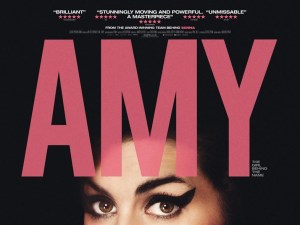
Amy-posterAmy (Asif Kapadia, director)  I don’t think I’d ever heard any of Amy Winehouse’s music before seeing this film. My awareness was limited to her downward spiral. When I finally heard her voice and the songs she wrote, I was seriously staggered. She had an amazing talent, raw and almost supernatural. What happened to her was a tragedy of self-destruction, aided, abetted, and enabled by her father, Mitch, and her husband, Blake Fielder-Civil. They are the villains of the story, per the persuasive evidence  by the film. No one was there to take care of Amy. I’d seen the director’s previous film, Senna (2010), about Ayrton Senna, the Brazilian Formula One race car driver who was killed on the track in 1994 at age 34. I know very little about Formula One racing and had never heard of Senna, but it was masterful film that drew me in completely. Amy had the same effect. I especially liked the sequence in a studio where she’s recording a duet with Tony Bennett. Winehouse seems fragile and insecure, but Bennett is caring and gentle with her, which is very moving. (Amy is available for streaming on Amazon.)

Cartoonists: Foot Soldiers of Democracy (Stéphanie Valloatto, director)  I saw this last January at a Film Society of Lincoln Center screening at the Walter Reade Theater,  a little over two weeks after two gunmen armed with assault rifles entered the offices of Charlie Hedbo in Paris and murdered eleven people, wounding eleven more. This made the subject of the film, which is about political cartoonists and freedom of speech, all the more on point. As far as I know, Cartoonists does not yet have a distributor in this country. This is inexplicable, since it couldn’t be any more topical on several levels. Hopefully it will eventually be picked up for distribution in theaters or on television.

Here is a link to the Film Society’s description of the film and a list of the heroic twelve cartoonists from around the world who are profiled: http://www.filmlinc.com/blog/entry/the-film-society-and-french-embassy-to-premiere-cartoonists-foot-soldiers-o

Dior and I (Frédéric Tcheng, director)  With what seems like total behind-the-scenes access, director Frédéric Tcheng follows Raf Simons as he settles in as the new artistic director for the Christian Dior fashion house in Paris. Simons has eight weeks to design a haute couture collection to be shown that spring (2012). This would normally take several months to prepare. The film finds a lot of drama in the countdown to Raf’s debut. It’s fascinating, exciting, and extremely well-made. (Dior is available for streaming on Netflix.)

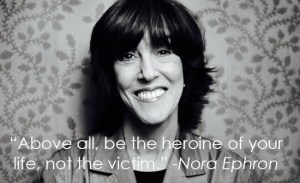
Everything Is Copy (Jacob Bernstein, director)  We saw this at the New York Film Festival last fall and loved it. Everything Is Copy is a profile of Nora Ephron, the celebrated screenwriter, film director, playwright, novelist, and essayist who died in 2012 at age 71. Her film work includes Silkwood (1983), When Harry Met Sally… (1989), Sleepless in Seattle (1993), and You’ve Got Mail (1998) As directed by her son, Jacob Bernstein, Everything Is Copy is very personal. I like documentaries where the filmmaker has a strong connection to the subject. When Bernstein is interviewing his mother’s sisters or friends, they often preface answers to his questions with “Your mother…” Bernstein is sometimes an on-screen interviewer, sitting on a couch with an aunt, or with his father, Carl Bernstein. This lends a feeling of intimacy, and draws us further in. Everything Is Copy will air on HBO this March. It’s well worth seeing.

Nora Ephron-photo & quote

From This Day Forward (Sharon Shattuck, director)  We saw this film at the Full Frame Documentary Film Festival in Durham, NC last April. From This Day Forward couldn’t be more personal for filmmaker Sharon Shattuck. When she was around eight, Sharon’s father, Michael, revealed that he’d been dressing in women’s clothing for some time, and wanted to be called Trisha. This was a huge adjustment for Sharon and her sister, as well as their mother Marcia. Marcia considered divorce, but ultimately realized she loved the person rather than the gender. If this situation sounds familiar, it might be because of the Emmy Award-winning Amazon series, Transparent, which has a similar premise. From This Day Forward is such a positive expression of love, tolerance, and acceptance that I couldn’t understand why it hadn’t been snapped up immediately for either theatrical distribution or airing on a cable channel. It couldn’t be more topical. So I was very happy to learn earlier this week that the film will be distributed this year by Argot Pictures. From This Day Forward has my highest recommendation. Don’t miss it when it comes around.

Trisha happens to be an accomplished artist. Check out the paintings on her website.

 Giovanni and the Water Ballet (Astrid Bussink, director)  We also saw this 18-minute short from the Netherlands at Full Frame last year. You may never have a chance to see Giovanni and the Water Ballet, but it’s so wonderful that I had to include it here. Giovanni is ten years old, and wants to be the first boy to compete in the Dutch synchronized swimming championship. But first he has to train long and hard in order to qualify. Giovanni’s dream is also a challenge to gender restrictions, which makes it rather timely.

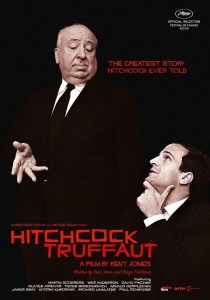
Hitchcock/Truffaut (Kent Jones, director/co-writer)  An absolute must-see for film buffs and Hitchcock aficionados in particular, Hitchcock/Truffaut is a lethal overdose of clips, information, and illuminating insights from directors such as Martin Scorsese, David Fincher, and Wes Anderson. The film provides fascinating background on François Truffaut’s lengthy interview sessions with Alfred Hitchcock, which were published in 1967. Kent Jones, current director of the New York Film Festival, even had access to audio tapes of the interviews, which are interspersed throughout. Hitchcock/Truffaut makes the case that Truffaut’s book was responsible for a reevaluation of Hitchcock’s importance as a filmmaker. The copy I’d bought when it first came out disappeared somewhere along the way, but Hitchcock/Truffaut inspired me to get another. It also makes me want to see all of Hitchcock’s films again. Not that I need to be persuaded.

Here are two discussions of Hitchcock/Truffaut: the first between Noah Baumbach and Kent Jones; the second Martin Scorsese and Jones.

Richard Leacock & Valerie Lalonde

Richard Leacock & Valerie Lalonde

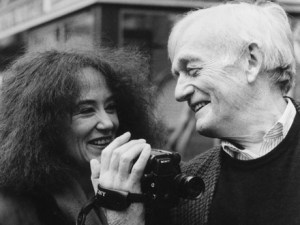
How to Smell a Rose: A Visit with Ricky Leacock in Normandy (Les Blank & Gina Leibrecht, directors) Richard Leacock was one of the founders of Direct Cinema and cinéma vérité, along with Robert Drew, D.A. Pennebaker, and the Maysles brothers. His importance to documentary filmmaking cannot be overstated. Leacock spent his last years living in France, which is where Les Blank shot this film. I could have listened to Ricky Leacock talk for hours about life and filmmaking. How to Smell a Rose is a rare pleasure. (This film is available for streaming on Netflix.)

In Jackson Heights (Frederick Wiseman, director)  Fred Wiseman is another documentary filmmaker whose importance can’t be overstated. Over the course of his long career, he’s amassed a staggering body of work. In Jackson Heights, released last year when Wiseman was 85, is as strong as anything he’s done. It struck me the other day that Wiseman is similar to Studs Terkel, in terms of documenting individuals and institutions. Wiseman, without apparent judgement, shows us how things work.

 Iris (Albert Maysles, director)  This study of Iris Apfel was the penultimate film from Albert Maysles, who died last year at age 88. Apfel, a larger-than-life fashionista with an irrepressible personality, reminds me somewhat of Little Edie Beale in Maysles Grey Gardens (1976) — though Iris is a high-functioning, much healthier version. She’s a trip. (Iris is available for streaming on Netflix.)

The following clip is from a press conference with Iris Apfel and Al Maysles at the 2014 New York Film Festival.

 Lambert & Stamp (James D. Cooper, director)  Kit Lambert and Chris Stamp wanted to make films, and they hit on the idea of finding a rock band to manage and then make a film about. The band turned out to be the Who, and despite knowing basically nothing about what was required or how to do it, Lambert and Stamp helped them become one of the most popular rock bands in the world. Kit Lambert has passed on, but Chris Stamp is very much alive. Interviews with Stamp, Pete Townsend, Roger Daltrey, and others (including Chris’ brother, actor Terence Stamp), take us through the story in extremely entertaining fashion. Anyone interested in the Who has gotta see this.

Listen to Me Marlon (Steven Riley, director/co-writer) See my previous post on this film. (This film is available via Showtime On Demand.)

A Poem Is a Naked Person (Les Blank, director) See my previous post on this film. (This film is available for streaming on Amazon.)

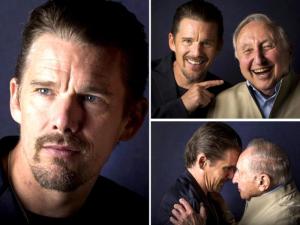
Seymour & SteinwaySeymour: An Introduction (Ethan Hawke, director)  Actor Ethan Hawke first met pianist Seymour Bernstein when he was seated next to him at a dinner party. They struck up a relationship that resulted in this wonderful film. After receiving numerous musical awards and grants, Bernstein gave his final public Seymour-Ethan & Seymour collageperformance in 1977 at age 50. He is now 88. For nearly 40 years he has been composing, writing, and, most importantly, teaching. He’s a great teacher. In the film, one of his students says Seymour showed him what a musician could be. The music throughout is rapturously beautiful, and even more powerful after hearing Seymour explain why he makes the choices he does as we see him practicing and teaching. The film itself is like a master class in music. Seymour talks about music in a way that’s clear, lucid, and compassionate — qualities he brings to his playing, teaching, thinking, and living. He believes that music is a language of feeling — a universal language. Bernstein has lived in the same studio apartment for 57 years. “I thrive on solitude,” he says, adding that he has to be by himself to sort out all the thoughts that course through his mind in order to escape the hurlyburly of the real world. And yet, at the end of the film, Bernstein agrees to perform publicly for members of Ethan Hawke’s acting class. Seymour: An Introduction offers us the privilege of spending time with this extraordinary person. (This film is available for streaming on Netflix.)

 What Happened, Miss Simone? (Liz Garbus, director)  I knew Nina Simone was a singer, but that’s about it. Seeing this film was a revelation. She had an incredible voice and a strong commitment to civil rights in her life and music. In her determination to be true to herself, Simone didn’t always play nice. This is a powerful portrait of a conflicted artist. (This film is available for streaming from Netflix.)

 The Winding Stream (Beth Harrington, director)  Per Wikipedia, the Carter Family, the subject of this film, “…was a traditional American folk music group that recorded between 1927 and 1956. Their music had a profound impact on bluegrass, country, Southern Gospel, pop and rock musicians as well as on the U.S. folk revival of the 1960s. They were the first vocal group to become country music stars.” I didn’t know much about their actual history, but this film clearly lays it out, as well as tracking June Carter Cash and her husband, Johnny. There’s a fascinating sidebar segment on the importance of Border Radio stations. But most importantly, there’s the Carter Family’s awesome music, which is ingrained in the history of this country. I especially liked a scene of George Jones in the studio singing “Worried Man Blues.” The Winding Stream employs some cut-out animation that I wasn’t too thrilled with, but this is a minor caveat.

___________________________________________________

— Ted Hicks

Posted in Film, Home Video, Music | Tagged , , , , , , , , , , , , , , , , , , , , , , , , , , | 6 Comments

What I Saw Last Year: Best Feature Films 2015

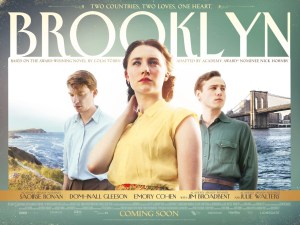
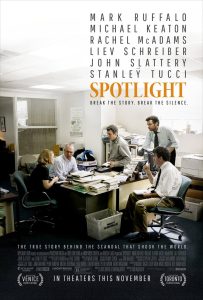
Brooklyn-poster2Spotlight-poster3I’m not sure how, but I managed to see 300 feature films in 2015. That’s probably nothing to brag about, but I love movies, and since I’ve got time to see a lot, that’s what I do. I thought it was an extremely good year for films. Following are thirty titles that represent the best of what I saw. More than half of these have been released since September, which is not surprising. The films are in alphabetical order, but Spotlight and Brooklyn are my top picks, the best of a really strong bunch. Note: I have not yet seen Beasts of No Nation, Room, or Tangerine, all of which sound very promising.

Anomalisa-poster2Anomalisa (Charlie Kaufman, director & writer; Duke Johnson, co-director) I love this film. It’s so strange, affecting, emotional, and just plain weird that you look at it with a sort of curious wonder. Charlie Kaufman has previously written Being John Malkovich (1999), Adaptation (2002), and Eternal Sunshine of the Spotless Mind (2004). In 2008 he directed, as well as wrote, Synechdoche, New York. These are all extremely original, wonderfully whacked-out visions, and Anomalisa is no less so, despite being set in a realistic, everyday world with realistic, everyday people — albeit puppets. Kaufman uses stop-motion animation to tell the story of a man, Michael Stone (voiced by David Thewlis), who has flown to Anomalisa-Michael & LisaCincinnati to give the keynote speech at a customer service convention. He’s extremely alienated and lonely. His encounter with Lisa (voiced by Jennifer Jason Leigh), a shy customer service rep from Akron, is sad, awkward, painful, and lovely. Thewlis and Leigh bring a great deal of humanity to the film. Tom Noonan voices all the other characters, using the same voice for male and female alike, which takes a while to get used to, but works thematically. Most stop-motion films, and animation in general, deal with fantasy, science fiction, or otherwise extremely exaggerated, often cartoonish worlds. Anomalisa is unique and special.

The Big Short (Adam McKay, director & co-writer) Not as good as I’d expected, but the ensemble cast is great. Despite the pains taken by the filmmakers to make the financial gobbledygook understandable, I still have no idea what happened in 2008, except that a lot of people should have gone to jail and only one guy did. Based on Michael Lewis’ non-fiction bestseller, this film would make a great triple bill with with J.C. Chandor’s Margin Call (2011) and Charles Ferguson’s documentary Inside Job (2010), with the addition of a fourth film, 99 Homes (2015).

Brooklyn (John Crowley, director; Nick Hornby, writer) As stated above, this is one of my two favorite films of the year. Saoirse Ronan, whom I first saw in Atonement (2007), plays Eilis Lacey, a young Irish woman who, at her sister’s urging, reluctantly leaves home in Ireland in 1952 to live and work in the United States. Her sister Rose has made arrangements through a priest (played by the always authentic Jim Broadbent) for Eilis to live in a rooming house in Brooklyn and work in a Manhattan department store. Eilis begins a relationship with Tony, a young man from an Italian family whom she meets at a dance. As played by Emory Cohen, Tony is sweet, open, honest, and decent. Watching them fall in love is a pleasure. We want it to work. Then Eilis receives news of a death that takes her back to Ireland. She intends to stay only a short time, but then meets Jim (Domhnall Gleeson), who begins to tentatively court her. (Gleeson, son of actor Brendan Gleeson, had a strong year in 2015, playing vastly different roles in Ex Machina, Star Wars: The Force Awakens, and The Revenant, as well as Brooklyn.) The big question is who will Eilis end up with, Tony or Jim? This is a film without villains, with the possible exception of the shopkeeper Eilis works for at the beginning of the film, who is just bitter and unhappy and tries to make sure everyone else is, too. The 50s period setting is impeccable, but doesn’t hit you over the head with details. This might sound pretty low key, but it plays out beautifully, and feels very real — or at least, I’d like to think so.

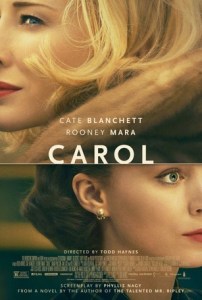
Carol-posterCarol (Todd Haynes, director;  Phyllis Nagy, writer) Based on Patricia Highsmith’s 1952 novel The Price of Salt, this is the story of a love affair between two women, in a time when such relationships were definitely not accepted. Therese Belivet (played by Rooney Mara) is working at counter in a Manhattan department store, when she meets Carol Aird (played by Cate Blanchett), who has come to buy a Christmas gift. Carol is an affluent, suburban housewife with children who has a polished and sophisticated air. Her sensuous, seductive voice and manner dazzles Therese from the start. Cate Blanchett is a great actress with a filmography that showcases stunning performances in such films as  Truth (2015), Woody Allen’s Blue Jasmine (2013), and Todd Haynes’ I’m Not There (2007), in which she plays a version of Bob Dylan. Carol was exquisitely shot by Ed Lachman, a cinematographer whose work includes Desperately Seeking Susan (1985), The Limey (1999), and the HBO mini-series Mildred Pierce (2011, also directed by Haynes). Carol draws us into an early 50s New York world seen in burnished, coppery tones. As with Brooklyn, the period setting feels completely detailed and authentic, with the most realistic use of period automobiles I’ve ever seen. Carol drives a Packard sedan. (When was the last time you saw one of those featured in a movie?) In most period films, the cars all look like they’ve just come off the showroom floor, with nary a dent or smudge. I didn’t see that here. A key element is the music by Carter Burwell, which contributes greatly to the mood and texture of the film. In addition to Carol, in 2015 Burwell also scored Anomalisa and Mr. Holmes. He’s works regularly with Joel and Ethan Coen, scoring 17 of their films so far. Like the title character, Carol is sensuous, seductive, and deeply romantic, with echos of Haynes’ earlier Far from Heaven (2002), and the 1950s Technicolor melodramas directed by Douglas Sirk.

Creed (Ryan Coogler, director & co-writer) Who would have thought a sixth Rocky sequel would be worth seeing? I initially resisted this one, didn’t think I needed another boxing movie. But what I was hearing about it got me interested. And it is, if you’ll pardon the expression, a knockout. This film has a lot of heart and emotion, and is only incidentally about boxing — though the two matches we see are quite brutal. Michael B. Jordon, previously seen in Ryan Coogler’s powerful Fruitvale Station (2013), stars as Adonis, the son of Apollo Creed (Rocky Balboa’s opponent from the first film in 1976). Sylvester Stallone returns as Rocky, who reluctantly agrees to train Adonis. Stallone’s performance is a low-key revelation, and he deserves all the attention he’s been getting.

45 Years (Andrew Haigh, director & writer) A week in the life of Kate and Geoff, leading up to the celebration of their 45th wedding anniversary. At the outset, unexpected news from the past threatens the stability of their marriage. Told from Kate’s point of view, the film is low-key and methodical, a slow burn of contained emotions and revelations. As Kate, Charlotte Rampling conveys a great deal by doing very little. Rampling, now 69, has been beautiful at every age, much like Catherine Deneuve. Rampling and Tom Courtenay, who plays her husband Geoff, bring the resonance of their long film careers to the screen; Rampling going back to Georgy Girl (1966), and Courtenay to The Loneliness of the Long Distance Runner (1962) and Billy Liar (1963).

Gett: The Trial of Viviane Amsalem (Ronit Elkabetz & Shlomi Elkabetz, directors & writers) See my previous post that includes this film along with other films seen last February (Gett is approximately half-way through the post).

The Gift (Joel Edgerton, director & writer). A real sleeper. Based on the trailer and print ads, it looked fairly predictable; it’s anything but. Director and writer Joel Edgerton (who gave a terrific performance last year in Black Mass ) plays a character from the past who insinuates himself into the lives and home of Jason Bateman and wife Rebecca Hall. It’s all very tense and creepy, and then it flips on you.

Goodnight Mommy (Severin Fiala & Veronika Franz, directors & writers) See my previous post on this film.

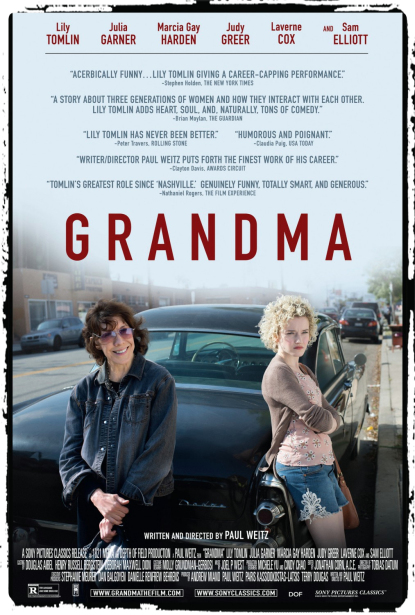
Grandma-poster2Grandma (Paul Weitz, director & writer) This film is edgier and darker than the advertising would suggest. Lily Tomlin plays Elle, an irascible woman in Los Angeles recovering from the recent breakup with her girl friend, Olivia (Judy Greer). Elle’s eccentricities include cutting up her credit cards to make a wind chime. At the outset, her granddaughter Sage shows up at Elle’s home, announcing that she’s pregnant and needs $600 for an abortion. On one level the film is a comedy of errors, as Elle attempts to raise the money from people she’s alienated at one time or another. One of them is played by Sam Elliott, an ex who hasn’t seen Elle in 30 years. It’s great seeing Elliott turning up as much as he has lately. He was exceptional in another film from 2015, I’ll See You in My Dreams. Elliott was a standout in the final season of Justified (FX) last year,  and will be appearing with Lily Tomlin in the next season of Grace and Frankie (Netflix). Besides writing and directing this film, Paul Weitz is currently a co-creator, executive producer, writer and director of the terrific Amazon series Mozart in the Jungle. With his brother Chris, he wrote and directed About a Boy in 2002. Grandma is not warm and fuzzy — at least not like you might expect. People’s emotions get bruised and hurt, but they survive. Lily Tomlin shines in this, as she does in Grace and Frankie.

Love & Mercy-posterLove & Mercy (Bill Pohlad, director; Oren Moverman & Michael Lerner, writers) Paul Dano plays the Beach Boys’ Brian Wilson as a younger man, with John Cusack playing him at an older age. I thought Dano’s was the more convincing portrayal. I couldn’t quite believe that Dano’s Wilson would age into Cusack (no fault of Cusack’s). They didn’t seem like the same person. But it was also more interesting seeing him during a more productive period in his life. What stands out in this film are the sequences with Wilson in the studio, working his way through the exacting recording sessions for “Good Vibrations.” The only other time I can recall seeing the creative process on screen in a comparable way was in Ken Russell’s Savage Messiah (1972), his film about French sculptor Henri Gaudier-Brzeska. There’s an amazing sequence of Gaudier-Brzeska sculpting a figure out of a block of stone in his studio overnight; you’re seeing an artist at work, just chipping away. The act of artistic creation is almost never convincingly portrayed in movies, but Love & Mercy nails it. As creepy and hateful as Paul Giamatti is as Eugene Landy, the doctor who takes over Wilson’s life, an acquaintance of mine, who wrote for Rolling Stone in the 70s and interviewed Landy, told me the real Landy was even worse than he is in the film. Love & Mercy,  is only the second feature directed by Bill Pohlad, but he has extensive credits as a producer, including Brokeback Mountain (2005), Into the Wild (2007), The Tree of Life (2011), and 12 Years a Slave (2013). Love & Mercy was co-written by Oren Moverman, who wrote and directed Time Out of Mind (2014).

Mad Max: Fury Road (George Miller, director) Coming out of this movie, I was as pumped as I’ve ever been . It’s visceral forward motion throughout. The action has a particularly bone-crunching impact, probably because much of it was done with little use of CGI effects. You can feel the difference. I’m a big fan of The Road Warrior (1981), the second film in the Mad Max series. When I subsequently saw the first, Mad Max (1979), it was a let-down by comparison. The third film in the series, Mad Max Beyond Thunderdome (1985), seemed a mistake. (What was Tina Turner doing in it anyway?) So it was a real surprise that at age 70, George Miller, director of the original three, would  return with a new Mad Max film that is easily the best of them all. Mad Max: Fury Road is one of the great action movies of all time. It should not be forgotten that Miller is the same director who gave us Babe (1995) and Babe: Pig in the City (1998). An interesting aspect of Mad Max: Fury Road is that Max is basically Charlize Theron’s sidekick; she’s clearly the top dog here. But sidekick or not, Tom Hardy makes a powerful impression as Max.. He’s a terrific actor, as evidenced by Locke (2013) and Legend (2015). I don’t think this movie can make any claims to socially-redeeming value, but it’s an amazing rush.

The following clip indicates how inventive and unhinged this film is. (I know this is not for everyone, which is probably a good thing.)

Mississippi Grind (Anna Boden & Ryan Fleck, directors & writers) See my previous post discussing this film along with several other films (it’s at the end of the post).

99 Homes-poster299 Homes (Ramin Bahrani, director & writer) While The Big Short dissects the housing market collapse of 2008, this film shows the human cost. When I first saw 99 Homes last fall, I liked it well enough, but could understand why people wouldn’t want to see it. It’s like Time Out of Mind, where audiences stayed away in droves. Nobody wanted to see homeless people close up; it’s hard enough ignoring them in real life. At least, that’s my theory. 99 Homes shows families getting evicted from their homes with all their possessions left on the lawn. Depressing, right? I saw it again at the Museum of Modern Art, with the director in attendence for a Q&A after. This time I thought it was great, really powerful. Still depressing, but well worth the ride. Michael Shannon, one of my favorite actors, plays a former real estate agent who’s making a profit out of evicting people from foreclosed homes. Andrew Garfield is a single father who is evicted with his son and mother (Laura Dern) by Shannon. He then goes to work Shannon evicting other families. This is a stunning irony, but Garfield justifies it with the intention of earning enough to buy back his family home. Shannon brings his usual level intensity to the film.

Sicario (Denis Villeneuve, director). See my previous post on this film.

Spotlight-cast photoSpotlight (Tom McCarthy, director & co-writer) This is it, the best film of the year, and that’s saying something. I’ve been a fan of Tom McCarthy’s films since seeing his first, The Station Agent in 2003 (see my previous post from 2012). As you probably know by now, Spotlight concerns an investigation by a team of Boston Globe reporters into pedophile priests and the subsequent cover-up by the Catholic Church . This is as close to a perfect movie as you can get. There’s not a false step. The cast is exceptional, with Michael Keaton and Mark Ruffalo as standouts in a group of actors that includes Liev Schreiber, John Slattery, Brian d’Arcy James, Stanley Tucci, and Rachel McAdams as the lone female on the team. It’s all portrayed so authentically it doesn’t feel like they’re acting. Like All the President’s Men (1976) and Zodiac (2007), this is a film is about process. Everything in Spotlight is tightly focused on the actual work of getting the story, and also the characters’ belief that they are absolutely doing the right thing. This is why I go to movies, in the hopes of seeing something this good.

**********************************************************************

In the interest of attention spans — yours and mine — my remaining picks are listed by title only.

Inside Out-posterLearning to Drive-poster3The Hateful Eight (Quentin Tarantino, director & writer)

Inside-Out (Pete Docter, director)

It Follows (Robert Mitchell, director & writer)

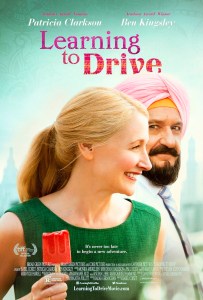
Learning to Drive (Isabel Coixet, director)

The Martian (Ridley Scott, director)

Me and Earl and the Dying Girl (Alfonso Gomez-Rejon, director)

The Revenant (Alejandro González Iñárritu, director & co-writer)

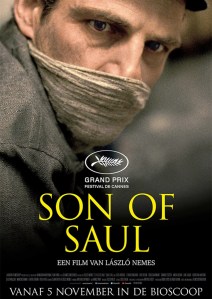
Son of Saul-Dutch posterSon of Saul (László Nemes, director & co-writer)

Spy (Paul Feig, director & writer)

Steve Jobs (Danny Boyle, director; Aaron Sorkin, writer)

Trainwreck (Judd Apatow, director; Amy Schumer, writer)

Tu Dors Nicole (Stéphane Lafleur, director & writer) See my previous post discussing this film along with two others.

Wild Tales (Damián Szifron, director & writer)

Youth (Paolo Sorrentino, director & writer)

It Follows-poster4

*****************************************************************

That’s all for now. See you at the movies. — Ted Hicks

Ted at the movies

Posted in Books, Film, Home Video | Tagged , , , , , , , , , , , , | 5 Comments

Happy New Year from Films etc.

Keaton-New Year's resolutionsI generally don’t do New Year resolutions, but if I did, one of them would be to not let procrastination prevent me from writing more posts. It’s time to get this thing out of the ditch and back on the road. To that end, here’s a short note wishing everyone HAPPY NEW YEAR — along with shots from a few of my favorite films to take us out.

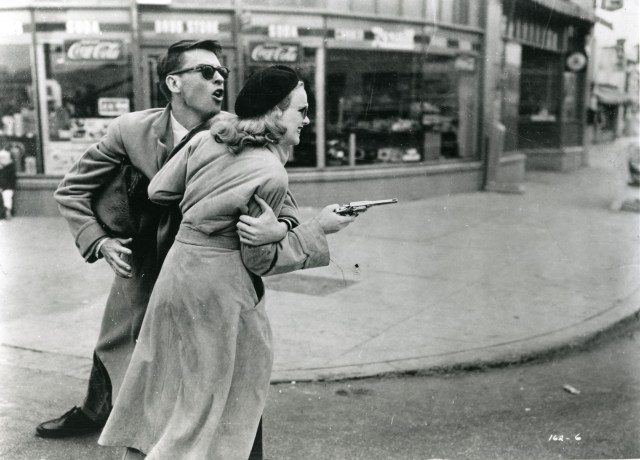
Gun Crazy - 1950

Gun Crazy – 1950

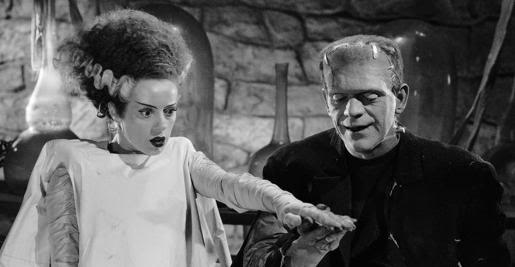
The Bride of Frankenstein - 1935

The Bride of Frankenstein – 1935

The Wild Bunch - 1969

The Wild Bunch – 1969

King Kong - 1933

King Kong – 1933

Finally, here’s a great clip of Gene Kelly dancing the title song from Singin’ In the Rain (1952). It’s joy personified, absolutely exhilarating.

Bela Lugosi & Boris Karloff wishing you a great 2016.

Bela Lugosi & Boris Karloff wishing you a great 2016.

I’ll be back shortly with lists of what I think were the best feature films, documentaries, and TV shows for 2015. In the meantime,  we’re bingeing our way through the second seasons of Mozart in the Jungle (Amazon) and Dicte (Netflix), plus catching up on films we haven’t seen yet. See you later. Ted Hicks

WB Bugs intro logo

Posted in Books, Film, Home Video | Tagged , , , , , , , , , , | 3 Comments

Brando doc on Showtime this Saturday!

Listen to Me Marlon-posterI had emergency gallbladder surgery a little over three weeks ago, which kind of slowed me down a bit. At least I’m able to blame this latest lapse on something other than procrastination. I’m just now getting back to working on a post for this blog, my first since October 2. I’ve started writing short takes on the films I saw last week, but we’re leaving tomorrow on a five-day trip to Minneapolis, and that won’t get finished until we return. Though earlier today I opened the new issue of The New Yorker to see an announcement that Listen to Me Marlon, a great documentary about Marlon Brando, will be aired on Showtime this Saturday, November 14, at 9:00 pm. I wanted to get the word out, so I’m knocking this out quickly. You’ve got to see this amazing film, if you haven’t already. It takes us inside Brando’s life and thought in a completely unique way. It’s a must-see.

Last July I wrote about the film in a post titled Listening to Marlon — Beyond the Screen, which can be accessed here. – Ted Hicks

Brando & catBrando-Streetcar


Brando & son


Brando-Last Tango


Brando & daughter

Posted in Books, Film, Home Video, Theater | Tagged , | Leave a comment