What I Saw Last Year: Best Feature Films 2014

Locke-posterAMVY_120_WEB.inddOf the approximately 230 feature films I saw last year, here are the 30 new films that stood out for me. Some of these choices are pretty obvious, others maybe not so much. These are films that entertained and sometimes challenged me, films that stayed true to the worlds they created, and generally made me feel better for having seen them. Or in some cases, just gave me a real kick.

Mr. Turner-poster______________________________________________________________________

The Babadook (Jennifer Kent, director & writer). This Australian movie is scary as hell, though not in the obvious, cliched ways we usually see in run-of-the mill horror films. The Babadook is anchored, though in a very destabilizing way, by the extraordinary performances of Essie Davis and Noah Wiseman, as mother and son. This one takes you through the wringer.

Big Hero 6 (Don Hall & Chris Williams, co-directors). The energy and the look of this film reminded me of The Incredibles (2004). Very detailed and just great.

Birdman or (The Unexpected Virtue of Ignorance) (Alejandro González Iñárritu, director & co-writer). This whirlwind of a movie is something else. You either get on the ride and go with it, or get thrown off on a sharp turn. The conceit of having it edited in a way that suggests the entire film is one continuous take is quite thrilling, and adds to the feeling of non-stop momentum. The performances are great; this is acting with all the stops out. And for New York audiences it’s great that so much of it was shot in the Broadway theater district, which gives the film an authentic sense of place.

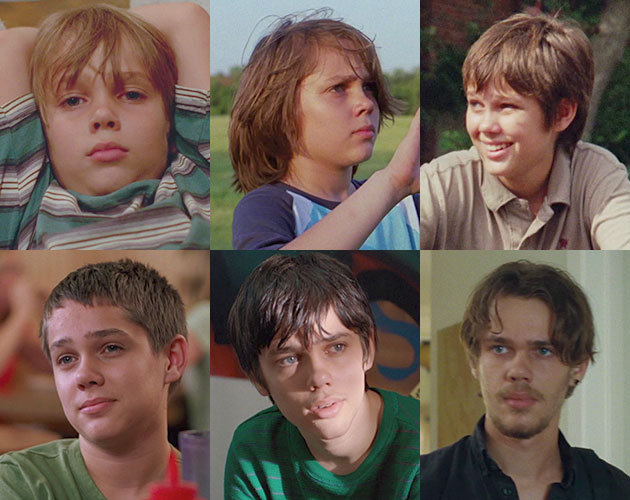
Boyhood (Richard Linklater, director & writer). Shot over a 12 year period from May 2002 to October 2013, this film tells the story of Mason (played by Ellar Coltrane) as we watch him age in real time from 6 to 18. There’s a documentary aspect to this that relates to Michael Apted’s great 7 Up series, which films the same set of people every 7 years (the most recent installment is 56 Up). When I was seeing Boyhood I started wondering if the story by itself would be strong enough to support all the attention the film has received if we didn’t know the extraordinary and unique way it was made. Because there didn’t seem to be anything much actually happening each time we checked in with Mason and his family. Then I realized that was sort of the point, that this is the way life plays out. There’s a point late in the film that was almost an epiphany for me, when Mason says with wonder, “It’s always right now!”

Boyhood-posterBoyhood-Mason x 6


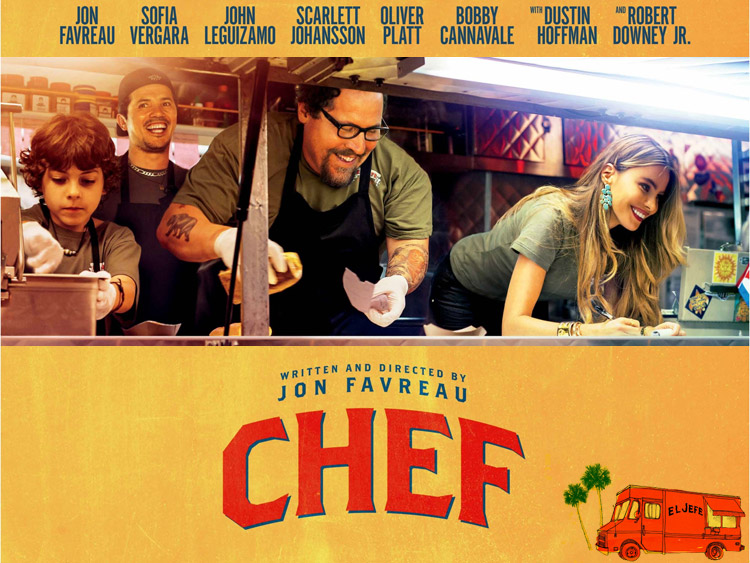
Chef (Jon Favreau, director & writer). Not always believable, but extremely entertaining and it made me feel really good. Plus it was something of a revelation to see Sofia Vergara play a fairly realistic character instead of a caricature. Also nice seeing Jon Favreau gear down to a smaller, more personal scale from the blockbusters (Iron Man, for example) he’s been making the last few years.

Chef-poster2_________________________________________________________________

Coherence (James Ward Byrkit, director & writer). See my previous post on this film.

Cold in July (Jim Mickle, director; Nick Damici, writer). This is a very smart neo-noir that reinvigorates and upsets genre expectations. Michael C. Hall, Sam Shepard, and Don Johnson are terrific. Johnson, especially, nearly walks away with the picture after his flamboyant entrance, and takes it in a darkly comic, though no less deadly, direction. The director’s and writer’s previous film, the excellent Stake Land (2010), was a take-no-prisoners tale of trying to survive in an economically and environmentally wasted landscape overrun by very down and dirty vampires. These filmmakers’ approach to genre reinvention is similar to what Adam Wingard and Simon Barret have done with this year’s other pleasant surprise, The Guest (see below).

Dom Hemingway (Richard Shepard, director & writer). Jude Law, paunchy and dissolute, really gets his teeth into the role of the title character much the way Jon Voight does in Showtime’s Ray Donovan series as Ray’s monster of a father, Mickey. Law’s character is totally outrageous and extremely entertaining. With Emilia Clark, who plays Daenerys Targaryen — the “mother of dragons” — on HBO’s Game of Thrones, as Dom’s estranged daughter, and Richard E. Grant, who I’ll always remember from the equally out- there Withnail & I (1987), as Dom’s prickly sidekick.

Dom Hemingway-poster3

Force Majeure (Ruben Östlund, director & writer). See my previous post on this film.

Generation War (Philipp Kadelbach, director; Stefan Kolditz, writer). Shown in three episodes on German television in 2013, Generation War was released theatrically in the U.S. in two parts. With a combined running time of over 4 1/2 hours, it’s a long haul, but definitely worth it. The plotting frequently has the five main characters, who are scattered all over the Eastern Front during World War II, manage to meet up in the same places at the same times. This contrivance pushes coincidence a little too far, but the strength of the film for me is in the combat sequences. These scenes are harrowing and brutal, the strongest I’ve seen since Stephen Spielberg radically raised the bar with Saving Private Ryan (1998).

The Grand Budapest Hotel (Wes Anderson, director & writer. Another of Wes Anderson’s incredibly detailed miniature worlds, filled with an assortment of eccentric characters portrayed by a great cast rushing from one absurd development to another. The increasingly frantic plot is secondary. Sometimes Anderson’s films get a bit too precious, but I really enjoyed this one. The performances are totally committed. The characters and events may be ridiculous, but the actors go at them with a deadpan seriousness.

Grand Budapest Hotel-poster3

Guardians of the Galaxy (James Gunn, director & co-writer). I loved this movie beyond all reason. Which is ironic, since the print ads and trailers I’d seen before it was released made the film seem goofy and silly. I had no intention of seeing it, since I take my science fiction more seriously than that. Then I read some things that piqued my interest, so I gave it a shot. Amazing, the movie more than succeeded on every level. It felt like the filmmakers knew exactly what they were doing from start to finish. Having the lead character listen to 80s pop songs throughout was a stroke of genius; the nostalgia they trigger somehow helps us connect more directly to the space-opera setting, and took Guardians to another level. This film was a thoroughly entertaining experience, and I must have been smiling a lot. Though I think my wife got a little tired of me saying “I am Groot!” for a couple of weeks after.

Groot

Groot

The Guest (Adam Wingard, director; Simon Barrett, writer). Dan Stevens is a long way from Downton Abbey in this very satisfying, tightly made thriller. The director and writer had previously made You’re Next (2013), another film I had no intention of seeing, based on the print ads. I didn’t need another home invasion movie, but I did see it and was totally sold. These guys have a way of taking familiar genre scenarios and twisting them into new shapes. You’re Next is probably a slightly better film — certainly a better title, which involves you right away — but The Guest does not disappoint. Part of the punch is seeing Dan Stevens inhabit this kind of character.

Ida (Pawel Pawlikowska, director & co-writer). A very minimalist film, shot in luminous black & white in the old 1.33:1 screen ratio. Very quiet and very understated, both a road movie and a kind of thriller. I’ve seen it three times, the last at a screening room with Thelma Schoonmaker, editor of all of Martin Scorsese’s films, in the row behind us. On the way out, she said she thought Ida was a “little forced.” I don’t agree with that opinion, but considering the source, it made me think.

The Imitation Game (Morton Tyldum, director; Graham Moore, writer). The otherworldly Benedict Cumberbatch as Alan Turing, the brilliant mathematician and closeted gay man who helped to break the unbreakable German Enigma code during World War II, creating a prototype computer in the process. Morton Tyldum previously directed Headhunters, one of my favorite films from 2011.

Into the Woods (Rob Marshall, director; James Lapine, writer). Before seeing it, I knew this had been a Broadway musical that combined several traditional fairy tales into one storyline, but not much more than that. We saw it on New Year’s Day at the Ziegfeld Theater, one of only two remaining single-screen theaters in Manhattan (the other is The Paris), and loved it. The musical numbers by Stephen Sondheim are quite thrilling. The entire cast is great, with Meryl Streep amazing as usual. Maybe even a little more so.

John Wick (Chad Stahelski, director; Derek Kolstad, writer). See my previous post on this film.

The Lego Movie (Phil Lord & Christopher Miller, co-directors & co-writers). Everything in this movie is made out of Legos, even the water. The whole thing is a hoot. I especially liked Lego Batman. It took days after to get the song “Everything Is Awesome” out of my head. Talk about hooks, this was diabolical.

Locke (Steven Knight, director & writer). Some kind of great movie. If I had to pick only three or four films for the year, this would be one of them. This film takes place entirely inside a car with a single character on one stressful phone call after another, attempting to put out out fires while he drives through the night to London, determined to get there in time for a birth. It’s a bold experiment for a feature film, and it completely works. Tom Hardy is great in this — he’s also very good in The Drop (2014), starring with James Gandolfini in Gandolfini’s final film.

Love Is Strange (Ira Sachs, director & co-writer). John Lithgow and Alfred Molina are great as two gay men who lose their New York apartment and have to live apart for the first time in 39 years until they can afford a new place. In the meantime, they stay with relatives and friends, which is an adjustment for everyone. This is an unsentimental film that respects its characters and conveys strong emotions.

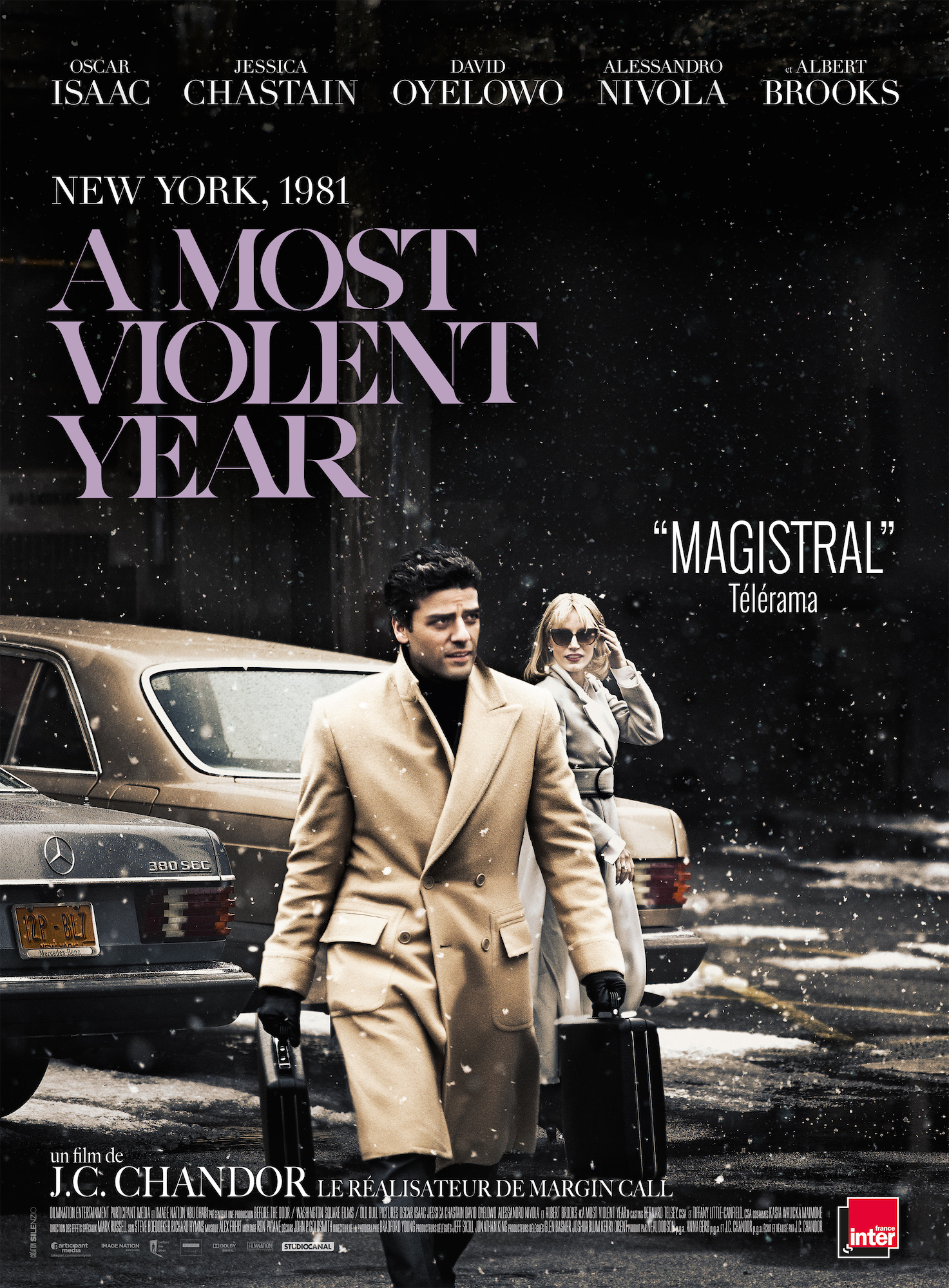
A Most Violent Year (J.C. Chandor, director & writer). Oscar Isaac looks more and more like a leading man these days. After strong performances in Drive (2011) and Inside Llewyn Davis (2013), he steps up to a new level in a film that has echos of The Godfather Part 2, with a character that suggests Michael Corleone at times. Despite the title, this is not a particularly violent film, but set in the New York City of 1981, there’s an abundance of violence and tension in the air. Jessica Chastain is excellent as Isaac’s wife, probably the scariest character in the film. This is only the third feature written and directed by J.C. Chandor. Margin Call (2011) and All Is Lost (2013) are terrific; A Most Violent year continues the concerns and themes of those films.

A Most Wanted Man (Anton Corbijn, director; Andrew Bovell, writer). See my previous post on this film.

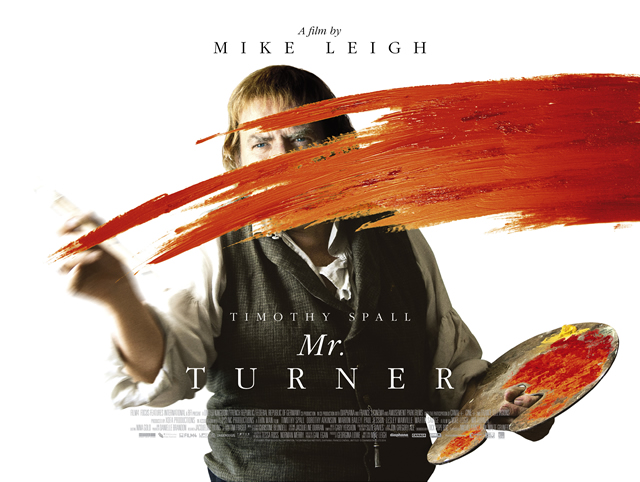
Mr. Turner (Mike Leigh, director & writer). Mike Leigh’s films are rather unique in that they are created from the ground up by Leigh and his cast over a long period of time with lengthy rehearsal periods before shooting begins. His films are put together in a truly organic way. You feel that life is being represented from the inside out. This is true for his period films as well as those with contemporary settings. Mr. Turner, which is about the life of British painter J.M.W. Turner, is no exception. Timothy Spall feels totally authentic in the title role, and the look of the film is extremely beautiful.

Only Lovers Left Alive (Jim Jarmusch, director & writer). I have liked vampire movies since I was a kid, but most of them are pretty disappointing. Hammer Films’ Horror of Dracula (1957), Kathryn Bigelow’s Near Dark (1987), and Guillermo del Toro’s Cronos (1993) are strong exceptions. That’s why I was happy to see Jim Jarmusch’s take on the subject, which sets up its own rules and stays true to them. Tilda Swinton and Tom Hiddleston are vampires as hipsters, with homes in Detroit and Tangier. One of their vampire friends is Christopher Marlowe (John Hurt), who talks of having written Shakespeare’s plays.  And they listen to the coolest music.

Salvo (Fabio Gassadonia & Antonio Piazza, co-directors & co-writers). An minimalist gangster film that weirdly reminded me of Camus’ The Stranger in terms of tone and spareness. There’s also a melancholy and sadness to the main character, Salvo, a hit man ordered by his boss to kill the sister of an enemy who tried and failed to assassinate the boss — no loose ends. It has one of the most powerful endings I’ve seen in a long time.

Selma (Ava DuVernay, director). David Oyelowo gives a monumental performance as Martin Luther King Jr, making him more of a real person and less of an icon. A large cast of committed actors in both large and small roles brings to life the 1964 march on Selma, Alabama, a key event in the Civil Rights movement. There is, however, ongoing controversy, both pro and con, over the film’s portrayal of Lyndon Johnson. Whatever the truth of that, this is an important film, and very timely, given recent events.

The Theory of Everything (James Marsh, director; Anthony McCarten, writer). Eddie Redmayne has been getting a lot of attention for his performance as Stephen Hawking, and rightly so. Felicity Jones more than holds her own as his wife, Jane. Designed to be uplifting, and it is.

Time Out of Mind-Richard GereTime Out of Mind (Oren Moverman, director & writer). We saw this at the New York Film Festival last fall. Richard Gere plays a homeless man on the streets of NYC, which is unlike anything he’s ever done before. He said in a Q&A after the screening that this was the film he was most proud of being a part of. Time Out of Mind is a truly powerful film that may alter the way you regard the homeless. Unfortunately, it doesn’t have a distributor yet, which is a shame. I also liked Oren Moverman’s 2009 film, The Messenger, with Woody Harrelson and Ben Foster members of a Casualty Notification Team tasked with informing families, wives and husbands that someone wasn’t coming home from the war. That film was really powerful, but this one feels way beyond that.

Tracks (John Curran, director; Marion Nelson, writer). See my previous post on this film.

Two Days, One Night (Jean-Pierre Dardenne & Luc Dardenne, co-directors & co-writers). For over 20 years the Dardenne brothers have been making films with deeply humanistic concerns. This is the first time they have worked with a major star, Marian Cotillard, and she more than delivers. Two Days, One Night is a quietly detailed study that plays like a life and death thriller, which it is.

*********************************

All of the films in this post are available for streaming or rental from Netflix, Amazon, You Tube, and other venues, with the exception of the following titles: Big Hero 6 (available 2/24/15), The Imitation Game, Into the Woods, John Wick (available 2/3/15), A Most Violent Year, Mr. Turner, Selma, The Theory of Everything, Time Out of Mind, Track, and Two Days, One Night. 

See you at the movies. – Ted Hicks


Posted in Film, Home Video, TV | 2 Comments

John Huston – The Stuff That Dreams Are Made Of

John Huston2As I write this, the Film Society of Lincoln Center (FSLC) here in New York is in the midst of a complete John Huston retrospective (December 19 – January 11). The series includes thirty-seven features and five documentaries directed by Huston, plus several of the many films he acted in, most notably Chinatown (1974), and less notably Tentacles (1977). For my money, John Huston is one of the best American directors, along with Orson Welles, Stanley Kubrick, Robert Altman, and Martin Scorsese. If I had to choose, I’d say my favorite Huston films are The Maltese Falcon (1941), The Treasure of the Sierra Madre (1948), The Asphalt Jungle (1950), and Fat City (1972). They are, without qualification, very close to perfect from beginning to end.

Maltese Falcon-posterBy the time he came to make The Maltese Falcon, Huston was already an established screenwriter at Warner Bros., having written or co-written Jezebel (1938), Juarez (1939), Dr. Ehrlich’s Magic Bullet (1940), High Sierra and Sergeant York (1941). He had a clause put in his contract that if he stayed on at Warners, they would give him a chance to direct. Huston said in 1969, “I saw no great dividing line between writing and directing…The directing of a film to me is simply the extension of the process of writing.”

Huston’s film of The Maltese Falcon is one of the most faithful adaptations of a novel ever made. I’d seen the film several times before reading the novel, and was surprised to see just how true to the book it was, particularly in the dialogue. “Dashiell Hammett’s book had been filmed twice before, but the previous screen adaptors didn’t have the faith in the story that we did. Our script simply reduced the book to a screenplay, without any fancy additions of our own.” (Huston, 1973) “I considered the Hammett novel practically a screenplay, and we had a wonderful time making the movie, no sense of making a classic, of course. Everybody just had a lot of fun doing what they were doing and liking themselves doing it.” (Huston, 1979)

Maltese Falcon-group shotI don’t know anyone who doesn’t like The Maltese Falcon. It’s endlessly watchable, no matter how many times you’ve seen it. The story and characters may not seem all that real, but after all these years it’s almost like a fairy tale. Sam Spade is one of Humphrey Bogart’s most iconic roles, along with Philip Marlowe in The Big Sleep (1946) and Rick Blaine in Casablanca (1942). The Maltese Falcon established the archetypal Bogart persona and made him a star.

It’s interesting to see how the film is sensationalized in the following trailer from the original release.

The Maltese Falcon was an auspicious and audacious directing debut for Huston, one that set the bar high for his future work. He certainly matched the promise of that film with The Treasure of the Sierra Madre in 1948. Seeing it again recently confirmed for me just how great it is. The film received many awards, including Academy Awards to John Huston for Best Director and Best Screenplay, and his father Walter for Best Supporting Actor. In an interview from 1973, Huston is asked, “If you could put just one scene from any of your films in a time capsule and label it John Huston, director, what would it be?” Huston answered, “Well, it would have to be my old man dancing in The Treasure of Sierra Madre.” The following clip shows that scene, and it is a wonder — Walter Huston at his best.

And then there’s this scene with Alfonso Bedoya as a Mexican bandit and his famous “No stinking badges!” dialogue.

Two years later Huston delivered another great film, The Asphalt Jungle, an important work of classic film noir. It has an especially strong cast, including Marilyn Monroe in her first real screen role. The film is anchored by Sterling Hayden in a role similar in appearance and behavior to his character in the equally great The Killing, directed by Stanley Kubrick in 1956 (see my previous post on The Killing4/2/13).

Asphalt Jungle-poster2The plotting of The Asphalt Jungle, which tells the story of the detailed planning of a robbery and its aftermath, is as tight as it could be. We always know who’s doing what and where we are. Huston’s often unusual compositions add to the tension and uneasiness of the scenes, which can be seen in this shot of Marilyn Monroe and Louis Calhern.

Asphalt Jungle-Monroe & CalhearnThe following scene tells us all we need to know about the unpleasant relationship between Monroe and the much older, decidedly creepy Calhern.

In 1973 Huston had this to say about his use of the camera in his films. “…I look upon the camera as still another actor on the set. The relationship between the actors is important but the relationship between the actors and the camera is also important. The camera can be as eloquent as the finest actor if you know how to use it…good camera work should be unobtrusive. One set-up should naturally lead to the next without anyone noticing – it’s like a ballet. A good scene tells you how it should be shot…A bad scene is the most difficult to shoot, since there is no way you can shoot it to make it look any better than it is.” The following clip from The Asphalt Jungle is an excellent example of this approach.

In the 1970s and 1980s John Huston turned out an unusually strong run of films, beginning with Fat City in ’72, and ending in 1987 with The Dead, his glorious final film, a poetic and meditative swan song based on James Joyce’s short story. In between were The Man Who Would Be King (1975), Wise Blood (1979), Under the Volcano (1984), and Prizzi’s Honor (1985).

I watched Fat City recently on DVD. I hadn’t seen it since its original release, but had remembered being strongly affected by it. It has a straightforward, almost documentary, approach to the material, which focuses on the down-and-out world of amateur boxers in Stockton, California. The film is objective, non-judgmental, and views the people of this world with an unsentimental respect. The alcoholic rawness of the relationship between Stacey Keach and Susan Tyrell is like something out of a Charles Bukowski story. This is very much a film of the 70s.

The IMDb bio of John Huston refers to him as “an eccentric rebel of epic proportions…” That’s not far wrong. He certainly went his own way, all the way to the end. While filming The Dead, he was wheelchair-bound and constantly hooked up to oxygen to combat chronic emphysema.

It’s hard to pin Huston down. In 1973 he said, “Critics have never been able to discover a unifying theme in my films. For that matter, neither have I…I don’t seek to interpret reality by placing my stamp on it. I try to be as faithful as I can to the material I have chosen to film. Everything technical and artistic in the picture is designed to depict that material for an audience.” It’s interesting that the vast majority of his films were adaptations of novels, short stories, and plays. Huston drew on the works of Dashiell Hammett, B. Traven, Maxwell Anderson, Stephen Crane, Rudyard Kipling, Flannery O’Connor, Malcolm Lowry, James Joyce, to name a few.

I really like this quote from an interview in 1974. I think it says a lot about the way Huston made movies. “The greatest piece of advice I ever had…When I went to make my first film The Maltese Falcon, Henry (producer Henry Blanke) said, ‘Just remember one thing John: all I ever need to tell you…each scene, as you make it, is the most important scene in the film. Whether it’s somebody getting out of an automobile or whatever – it’s the most important scene at that moment.’”

The following clip is of Huston’s speech accepting the AFI Life Achievement Award in 1983. It’s just beautiful.

*************************************************************************************

Supplemental:

Angelica Huston on The Treasure of the Sierra Madre

John Huston on Marilyn Monroe in The Asphalt Jungle

John Huston on Fat City

TCM Tribute to John & Walter Huston

Across the Pacific-posterKey Largo-poster


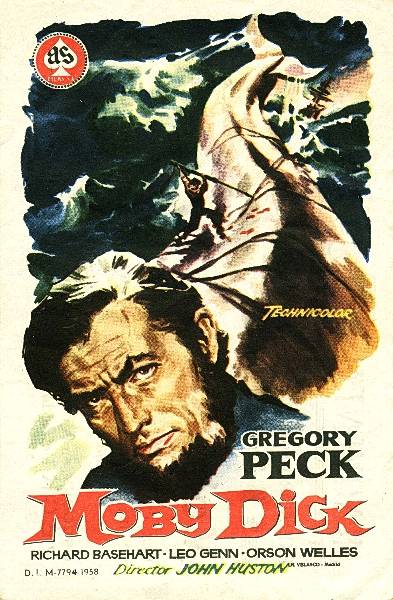
Moby Dick-poster

Beat the Devil-poster


Unforgiven-posterNight of the Iguana-posterMisfits-poster


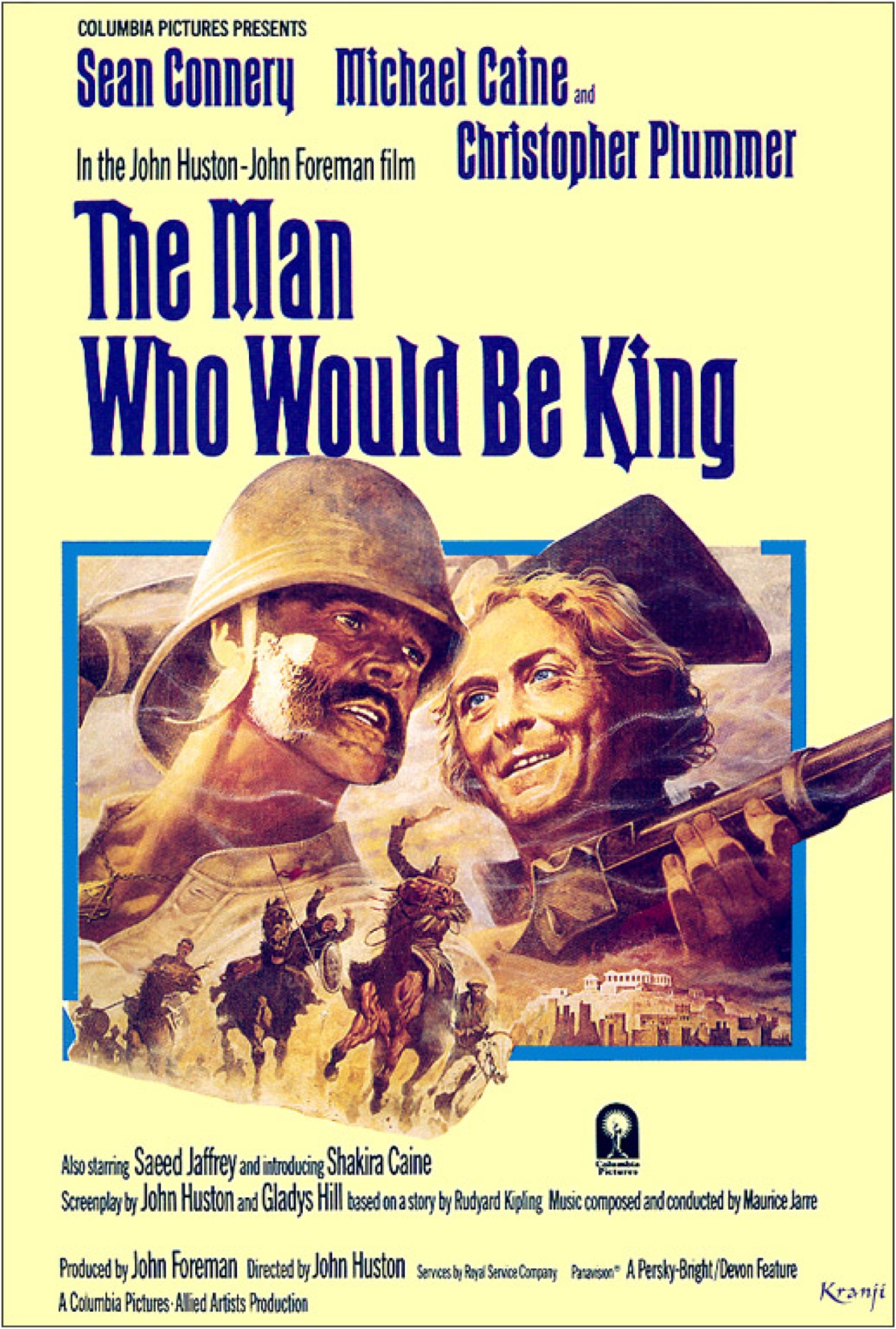
Man Who Would Be King-poster3John Huston4


Huston & Angelica

Huston & Angelica

Huston & Angelica

Huston & Angelica

Huston & Orson Welles

Huston & Orson Welles

Bogart & Huston

Bogart & Huston

Huston on the set of "Annie" - 1981

Huston on the set of “Annie” – 1981

*****************************************************************************************

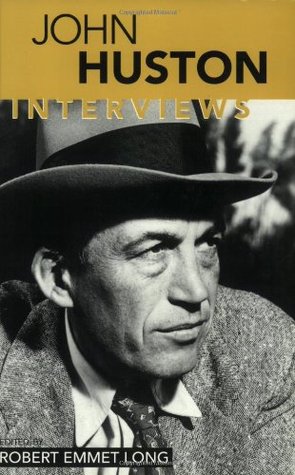
John Huston Interviews-book cover2All of the quotes in this post, including the ones that follow, are taken from John Huston Interviews, edited by Robert Emmet Long, published in 2001 by the University Press of Mississippi as part of their excellent “Conversations with Filmmakers” series.

“The one thing I always try to experiment with is accepting suggestions from people who work with me. I don’t like to dictate, I like to receive stimuli from all: not only the cameraman and the actors, but the grips and the script girl, or the animal trainers in the case of The Bible. I try to create an atmosphere on the set where everyone feels he can participate.” – 1965

“The trick is in the writing and casting. If you cast the right people, using only good actors, and adjust the script to suit the actors you’ve chosen, then it’s best to leave them to work out their own gestures and movements. Your job is to explain to them the effect you want, and your skill lies in being to do that exactly and vividly. Then, if they’re good actors, it’s best not to interfere in how they get your effect across – you’ll only throw their natural performance out of gear if you try.” – 1952

“I believe the most important part of picture making is the casting – matching the actor to the proper character and making sure the actor understands the character.” – 1972

“Acting is part intuitive and part technical. The English train their actors to be superb technicians. Americans tend to rely on charisma.” – 1972

“I direct actors about as little as possible. The better an actor, the less I have to direct. I want to get as much out of the actor himself as I can. Because wonderful accidents occur. I guide an actor rather than direct; expand a performance or reduce it. So far as the mechanical element goes – why, that’s just being a traffic cop.” – 1972

“I choose an actor as a rule for his…no, not as a rule, but always…for his kinship to the role. I cast personalities rather than actors. Then if they’re superior actors, why that’s so much velvet.” – 1972

“The very best actors, the ones that fill me with admiration, are those that furnish surprises.” – 1972

“I like working on location. The location, just like an actor, gives something to the picture and helps to color it, you know, envelop it in an atmosphere.” – 1973

“I don’t make a distinction between writing and directing. But to write and direct one’s own material is certainly the best approach.” – 1977

“The films that were well-written and well-prepared beforehand had fewer of the kinds of problems that are really disturbing than the ones that weren’t. The ones that got you down were those where you were working with material that wasn’t very good – and you were trying to hide from the audience the fact that what they were seeing was not all that good.” – 1977

“I always do as little directing as possible. Always. Because I don’t want to color characterization with my own personality. I try to get as much out of the actor as possible and tell him as little as possible.” – 1977

“I don’t tell them (actors) what to do to begin the scene, I just say go ahead and show me. And with a rehearsal, as a rule, they fall right into the right positions. You don’t have to tell them. Just let nature take its course. Sometimes of course you have to give some help, but generally speaking they present you with the scene and then you discover what is the best set-up to photograph the scene. As a result you get something that isn’t mechanical – that isn’t done for the camera. And because it’s true, you can just naturally introduce the camera into the scene.” – 1977

“Making a film is like every other undertaking in life. Its success depends on whether or not you’re equipped for it. And I’m not referring to learning. I don’t know that I’ve learned a hell of a lot. I think I was probably as good a director at the beginning as I am now.” – 1977

“The cameraman is of course cast for the picture just that same as an actor would be.” – 1977

“…I don’t look for certain themes. I don’t even read with the intention of finding material, I just read out of interest…But there are also those films I do for money, and not for any other reason.” – 1977

Michael Caine (co-star with Sean Connery in The Man Who Would Be King) re Huston: “Most directors today don’t know what they want – so they shoot everything they can think of. They use the camera like a machine gun. John uses it like a sniper.” – 1981

****************************************************************************************

The John Huston films referenced in this post are available for streaming, rental, or purchase from Amazon and Netflix. – Ted Hicks

Posted in Books, Fiction, Film, Home Video, TV | Tagged , , , , , , , , | 5 Comments

“Rosebud was his sled!” – Random Notes on Orson Welles

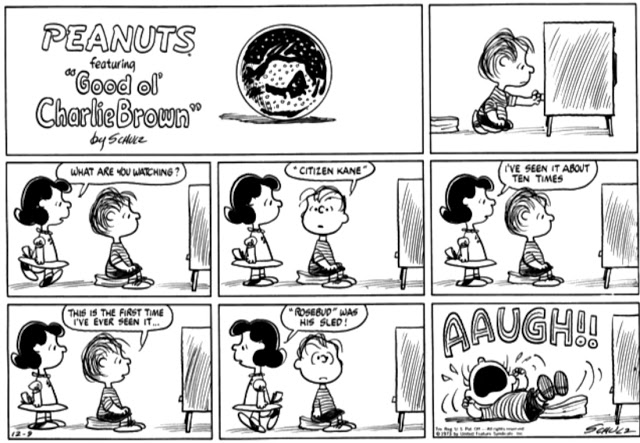
"Rosebud was his sled"2-Peanuts***************************************************************************************

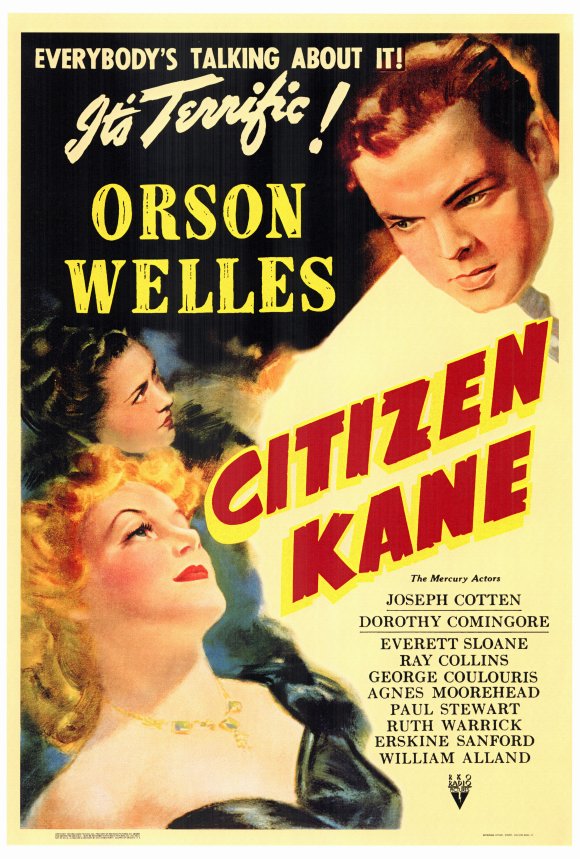
Citizen Kane-posterThe first time I saw Citizen Kane — an experience I’ll never forget — was in a film class at the University of Iowa in 1964 or ’65. The class was held in a long, narrow room with rows of fixed, wooden seats and a small projection booth in the back. Not a likely setting for a powerful revelation. I’d heard of Orson Welles and Citizen Kane , but wasn’t prepared for the thrilling jolt I was about to get at the end of the film’s noirishly ominous opening sequence — almost like the beginning of a horror film — with the abrupt cut to the blaring “News on the March!” footage. This was something else again. From that point on, Kane completely blew up my notions of what movies could be.

Joseph Cotton, Welles, Everett Sloan

Joseph Cotton, Welles, Everett Sloan

We had a single 16mm projector for the classroom. Citizen Kane runs 2 hours, and as I recall, the print was mounted on at least three reels. When a reel ran out, there was about a 5 minute break while the next reel was threaded up on the projector. I remember feeling quite anxious during the reel changes, for fear Kane wouldn’t continue to be as great as it had been up to that point. No problem there. I very much wanted to see it again, but it was only being shown once for this class. I’m not sure how I managed this, but I borrowed the print from one of the class TAs, who I think had the responsibility of shipping it back to the distributor. He must have also given me a key to the classroom, because I went there at night to watch Kane by myself from the projection booth. It was just as great the second time. Bernard Herrmann wrote a powerful music score that lends amazing emotional resonance to the film, especially during the ending, which gets me every time I see it..

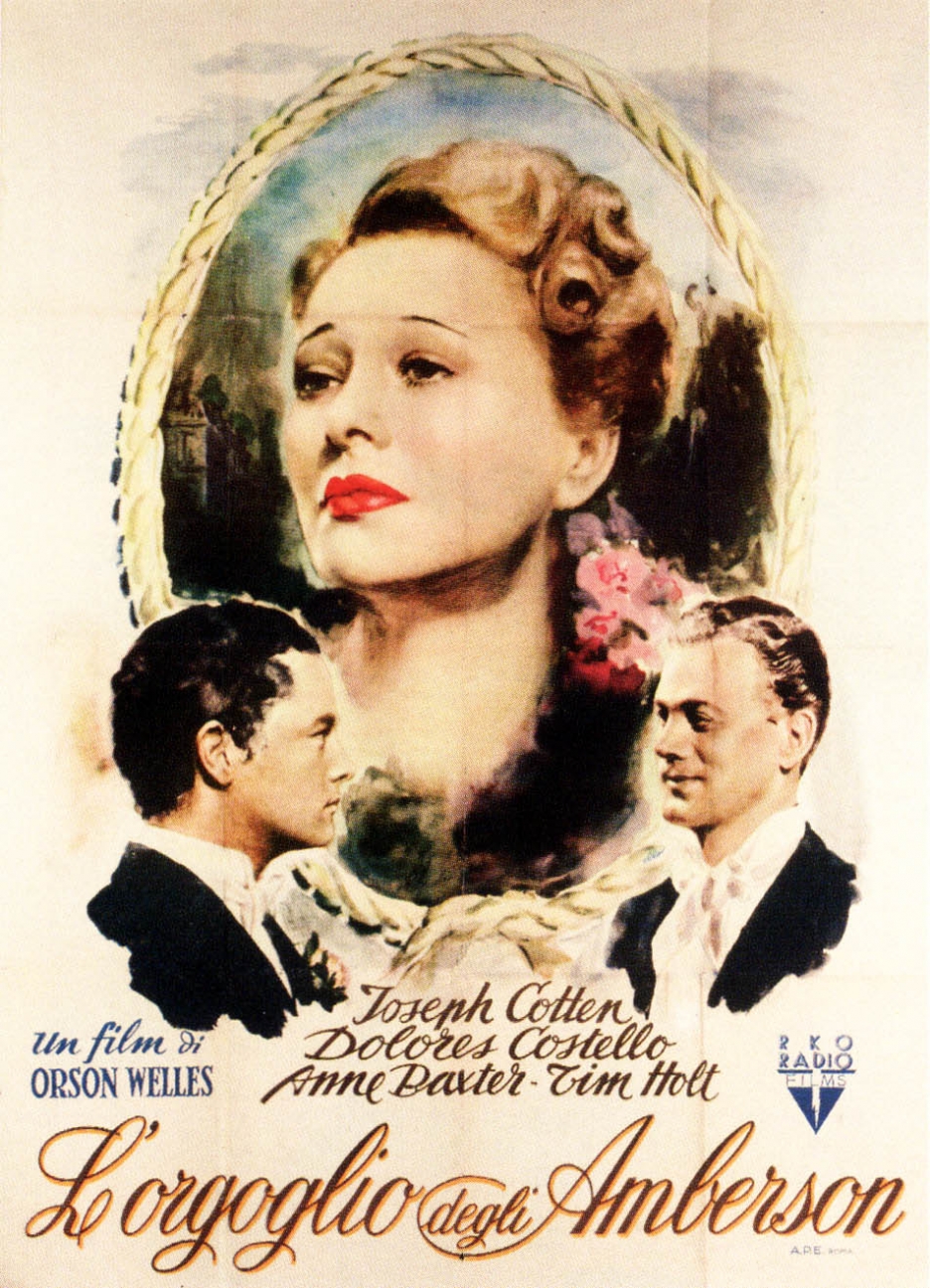
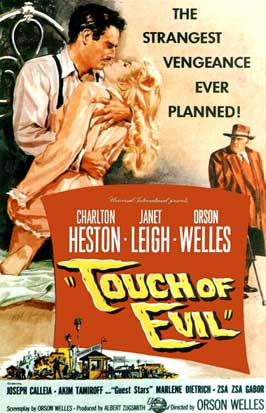
Ambersons-Italian posterTouch of Evil-poster2My favorite Welles films, after Kane, are The Magnificent Ambersons (1942) and Touch of Evil (1958). Ambersons was famously taken away from Welles when he was out of the country. It was re-edited, additional scenes were shot, and an ending was added that was definitely not what he intended. Even so, it’s a beautiful film. Sure, I’d love to see it in the form Welles had planned, but it’s pretty great as it is. Touch of Evil, a flamboyant display of B-movie pulp raised to a much higher level, is a tour de force from beginning to end, especially in the astonishing opening — a single-take tracking shot lasting 3 minutes, 20 seconds. I saw it again last week at Film Forum, and it still burns up the screen.

Directing "Too Much Johnson"

Directing “Too Much Johnson”

Orson Welles is never far from my mind, especially of late. He keeps turning up. In 1938, three years before Citizen Kane, Welles directed a silent film called Too Much JohnsonIt had been intended to be part of a Mercury Theatre stage production of the 1894 comedy by William Gillette. This didn’t happen, and the film was never publicly screened. Too Much Johnson was thought lost until a print was discovered in a warehouse in Pordenone, Italy, in 2008. It was shown at the Pordenone Silent Film Festival in October 2013, and had its New York premiere at the DGA Theatre the following month. Richard Brody wrote a lively piece about the film in the 11/26/13 issue of The New Yorker , which is definitely worth reading.

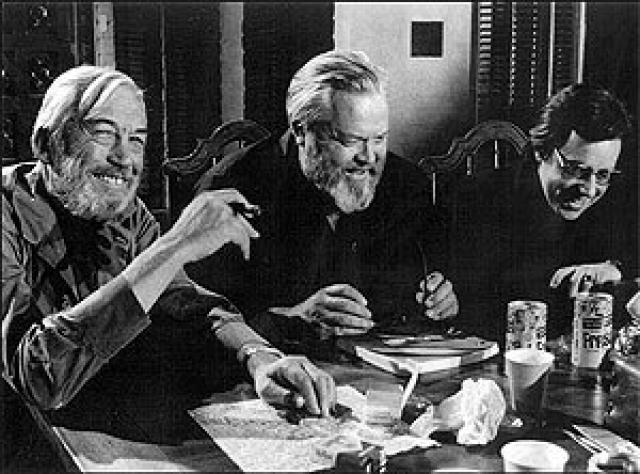
John Huston, Welles, Peter Bogdanovich

John Huston, Welles, Peter Bogdanovich

And then last month there was news that the last film Welles had been working on for years, The Other Side of the Wind, would be completed and released next year, in time for what would have been Welles’ 100th birthday on May 6th. After Ernest Hemingway’s suicide in 1961, Welles had the idea to make a film about an aging bullfight enthusiast. By 1966 he had changed the character to that of a film director — played by an aptly-cast John Huston in scenes shot between 1970 and 1976. Per an article in the The New York Times on 11/10/14, Welles had “worked obsessively on the film” during the last 15 years of his life. After his death in 1985, he left behind a 45-minute edited work print and hundreds of cans of negatives. The film had already been tied up for years in legal struggles with investors. It appears that now the various rights holders are in agreement and have cleared the way for the film to be finished by producer Frank Marshall and director Peter Bogdanovich (who plays a character in the film), using notes from Welles. We can only hope.

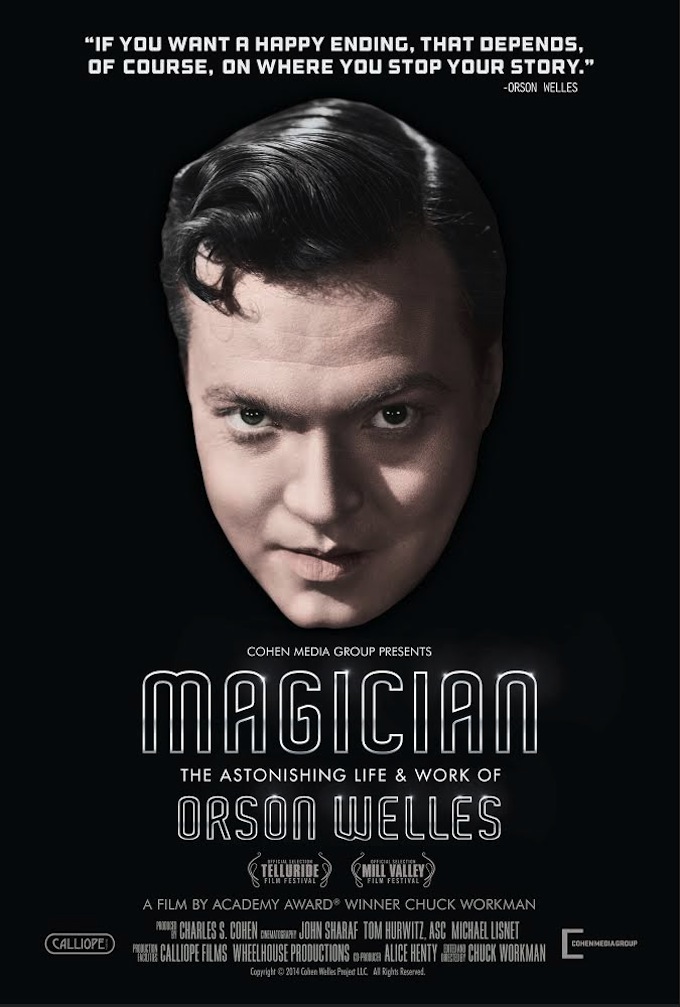
Magician-posterAnd more Welles! Last month I attended a screening of a documentary called Magician: The Astonishing Life and Work of Orson Welles, directed by Chuck Workman, well-known for creating short films and openings for twenty Academy Awards telecasts over the years. His film Precious Images (1986), an 8-minute compilation of 470 shots from films covering the range of American film history, won an Oscar for Best Live Action Short. Magician didn’t quite meet my expectations, but it came close. It’s very good, and well worth seeing. What I found most compelling was the material on Welles’ early life, and the rich variety of clips from interviews conducted over the years. Chuck Workman’s strength as a filmmaker is evident in the way he has edited this wealth of material together. It’s a good film for those who know little about Welles, as well as those who know a lot.

Magician opens here on December 10 at Lincoln Plaza Cinemas.

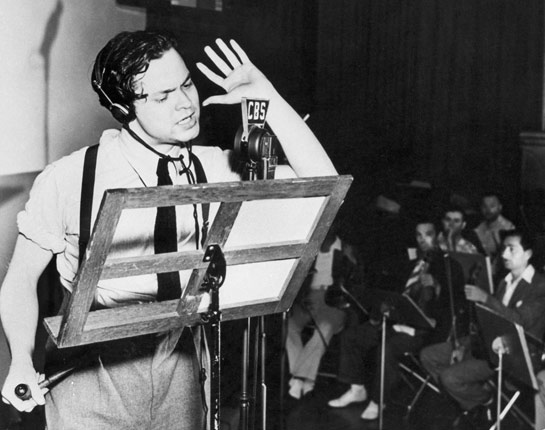
"War of the Worlds" broadcast, 1938

“War of the Worlds” broadcast, 1938

Orson Welles is a nearly unique figure in American life, a brilliant, tragic, magical presence. In 1938, at age 23, he freaked out a good part of the country with his War of the Worlds broadcast. I’ve listened to it several times, and I can see why. Three years later he delivered Citizen Kane, arguably one of the greatest films ever made. How could anyone follow that, even Welles? His subsequent efforts to get films made despite lack of funds or studio support are well documented. It’s seems appropriate that Welles never finished his film of Don Quixote, since he seemed to spend much of his life after Kane tilting at windmills. There have been hundreds of books and articles written about Welles, and I’m sure there’s no end in sight. Welles is a cinematic touchstone, an endless source of fascination.

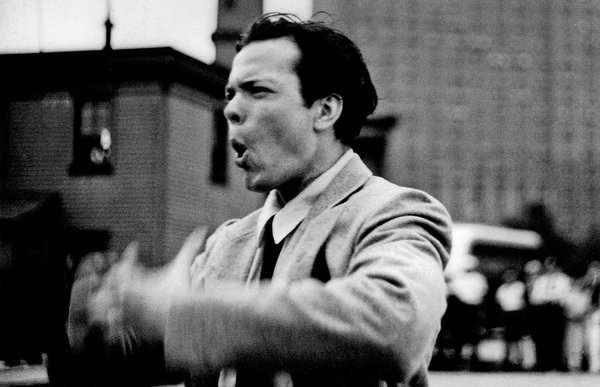
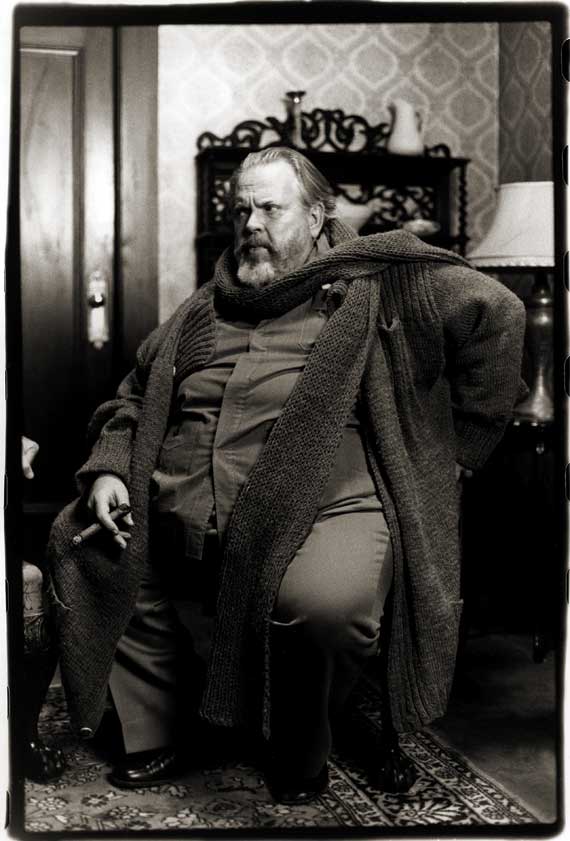
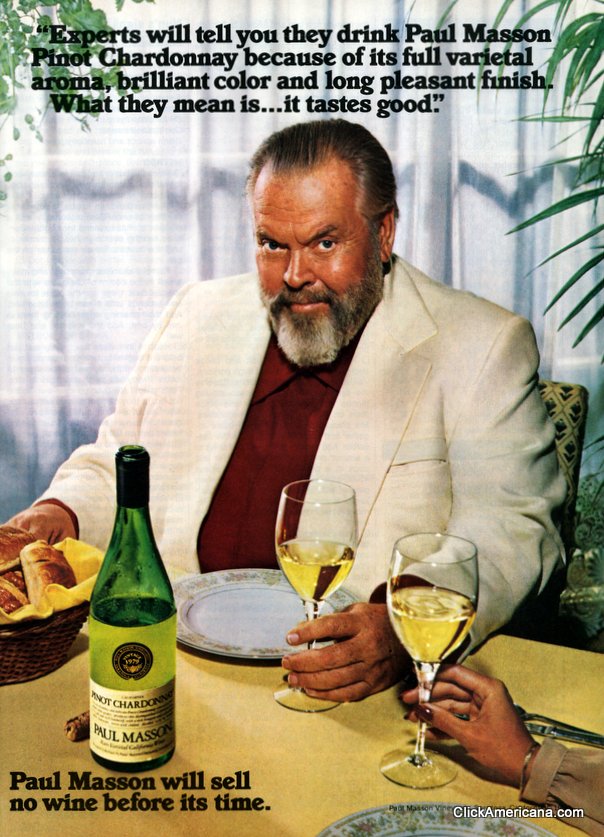
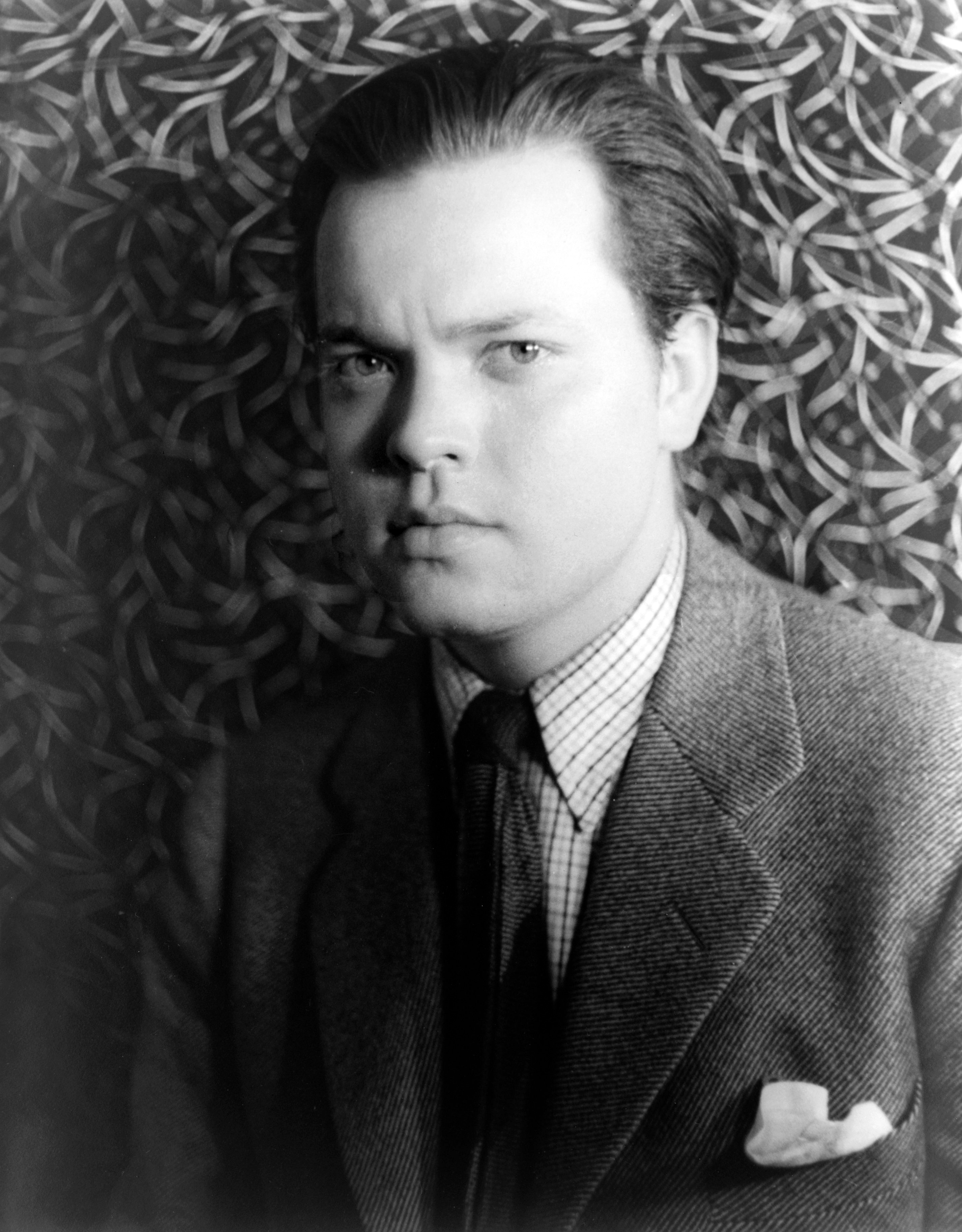
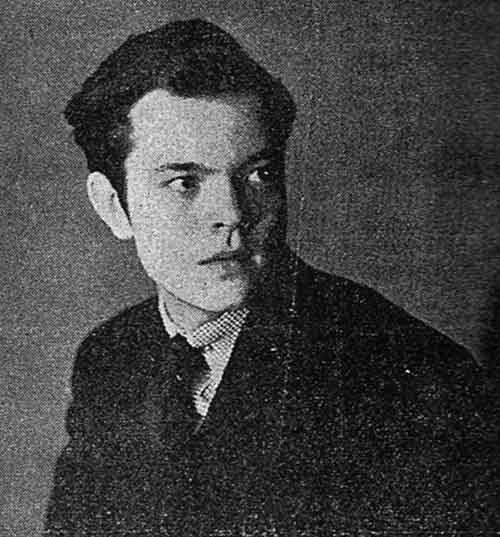
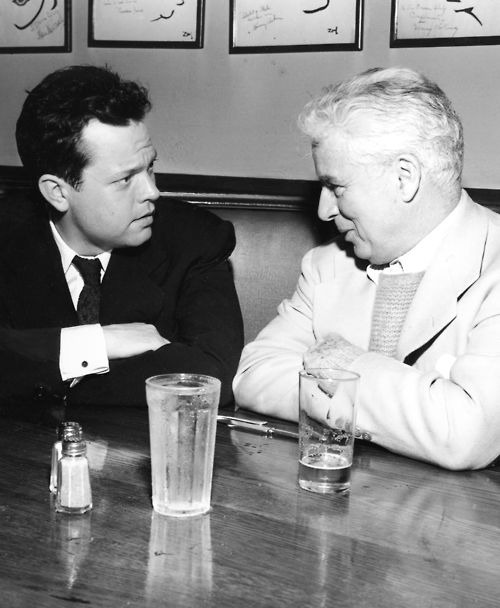
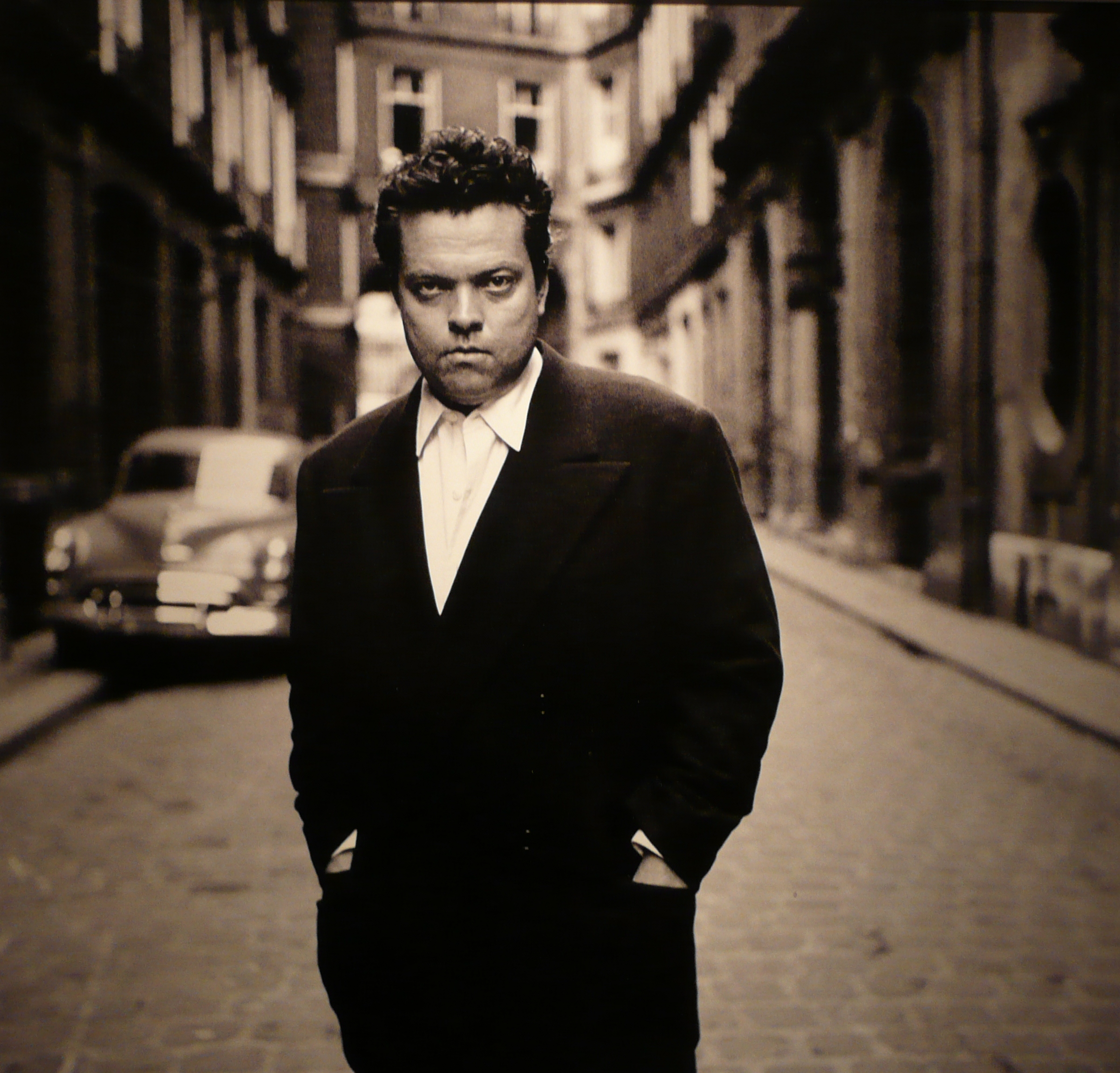
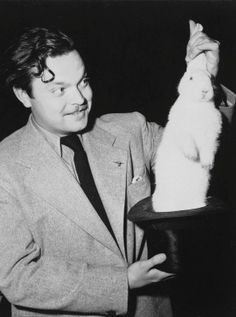
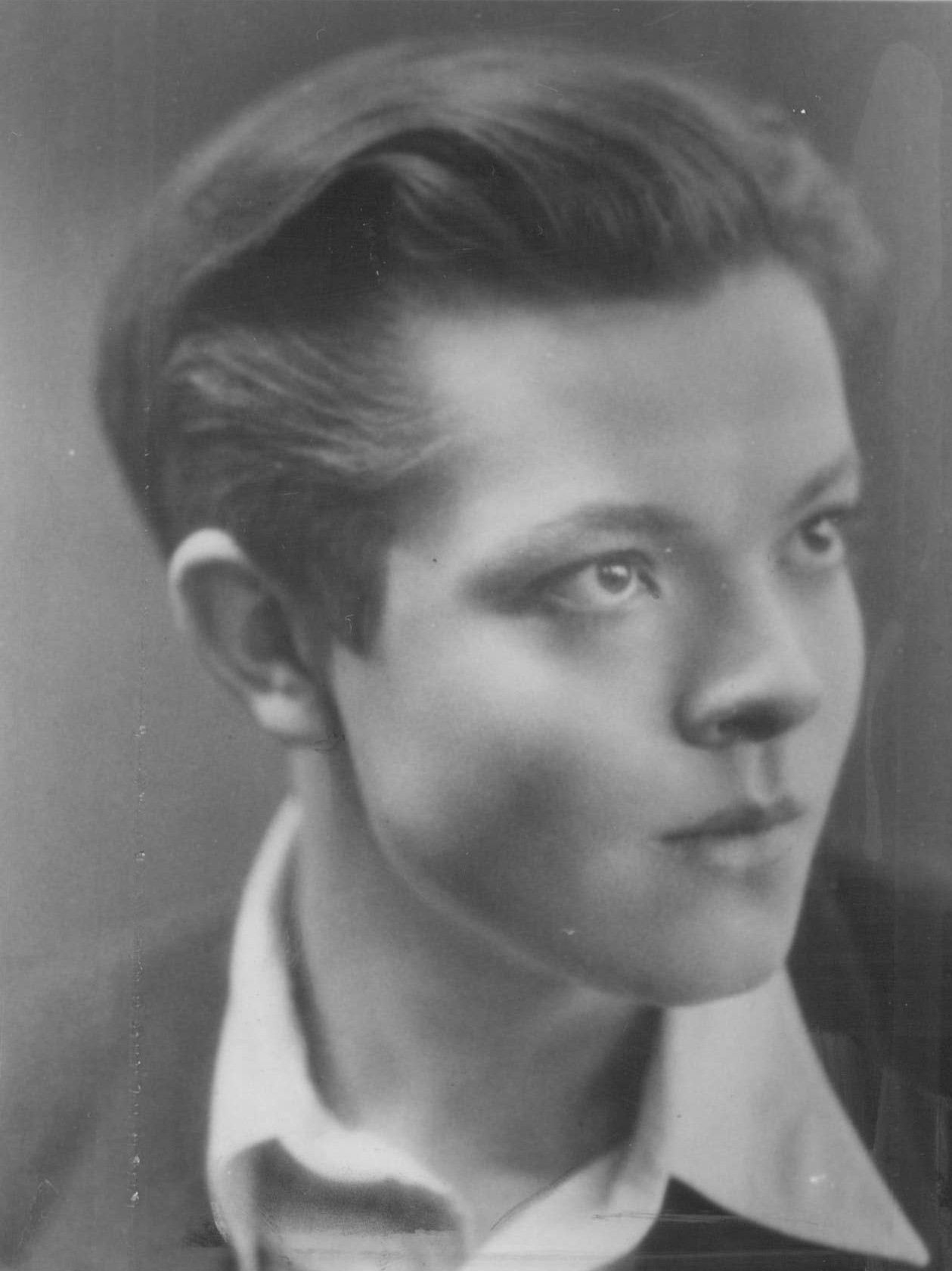
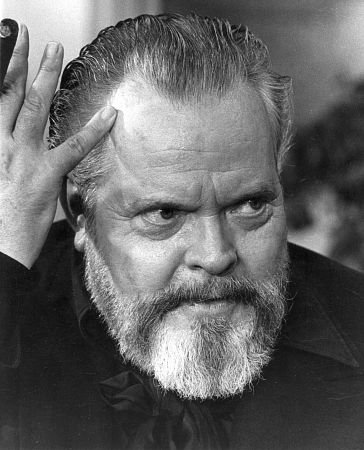
Orson Welles-later in lifeOrson Welles-1981 wine adPart of my preparation for writing this post was searching for photos and film clips to include. What struck me when I saw the many pictures of Welles was how much his appearance and presence changed over the years. Off the top of my head, it’s hard to think of anyone else where this evolution has been quite so dramatic. The image that most readily comes to mind for a lot of people now, I’m sure, is that of the grossly overweight Welles in his later years, seen frequently on talk shows or in ads selling Paul Masson wine. The man who made Citizen Kane! Seeing him younger can be quite a jolt. In photos taken when he was 15 or so, he has a strange beauty that can seem almost extraterrestrial.

1937

1937

1934

1934


Directing "Citizen Kane"

Directing “Citizen Kane”

Welles & Chaplin, 1947

Welles & Chaplin, 1947


Paris, 1952

Paris, 1952


Welles the magician

Welles the magician


**************************************************************************************

As I wrote earlier, Orson Welles is never far from my mind. He keeps turning up. He’ll always be here. — Ted Hicks

image0000003AA.700.jpgOrson Welles-bearded


***************************************************************************************

Supplemental:

The War of the Worlds radio broadcast, 10/30/38.

Orson Welles interview 8 days before his death on 10/10/85.

************************************************************************************

There’s more! Bruce Goldstein at Film Forum, here in New York, has programmed a 5-week Orson Welles retrospective celebrating his centennial year. This series kicks off on January 1 with an 8-day run of Citizen Kane, followed by all of his features and many films he acted in.

Posted in Books, Film, Home Video, TV | Tagged , , , , , , , , | 9 Comments

Film School Flashback – Double Feature

I knew I wanted to be a writer when I started at the University of Iowa in 1962, but at the time I thought that meant journalism. I quickly found out that wasn’t the kind of writing that interested me, and by 1963 I was taking fiction writing courses in the Undergraduate Writers Workshop. Some of the people I met in these workshops were also taking classes in the Film Department. This clicked for me. I was already a full-blown movie buff, so it seemed perfect that I could be writing stories and making movies at the same time.

In the Fall semester of 1964 I took a course called Cinematography Techniques, taught by Dr. John Kuiper, who a year later became the Head of the Motion Picture Section of The Library of Congress. TAs in that class were Ted Perry — later the Director of the Film Department at the Museum of Modern Art in NYC and Chairman of Cinema Studies at NYU, and now in the Film and Media Culture Department at Middlebury College in Vermont — and Bob Rose, a crazy guy with a big beard, sort of a beatnik, and kind of brilliant. I’m still in touch with Ted, but unfortunately have lost track of Bob. This was a very exciting time. I was just off the farm, turned loose in a college town seemingly filled with crazy hipsters as the 60s got rolling. I was over-stimulated by all this stuff and all these people. Anything and everything seemed possible. Ah, youth!

At that time, production courses and film studies classes were held in the Old Armory Televison-Film Laboratory, seen below in a map of part of the campus at that time.

Old Armory on campus map

In the second semester of that school year, I took Cinema Production, which is when I made my first short film, Bridgework. We’d done short exercises every week as part of the Cine Tech class, but this was the first time it was my film, not an exercise, and something I was totally responsible for from start to finish. I discovered that editing was what I enjoyed most about the filmmaking process. Which I guess makes sense. I’m a writer, and film editing is a kind of writing, splicing shots together instead of words.

This was no-frills filmmaking. We didn’t haveBell&Howell 70DR camera sync sound capabilities and were using spring-wound Bell & Howell 70DR cameras that held 100 feet of 16mm black & white film and were basically indestructible. They’d been used by combat photographers during World War II. I shot most of Bridgework riding on the back of a motorcycle. So if I’d fallen off or we’d crashed, the camera would have been okay. Good to know.

In the fall of 1965 I made my second film, The Killing Ground. This one was more ambitious than my first, but as usually happens, it turned out somewhat different than I’d imagined. I’ve kept prints of both films all these years, and recently had them transferred to Blu-ray disc and flash drive. When I watched them a few days ago, for the first time in many years, they were almost exactly as I’d remembered them — except that The Killing Ground has some shots that are way too dark. Do over!

Remember that these films were made nearly 50 years ago when I was 20 years old. But no more excuses; here they are in all their glory. — Ted Hicks
Posted in Film | 6 Comments

Headbanging with “John Wick”

John Wick-posterJohn Wick is an uncommonly good action film, a B-movie on steroids. It’s lean and mean, and gets the job done. I found it immensely satisfying from beginning to end, much the same way I felt during Guardians of the Galaxy and The Guest earlier this year. The basic format is familiar and predictable: a protagonist (almost always male) takes revenge on those who’ve done him wrong. There’s something hugely satisfying and wish-fulfilling about these kinds of films. We’ve seen this many times before in such films as The Big Heat (1953), Death Wish (1974), The Outlaw Josey Wales (1976), Rolling Thunder (1977), Kill Bill I & II (2003/2004), and Taken (2008), to name just a few.  The protagonists have to either acquire the skills necessary to achieve their goals, or they already possess those skills.

At the beginning of John Wick, the title character (played by a perfectly cast Keanu Reeves) has been retired for five years from his career as a professional killer for a Russian gang in New York City. Of course, in these films, we know that guys like this never really “retire.” Wick had fallen in love, gotten married, acquired a vintage ’69 Mustang, and moved to a split-level house in New Jersey with a lot of glass that lends itself nicely to a subsequent shootout. It’s unlikely that the Russians would have been willing to let Wick leave, since he was apparently the best they had at his job, by far. Usually in these scenarios, getting out is not even an option, but I was willing to go with it, perhaps because the head of the Russian mob, Viggo Tarasov, is played by Swedish actor Michael Nyqvist, from the original The Girl with the Dragon Tattoo (2009) and the two sequels. He brings an avuncular, unusually understanding dimension to a character type more frequently portrayed as a thuggish, sadistic sociopath (see Martin Csokas, for comparison, as “Teddy” in The Equalizer, a poor, but more common, example of this type of film that even Denzel Washington couldn’t save).

We learn very quickly that John’s wife has died from an illness, but not beforeJohn Wick-puppy ordering a puppy to be delivered after her death so he won’t be alone. This might sound sappy, but it plays nicely — and in any event, it’s a necessary set-up for the plot, which shifts to the next gear when John is at a gas station. Iosef Tarasov, Viggo’s violent, privileged, nutjob son, pulls into the station and demands to know how much John wants for the Mustang. John says it’s not for sale, which doesn’t make Iosef happy. As we see later, just mentioning the name “John Wick” is enough to strike fear in the hearts of those who hear it, and give them pause. Iosef obviously doesn’t know who John is and probably wouldn’t care if he did. So he doesn’t think anything of breaking into John’s house that night with his companions, who savagely beat John with baseball bats and kick him in the head a few times. Then, annoyed by the barking puppy, Iosef takes a bat to the dog as well (this is not a spoiler since it’s in the trailer). This is all it takes to bring John out of retirement. Stealing his Mustang is bad enough, but killing his dog is way over the line for John (it was gift from his dead wife!), and basically justifies all the mayhem to follow.

Chad Stahelski & David Leitch (r)

Chad Stahelski & David Leitch (r)

Someone once described John Woo’s Hong Kong gangster films as “maximum firepower at close range.” If you’ve seen Woo’s The Killer (1989), Bullet in the Head (1990), or Hard Boiled (1992), you know what this means. It‘s also an apt description of John Wick, which was co-directed by Chad Stahelski and David Leitch, two former stunt men and stunt coordinators. Stahelski was Keanu Reeves’ stunt double in The Matrix (1999) and martial arts stunt coordinator for the The Matrix Reloaded and The Matrix Revolutions  (2003). Their backgrounds and experience have served John Wick‘s action sequences well. There’s a clarity to the choreography of the fight scenes that reflects a level of filmmaking skill you might not expect from first-time directors. These scenes — involving gunplay and martial arts (called “gun-fu” by the directors) — are shot and edited so that we know what’s going on. They don’t use disorienting close-ups and quick cuts the way so many action films do, nor do they use shaky, handheld cameras.

Here are two examples that illustrate the film’s method and style. These clips should also tell you if this is a movie you’d want to see or not. The music is very effective here and throughout the film.

Of course, nobody could do this. It’s absurd, but the film follows its own logic, and it basically works if you get on the ride. Though no one would claim it has redeeming social value (not that it has to). Reeves’ performance is just right for this role, which is similar to many he’s played before, i.e. tightly wrapped and showing little outward emotion. Which serves to heighten the deadpan humor he brings to many of his line readings. His character here evokes Clint Eastwood in Sergio Leone’s A Fistful of Dollars (1964), Toshiro Mifune in Yojimbo (1961), Lee Marvin in Point Blank (1967), Brandon Lee in The Crow (1994), and the unrelenting drive of Arnold Schwarzenegger as the Terminator. Reeves’ John Wick may not be invincible, but he is unstoppable. He becomes increasingly tattered and beaten up as the film progresses. Which doesn’t prevent him from dispatching approximately 84 mostly nameless adversaries (this is the directors’ count, and I’ll take them at their word).

John Wick-Keanu still2One of the pleasures of this film is the quality of the actors who round out the cast. Whether their parts are large or small, everyone knows what they’re doing. Willem Dafoe and John Leguizamo are standouts. Two of my favorite actors from HBO’s great series The Wire, Lance Reddick and Clarke Peters, are here. Reddick is especially effective — and funny — as the the manager of the Continental Hotel, where Wick resides when he comes from New Jersey to NYC to take care of business. The Continental, whose clientele is apparently made up entirely of professional killers, seems to occupy an alternate dimension of some kind, like something David Lynch would come up with. Other actors include Alfie Allen (Theon Greyjoy on HBO’s Game of Thrones) as Viggo’s mad dog son Iosef; David Patrick Kelly (The Warriors; 48 Hours) as the leader of a team of “cleaners” dispatched to remove the bloody evidence of John Wick’s dust-ups; Ian McShane (HBO’s Deadwood) as the owner of the Continental Hotel; and Dean Winters (from 30 Rock, as Tina Fey’s sometime boy friend, and currently in Allstate Insurance TV spots).

John Wick is an impressive debut feature from two new directors who clearly absorbed a great deal about filmmaking from their time on movie sets. They obviously knew what they wanted to do with this film and how to go about it. Something this assured makes me look forward to what they do next. If you like this genre, John Wick is a cut above, and a hell of a ride. – Ted Hicks

Posted in Film | 2 Comments

“Force Majeure” – Women and Children First

Force Majeure-posterIf you’ve ever wondered, as I often have, how you’d react in a crisis situation (you’re with your family on a ship that’s sinking, or in a store that’s being robbed at gun point, or trying to get out of the way of a tidal wave – or an avalanche), then you should see Force Majeure, an extraordinary Swedish film written and directed by Rueben Östlund that puts a nasty spin on that question.

In films I always want to identify with characters who stand up and do the right thing, usually at great emotional, professional, or (especially) physical risk to themselves. Many movies are built on this dynamic and depend on audiences identifying with these characters. Gary Cooper coming back to town to face the men who’ve come to kill him in High Noon when it would be easier to turn away, for example. Force Majeure, however, confronts us with a lead character who doesn’t do the right thing, who briefly abandons his wife and two kids in a moment of panic and later denies that it happened at all. Not much of a role model, not much to admire, and not someone you’d want to identify with.

Tomas (Johannes Kuhnke), his wife Ebba (Lisa Loven Konglsi), and their two children Vera and Harry (real-life siblings Clara Wettergren & Vincent Wettergren) have come from Sweden to a resort in the French Alps for five days of skiing and relaxation. It’s stated that Tomas spends so much time at work that he has very little time for his children. This is a chance to be together. They seem quite ordinary, nothing out of place, an Ikea family. The first day is pleasant and goes smoothly; they ski together, they all nap on the bed (a great shot that’s held for a long time), and in a scene that’s repeated several times during the film and feels increasingly unsettling, we see them standing side by side reflected in the bathroom mirror as they brush their teeth with electric toothbrushes.

Force Majeure-family in bedForce Majeure-brushing teethOn the second day they are eating breakfast outside on a terrace facing the mountains (actually, every view from this resort seems to face mountains). Since the start of the film we’ve been hearing sporadic booms that sound like cannon fire. I couldn’t figure this out at first, but then found out it has to do with deliberately creating avalanches as a way of preventing large, dangerous avalanches (or something like that). These random booms throughout the film add to a sense of unease. As the family eats, they see a “controlled” avalanche start down the mountain. Tomas says not to worry, this is perfectly okay. But as the billowing snow advances closer and closer, the situation suddenly doesn’t seem quite so safe. People definitely rush to get out of there, but Tomas bolts, knocking someone aside to clear the way, leaving his wife and children at the table. The frame whites out from the snow and stays that way for what feels like a long time as we hear sounds and voices. People and objects slowly emerge, first as shapes and shadows, then more recognizably as the snow settles. There have been no cuts and the camera hasn’t moved an inch during this entire scene.

Force Majeure-the avalancheThat night Tomas and Ebba are eating dinner with a couple they’d met earlier. Ebba starts talking about the avalanche that almost got them at breakfast. With a kind of chagrined laugh she says that Tomas ran away and left them, which he immediately and emphatically says never happened. This denial seems actually worse than his running away in the first place. He keeps it up even when he and Ebba are alone together.

Force Majeure raises issues about what it means to “be brave” and “be a man,” and challenges those concepts in the process. In press notes for the film, the director writes that inspiration for the film came from researching “…true stories of distress and emergency, of passengers during the sinking of ships, of tourists stricken by tsunamis or held hostage by hijackers. In such extreme situations, people can react in completely unexpected and exceedingly selfish ways… It also appears that, in many cases, men do not act according to the expected codes of chivalry. In life or death situations, when their own survival is at stake, it seems that men are even more likely than women to run away and save themselves…” This is uncomfortable information for us guys, though women will probably just nod their heads in agreement.

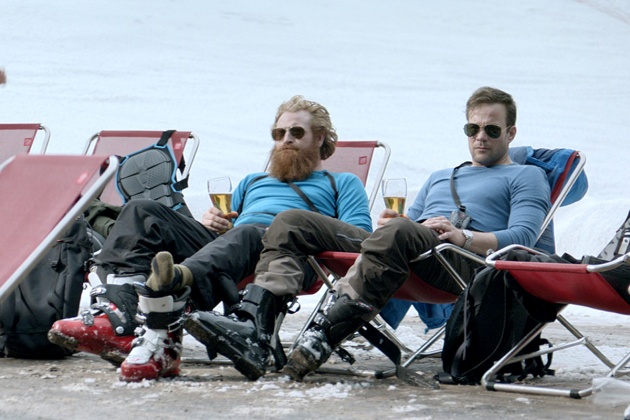
Force Majeure-Tomas & MatsThe concept of masculinity is also examined in a very funny, off-kilter scene in which Tomas and a friend of his, Mats (Kristofer Hivju), are seated outdoors drinking beer after skiing. A woman comes over and tells Tomas that her friend (a woman we don’t see) has pointed out Tomas and Mats as being the most attractive men there. She returns a moment later to say sorry, her friend didn’t mean them, she had pointed at someone else. There’s something about this scene that just seems so odd and so deadpan. Like so many scenes in the film, this plays out in a single camera setup, with no cuts to distract as Tomas’ and Mats’ egos are puffed up and then deflated in rapid order. (The actor playing Mats looked familiar, but I couldn’t remember where I’d seen him. It turns out he plays a Wildling leader, Tormund Giantsbane [that’s some name], on HBO’s Game of Thrones.)

Force Majeure is impeccably made. The images have a clarity that’s stunning at times. Scenes often play out in silence, or with pauses (often uncomfortable) and looks that are quite revealing without spelling things out. The following scene takes place on the night of the third day when Mats and his much younger girlfriend Fanni are having dinner in Tomas and Ebba’s suite. Ebba again returns to Tomas’ actions of the day before.

This is a very unusual film with an almost clinically objective eye. I liked it a lot. Original and provocative, Force Majeure is a sharp-edged satire that wraps up in a way that makes us rethink much of what’s transpired, and suggests that the issues may not have been as clear-cut as they originally seemed.

*****************************************************************************************

Force Majeure won a prize at this year’s Cannes Film Festival and is Sweden’s 2014 official Oscar entry for Best Foreign Language Film. After playing the international and domestic festival circuit earlier this year, it opens theatrically in this country on Friday, October 24th. – Ted Hicks

*** Since posting this review yesterday, I read an interview with Rueben Östlund in the October 19th New York Times. If you’re interested in the film, this is definitely worth checking out.

Posted in Film | 2 Comments

“Tracks” – On the Road with Camels and a Dog

Tracks-posterIn April of 1977 a young woman named Robyn Davidson set out walking from Alice Springs in the Northern Territory of Australia on a 1,700 mile trek through Western Australia, much of it desert, to the Indian Ocean on the west coast, where she arrived nine months later. She was accompanied by four camels and her dog, Diggity. Robyn’s epic undertaking was funded by National Geographic, in exchange for allowing photographic coverage by an American, Rick Smolan, who visited Robyn periodically along the way.

Robyn published an account of the journey in her book Tracks in 1980. As Rick Smolan said in an interview with myself and several others this past Monday, Robyn wrote the book entirely from memory, as she kept no notes or journal on her journey. I hadn’t heard of Robyn or her book until I read about the film version, but as producer Eric Sherman said, “Tracks is one of those books that pretty much every Australian knows. It’s sort of a seminal epic Australian story.”

That story has been turned into an extraordinary film that opens here in limited release this Friday, September 19th, after successful screenings at many film festivals last year, including Venice, Telluride, and Toronto, as well as San Francisco and Seattle earlier this year. But it didn’t happen overnight. Reportedly there had been five previous attempts to film the book in the 1980s and ’90s. Julia Roberts was “attached” to star as Robyn Davidson in 1993. Nicole Kidman and Helen Hunt were also mentioned at various times. But it was Mia Wasikowska who was finally cast as Robyn. Having seen the film, it’s hard to imagine anyone but Wasikowska playing the part. She really owns it. Filming finally began in October of 2012 with John Curran directing from a script by Marion Nelson. The results are amazing, inspiring, unsentimental, thought-provoking, and incredibly human. I loved it.

Like most people in this country, my first exposure to Mia Wasikowska was in 2008 in the HBO series In Treatment as Sophie, a tightly-wrapped teenage gymnast undergoing psychotherapy. She was explosive, violent, suicidal, and totally got my attention in the role. (I’ve since learned, by the way, that Wasikowska is pronounced VAH-shee-KOF-ska.  Maybe everyone knows this, but I was clueless. She was born in Australia and her mother is Polish.) Mia Wasikowska has done great work since then in features that include Defiance (2008), Alice in Wonderland (2010), The Kids Are All Right (2010), Jane Eyre (2011), and Only Lovers Left Alive (2013), to name but a few.

Per Rick Smolan, the extent to which Mia embodied Robyn was uncanny. He also said, “What’s amazing about Mia is she reminds me of a young Meryl Streep, you don’t even believe it’s the same person from movie to movie, she completely transforms into that character. As somebody who spent three months traveling with the real Robyn, it was eerie watching (Mia) become Robyn.” Several weeks before shooting began, Mia and Robyn Davidson traveled to South Australia so Mia could meet the camels and Robyn could show her how to work with them.

Robyn Davidson

Robyn Davidson

Mia Wasikowska as Robyn

Mia Wasikowska as Robyn

John Curran says he’d heard of Adam Driver because of the HBO series Girls, and began to consider him for the role of Rick Smolan when he came across a blog that described Driver as “…weird and fantastic.” This piqued Curran’s interest. Driver has an unpredictable, wonderfully off-center quality that feels just right for his role in Tracks. When asked if it was weird seeing himself on screen, Rick Smolan said, “Very.” Then he was asked if he felt that Adam Driver’s portrayal was authentic and if he’d taken liberties, and Smolan said, “My brother’s a director, so he said they’re going to have to make you into a jerk at the beginning, and then hopefully you’re better by the end of the movie.” He added, “It was the most interesting year of my life, being out there with this woman (Robyn).”

Rick Smolan, NYC 9/15/14

Rick Smolan, NYC 9/15/14

Adam Driver as Rick Smolan

Adam Driver as Rick Smolan

John Curran’s direction is straightforward and intensely quiet. He never gets in the way of the material; he lets it speak for itself and doesn’t amp up moments that are powerful enough in their own right. Curran’s films all have strong female characters. In addition to Mia Wasikowska in Tracks, I’m thinking especially of Laura Dern’s powerhouse performance in We Don’t Live Here Anymore (2004). Tracks has an ineffable quality that at times has echos of such Australia films as Picnic at Hanging Rock (d. Peter Weir, 1975) and Walkabout (d. Nicolas Roeg, 1971). These films have a strangeness that feels almost extraterrestrial, especially that scene in Walkabout with Rod Stewart’s “Gasoline Alley” playing in the distance when the father shoots himself to death in his car after driving with his children into the Outback. All of these films have an expectant air about them, like something terrible or great is about to happen, but you don’t know what. When Mia loses her compass at one point, it made me think of Peter O’Toole losing his compass during an arduous desert crossing in Lawrence of Arabia (1962), but unlike O’Toole, she finds hers. And promptly gets lost, but Diggity gets her home.

John Curran, NYC 9/15/14

John Curran, NYC 9/15/14

John Curran, NYC 9/15/14

John Curran, NYC 9/15/14


_________________________________________________________________

Animals are major characters in Tracks, as is the landscape itself. This film could not have been shot in a studio, and Robyn could not have made the trip without the aid of her four camels, Bubs, Dookie, Zeleika and Zeleika’s calf, Goliath. At first I thought,  camels in Australia? Then I learned early in the film that camels were brought to Australia in 1840 to help transport people and goods because they were well suited to desert country. When motorized vehicles replaced them, most of the camels were turned loose, and now Australia has the world’s largest population of feral camels.

Here is a short clip of Mia and her camels. In voiceover we hear the letter she writes to National Geographic requesting sponsorship for her venture. It also has a nice taste of the very effective music score by Garth Stevenson.

There’s so much about Tracks that has stayed with me. Such as Mr. Eddy, the tribal Elder Tracks-Mia & Mr. Eddywho travels with Robyn across sacred territory where women are not allowed to go unaccompanied. Mr. Eddy is portrayed by the indigenous Rolley Minutma in a wonderful performance that expresses an abundance of humor and dignity. Or the rather tender interlude when Mia encounters an old man and his wife living on a dried-up farm with nothing else in sight for miles around (it is the desert, after all). She spends a day or so with them, almost like a daughter with her parents. It’s hard to describe. Or the beautiful shot of an incredibly starry sky at night that fills the screen, and then dissolves into a tight close-up of Mia’s face as she watches the sky. Or her relationship with the camels and her dog Diggity (who we learn in the credits is played by a dog with the wonderful name of Special Agent Gibbs). At one point we hear her say in voice-over, “The universe gave us three things to make life bearable: hope, jokes, and dogs. But the greatest of these was dogs.” I was especially blown away by a shot of Mia swimming underwater in slow motion toward the camera; then she pauses and her hair billows forward in a way that’s beyond magical. – Ted Hicks

Tracks-Mia & camel in ocean__________________________________________________________________

Extras:

Below are clips from an interview with John Curran at the Venice Film Festival last year followed by an interview with Robyn Davidson & Mia Wazikowska.

And for those who really want to get into it, The Weinstein Company (U.S. distributor of Tracks) has provided impressively extensive production notes for the film.

And finally, here’s an excerpt from the book itself.

Posted in Books, Film | 3 Comments

On the Radio – Monsters & Noir Podcasts!

Podcasts are now available for the two interview shows I did earlier this year for “Talk Art Radio” on WSOU, the campus radio station at Seton Hall University in South Orange, NJ, not far from Manhattan. I wrote about doing the first show in a post last April called “On the Radio – Movies, Zombies & “Homecoming.” About two months after that program, Mark Svenvold and I did another one; this time the focus was on film noir. Both can be heard via free iTunes downloads at the following site:

https://itunes.apple.com/us/itunes-u/wsou-talk-art-radio/id542463190?mt=10

Under the Description heading look for “Noir: A Style or Genre?” (released 8/23/14) and “Monsters and Me” (released 7/5/14). Both are just under 30 minutes each.

I think they both come off pretty well. It actually sounds like I know what I’m talking about. Mark is also great at keeping the conversation moving forward with a minimum (I hope) of stammering and/or dead air on my part. I was disappointed that our discussion of Joe Dante’s great Homecoming episode on Showtime’s series Masters of Horror wasn’t included, but we talked well beyond the 30 minutes allowed for the shows, so something had to go (see the blog post indicated above for more about Homecoming).

Big Heat-posterThe second show really should be called Film Noir: Then & Now, since we spent a lot of time talking about how the classic noir films of the 1940s & 50s have influenced the “neo-noir” films that came after. Classic noirs include Billy Wilder’s Double Indemnity (1944), Edward Dmytryk’s Murder My Sweet (1944), Edgar Ulmer’s Detour (1945), Jacques Tourneur’s Out of the Past (1947), Fritz Lang’s The Big Heat (1953), to name but a very few. It’s a long list.

Key neo-noirs include J. Lee Thompson’s Cape Fear (1962), Robert Altman’s The Long Goodbye (1973), Roman Polanski’s Chinatown (1974), ), Carl Franklin’s One False Move (1992), and Curtis Hansen’s L.A. Confidential (1997). Chinatown-poster3Again, this is just the tip of the iceberg. Noir is an incredibly fluid, flexible category. While noirs typically tend to have urban settings and involve some sort of criminal activity, there have been science fiction noirs (Blade Runner – 1982) and even Western noirs (Ramrod – 1947). Noirish elements turn up almost everywhere these days in films and television. It’s basically endless.

L.A. confidential-poster2


Blade Runner-poster2


Ramrod-posterDetour-main title


*******************************************************************************************

I could go on and on but I’m sure most of you already know this stuff, so I’ll let the podcasts speak for themselves. I’ve enjoyed doing these shows and I hope you enjoy hearing them. Mark and I intend to do more of them.

A special thanks to Ben Rader at WSOU, who engineers these epic broadcasts.– Ted Hicks


Posted in Books, Comics, Fiction, Film, Home Video, TV | Leave a comment

Barry Gifford on Film Noir – A Way with Words

As a writer, Barry Gifford definitely gets around. Born in Chicago in 1946, Gifford’s hefty  output (over 40 titles to date) includes fiction, non-fiction, biographies, poetry, and screenplays. I first became aware of his name as the author of the 1989 novel Wild at Heart, which David Lynch made into one of his very strange (as you’d expect) films the following year. In 1997 Gifford co-wrote the screenplay for Lynch’s even stranger film, Lost Highway.

Gifford also co-wrote a 1997 film called Dance with the Devil, based on his novel 59° and Raining: The Story of Perdita Durango. The cast includes Rosie Perez, Javier Bardem, James Gandolfini, and Screamin’ Jay Hawkins, which is pretty intriguing lineup. As far as I can tell, this film was not released theatrically in this country, only on home video.

So far I haven’t read any of Gifford’s fiction or poetry (though I just remembered that I’d read and liked Jack’s Book: An Oral Biography of Jack Kerouac, a book Gifford did with Lawrence Lee that came out in 1978), but I recently read his incredible Out of the Past: Adventures in Film Noir (University Press of Mississippi, 2001). This is an expanded edition of a collection previously titled The Devil Thumbs a Ride & Other Unforgettable Films, published by Grove Press in 1988. I’m not even sure what you’d call this book. It’s not film criticism in any traditional sense. Gifford covers approximately 120 films (mostly noir, but not exclusively) in short, punchy entries of a page or two each. The pieces are not necessarily descriptive of the films, though sometimes they are. The writing is highly subjective, impressionistic, sarcastic, cynical, sincere, even poetic at times. I love his use of language, which is very alive, often with surprising and unpredictable word choices. He’s loose, idiosyncratic, and as far from stuffy as you’re likely to get. It occurred to me at times that if Charles Bukowski had written film reviews, they might have been something like these.

In an Author’s Note at the end he writes: “Insofar as accuracy is concerned in the following, I guarantee only the veracity of the impression. I wrote these essays as I imagine many of the Cahiers du Cinema reviews of the 1950s were written, on the café or kitchen table at one in the morning. None have been revised for their publication in magazines. This is and was by design, in an effort to retain the freshness of the thought.” Indeed.

Out of the Past Adv in Film Noir-cover

Barry Gifford

Barry Gifford


*****************************************************************************************

Following are quotes from 48 of the films Gifford writes about. I found these particularly vibrant. They definitely got my attention. Reading these can be a kick even if you don’t know the films, but even more so if you do.

*****************************************************************************************

American Friend-poster2The American Friend (Wim Wenders,1977) with Dennis Hopper, Bruno Ganz, Sam Fuller, Nicholas Ray.

“The real dramatic life of this movie is in the undertow, the way Wenders meanders broodingly, using Ganz as his ameneusis, stroking the viewer with images, making all colors seem brown at their core – the world turning to shit.”

The Asphalt Jungle (John Huston, 1950) with Sterling Hayden, Sam Jaffe, Marilyn Monroe, James Whitmore.

Jungle reflects two shades: dark and darker.”

“…the streets are filled with spiders and their webs enfold the earth.”

"Asphalt Jungle" - Spanish

“Asphalt Jungle” – Spanish

Asphalt Jungle-poster


Autumn Leaves (Robert Aldrich, 1956) with Joan Crawford, Cliff Robertson, Vera Miles.

“She’s giddy, wild with the smell of love and she’s not sure what to do about it.”

The Big Combo (Joseph H. Lewis, 1955) with Cornel Wilde, Richard Conte, Jean Big Combo-poster3Wallace, Lee Van Cleef.

“…the tentacles of light directed at us and slowed down so that the smoke curls and wraps around the darkness like reticulate pythons.”

“…dynamite. When it blows it’s in slow motion again, the white piles of flame and smoke slithering over and around each other, another exquisite maze of deathclouds.”

“Darkness disguises cheap sets… but it takes a visual artist to make the black work, to infect it with just enough light so that anything other than dark seems wrong, uncomfortable, unnatural.”

The Big Heat (Fritz Lang, 1953) with Glenn Ford, Gloria Grahame, Lee Marvin.

Big Heat-Marvin, Grahame, Ford“Grahame’s sharp-angled face is savage enough to begin with, but after she’s burned by the coffee she becomes a kind of she-creature, an untouchable sex bomb.”

“…Gloria Grahame comes out looking like Mary Magdalene, a slender cut above all the other sick fools caught in the bad light.”

The Big Steal (Don Siegel, 1949) with Robert Mitchum, Jane Greer, William Bendix.

“The plot is simple but Siegel makes it lively as hell, with wild cutting during the chase scenes. It’s easy to pick out the sequences shot exclusively in the studio; they’re hokey but topsy-turvy and it’s fun to watch Mitchum and Greer goose each other like Bogart and Bacall. Short, sweet, and not too deep.”

Body Heat (Lawrence Kasden, 1981) with William Hurt, Kathleen Turner, Richard Crenna, Ted Danson, Mickey Rourke.

“Kasdan does a good job there, and he throws in enough rustling palm leaves, clanging wind chimes, and sweaty foreheads to usher in a grand sexual rush.”

Born to Be Bad (Nicholas Ray, 1950) with Joan Fontaine, Zachary Scott, Robert Ryan.

“Krisabel’s got Curtis snowed – he hardly notices that cash kicks off her shoulders like dandruff and that she manages to find a double dozen reasons to avoid making love with him.”

Cape Fear (J. Lee Thompson, 1962) with Robert Mitchum, Gregory Peck, Polly Bergen, Telly Savalas, Martin Balsam.

Cape Fear-still“Mitchum is a giant of evil in this movie; a slithery, completely corrupt, malevolent force.”

“He’s the angel of death-with-pain, put on earth to give men pause. When he describes to Peck how he got back at his ex-wife after he got out of prison, kidnapping her from her new husband and holding her captive in a motel room for days, raping and torturing her, and finally throwing her naked and filled with whiskey onto the road, we hear the Truth; it’s a swift lesson in the validity of Bad.”

Charley Varrick (Don Siegel, 1973) with Walter Matthau, Joe Don Baker.

“The movie is dusty and low-rent, a late 20th-century western with no generous souls.”

Conflict (Curtis Bernhardt, 1945) with Humphrey Bogart, Sidney Greenstreet, Alexis Smith.

“The atmosphere is heavy, ponderous, dark, with lots of rain and misty windows and too much furniture in the rooms.”

“The movie is like good German potato salad, heavy and spicy at the same time.’

Cry Danger (Robert Parrish, 1951) with Dick Powell, Rhonda Fleming, William Conrad.

“Nancy lives in a bric-a-brac heaven, a cozy trailer covered by clinging vines. The setting is claustrophobic, and you can see Rocky squirm thinking about life with this devil-woman.”

Cult of the Cobra (Francis D. Lyon, 1955) with Faith Domergue, Richard Long, David Janssen, Jack Kelly.

Cult of the Cobra-poster2“…Cobra Princess, played by Faith Domergue, who somehow manages to look reptilian even in female human being drag.”

“Faith Domergue gets to like her life as a hot-blooded woman more than her slimey cobra body; she heats up as a dame and can’t take the schizophrenia of it all and goes out her apartment window one last time.”

Cult of the Cobra” is director Francis D. Lyons great paean to anthropomorphism; sophisticated foolishness that nevertheless conveys a vivid image of psychosexual conflict.”

Dark Passage (Delmer Daves, 1947) with Humphrey Bogart, Lauren Bacall, Agnes Moorehead.

“So here we have Agnes Moorehead’s best screen performance. She literally vibrates with evil as the murderess Madge Rapf, an arch slut/bitch unlike any other female villain this side of Judith Anderson in Rebecca.

“…the feline Bacall picks up Bogey on a country road.”

“The scene with the crazy plastic surgeon at two A.M. whose office is down a dark alley is the best of all, full of distended closeups and warped proportions, like faces leaning over a coffin; and we see them as would a corpse. Everyone looks already-dead, half-faded in failing light.”

“…Bacall slithering across the room toward him…”

“…Bogey’s grinning like the Chesire Cat as the warm waves slather the palm-strewn sands, and we fade out to a wonderland where the wounded survive and the wicked don’t.”

Dead Reckoning (John Cromwell, 1947) with Humphrey Bogart, Lisabeth Scott.

“Movies like this depend on nothing so much as mood, on Bogey’s epiphanic expressions, his ability to skate through and around the ham-fisted situations, to make the viewer comfortable through an illusion of competence.”

Dead Reckoning is better than the sum of its parts would seem to yield, which is probably due to the soft sea breeze that blows through it.”

Detour (Edgar G. Ulmer, 1945) with Tom Neal, Ann Savage.Detour-still

“Ulmer’s master was F. W. Murnau (Sunrise, Nosferatu), and those Prussian shadows shriek throughout his work.”

“Tom Neal is perfectly cast as the dumbshit dupe who thinks he knows what he’s doing. Ann Savage… gives a tour de force performance as the tubercular madwoman manipulating Neal to Total Loss.”

“Her head is like a bowling pin with brown hair and heavy eyebrows painted on.”

“She looks like a deranged leopard stalking off to the bedroom with the telephone to call the cops on him.”

“The almost ultraviolet bands of light across Neal’s face in Ulmer’s film are like streaks of evil.”

“Even the daylight in this movie is cloudy.”

The Devil Thumbs a Ride (Felix Feist, 1947) with Lawrence Tierney.

“The hours covered in this film are from midnight to dawn, the period during which reality is suspended, when the rational mind loses control, and everything goes haywire. This is one of the meanest, most boldly deranged exercises in maniacal behavior this side of Ed Gein, minus the dismemberment.”

“…evil doesn’t lurk in his face, it gloats.”Devil Thumbs a Ride-Tierney

“Tierney invests this basically stupid plot with such genuine virulence that Devil must be ranked in the upper echelon of indelibly American noir.”

“There is no daylight in that face.”

D.O.A. (Rudolph Maté, 1949) with Edmund O’Brien, Luther Adler, Neville Brand.

“…this ultra-noir masterpiece, a movie that has everyone in a violent sweat from beginning to end.”

“Maté uses the city streets brilliantly in this, making it all into a maze with O’Brien the fightened, maddened, careening rabbit slamming into the wall with nothing making sense. Sweat, sweat, sweat – this movie has it. All improbable, impossible, with finger-snapping blondes, bop, post-World War Two ‘50s-prosperous American city scenes twisted through the bottom of a glass by an uncompromising Kandinskylike eye.”

Get Carter (Mike Hodges, 1971) with Michael Caine, Ian Hendry, Britt Ekland.

“An underrated, seldom-mentioned noir masterpiece, Mike Hodges’s Get Carter is the shiny suit of British cinema.”

Gilda (Charles Vidor, 1946) with Glenn Ford, Rita Hayworth, George Macready.

“It’s enough just to watch Rita in all her glory descend a winding staircase, to fluff up her hair with one hand and let it fall all over her face while her ears and eyebrows twitch and Macready’s nose goes out of joint.”

Get Carter-posterGilda-poster


************************************************************************************

Gun Crazy-poster2Gun Crazy-stillGun Crazy (Joesph H. Lewis, 1949) with John Dall, Peggy Cummins.

“The guy – long, tall John Dall, kind of a horse-faced Gary Cooper – has to wrest the platinum Peggy Cummins away from the carnival owner.”

“The camerawork is wicked, like Peggy’s mind; the eye is unblinking, relentless, raking across everything it sees like a claw. It’s a hard, mean focus, and I suppose that’s Joseph Lewis’s trademark: the screen pulsates like an injured nerve…”

“The climactic scene, shot in heavy white fog, is exquisite, startling because of the visual quiet – we just hear voices and shots. All in all, a remarkable little movie: sexy, violent, stupid, sad, pretty, tense, strange. More than enough.”

High Sierra (Raoul Walsh, 1941) with Humphrey Bogart, Ida Lupino.

“When he gets pinned down on a mountaintop, Marie returns with the dog, who leaps out of her arms and runs to Bogey, who’s then drilled into immortality by the bulls.”

House of Horrors-posterHouse of Horrors (Jean Yarbrough, 1946) with Rondo Hatton.

“A personal favorite of mine, House of Horrors is a fractured exegesis on art, love, and curvature of the spine.”

“His face really was remarkable: a grotesquely beautiful shape that the sculptor in House of Horrors just has to render in clay.”

I Walked with a Zombie (Jacques Tourneur, 1943) with Francis Dee, Tom Conway.

“The light is always hazy, the black not quite black but with an opaqueness that makes you strain to see more clearly. The effect is like looking through a keyhole and being shocked by a cold fingertip on your neck.”

Cat People (Jacques Tourneur, 1942) with Simone Simon, Kent Smith, Tom Conway.

“So much is unexplained in this movie that it works – it’s simple but bizarre and very dark.”

The Leopard Man (Jacques Tourneur, 1943) with Dennis O’Keefe, Margo, Isabel Jewell.

“The Penitente Parade at the end is as weird a procession as anything ever filmed. Lewton and Tourneur knew precisely how to make the innocent and obvious seem strange and unknown. Submitting yourself to them is like giving yourself over to a leering hypnotist and his hunchback dwarf assistant…”

Cat People-poster2Leopardman-posterI Walked with a Zombie-poster


**************************************************************************************

I Want to Live! (Robert Wise, 1958) with Susan Hayward, Simon Oakland, Theodore Bikel.

“All that’s stacked against a woman is in evidence here, and for a chick who’s trying hard to be a stand-up guy it’s especially gut wrenching. Bodies and shadows pass through, the blacks and whites licking at one another like flames, giving out auras of blue, yellow, green, and gray – until she goes down for the count and everything fades to basic black.”

In a Lonely Place (Nicholas Ray, 1950) with Humphrey Bogart, Gloria Grahame, Frank Lovejoy.

“Bogey’s problem is that he can be a mean drunk even when he’s not drinking.”

In Cold Blood (Richard Brooks, 1967) with Robert Blake, Scott Wilson, John Forsythe, Jeff Corey.

“The dark quality of remote flatlands haunts the frame, even indoors. What’s outside is real, ominous, waiting; as dramatic and dynamic as a madman in a hockey mask holding a hatchet.”

“The killers are scars on the plain face of the land, scuttling across it like crabs miles from sand, no place to bury themselves, to escape the light. When they’re hanged their perverse energy oozes out of them like pus from a wound. As valid a portrait of the heart of the country as It’s a Wonderful Life.

The Killers (Robert Siodmak, 1946) with Burt Lancaster, Ava Gardner, Edmund O’Brien.

“The Swede offers no resistance: he knows it’s time, life isn’t worth living, and they plug him. But why go down so easily? Why the fatalist? You guessed it: betrayed by a woman. Again. Remember the green scarf with the birds or whatever the hell it had on it? The one she used to wear? Especially if she’s Ava Gardner at her loveliest. Just enough to make you swoon and die. If you’re the Swede, that is.”

The Killing (Stanley Kubrick, 1956) with Sterling Hayden, Marie Windsor, Elisha Cook, Jr., Timothy Carey, Colleen Gray.

“It’s another great Carey performance as he leers and grunts and groans out of his permanent death-mask face.”

“Everyone looks so worried and concerned throughout that their features are marred, twisted, bent, screwed up in the physical as well as psychological sense.”

Kiss Me Deadly (Robert Aldrich, 1955) with Ralph Meeker, Albert Dekker, Paul Stewart, Cloris Leachman.

“This Hammer is kind of an automaton, almost as if he’d been body-snatched and is running on remote control – very remote.”

Kiss of Death (Henry Hathaway, 1947) with Victor Mature, Richard Widmark, Colleen Gray, Brian Donleavy.

Kiss of Death-Tommy Udo3“Mature fills up the screen while Widmark wriggles sideways into the frame, a nasty little reptile.”

Mildred Pierce (Michael Curtiz, 1945) with Joan Crawford, Ann Blythe, Zachary Scott.

“The theme here is greed, like always, except it’s Southern California style. We get beach houses, mansions, drive-ins, swanky yellow convertibles, adultery out the wazoo, and prick-teasing at its middle-brow best.”

Mr. Majestyk (Richard Fleischer, 1974) with Charles Bronson.

“Bronson doesn’t really mind Cristal’s attention but life beyond the melon patch isn’t quite happening for him.”

“If Peckinpah had made it, movie lizards would consider Mr. Majestyk a masterpiece.”

Night Moves (Arthur Penn, 1975) with Gene Hackman, Jennifer Warren, Susan Clark, Melanie Griffith.

“Daylight is just some stage we have to go through to get to the moments of truth.”

Night Moves-posterOn Dangerous Ground (Nicholas Ray, 1952) with Robert Ryan, Ida Lupino, Ward Bond.

“The first half of this movie moves ahead like an express train barely able to stay on the tracks.”

“And the music by Bernard Herrmann, who did so many Hitchcock scores, fractures the pictures, taking them apart and then rewelding them so that the pace hits home like a whirling, bucking bronc, each concussion shattering the previous mood or moment.”

On Dangerous Ground-posterShack Out on 101 (Edward Dein, 1955) with Lee Marvin, Terry Moore, Keenan Wynn, Frank Lovejoy.

“It’s as if William Inge were forced by the government to rewrite some Chekhov play, but set in McCarthy-era America, and he took twenty Valium, washed them down with Old Crow, and dashed it off as the drug grabbed his brain and put him in Palookaville.”

“This movie is a dead-on minimalist portrait of America at its most paranoid. It’s the one to show the history class.”

Straight Time (Ulu Grosbard, 1978) with Dustin Hoffman, Harry Dean Stanton, Gary Busey, Theresa Russell.

“This is a troubling movie; it doesn’t make it all the way and yet it nags, gnaws on the viewer like food that just won’t digest.”

Strange Love of Martha Ivers-posterThe Strange Love of Martha Ivers (Lewis Mileston, 1946) with Barbara Stanwyck, Van Heflin, Kirk Douglas, Lisabeth Scott.

“This movie is filled with darkness, brown soot, pessimism, secrecy, control freaks.”

“Nice story, yes? Nobody is happy in this, not even a little bit.”

“Rain, smoke, dirty minds, and bad ideas make this a classic of the corrupt.”

The Strange One (Jack Garfein, 1957) with Ben Gazzara, George Peppard.

“Jocko’s malevolent leer has everyone weirded out, but they’re powerless to avoid him.”

Strangers on a Train (Alfred Hitchcock, 1951) with Farley Granger, Robert Walker, Leo G. Carroll.

“Nothing’s bolted down in Bruno’s brain; his head is like a trashed pinball machine, with little sparks and bulbs lighting up here and there but in all the wrong places and sequences.”

Sunset Boulevard (Billy Wilder, 1950) with William Holden, Gloria Swanson, Erich von Stroheim, Jack Webb.

“The movie is an arrow straight into the heart of the Hollywood mystique. It’s something beyond aberration, a larger remark which may not be literature but is nevertheless serious and quite profound.”

They Made Me a Criminal (Busby Berkeley,1939) with John Garfield, Claude Rains.

“This is a sentimental sucker punch of a movie.”

Touch of Evil (Orson Welles, 1958) with Charlton Heston, Orson Welles, Janet Leigh, Marlene Dietrich, Akim Tamiroff, Dennis Weaver.

“He uses Akim Tamiroff, who looks like a Turkish Groucho Marx, to set up Vargas’s wife, Susan, as a junkie in order to discredit Vargas. This is an especially fascinating scene, with Mercedes McCambridge playing a lesbian Mexican hoodlum, with the gang of wolf-eyed, leather-jacketed Mex punkers coming down like hyenas on the vulnerable blonde babe.”

The Turning Point (William Dieterle, 1952) with William Holden, Edmund O’Brien, Ed Begley.

“…he’s an amoral monster, willing to torch babies in order to stay on top.”

Where Danger Lives-poster2Where Danger Lives (John Farrow, 1950) with Robert Mitchum, Faith Domergue, Claude Rains.

“She was snakily seductive, though, and her reptilian eyebrows slither and squirm as she coils, strikes and collects Big Bob.”

“Actually, there’s a lot of eyebrow raising in this movie: Domergue, Mitchum and Rains were all experts at one-eyebrow-upmanship, so for a while here it’s kind of an eyebrow Olympics, with the three of them madly manipulating their respective forehead muscles.”

“This is a guy who hasn’t been laid enough because he’s been too busy studying, and when Domergue makes him think she’s giving herself to him when in fact he’s being sucked dry and made stupid by a voracious vampire whore, all we can do is shudder and be wary of love at first bite.”

The Wild One (Laslo Benedek, 1954) with Marlon Brando, Lee Marvin.

“Actually, Brando’s mob are decent fellows compared to the group led by Lee Marvin, who steals the picture right, left, and up the middle.”

Wild One-Lee Marvin****************************************************************************************

Most, if not all, of the films referenced here should be available for either rental or streaming from Netflix, Amazon, and other points on the compass. – Ted Hicks
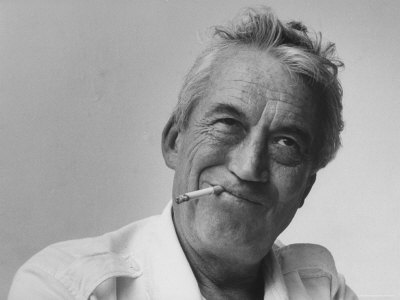


Posted in Books, Fiction, Film, Home Video, TV | 3 Comments

“A Most Wanted Man” & “Double Indemnity” – Top of the Line

A Most Wanted Man-poster3A Most Wanted Man – Sunday, August 3 at AMC Loews Lincoln Square. I love spy stories in films, TV shows, novels & non-fiction, but I’m sure my most immediate reason to see A Most Wanted Man was to watch Philip Seymour Hoffman in the last full performance we’re going to have from this amazing actor. He’s so good in the film, as he always is, that it made me both sad and angry to realize that this is it. I was somewhat startled looking at a list of his films to see all those titles together and realize what a great body of work he’d created by the time of his death at age 46. A partial listing of these films, titles that jumped out at me, include Boogie Nights (1997), The Talented Mr. Ripley (1999), Magnolia (1999), Almost Famous (2000), Capote (2005), Before the Devil Knows You’re Dead (2007), The Savages (2007), Synecdoche, New York (2008), Doubt (2008), The Master (2012), and A Late Quartet (2012). When I think of his a cappella rendition of  “Slow Boat to China” near the end of The Master, or having a cocaine-fueled meltdown in Before the Devil Knows You’re Dead, it makes me crazy to realize we won’t see what he might have done over the next 20 or 30 years.

A Most Wanted Man is the third feature directed by Anton Corbijn and written by Andrew Bovell, based on the John Le Carré novel. Corbijn’s previous features were Control (2007), a profile of Ian Curtis, the lead singer with the band Joy Division who committed suicide at age 23, and The American (2010), with George Clooney as a contract killer in Europe. Corbijn’s controlled, slow-burn approach was a good match for Le Carré. A Most Wanted Man also reminded of what I think is one of the best adaptations of a Le Carré novel, The Spy Who Came in from the Cold (1965).

As Günther Bachman, the head of a covert intelligence operation in Hamburg, Hoffman is rumpled, short-tempered, possibly alcoholic, and totally focused on getting the job done. Hoffman’s performance isn’t at all flashy; but it is just about perfect. The narrative of A Most Wanted Man is set in motion by Issa Karpov (played by Grigoriy Dobrygin), a recently imprisoned and tortured half-Chechen, half-Russian Muslim who has illegally entered Germany. In a post-9/11 world, Hamburg is especially paranoid about the agenda of anyone who fits Issa’s profile. The German government, the CIA (represented by a cold-eyed Robin Wright with a bit of an echo of her steely Claire Underwood on the House of Cards Neflix series), and Bachman’s own organization are all competing to locate Issa and determine the truth of why he is in Hamburg. The film takes its time. The pace is deliberate, but far from boring (unless you need something blowing up every five or ten minutes to hold your interest).

I thought it might bother me that this was another film in which everyone, regardless of nationality, speaks English. But it didn’t distract me at all. There’s something different about Hoffman’s accent in particular. Whatever it is, it works. In a piece in the New York Times this past July 17, John Le Carré describes his visit to the set of A Most Wanted Man and his impressions of Hoffman, at the end of which he talks about Hoffman’s accent in the film. It’s definitely worth reading.

A Most Wanted Man was shown at the Sundance Film Festival on January 17, 2014. Below is an excerpt from a press conference with Hoffman, cast members Willem Dafoe and Rachel McAdams, and director Anton Corbijn following the screening from. I wish the entire press conference was available, but this is very interesting nonetheless. Seeing Philip Seymour Hoffman in this clip and knowing that he died three weeks later on February 2 is a weird kind of disconnect. What an unnecessary loss.

*****************************************************************************************

Double Indemnity (1944) – Monday, August 4 at Film Forum. Director: Billy Wilder. Co-Writers: Wilder and Raymond Chandler. Film Forum wrapped up its terrific “Femmes Noirs” series with a week’s run of this great film, a key early entry in the “classic” noir cycle (Double Indemnity was scheduled to end on August 7, but has been held over through Thursday, August 14, when the equally great The Killing [Stanley Kubrick – 1956] and Gun Crazy [Joseph H. Lewis – 1949] return for a week’s run through August 21. All three are digital restorations and have never looked better).

Double Indemnity-Neff's doorwayDouble Indemnity set the template for many noirs to follow. Wise-cracking insurance salesman Walter Neff (Fred MacMurray) gets involved with Phyllis Dietrichson (Barbara Stanwyck), a bored housewife who uses Neff to help kill her husband and collect the insurance money. As Neff says in his confession to claims adjuster Barton Keyes (Edward G. Robinson), recorded on a Dictaphone in his office as he bleeds out from a gunshot wound, “I killed him for the money, and for a woman. I didn’t get the money… and I didn’t get the woman.” That’s usually how it works out for most noir protagonists.

Here is a clip of the beginning of that confession. This scene begins just a few minutes after the opening credits, so I don’t consider it a spoiler. The rest of the story is told in flashback via Neff’s confession.

The cast is uniformly great. For anyone who grew up seeing Fred MacMurray as the father on the TV series My Three Sons (1960-1972) or in Disney films such as The Absent-Minded Professor (1961) or Son of Flubber (1963), seeing him in something like Double Indemnity can be quite a jolt. He’s perfect, as is Barbara Stanwyck, whose role as the manipulative Phyllis Dietrichson set the bar for femme fatales, and that’s saying something. Edward G. Robinson is terrific as the brilliant claims adjustor Barton Keyes, shrewd, cynical, and a closet softee, with a “little man” inside who alerts him when something is amiss. His final scene with MacMurray is a punch to the heart.

Everything seemed to come together for this film. Much like Casablanca (1942), there was a happy confluence of director, script, and cast. Based on the novel by James M. Cain, Double Indemnity was the third feature directed by Billy Wilder in this country. His began his career as a screenwriter in Germany in 1929. Like many German directors (Fritz Lang, Robert Siodmak, and others), Wilder got out when the Nazi Party began to come to power. He directed his first feature, Mauvaise Graine (1934), in Paris, before moving to Hollywood, where he had his first hit writing the screenplay for Ernst Lubitch’s Ninotchka (1939). After Double Indemnity, Wilder went on to direct such classics as The Lost Weekend (1945), Sunset Blvd. (1950), and Some Like It Hot (1959). Wilder co-wrote Double Indemnity with novelist Raymond Chandler, whose Philip Marlowe came to personify the image of a private eye in the public’s mind. Their working relationship was reportedly rocky, but you can’t argue with the result. Chandler went on to write the screenplay for Alfred Hitchcock’s Strangers on a Train (1951), though he requested that his name be removed when it turned out that virtually nothing of his work remained in the finished film. Hitchcock readily agreed (his relationship with Chandler was apparently even worse than Chandler’s with Wilder), but Warner Bros. refused because they wanted Chandler’s name on the film.

Raymond Chandler & Billy Wilder

Raymond Chandler & Billy Wilder

Another important component of Double Indemnity is Miklos Rozsa’s score. It’s value to the film cannot be over-estimated. The music is heard at its most forceful during the opening credits, creating an inexorable momentum and emotion that drives the story and its characters to what feels like an inevitable conclusion. The theme weaves in and out of the film and never lets go. As Walter and Phyllis repeatedly say to each other to underscore their determination to stick it out together, “Straight down the line.”

I especially like the tag line on the poster below at left: “You can’t kiss away a murder!” That’s a pretty hard-boiled line, befitting the film. I also can’t resist including a couple of great foreign posters for Double Indemnity. This film is available for streaming or rental via Netflix and for streaming or purchase from Amazon. If you haven’t seen it, you should. – Ted Hicks
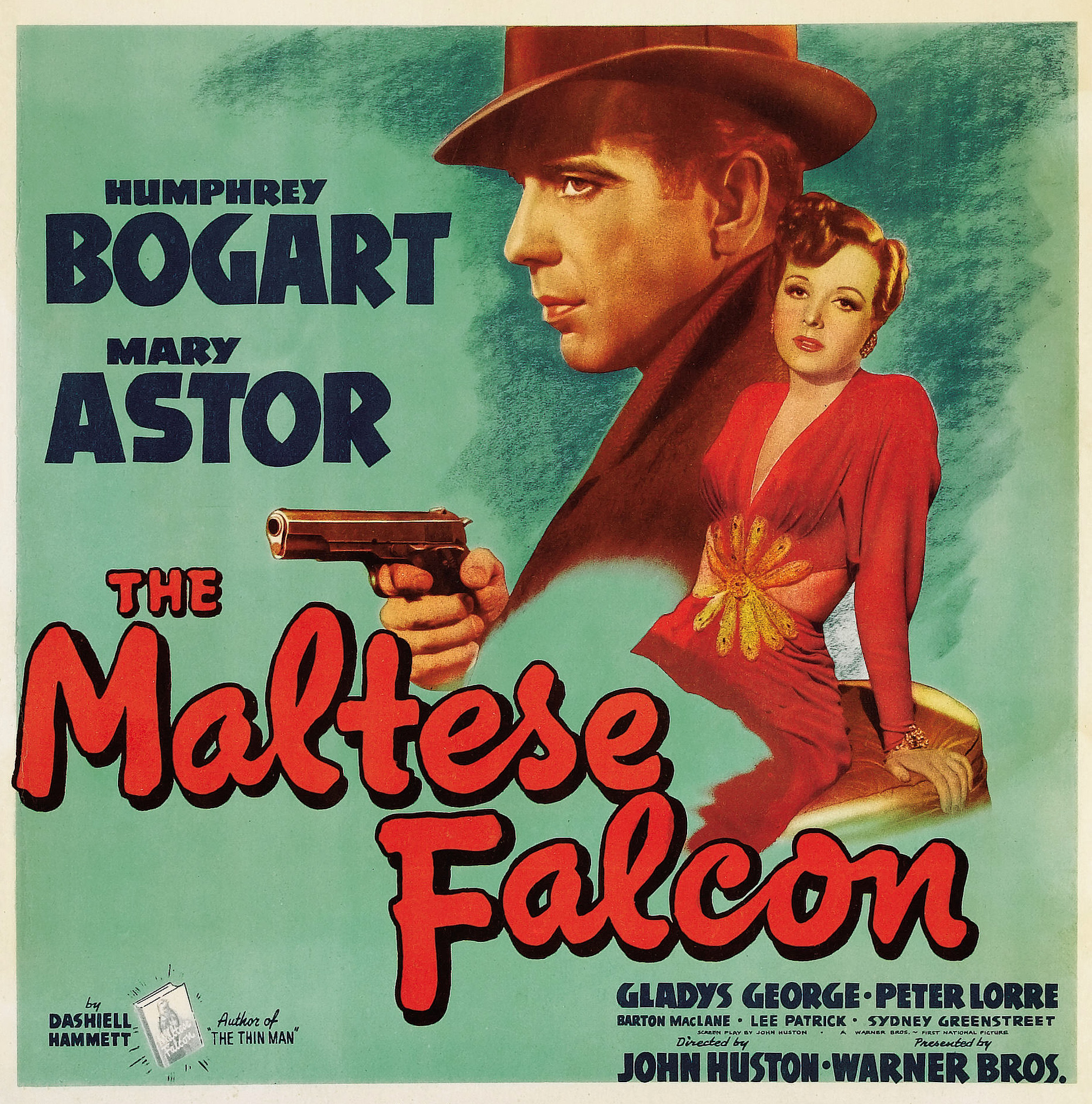
Double Indemnity-poster4Double Indemnity-French poster


Double Indemnity-German poster2*****************************************************************************************

Posted in Books, Fiction, Film, Home Video, TV | 5 Comments