Didn’t happen! But it is the end of the year, so Happy New Year everybody! This was a strong year for films and television. I’ll be posting my picks for 2012 in a day or so. In the meantime, to help ring out the old year (and ring in the new), here’s a clip of Bill Haley & His Comets performing “Rock Around the Clock” on American Bandstand. I remember how much this song rocked my world when I first heard it under the opening credits of Blackboard Jungle in 1955. This was the first feature film to use rock music, and to use it this loud and in your face at the start of a movie about juvenile delinquency really freaked out a lot of people, but not us kids. This felt like a real seismic shift, and it turned out to be just that.
Let’s let Bette Davis take us out (from Cabin in the Cotton – 1932).
No, wait, let’s finish with the great Buster Keaton and the climax from Seven Chances (1925) where he’s chased by rocks and boulders and aspiring brides. It’s such a joy watching Buster run.
As I wrote in my first “Famous Monsters” post last May, “…from an early age, as early as I can remember, I was totally in love with science fiction and horror (monsters!) via all their delivery systems; i.e. books, magazines, comics, TV, and movies. Mainly movies, probably because films are so immediate.” This is true, but I can’t overestimate the importance of books to me at that time, either. Books fed my imagination and kept me going between films. I was in love with the library and the newsstand.
I remember my sixth grade teacher, a pretty young woman I had a crush on, tentatively handing me her own copy of Franz Kafka’s “Metamorphosis” one day after class. She said I might not understand all of it (that’s putting it mildly), but given my interests, she thought I’d find it interesting. Years later I realized there were other layers to the story, but what I understood then was that it was about a guy who changed into a giant bug over night. A monster story! But not the kind I was used to, so it was awhile before I returned to Kafka.
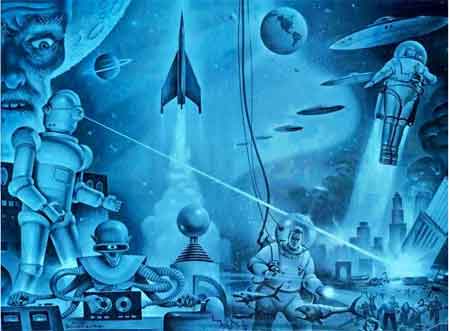
The Winston Science Fiction series, 35 science fiction novels for young readers published by the John C. Winston Company between 1952 and 1961 and written by established names in the field, had a great collective impact on me. I burned through every copy in our home room library during junior high school, around 1957-58. The dust jacket illustrations were especially exciting, 18 of which were created by the superb Alex Schomburg, who also did the endpaper illustration that appeared in every book (seen at the top of this post). I still find it thrilling to see this. Schomberg did cover illustrations for hundreds if science fiction magazines and book jackets during his long career. Here are two examples of his work; at left a detail from the endpapers, and a vivid re-working of that image at right.
Several years ago I satisfied my nostalgia for these books by acquiring a copy of one of my favorite titles in the series, Danger: Dinosaurs!, a story of time travel to the Jurassic period written by Evan Hunter under the pen name Richard Marsten in 1953. I ended up paying $125 for a book that originally cost $2. It was worth it.
I was also reading a lot of science-fiction comic books during the 50s, but remember very few of them. The comics I really wanted to read were those put out by EC: horror, science fiction, crime and war comics, as well as the original Mad. EC’s horror and crime titles especially had a lot of people up in arms, parents and other uptight watchdogs. Here are two examples of what was bending authority figures out of shape.
My dad didn’t want me reading these comics. I can’t imagine why. My mother let me read most anything I wanted. I don’t think she was really paying attention. Remember, this is the woman who let me see The Thing from Another World when I was 6 years old. Pretty cool. My dad usually stayed out of it, but he put his foot down when it came to horror comics. I knew about the EC titles and would see them at news stands, but it wasn’t until years later, when boxed sets of oversize black and white reprints with color covers started appearing in the 1980s, that I was able to fully indulge myself. I ended up buying sets of every title EC had put out through the mid-50s. An example of these slip-cased volumes is at left.
All of this material was filling up my head with crazy, wonderful stuff. I wasn’t aware of film directors then, but I knew the book authors, especially Richard Matheson. He has had a huge impact in the fields of science fiction, horror, and fantasy. Matheson has written novels, short stories, film and television scripts. His work in television alone is astounding. He wrote 16 episoes of The Twilight Zone, including the classic “Nightmare at 20,000 Feet” with William Shatner going bonkers when he sees a demon on the wing. I doubt I’ve ever been on a flight and not thought of that episode, especially if I was seated over a wing. Matheson wrote the short story and script of Duel, the TV movie that helped put Stephen Spielberg on the map. He wrote The Night Stalker for TV, which gave us a hardcore vampire in the modern world, followed by The Night Strangler, which led to the series Kolchak: The Night Stalker. These are just a few examples of his work. Matheson is a giant. His fingerprints are everywhere. I can’t imagine the landscape without him.
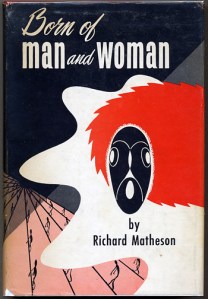
His first short story, “Born of Man and Woman,” was published in 1950 when he was just 23. An auspicious beginning, to say the least, “Born of Man and Woman” is the account of a monster child kept chained in its parent’s cellar, told in the first person in mangled diary entries. It’s a profoundly disturbing story, which I don’t think has dated in the least. I’ve included it at the end of this post, so you can see for yourself.
But it was Matheson’s novel I Am Legend (1954) that really got my attention. I bought a copy in 1957, the edition seen at left, and proceeded to read and re-read it many times. I still have this copy, though it’s falling apart, held together by rubber bands. It wouldn’t survive another reading, but I can’t bring myself to throw it away. The book conveys a genuine sense of dread in its apocalyptic account of a plague of vampires and Robert Neville’s existential efforts to remain alive from one day to the next. Neville narrates the story and we never know more than he does. I Am Legend is matter of fact and quite serious. I recently re-read the book for the first time in years, and despite an over-reliance on exclamation marks, it still works. Matheson also has sex in his writing, especially in his next novel, The Shrinking Man (1956). To a 13-year-old boy in 1957, this was something else again, and definitely new in the horror stories I’d been reading. This, too, got my attention.
I’ve given up any hope that a decent film will ever be made from this novel. The Last Man on Earth (1964), made in Italy with Vincent Price as Robert Neville is the most faithful adaptation to date, despite its deficiencies. This is probably because Matheson, using the pen name Logan Swanson, was a writer on the script. The Omega Man (1971) with Charlton Heston has little to do with the novel, and I Am Legend (2007), the Will Smith version, even less.
Matheson had far better luck with the movie version of The Shrinking Man, which in the fashion of the time was retitled The Incredible Shrinking Man. As if a shrinking man wasn’t incredible enough to begin with. One of a series of very fine science fiction films directed by Jack Arnold, The Incredible Shrinking Man is genuinely tragic, and ends on a spiritual, metaphysical note, rather unusual for a Hollywood film of the 50s. This is emphasized by the music score, which features a haunting trumpet solo by Ray Anthony, also unusual for the genre. The theme music can be heard in the clip below.
Finally, here is Richard Matheson’s first published story, “Born of Man and Woman.” It appeared in The Magazine of Fantasy and Science Fiction in 1950. It became the title of his first short story collection in 1954. – Ted Hicks
“Born of Man and Woman”
X— This day when it had light mother called me a retch. You retch she said. I saw in her eyes the anger. I wonder what it is a retch.
This day it had water falling from upstairs. It fell all around. I saw that. The ground of the back I watched from the little window. The ground it sucked up the water like thirsty lips. It drank too much and it got sick and runny brown. I didn’t like it.
Mother is a pretty thing I know. In my bed place with cold walls around I have a paper things that was behind the furnace. It says on it Screen Stars. I see in the pictures faces like of mother and father. Father says they are pretty. Once he said it.
And also mother he said. Mother so pretty and me decent enough. Look at you he said and didn’t have the nice face. I touched his arm and said it is alright father. He shook and pulled away where I couldn’t reach.
Today mother let me off the chain a little so I could look out the little window. That’s how I saw the water falling from upstairs.
XX — This day it had goldness in the upstairs. As I know when I looked at it my eyes hurt. After I looked at it the cellar is red.
I think this was church. They leave the upstairs. The big machine swallow them and rolls out past and is gone. In the back part is the little mother. She is much small than me. I am big. It is a secret but I have pulled the chain out of the wall. I can see out the little window all I like.
In this day when it got dark I had eat my food and some bugs. I hear laughs upstairs. I like to know why there are laughs for. I took the chain from the wall and wrapped it around me. I walked squish to the stairs. They creak when I walk on them. My legs slip on them because I don’t want on stairs. My feet stick to the wood.
I went up and opened a door. It was a white place. White as white jewels that come from upstairs sometime. I went in and stood quiet. I hear laughing some more. I walk to the sound and look through to the people. More people than I thought was. I thought I should laugh with them.
Mother came out and pushed the door in. It hit me and hurt. I fell back on the smooth floor and the chain made noise. I cried. She made a hissing noise into her and put her hand on her mouth. Her eyes got big.
She looked at me. I heard father call. What fell he called. She said a iron board. Come help pick it up she said. He came and said now is that so heavy you need me. He saw me and grew big. The anger came in his eyes. He hit me. I spilled some of the drip on the floor from one arm. It was not nice. It made ugly green on the floor.
Father told me to go to the cellar. I had to go. The light it hurt now in my eyes. It is not like that in the cellar.
Father tied my legs and arms up. He put me on my bed. Upstairs I heard laughing while I was quiet there looking on a black spider that was swinging down to me. I thought what father said. Oh god he said. And only eight.
XXX – This day father hit in the chain again before it had light. I have to try to pull it out again. He said I was bad to come upstairs. He said never do that again or he would beat me hard. That hurts.
I hurt. I slept the day and rested my head against the cold wall. I thought of the white place upstairs.
XXXX — I got the chain from the wall out. Mother was upstairs. I heard little laughs very high. I looked out the window. I saw all little people like the little mother and little fathers too. They are pretty.
They were making nice noise and jumping around the ground. Their legs was moving hard. They are like mother and father. Mother says all right people look like they do.
One of the little fathers saw me. He pointed at the window. I let go and slid down the wall in the dark. I curled up as they would not see. I heard their talks by the window and foots running. Upstairs there was a door hitting. I heard the little mother call upstairs. I heard heavy steps and I rushed to my bed place. I hit the chain in the wall and lay down on my front.
I heard mother come down. Have you been at the window she said. I heard the anger. Stay away from the window. You have pulled the chain out again.
She took the stick and hit me with it. I didn’t cry. I can’t do that. But the drip ran all over the bed. She saw it and twisted away and made a noise. Oh my god my god she said why have you done this to me? I heard the stick go bounce on the stone floor. She ran upstairs. I slept the day.
XXXXX — This day it had water again. When mother was upstairs I heard the little one come slow down the steps. I hidded myself in the coal bin for mother would have anger if the little mother saw me.
She had a little live thing with her. It walked on the arms and had pointy ears. She said things to it.
It was all right except the live thing smelled me. It ran up the coal and looked down at me. The hairs stood up. In the throat it made an angry noise. I hissed but it jumped on me.
I didn’t want to hurt it. I got fear because it bit harder than the rat does. I hurt and the little mother screamed. I grabbed the live thing tight. It made sounds I never heard. I pushed it all together. It was lumpy and red on the black coal.
I hid there when mother called. I was afraid of the stick. She left. I crept over the coal with the thing. I hid it under my pillow and rested on it. I put the chain in the wall again.
X — This is another times. Father chained me tight. I hurt because he beat me. This time I hit the stick out of his hands and made noise. He went away and his face was white. He ran out of my bed place and locked the door.
I am not so glad. All day it is cold in here. The chain comes slow out of the wall. And I have a bad anger with mother and father. I will show them. I will do what I did that once.
I will screech and laugh loud. I will run on the walls. Last I will hang head down by all my legs and laugh and drip green all over until they are sorry they didn’t be nice to me.
If they try to beat me again I’ll hurt them. I will.
Silver Linings Playbook– Saturday, December 1 at the Crosby Street Hotel screening room. Director/Writer: David O. Russell. Loved it! I was with this film from start to finish. At the risk of overstatement, it felt like there was never a wrong move, never a false step. Silver Linings Playbook is odd and quirky in ways that feel fresh. It’s not your typical romantic comedy, far from it, but it is comic and there is romance. The way it plays out is what makes it special. By the time the end credits started to roll, I felt that it was all of a piece, that everything, the direction, writing, performances, the use of music, all of it, fit together seamlessly.
Bradley Cooper plays Pat Solitano, a teacher in Philadelphia with a bi-polar condition who has spent eight months in a mental health facility. He was sent there as a condition of his plea bargain for a violent incident we learn more about later. As the film begins, Pat is being sprung from treatment by his mother Dolores (Jacki Weaver), who takes him back to the family home. Pat has lost his own home, his job, and his wife Nikki (Brea Bee), who has a restraining order out against him. His father Pat, Sr. (Robert De Niro in a particularly strong performance) is also out of work and running a bookmaking operation in order to earn enough money to start a restaurant.
Invited to dinner by his friend Ronnie (John Ortiz), Pat meets Ronnie’s sister-in-law Tiffany (Jennifer Lawrence), who has problems of her own. A high point of the dinner scene is when Pat and Tiffany start comparing anti-depressant meds they’ve both taken. Cooper and Lawrence have great chemistry together. Their scenes are a real pleasure to watch, largely because of the way they play their characters’ unpredictable behaviors, which threaten to derail things at any given moment. Despite Pat’s constant delusional talk of how he plans to win Nikki back, his developing relationship with Tiffany is at the core of the film.
Pat’s father is a major Philadelphia Eagles fan. His bookmaking operation rises and falls on the team’s wins and losses. Pat, Sr. was banned from the Eagles’ stadium for getting into fist fights with opposing fans. He’s extremely superstitious, more than a little obsessive-compulsive, and convinced that he can’t lose if his son will watch the televised games with him, that this will bring good luck. But by now Pat has reluctantly agreed to train as Tiffany’s partner in an upcoming dance competition, in exchange for Tiffany getting a letter to Nikki. This comes to a head when his father asks Pat to attend an Eagles game he has placed a huge bet on, but which conflicts with Pat’s dance practice. (I won’t go further into the storyline; it’s best to see how it plays out yourself.)
Bradley Cooper is an actor who impresses me more every time I see him. Silver Linings Playbook is his third film released this year, after The Words and the underrated Hit and Run. He was excellent in last year’s Limitless, his first time working with Robert De Niro. In the two Hangover films (2009 & 2011), Cooper was a solid, straight-faced presence, grounding the films in something like reality, in spite of their absurd, outlandish (and quite funny) events. An actor with his looks, which remind me somewhat of Paul Newman, has to be careful not to end up in one clichéd rom-com after another. This seemed to be happening to Matthew McConaughey until he broke the pattern with The Lincoln Lawyer last year, followed in short order by Bernie, Killer Joe, Magic Mike, and The Paperboy. Hopefully Bradley Cooper will continue to make smart choices as well. His performance in Silver Linings Playbook is bringing him a lot of well-deserved attention.
Jennifer Lawrence landed on the map two years ago with her performance in Winter’s Bone, which resulted in an Oscar nomination for Best Actress. With the lead role in The Hunger Games this year she’s shown that she can carry a big-budget film as well as “smaller” films. She’s more than a match for Bradley Cooper in Silver Linings Playbook. It’s hard to imagine anyone else in either of their roles.
All of the performances feel totally right to me. The characters come off as real people. It’s especially gratifying to see De Niro in a more nuanced role than the character he’s played in the Meet the Fokkers films, for example. There are some amazing ensemble scenes in Silver Linings Playbook with half a dozen or more characters all active at once. It’s a tribute to David O. Russell’s talents as a director, as well as the actors, that these scenes work so well. He scored heavily with his previous film, The Fighter (2010), which received Best Supporting Actor & Actress Oscars for Christian Bale and Melissa Leo, as well as nominations for Best Picture, Director, Writing, and Editing. His other films include I Heart Huckabees (2004), Three Kings (1999), and Flirting with Disaster (1996).
Music is also a crucial element in Silver Linings Playbook. David O. Russell wrote in the liner notes to the soundtrack album that the music “is essential to the heart and soul of this film.” When music is well used, as it is here, it doesn’t tell you what to think or feel, but it does make the scenes stronger. The music makes the film better, and the film makes the music better. From Stevie Wonder’s “My Cherie Amour,” the song played at Pat and Nikki’s wedding that sends him into a frenzy whenever he hears it (or imagines he hears it), to the Bob Dylan/Johnny Cash duet on “Girl From the North Country” from Dylan’s “Nashville Skyline” album, to an incredible song, “Always Alright,” by a group I’d not heard of before, Alabama Shakes, which kicked in as the end credits began, and sealed the deal on the feeling that I’d just seen something special.
The Independent Spirit Awards nominations were announced last week. Silver Linings Playbook is up for Best Feature, Director, Screenplay, Female Lead, Male Lead, and Supporting Female. I know we’re about to be buried in an onslaught of nominations by a seemingly endless number of different awards groups, but these Spirit Awards nominations for Silver Linings Playbook make me feel that I’m not delusional for liking this film as much as I do.
The films I’ve referenced here, with the exception of Hit and Run, are currently available from Netflix and/or Amazon. – Ted Hicks
In 1982 Tim Burton had been working as a conceptual artist at Walt Disney Animation Studios for about two years. Samples of his work at the time already reflected a uniqueness, a fairy-tale strangeness. This was recognized by Tom Wilhite, Disney Head of Development, who gave him $60,000 to make Vincent, a 5-minute stop-motion short based on a poem Burton had written in the style of Dr. Seuss, his favorite children’s book author. In fact, he’d originally intended Vincent to be a children’s book.
Burton says he was given the money to make the film under the studio radar as a stop-motion “test.” He worked on Vincent for two months with Disney animator Rich Heinrichs and stop-motion animator Steven Chiodo. Vincent is narrated by Vincent Price, one of Burton’s childhood idols. This was the beginning of a friendship lasting until Price died in 1993. Burton: “We sent Vincent Price the storyboards and asked him to do the narration, and he was incredible… It’s a scary proposition meeting someone who helped you through childhood, who had that effect on you, especially when you’re sending them something that’s showing that impact in a kind of cheesy, children’s book kind of way. But he was so great.”
Shot in black & white in a style reminiscent of German Expressionist films, Vincent concern a boy, Vincent Malloy, who emulates Vincent Price and is obsessed with the works of Edgar Allan Poe. The film alternates between Vincent’s reality as a little boy and his imagined life inside Poe’s tales.
Burton: “They (Disney) wanted it to have a more upbeat ending, but I never saw it as being downbeat in any way. It’s funny, I think it’s more uplifting if things are left to your imagination. I always saw those tacked-on happy endings as psychotic in a way.”
Vincent was shown at film festivals in London, Chicago, and Seattle, winning two awards in Chicago and the Critic’s Prize at the Annecy Film Festival in France. It was released theatrically for two weeks in a single Los Angeles theater with the feature Tex, a teen drama with Matt Dillon, directed by Tim Hunter. Burton says Disney was pleased with the film, but didn’t really know what to do with it.
In 1984, with a much larger budget of nearly $1 million dollars, Burton made Frankenweenie, a 25-minute life-action film inspired by James Whale’s classic Frankenstein (1931), written by Lenny Ripp from a story by Burton (a new Frankenweenie was released earlier this year in an expanded, feature-length stop-motion version in 3D). The “weenie” of Frankenweenie is a snappy bull terrier named Sparky, who gets run over by a car while chasing a ball thrown by his master, young Victor Frankenstein. This breaks Victor’s heart, who manages to bring Sparky back to life, albeit with much stitching and bolts in Sparky’s neck.
The film takes place in Southern California suburbia, much like the setting of one of Burton’s strongest films, Edward Scissorhands (1990). Per Burton, “Growing up watching those horror movies, for some reason, I was able to make direct links, emotionally, between that whole Gothic/Frankenstein/Edgar Allan Poe thing and growing up in suburbia. Frankenweenie was just another outgrowth of that.”
Frankenweenie was initially intended to play with the re-release of Pinocchio, but was shelved by Disney, apparently freaked out that it had received a PG rating instead of a G rating. It received a limited release in England, and was made available on video prior to the release of Burton’s Batman Returns in 1992.
I was aware of Frankenweenie, had probably read about it in a film magazine, but don’t recall when or where I first saw it, though I remember liking it a lot. I was looking forward to the longer feature version this year, but was disappointed when I finally saw it. The new film is incredibly well made, filled with very clever detail, and fun to look at, but there’s something lacking for me. I’m not sure why I didn’t like it more, but it just didn’t capture my imagination the way my favorite Burton films have, such as Pee Wee’s Big Adventure, Beetlejuice, Edward Scissorhands, and Ed Wood.
Here are Vincent and the original live-action Frankenweenie together.
To give you some contrast, here’s a trailer for the new feature-length, stop-motion Frankenweenie.
I feel a strong connection to Tim Burton’s way of seeing the world. His love of horror and science-fiction films when he was growing up matches my own from the earliest age I can remember. His films reflect a childlike spirit, wonderfully twisted at times and refreshingly morbid (Corpse Bride, anyone?). Even the films that don’t work have moments of unique strangeness and originality that make them worth seeing. He definitely got my attention with his first feature, Pee Wee’s Big Adventure (1985), which seemed quite magical to me. Burton’s sensibility was perfectly matched with that of Paul Reubens, aka Pee Wee Herman. It’s hard to imagine two people more attuned to each other.
From November 2009 to April 2010, the Museum of Modern Art in New York City held a retrospective of Tim Burton’s work, including early illustrations, paintings, artifacts, bizarre props, as well as screenings of his films. This show was incredibly popular, drawing the third-highest attendence of any exhibition in MoMA’s history. Nonetheless, I managed to miss it, despite repeated plans to go. Here’s an interview done with Burton at the time, which includes examples of his amazing drawings.
Finally, in the spirit of name dropping, here’s my Tim Burton story. In 1999 I was working for a subtitling company here in the city. The wife of a co-worker was reviewing films for a radio show in Pennsylvania. She asked me to attend a pre-release screening of Burton’s new film, Sleepy Hollow, and cover for her at a press junket that Sunday morning at a hotel on Park Avenue, recording the Q&A with Burton and the cast. I was thrilled to do this, though fearful I’d somehow screw up the recording (I didn’t). The way these things work is that there are different rooms set up for the various media; i.e. television, print, radio, and whatever else. Burton and the cast would go from room to room one at a time to sit at the head of a table and be asked basically the same questions they’d just been asked in the previous room. It was quite exciting to be seated two chairs away from Christina Ricci (porcelain skin!), Johnny Depp, Michel Gambon, and finally Tim Burton. I hadn’t intended to say anything, but couldn’t keep my mouth shut and asked a few questions. I remember asking Burton what it was like for him having the Hammer Films star, Christopher Lee (Dracula himself) in the film. Unfortunately, I remember my question, but not his answer. Okay, maybe not that great a story, but it was a thrill to be part of a different world for even a couple of hours. – Ted Hicks
The quotes I’ve used are from a very informative book of Tim Burton interviews, Burton on Burton, edited by Mark Salisbury, with a foreward by frequent Burton collaborator, Johnny Depp. The 2nd revised edition, published in 2006 by Faber & Faber, covers Burton’s films through Corpse Bride. His films are available via Netflix and Amazon.
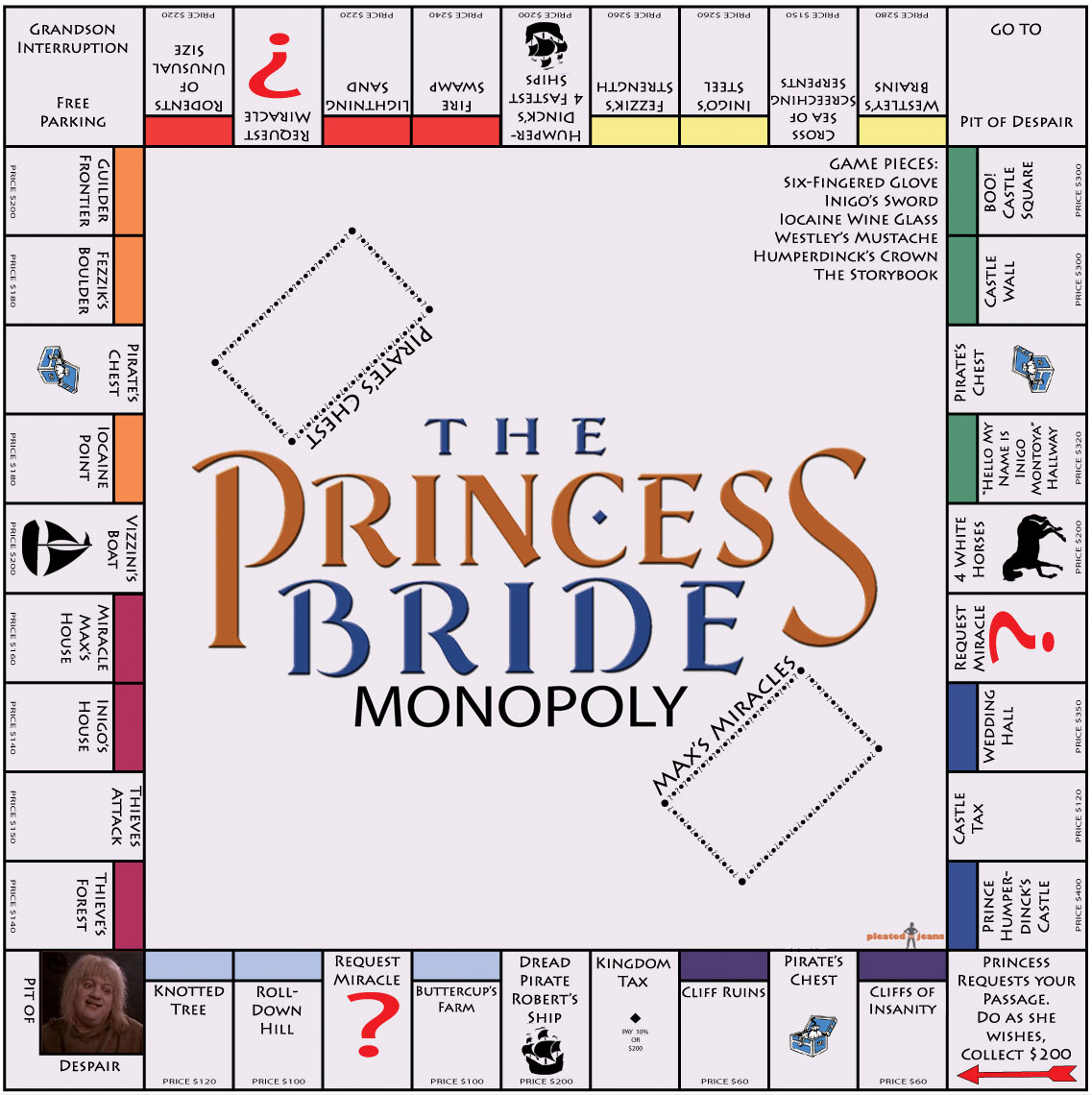
One of the great pleasures of this year’s New York Film Festival was a special showing of The Princess Bride (1987). The film has developed a strong following in the 25 years since its initial release, though I didn’t realize just how strong until seeing it in a sold-out auditorium filled with fans who clearly love the film, anticipating all the great scenes and dialogue. The Wizard of Oz (1939) was invoked several times during the introduction and discussion that followed. My first reaction was that Oz is an established classic, but is The Princess Bride on the same level? It continues to connect in a very real way with successive generations of filmgoers since its release, so maybe it is. There’s even a special edition of Monopoly keyed to the film. What more proof do we need?
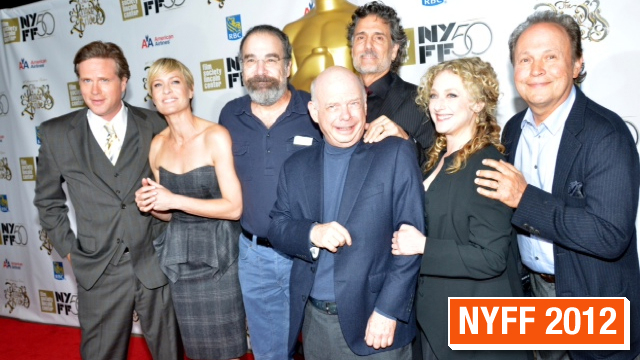
The NYFF screening was especially exciting because director Rob Reiner, writer William Goldman (author of both novel and screenplay), and most of the cast, including Billy Crystal, Carol Kane, Robin Wright, Cary Elwes, Mandy Patinkin, Wallace Shawn, and Chris Sarandon were introduced onstage before the film and returned for a lengthy discussion after.
I was surprised by the rush I felt in seeing all these people together onstage, after just seeing The Princess Bride for only the second time since 1987. Part of that was seeing all this star power breathing the same air as I was. But it was also because I realized I really loved the movie, and here were the people who had made it. Plus they were incredibly entertaining as they reminisced, especially Billy Crystal, no surprise there.
I’d forgotten much of the film, but the scene that had stayed with me all these years was of Mandy Patinkin’s character, Inigo Montoya, finally avenging the murder of his father by the six-fingered man (Christopher Guest). It’s simply thrilling, and quite emotional.
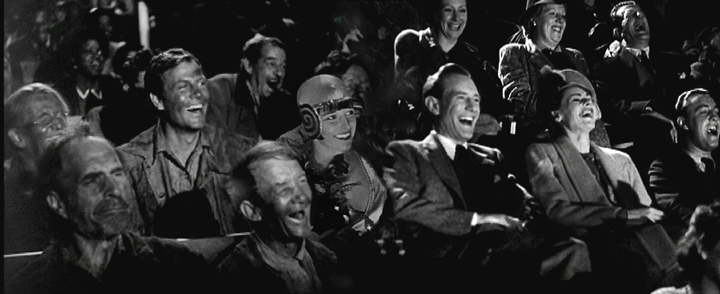
You could really feel the anticipation and enthusiasm in the air before, during, and after this showing. It got me thinking about the shared experience of seeing movies with an audience in a movie theater, and how that is markedly different from watching films at home on DVD or a computer. I had a dramatic example of this a few years ago when I first saw Little Miss Sunshine (2006) in a small screening room with only three or four other people. When the film was over I remember thinking that it was okay, but nothing special. A month or so later I saw it with my wife in a crowded theater at a local multiplex. This time I thought it was great! Same movie, so what had changed? I’d been swept along with the reaction of an audience that was totally tuned into this quirky comedy, and laughed a lot. Laughter is contagious, almost impossible to resist. But now I was seeing Little Miss Sunshine in a different way than I had before. Comedies especially benefit from being seen with an audience.
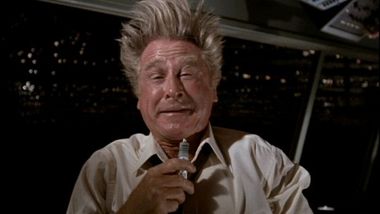
In 2010 we attended a 30th anniversary screening at the Walter Reade Theater of Airplane! (1980), one of the most gloriously demented films ever made. No one is likely to compare Airplane! to The Wizard of Oz, except for the loyalty they both inspire in their audiences. It’s the same with Young Frankenstein. My wife and I frequently toss quotes back and forth from that film. (“Put. The. Candle. Back!”) Airplane! had a packed house, an audience totally familiar with the film from start to finish. I was quite happy and rather amazed to find that the film totally worked 30 years later. It was just as funny now as it had been when I first saw it. The audience reaction convinced me of that. Airplane comes from the school of throw everything at the wall and see what sticks. A surprising amount of it does.
Conversely, it’s interesting to see a really bad movie with an audience that seems to feel the same way as you do about it. A prime example of this is when I saw Brian De Palma’s Mission to Mars (2000). It’s hard to convey how stunningly bad this film is. De Palma is a director I usually don’t care for. But I’ve loved science fiction in all forms since I was a young boy, so I was interested in this. Mission to Mars had a big budget and a good cast (Tim Robbins, Don Cheadle, Gary Sinise). I don’t remember much about it, except the certainty, perhaps delusional, that the entire audience was seeing it as I was. Mission to Mars was dying before our eyes, sucking the air out of the theater, leaving a bad smell. You could feel the audience discomfort. I imagined we were all embarrassed for having had to witness this. Except, of course, that we chose to. If it was that bad, why did I stay? It’s hard for me to leave a movie before it’s over, no matter how bad. It feels like I’ve somehow failed if I don’t go all the way with it. And if I didn’t leave Mission to Mars or something like EatPray Love, I’ll obviously stay for anything.
Sometimes you can be with the wrong audience. Earlier this year I saw a violent action film, The Raid: Redemption (2011) at the Museum of Modern Art as part of the annual New Directors/New Films series. The Raid concerns an elite police squad trapped in a rundown apartment building controlled by a local mob boss in Jakarta. They have to fight their way out against overwhelming odds by any means necessary. This involves extreme violence, each encounter more inventive and outlandish than the last. I like films like this when they’re well done, and The Raid definitely had my attention at the outset. But then the audience reaction to the violence began to get in the way. They were laughing hysterically in a way that made me very uncomfortable, as though every bit of violence was a punchline. I also felt a disconnect because of the venue, MoMA, where you expect to find “serious” filmgoers. This has happened to me once or twice before, where the audience reaction makes me examine my relationship to what’s up there on the screen. I usually stop before I reach any conclusions, because I really don’t want to give up seeing these kinds of films. I didn’t want to see myself as part of that crowd in any way, yet there I was. This was a case where I would have been much better off seeing The Raid by myself. Being with this audience worked against me.
The viewing experience is changing, and has been for some time. Computers and iPhones are now viable delivery systems. I never thought I’d be willing to watch a movie or TV show on a computer screen, but I can do it, and quite easily, as it turns out. Though my preferred way to see a movie will probably always be in a theater with other people (as long as they don’t talk, or text, or otherwise get between me and the screen).
There will always be movies (I hope). There will just be different ways of experiencing them. Are we missing something by watching a movie on a tiny screen rather than seeing it in a theater? I think so, but since there are so many more venues now, maybe films will be seen that might otherwise would not get distribution. That said, I hope that no one’s first experience of Lawrence of Arabia or 2001 or Apocalypse Now is on an iPhone screen. In any event, movie theaters aren’t going away anytime soon, and people are still attending. Last weekend I saw Skyfall on Friday and Lincoln the next day at the AMC Loews Lincoln Square, a 13-screen multiplex on Broadway near Lincoln Center. The theater was jammed with people. And this was for matinee showings. There’s just something about being with an audience in a theater when the lights go down and the movie starts. At this point, I sometimes say to my wife, “See you later.” I’m by myself with the film, but also with the audience. Nothing can replace it (until it does).
Here’s a great clip from Sullivan’s Travels (1942). I think it illustrates everything I’ve been talking about here. – Ted Hicks
Wreck-It Ralph– Friday, November 2 at AMC Loews Lincoln Square. Director: Rich Moore. Writers: Jennifer Lee & Phil Johnston. This terrific feature from Walt Disney Animation Studios is easily my favorite animated film so far this year. I saw it at a mid-morning showing on opening day that was packed, mostly with kids. This many kids in an audience usually makes me apprehensive. It reminds me of Saturday matinees when I was growing up, which were usually pretty chaotic, lots of chatter and running around. Even then I mainly just wanted to watch the movie (nerd alert!). But soon after Wreck-It Ralph began there was barely a peep. Everyone seemed transfixed, young and old alike. A sure sign that a film is really working is when it completely captures the attention of the audience.
I was disappointed to varying degrees earlier this year with Paranorman, Frankenweenie, Hotel Transylvania, and Brave. Wreck-It Ralph is a much stronger film. All of its pieces fit together in a thoroughly enjoyable way. Like most of the best animated films, there’s a sense of wonder, of discovery, inventiveness, and emotional content that feels real. Animated films that do this for me include The Iron Giant (1999 – greatly underrated), Spirited Away (2001), The Incredibles (2004), WALL-E (2008), Up (2009), How to Train Your Dragon (2010), Toy Story 3 (2010), and almost anything from Aardman Animations, going back to Creature Comforts and the thoroughly bonkers Wallace & Gromit shorts.
Here’s a trailer for Wreck-It Ralph. It’s an international version, which is a bit different from others I’ve seen. It conveys a good sense of the film.
Ralph is the antagonist in a video game called “Fixit-Felix, Jr.”, one of many games in an arcade. The premise is that, as with the characters in the Toy Story films who come to life when humans aren’t around, the characters in these games all have lives in a cyberspace reality inside the games. Ralph is a classic outsider, tired of his “bad guy” status and the isolation he feels because of that. Wreck-It Ralph tells the story of his struggle to become a “hero” in his world, to find acceptance. Along the way he meets his counterpart, another outsider named Venelope von Schweetz, who lives in a game called “Sugar Rush.” Here’s a clip of their first meeting.
Ralph is voiced by John C. Reilly and Vanelope by Sarah Silverman. They both bring a lot to the party, creating an emotional reality that goes a long way in helping us become invested in their characters. Here’s a clip of Sarah Silverman talking about her character.
Fixit-Felix, Jr., the hero of his game, is voiced by Jack McBrayer, best known for his role as Kenneth on the Tina Fey TV seriee 30 Rock. Sergeant Tamora Jean Calhoun, the lead character in a high-tech military/sci-fi game called “Hero’s Duty,” who reluctantly joins Ralph in his quest, is voiced by Jane Lynch. I was a bit put off by her the few times I’ve watched Glee, but she’s perfect here.
The bottom line is that Wreck-It Ralph is an incredibly engaging, clever and inventive film from start to finish. It made me feel really good. You won’t be bored.
As a bonus, there’s a really great 7-minute black & white animated short called Paper Man that plays before Wreck-It Ralph. A young man, an office worker buried in paperwork, chances to meet a pretty young woman on a subway platform, who boards a train and leaves before he can say anything. The rest of the short concerns his efforts to get her attention with paper airplanes after he sees her through an open window in a office across the street from where he works. I tried to find a clip, but had no luck. Here’s a still I found which conveys the look of this wonderful, touching little film.
The Bay– Friday, November 2 at the Elinor Bunin Munroe Film Center. Director: Barry Levinson. Writer: Michael Wallach. This is a very effective little horror film, or eco-horror, to be more precise, as it concerns parasitic isopods mutated by various toxic spills in Chesapeake Bay that terrorize a small, ocean-front community by eating their way of their victims after they’ve infected them. This takes place over the course of a Fourth of July celebration filled with tourists, more fresh meat for these ghastly crustaceans sporting seven pairs of leg. Pretty grim, and they actually exist. The Bay has antecedents in sci-films of the 50s such as Them! (giant ants!), Tarantula (giant spider!), and many others. Atom bomb testing was frequently the culprit in those films. The Bay updates the scenario with environmental issues and the fear of viral contagion. It’s also yet another film presented as a patched-together documentary in the currently trendy “found footage” style. I guess we have the success of The Blair Witch Project to thank (or blame) for this trend. This can be a lazy way to tell a story, and it usually turns me off before I even see the film. But I have to say, it works very well here, just as it did in Chronicle earlier this year. Like any tool, it all depends how you use it.
One of the most interesting aspects of The Bay is that it was made by Barry Levinson, an Academy Award winning director. He kicked off his career most famously with Diner in 1982, followed by The Natural (1984), Good Morning, Vietnam (1987), Rain Man (1988), and recently You Don’t Know Jack (2010), an HBO movie with Al Pacino as Jack Kervorkian. These are just a few of his films. The point is, he’s a very good director and these are very good films, but most of them mainstream studio productions. That he would make a film like The Bay seems almost an anomaly (or maybe a mid-life crisis). Whatever the reason, it’s rather exciting that old-school directors are willing to tackle edgy material in new ways. William Friedkin (The Exorcist, The French Connection) certainly did this with Bug in 2006, a corrosive, truly disturbing psychological horror film with Ashley Judd and the always fascinating Michael Shannon, tightly wound and freaked out as only he can be. Friedkin was less successful with Killer Joe earlier this year, adapted from a play by Tracy Letts (as was Bug), but you certainly can’t say he’s taking the easy out at this stage of his career. It’s like Levinson and Friedkin are reinventing themselves for a new marketplace, and producing some very interesting stuff in the process.
This film may not be everyone’s taste (and would be pretty uninteresting if it was), but if you like this kind of thing, which I definitely do, it’s pretty good. The Bay can be streamed from Amazon Instant Video for $3.99. Bug, which I strongly recommend, is also available via Amazon Instant Video for $1.99 and Netflix streaming or DVD.
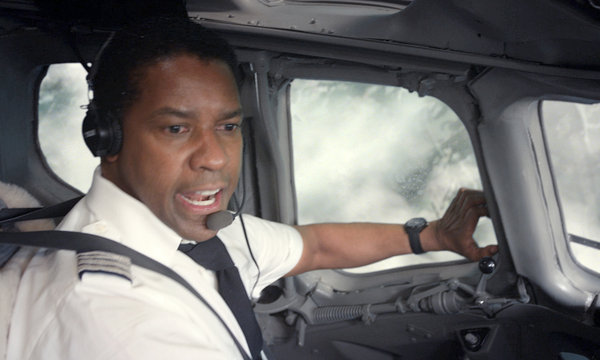
Flight – Saturday, November 3 at AMC Loews Lincoln Square. Director: Robert Zemeckis. Writer: John Gatins. This is a very strong film about addiction and powerlessness. Lest that put you off, it’s also a gripping story, a kind of thriller, with a great performance by Denzel Washingtonand a return to live-action filmmaking by Robert Zemeckis (Forrest Gump, Cast Away). Flight had my complete attention from beginning to end.
Washington plays Whip Whitaker, an alcoholic commercial airline pilot who successfully crash lands a damaged aircraft with only 6 fatalities (4 passengers and 2 crew members) out of 104 passengers (or “souls,” as they’re referred to by a flight attendant when she reports “104 souls on board” at the beginning of the flight). This sequence, which we return to several times over the course of the film, is extremely harrowing, at least as frightening as the plane crashes in Zemeckis’ Cast Away (2000) and Peter Weir’s Fearless (1993). Whip is initially hailed as a hero for managing the seemingly impossible feat of bringing this plane down without killing everyone on board. But the audience already knows that he was boozing the night before with one of the flight attendants and snorted coke just to get on his feet in time for his 9:00am flight. His hero status suddenly changes, and Whip finds out with a jolt that he’s now the subject of an investigation to determine if he was drunk during the flight, which could send him to prison. Whip’s adamant denial of his alcoholism, to himself and others, and how this plays out, forms the crux of the film.
Denzel Washington’s performance is the backbone of the film, but all the performances are strong. These include Bruce Greenwood as the airline union rep who has been friends with Whip for years; Don Cheadle as his lawyer; Kelly Reilly (a new face to me) as a recovering addict Whip becomes involved with; Melissa Leo as the lead NTSB investigator; and John Goodman as Whip’s drug supplier. Goodman’s performance may be a little over the top, blustery and out-sized, but it fits the character. He’s very effective and entertaining in his two scenes.
A performance that deserves special mention is that of James Badge Dale in a single scene as a cancer patient Whip encounters during his stay in the hospital after the crash. It’s night, and Whip has gone to a stairwell to smoke a cigarette. This is where he first meets Kelly Reilly’s character, Nicole, who’s also there for a smoke. They’re joined by Dale’s character (“Gaunt Young Man” in the credits), a very outgoing and engaging guy who apparently hasn’t got long to live. This struck me as a key scene in the film, though I don’t quite know how to say why that is. It just felt like it. In a very funny spiel, Dale talks about death and the preciousness of life. You sense it’s bravado, but there’s something so appealing and life-affirming about this kid who’s going to die that it’s rather heartbreaking. James Badge Dale has been good in everything I’ve seen him in (24, The Pacific, and the grossly underrated Rubicon, all on TV), but he really scores in this one scene.
The music track also deserves mention. Some might think the song choices (which include “Feelin’ Alright”/Joe Cocker, “With a Little Help from My Friends”/Beatles, “Ain’t No Sunshine”/Bill Withers, and “Gimme Shelter”/Rolling Stones) are a bit too obvious for the scenes they accompany, but for the most part I think they work. And besides, they’re all really great songs. I especially liked the use of “Gimme Shelter” and the Cowboy Junkies’ cover of “Sweet Jane”. The instance that rather calls attention to itself is having the Stones’ “Sympathy for the Devil” introduce John Goodman not once, but twice. It’s like, okay, we get it. But I wasn’t bothered all that much.
Everything pays off, is delivered in full, during the climactic NTSB hearing near the end of Flight. Sometimes there’s a scene, a moment in a film, that’s almost overwhelming, that makes me feel like the distance between myself and the screen has collapsed. In that moment I’m completely vulnerable to what the film is giving out. This scene, and the next two that close the film, really laid me out, which felt great. This might be a great film. Time will tell on that score, but for now Flight is one of the best films I’ve seen this year, and that’s good enough for me. – Ted Hicks
Beauty IsEmbarrassing – Saturday, September 8 at the IFC Center. Directed by Neil Berkeley. This is great! Do I mean it’s “great” like Citizen Kane or Children of Paradise? No, of course not, but I know I loved it. It made me feel good. I was moved and surprised, and I had a smile on my face almost from the start. I think that’s pretty great. Beauty Is Embarrassing is a new documentary about the life and career (which are basically one and the same) of Wayne White – artist, puppeteer, sculptor, performer, painter, and a very funny guy. I’d not heard of him before, but he was a three-time Emmy winner for his work on Pee Wee’s Playhouse, which I’d watched religiously in the 80s. His cartoons and illustrations also appeared in The New York Times, The Village Voice, and Raw. I’ve still got nearly all the issues of Raw, so I’d been exposed to his work without knowing who he was.
I’m so enthusiastic about this film that I want to get word out now. I’m going to bang this post out as fast as possible, more of a newsflash than a review. Here’s the trailer, which I think gives a good sense of the film:
Wayne White grew up in Chattanooga, Tenn., where, according to his mother, he began drawing at a very, very young age. He moved to New York City in 1981 to try his hand at cartooning and puppetry. He eventually became heavily involved in Pee Wee’s Playhouse, and when Paul Reubens moved the show to Los Angeles, White went with it.
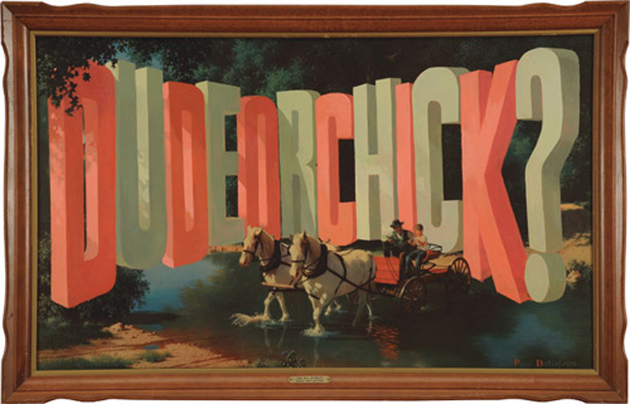
He eventually got involved in painting, but with a somewhat different approach. Wayne White buys generic landscape paintings from thrift shops, then works 3D-style words and phrases into the picture. Here’s one of them. In the film you see a lot more of this, how he does it, and in the process overcame the established art world’s stuffy resistance to art that could be fun and make people laugh.
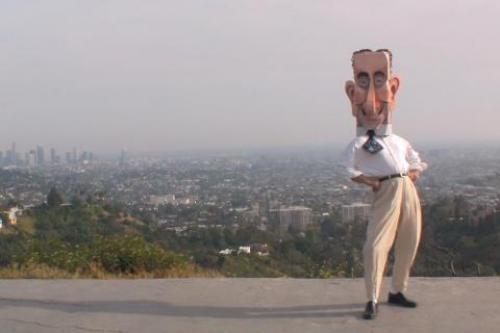
Wayne’s wife, Mimi Pond, is a successful graphic artist (as well as writing the very first Simpsons episode in 1981, “Simpsons Roasting on an Open Fire”). They have a son and daughter who have artistic aspirations of their own. One of the greatest things in the film is watching White and his son construct a large (about a yard in height) Lyndon Baines Johnson puppet head, and then seeing White wearing the head and dancing on a hill overlooking downtown Los Angeles in the distance. There’s something so free, joyous, and ridiculous about this, that at this point I absolutely fell in love with Wayne and the film itself.
Here’s something more about Wayne and his work. Some of these shots are in the trailer, but this goes a little further.
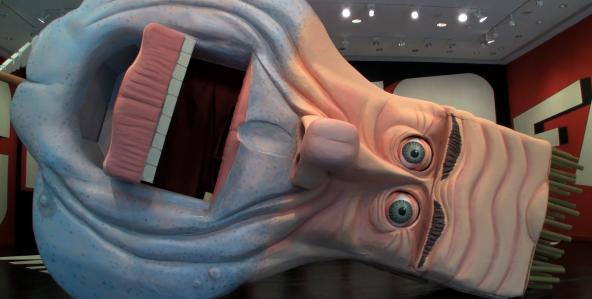
Finally, here’s a photo of a really big head of George Jones that Wayne installed in a gallery at Rice University in Houston, Texas in 2009. Like so much of the incredible stuff Wayne White comes up with, seeing this makes me feel like a little kid confronted with something magical and wonderful.
Wayne White comes across as thoughtful, self-deprecating, very self-aware, and extremely entertaining to listen to. Here are some things he said that really got my attention:
“Humor is the most important thing we have.”
“Art can be fun. It can be a big part of your life that never ends.”
“Do what you love. It’s gonna lead to where you want to go.”
By now you probably get the idea that I like this film. This is a very well-made documentary. It reminds me of others I’ve especially liked that are almost invisibly constructed around strong, charismatic people. Beauty Is Embarrassing is scheduled to run at the IFC Center here in New York City only through September 13th. I don’t know what kind of distribution is planned for the film elsewhere, though it’s not likely to be in multiplexes. Just try to see it if you can, even if you have to wait for DVD. I guarantee you’ll like it. – Ted Hicks
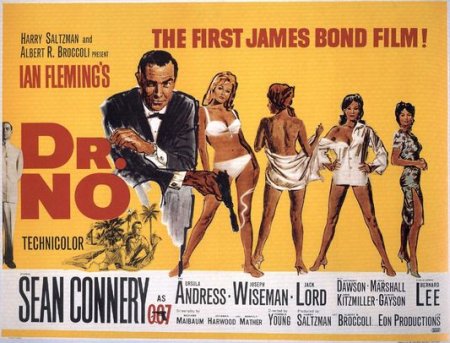
It’s hard to believe that it’s been 50 years since Dr. No, the first James Bond film, was released. How is that possible? Am I that old? Then again, it feels like Bond has always been on the scene, part of the pop culture landscape. Ian Fleming’s first Bond novel, Casino Royale, was published in 1953, but the series got a big boost in this country in 1961 when President Kennedy said in “Life Magazine” that From Russia with Love was one of his ten favorite books. The movie versions took off, and were hugely influential, though they quickly became formulaic and over the top. Dr. No’s popularity and financial success created its own genre and unleashed a flood of Cold War spy films and TV shows in the 1960s.
The IFC Center in NYC just finished a week of showing all seven of the Sean Connery Bond films, including the “unofficial” Never Say Never Again (1983), which is basically a remake of Thunderball (1965). For many of us, I think, Connery is the best Bond, our favorite Bond. And not just because he was the first. That’s definitely a factor, but more importantly, Sean Connery really nailed the role. All subsequent Bonds have been versions of Connery’s. I never much liked the Roger Moore films, with the exception of For Your Eyes Only (1981), which seemed less jokey and more serious, grounded in a somewhat believable reality. Timothy Dalton brought intensity and brutality to the role, but was probably too dour a presence for wide acceptance, and only lasted two films. Like many, I felt that Pierce Brosnan was the “best Bond since Connery,” but only liked the first of his four Bonds, Goldeneye (1995). And with Daniel Craig, Bond has been effectively reinvented for the new millennium. Casino Royale (2006) is tough and gritty, with a physicality that has some heft to it. But I felt badly let down by the follow up, Quantum of Solace (2008), though I still like Craig in the role. The truth of it is, I can recall very little from the later films, while many scenes from the first three are still very vivid for me. For me, Bond will always belong to Sean Connery.
(Trivia footnote: Sean Connery was not actually the first actor to portray James Bond. Barry Nelson played Bond in an adaptation of Casino Royale, broadcast live in 1954 on the CBS television series “Climax!”, which recast Bond as an American [!] intelligence agent, and co-starred Peter Lorre as the villain, Le Chiffre. Nelson apparently made little impression as “Jimmy” Bond, as he was called in this version. Somehow “Jimmy” doesn’t work.)
I saw the first three films last weekend. I had intended on seeing them all together, a back-to-back triple feature, just to see what that would be like. But while the spirit was willing, the flesh, as they say, was weak. So I settled for a double-feature on Friday, and the third film the next day. And here they are.
Dr. No (1962) Director: Terence Young. I remember seeing this twice in the space of a week in the summer of 1963 at a small theater in Iowa, so something about it obviously got my attention. As far as I know, there hadn’t been many secret agent/spy movies before Dr. No, and certainly none like this, with a chain-smoking protagonist who enjoyed booze, women, casinos, fast cars, beating the crap out of bad guys, and to top it off, had a license to kill. There’s a scene in Dr. No where Bond executes a man who has come to kill him. It’s very cold-blooded and matter of fact. I doubt that Bond’s pulse rate increases a single beat. I also don’t remember Bond ever being quite this ruthless in the subsequent films (though he seems just as tough in From Russia with Love). What got my attention was when he fires a second slug into the guy, who seems quite dead already. Here’s a clip of the scene. The sound is low, but it was the best one I could find.
And who can forget (at least if you were a teenage boy) the first sight of Ursula Andress as she emerged from the sea, like a goddess. Her bikini caused a serious increase in the sale of two-piece swimwear, though I’ve always thought there was something odd about the wide belt that held her knife sheath. Maybe it was the buckle, I don’t know.
Many of the elements that became regular features, catch phrases, in the subsequent films were introduced here. For example, Bond’s way with those came to be called “Bond girls” is established almost immediately; a supremely self-confident, wise-cracking command of women, most of whom are beautiful, some deadly and trying to kill him, but almost all sooner or later susceptible to his somewhat thuggish, heavy-lidded charms. These were definitely pre-feminism years. We see for the first time Bond’s flirty banter with Miss Moneypenny when he comes to M’s office to get his new assignment, which is repeated in nearly all the films. His relationship with M is also established, that of an errant schoolboy always in danger of being dressed down by the headmaster. Desmond Llewelyn as “Q,” the head of Q Branch, doesn’t appear until the second film, but his sarcastic disapproval of Bond was a fixture from then on.
Of course, one of the most iconic trademarks of the series occurs in Dr. No when we first see Bond in the casino and he delivers the line, “Bond… James Bond,” which cues the “James Bond Theme” to rise in the background. This line, endlessly quoted and parodied, was voted the “best-loved one-liner in cinema” by British filmgoers in 2001. And in 2005, it was picked as the 22nd greatest quote in film history by the American Film Institute. Something I hadn’t picked up on before, until seeing it noted in a Wikipedia entry on Dr. No, is that Bond actually seems to be mimicking the woman across from him at the baccarat table, who introduces herself as “Trench… Sylvia Trench.” But Connery saying it had a terrific impact in the film. It sounded great, and was used thereafter by all the Bonds. Here’s a compilation of the Bond actors saying the line. This gets old fast, but it’s nonetheless interesting to see the differences.
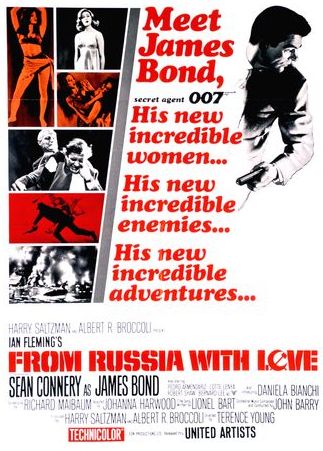
From Russia with Love (1963) Directed by Terence Young. This is the one. Many people consider this to be the best Bond film, and I’m inclined to agree. After From Russia with Love the films began to get bigger and jokier, more outlandishly spectacular. The story takes place in something like the real world, and is somewhat more believable. Ken Adams’ sets are starting to get bigger, but nothing like the incredible spaces they’ll be in later films. The nominal mastermind behind a plot to steal a Russian decoder device for SPECTRE is referred to only as “Number One” (he’s Blofeld in later films). His face is never seen in the early films, though we do see him slowly stroking a large, long-haired white cat that sits smugly in his lap. He’s not larger than life in the way that Auric Goldfinger is in the next film, but Lotte Lenya as Rosa Klebb, and especially Robert Shaw as the assassin Red Grant, more than make up for that. When you consider Lotte Lenya’s background as a well-known stage and film actress in Germany during the 1920s, often in Brecht-Weill plays (she was married to Kurt Weill – twice!), her appearance in a James Bond film seems almost surreal.
My most vivid memory from this film has to be Bond’s fight to the death with Red Grant in a cramped train compartment. This wasn’t the first time I’d seen Robert Shaw, though it felt like it (I’d forgotten until recently when I looked up his credits that he’d been in a 1956-57 British TV series called The Buccaneers, which I watched as a kid). He doesn’t say a word in From Russia with Love until he meets Bond on the train. I remember being jolted by his voice, which didn’t sound right for the lethal figure we’d followed through the film. But the fight itself was amazing. We know Bond will survive, because he has to, but this fight really takes him to the edge. There may not have been anything quite like it in movies before, nothing this brutal and claustrophobic. It still packs a punch.
Goldfinger (1964) Director: Guy Hamilton. This is the Bond film that really sets the tone and style for the ones that followed. In the pre-credit sequence, Bond emerges from the water of a marina in frogman gear with a prop seagull attached to the top of his head as “camouflage.” After attaching explosives to something that needs blowing up, he unzips his wet suit to reveal that he’d been wearing a white dinner jacket and evening wear underneath, ready to go to the nightclub next door to check out the ladies and light a cigarette. This can only be taken as a joke. With Goldfinger, overt humor and satire become frequent features.
Goldfinger has a killer theme song, though, maybe the best of all the Bonds, and a great score throughout. The main title sequence is also one of the best, incorporating many images from the film itself, which creates a sense of expectation for what’s to follow.
Though From Russia with Love is, for me, a much better film, I’d bet that Goldfinger is the one that comes most immediately to mind when people think of Sean Connery and the Bond films. As portrayed by Gert Fröbe, Auric Goldfinger is one of the stronger Bond villains, a powerful, threatening presence, down to his gold-plated pistol. Yet also someone who cheats at cards to make sure he wins. Memorable scenes and images from the film include Goldfinger’s Korean bodyguard, Oddjob, his deadly bowler hat, and the way he rattles Bond by crushing a golf ball to dust in his bare hand; Shirley Eaton covered in gold paint, dead on the bed, one of the most iconic images from any Bond film; the introduction of Honor Blackman’s character, Pussy Galore, and wondering how they got away with that. But perhaps the scene that comes most to mind is Bond captured by Goldfinger, strapped spread-eagle to a metal table with a laser beam burning its way through the table toward his crotch, capped by one of the greatest Bond dialogue exchanges. Bond: “Do you expect me to talk?” Goldfinger: “No, Mr. Bond, I expect you to die!”
It’s interesting that in 1963, in the midst of the releases of Dr. No and From Russia with Love, John Le Carré’s novel The Spy Who Came in from the Cold was published. Two years later, 1965, a film version was released, directed by Martin Ritt and starring Richard Burton in one of his best performances. The SpyWho Came in from the Cold could not have been any more different from the James Bond world. And it was great. In it, the work of a spy was plodding and grubby, and likely to end with a bullet in the back. This may not have been any more “real” than Bond’s world, but it felt like it was. The same year saw Michael Caine as secret agent Harry Palmer in The Ipcress File. While not as bleak as the world of The Spy Who Came in from the Cold, Caine’s Harry Palmer nonetheless turned the image of James Bond on its head.
Seeing the first three films over two days was an educational experience. I realized that, with the strong exception of From Russia with Love and parts of Goldfinger, the Bond films, even the later ones with Sean Connery, are pretty disposable. After Goldfinger, the films came more and more to resemble theme park rides. Still, by now the James Bond films have the weight of a cultural insititution. My favorite Bond will always be Sean Connery. For me, he’s the real deal. For younger filmgoers, their first Bond may have been Roger Moore, or Pierce Brosnan, or Daniel Craig. Sean Connery may not mean the same to them as he does to someone with my point of view. But whoever your Bond is, I’m sure we’ve all practiced, at one time or another, saying the line. You know how it goes: “Bond… James Bond.” – Ted Hicks
The Bourne Legacy – Friday, August 10 at AMC Loews 84th Street. Director/Co-Writer: Tony Gilroy. I’m a big fan of the Bourne films, especially the second and third directed by Paul Greengrass. I find them immensely watchable, repeatedly so. The immediate challenge for this fourth installment was doing a Bourne film without Jason Bourne. Despite the fact that Greengrass and actor Matt Damon weren’t involved, I had reasonably high expectations. Tony Gilroy had written (or co-written) the first three Bournes, which was a good sign, plus he’d also written and directed the excellent Michael Clayton (2007), though the physical scale of that film was much smaller, to say the least. Another hook for me, though, was Jeremy Renner in the lead role. He was terrific in The Hurt Locker (2008), and I looked forward to seeing him in this.
So did I like it or not? Mostly yes, but with reservations. I can definitely recommend it to those who have followed the Bourne films, or just like this type of film in general. It’s very well made, though I think it needed a stronger ending. There is at least one really great action sequence, and several more that are very good, though overall not quite up to the level of those in the earlier films. There’s also a workplace shooting that’s pretty disturbing, maybe a little too real, given what we hear about too often in the real world. Renner is perfect for the film, though it will be interesting to see if he can play other kinds of roles, characters who aren’t so professional, tough and confident, and capable of violence. What was lacking for me was the emotional depth and vulnerability that Matt Damon brought to the films. His Jason Bourne starts out by not knowing who or what he is. His goal throughout the first three films, regardless of whatever else is happening, is to unravel that mystery and find out who’s responsible for what’s been done to him. The pain and sense of loss that Bourne feels is heightened by the empathy Matt Damon makes us feel for the character.
In the Damon films, each death is personal. We don’t have that, for the most part, in the new film. Aaron Cross, Renner’s character, doesn’t have Bourne’s identity issues. He knows exactly who and what he is, and understands the training he underwent to get there. That this mainly comes down to drugs (one pill makes him smarter, another makes him stronger) is a little disappointing and somewhat old hat; i.e. The X-Files’ super soldiers, among others. But okay, I can go with it. What he doesn’t understand at the outset is the level of duplicity of those controlling him. Aaron Cross’ main problem here is one of not-so-simple survival. He spends most of the film on the run from government forces (headed by Edward Norton, ruthless and dead-eyed) trying to kill him. Cross is aided in this effort by Rachel Weitz, an excellent actress who brings a lot to the film. The bottom line is I liked The Bourne Legacy, despite my objections, and could see it again.
Hope Springs– Saturday, August 11 at AMC Loews Lincoln Square. Director: David Frankel (The Devil Wears Prada – 2006). This film is mainly counter-programming for a somewhat older audience who wants to see something other than superheroes, car chases, and stuff blowing up over and over in slow-motion. And let’s face it, the real draw here is seeing Meryl Streep and Tommy Lee Jones in a movie together (just as it was seeing Judi Dench, Bill Nighy, Maggie Smith, Tom Wilkinson et al in The Best Exotic Marigold Hotel, another instance of a really great cast in a so-so film). Meryl and Tommy Lee play a couple, Kay and Arnold, whose marriage, after 31 years, is in a rut, to put it mildly. At least Kay definitely sees it that way, though Arnold doesn’t have a clue. Kay, in desperation, books a trip to Hope Springs, Maine for sessions with a couples therapist, Dr. Feld. Arnold doesn’t want anything to do with this whatsoever, but goes along in the end; otherwise there wouldn’t be a movie.
The issue of how to revive a marriage of many years that has fallen out of intimacy and into deadly routine is an important one, but this is a talky, talky movie. Steve Carell plays Dr. Feld, who doesn’t get out of his office chair once, though he is apparently on his feet in scenes we see during the closing credits. This role is a real change of pace for Carell. I imagine the main attraction for him was the same as for most of us in the audience: Meryl Streep and Tommy Lee Jones. Arnold is also quite a different character for Jones; it’s interesting and fun to see him in a part like this. Streep and Jones are both such pros, and plainly enjoyed working together. The ending is never really in doubt, but they keep it interesting along the way. I just wish it was a better movie.
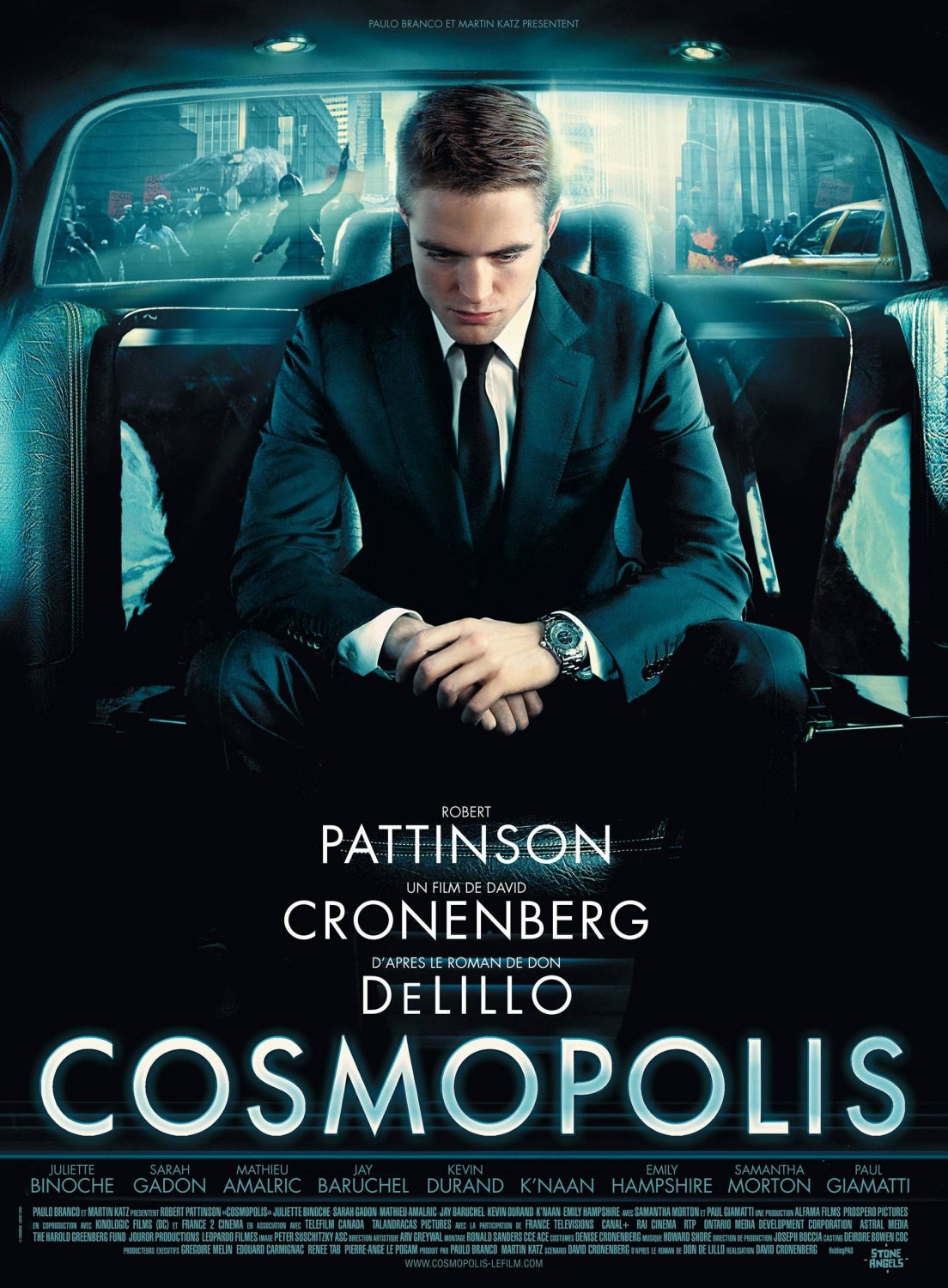
Cosmopolis – Friday, August 17 at the Walter Reade Theater. Director/Writer: David Cronenberg. Starting with his science fiction/horror films, David Cronenberg has had my complete attention. These early films include They Come from Within (1975), Rabid (1977), The Brood (1979), Scanners (1981), and the awesome Videodrome (1983), all very original and disturbing with their icky body-horror concerns. I don’t think anyone else at the time (or since) was doing this kind of thing with the same level of skill and vision. The Dead Zone (1983), is, for my money, the best film version of a Stephen King novel to date, while The Fly (1986) is a remake that totally blows away the original 1958 film. He was also the ideal director to tackle William Burrough’s novel Naked Lunch, long considered unfilmable, which he did in 1991.
Even when he’s veered away from more fantastical storylines, as he has with A History of Violence (2005), Eastern Promises (2007), A Dangerous Method (2011), and now Cosmopolis, Cronenberg’s films give off a sense of strangeness, of unpredictable and different ways of seeing the world. I know of no other director, with the possible exception of David Lynch, who can create a sense of dread from something as ordinary as a slow track-in on a cast-iron tub in an empty loft slowly filling with water from a dripping faucet (Spider, 2002).
Of the new films I’ve seen in the last several weeks, Cosmopolis is definitely the most interesting, the most engaging, the one that’s stayed in my head the most. Though set in something like the present, it feels like science fiction. I haven’t read Don Delilo’s novel, so I can’t speak to how much of the tone comes from that, but the title alone certainly has a sci-fi vibe. The film takes place largely inside the white stretch limo of Eric Packer (Robert Pattinson, excellent in a role that has him in virtually every scene), a young financial wizard. His main goal as the day begins is to cross Manhattan to get a haircut, while trying to deal with the probable loss of millions of dollars due to a risky gamble involving Chinese currency, the mechanics of which I couldn’t begin to understand, and don’t think I was supposed to. The level of financial techno-speak in this film will make your head spin, but in a cool way. During the slow crawl across town, Eric takes multiple meetings in the limo with his financial advisers, has sex a couple of times, is warned of a “credible” threat on his life, and watches as protesters (some dressed as rats) fill the streets, rock and spray paint his limo as he inches by, and on and on.
The limo is a self-contained sarcophagus, claustrophobic yet expansive, with shiny dark surfaces, leather and chrome, numerous computer screens glowing in the cool light. It suggests a submarine, a tomb, a rocket ship. Events take on an increasingly surrealistic feel as the day progresses. Eric projects a flat affect throughout, is tightly wrapped, bored, looking for something new, and seemingly amused by some private joke as he moves closer and closer to something much more than a haircut. – Ted Hicks
Here’s the trailer, followed by very interesting interviews with David Cronenberg and Robert Pattinson:
The portrayal of alcoholism and drug addiction in film and television has evolved over time. Early depictions of drinking in films tended to be comic and unrealistic. W. C. Fields is one example. Another is The Thin Man series (1934 – 1947), in which Nick and Nora Charles drink basically non-stop, but never seem impaired. At most they get mildly tipsy, which only makes them wittier, more charming and attractive.
As recently as 1981, in Arthur, Dudley Moore’s character is of the “lovable drunk” variety. His constant drunkenness is seen as comic rather than a source of concern. In Cat Ballou (1965), Lee Marvin won an Academy Award as a washed up gunfighter, a falling-down drunk played for laughs; even his horse got drunk.
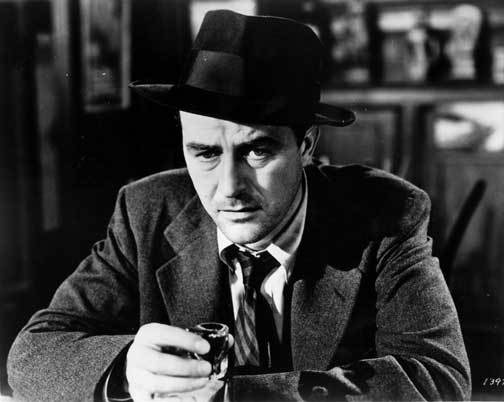
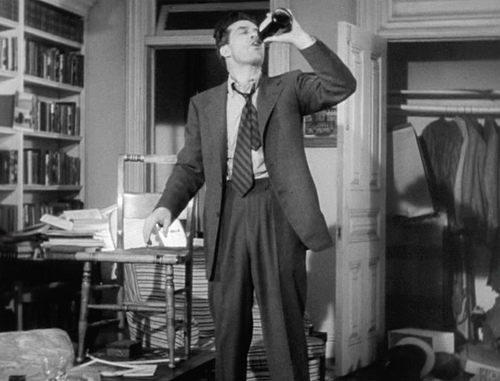
The Lost Weekend (1945) was, to my knowledge, the first dramatic film to deal seriously with alcoholism. Don Birnham, an aspiring writer in New York City, is a drunk. His girlfriend and brother are enablers despite their desire to help him. Though Alcoholics Anonymous isn’t mentioned, the disease concept is acknowledged when Don’s girlfriend states that he has a sickness. The film was a major success, winning Academy Awards for Best Picture, as well as Director (Billy Wilder), Actor (Ray Milland), Screenplay (Wilder and Charles Brackett).
Ten years later, The Man with the Golden Arm (1955), the first American film to deal openly with drug addictionwas released without the MPAA seal of approval, as this had been a taboo subject for films since the 1930s. And while this film opened the door, films depicting substance abuse continued to be mainly about alcoholism until the 1970s.
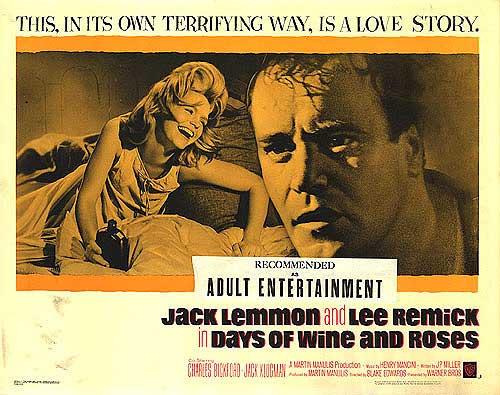
Since then many films have dealt with alcoholism and drug addiction in a variety of ways. In films of the 1950s, substance abuse is almost always the main subject of the story, which usually ends with the protagonist either being destroyed by his or her addiction or in recovery from it (often not a 12-Step program of recovery, though Alcoholics Anonymous progressively becomes more of a presence). Days of Wine and Roses (1962) gives us both of these endings, with Jack Lemmon’s character surviving in recovery, while his wife (Lee Remick) continues her downward spiral.
Over the last twenty-five years or so, there have been real changes in the way alcoholism and drug addiction have been portrayed in film and television. This may be due largely to a greater awareness of the realities involved, as substance abuse becomes less stigmatized and stereotyped, and the public learns more about 12-Step recovery programs, rehabs, the disease concept, etc. One result of this is that a character’s alcoholism often becomes less the main subject of the story and more a part of the character’s background, often a critical determining factor of his or her behavior.
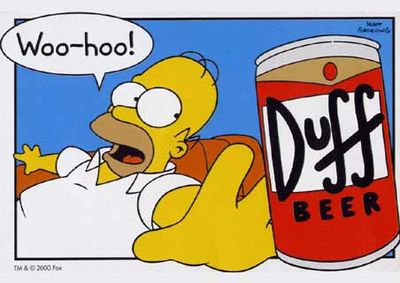
Alcoholism or drug use is presented as a lifestyle in films such as Ironweed (1984), Barfly (1987), and Factotum (2005). Recovery is not an issue or an option. We certainly see the effects alcohol and drugs have on these characters, but this is presented as a fact of life for them. This is even true on the long-running TV series The Simpsons. Homer is addicted to food and booze, and proud of it. His friend Barney is presented as a totally terminal alcoholic, but no problem, it’s just the way he is.
Trees Lounge (1996), with Steve Buscemi as writer, director and star, is a particularly strong film. It takes the subject of a drinking life head on. The world that Buscemi’s character Tommy inhabits feels totally accurate. Tommy literally lives above the Trees Lounge bar in suburban Long Island, and seemingly spends every waking moment hanging out in the bar, when he’s not at his day job driving an ice-cream truck. The details of his day-to-day existence are at once tragic and mundane. Charles Bukowski would be at home here.
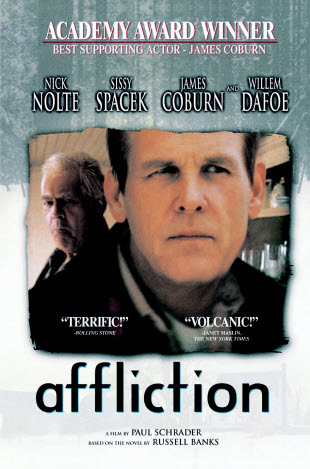
While not about addiction per se, in Affliction(1997) a key component of the story deals with generational alcoholism, set in a snow-covered New Hampshire town. In the film, the alcoholism and behavior of Glen Whitehouse (James Coburn in a truly powerhouse performance) is passed down to his son Wade (Nick Nolte), and is seen as the root cause of dysfunction in the family. We see how Wade’s often-disastrous actions, large and small, are the direct result of his totally stunted upbringing by an alcoholic father.
In a telling scene, Wade’s younger brother Rolfe (Willem Dafoe) has returned from Boston for their mother’s funeral. He remembers an incident from their childhood when Glen had physically injured Wade. Rolfe says, “After I heard, I became real careful around Pop. I was a careful child. I became a careful adult. At least I was never afflicted by that man’s violence.” To which Wade responds, laughing, “That’s what you think.”
Since the 1990s, alcoholic characters have appeared on TV shows with increasing frequency. For example, on NYPD Blue, the alcoholism of Andy Sipowitz and Diane Russell is key to their character development, and important to the plotlines. For Lenny Briscoe on Law and Order, Capt. Cragen on Law and Order: Special Victims Unit, and Fritz Howard on The Closer, it functions more as background for their characters.
In some instances, giving characters alcoholic histories may simply be a device, an easy way to make them seem more interesting. But it can also be integral to the character and the story. In either case, I think it reflects the greater awareness and understanding of substance abuse I mentioned earlier. To the extent that these characters are seen as recognizable human beings instead of stereotypes is a definite step forward.
Other films and TV programs worth checking out that depict alcohol and drug use to one degree or another include the following:
Come Back, Little Sheba (1952)
The Country Girl (1954)
I’ll Cry Tomorrow (1955)
On the Bowery (1956)
Who’s Afraid of Virginia Woolf (1966)
The Panic in Needle Park (1971)
Born to Win (1971)
Fat City (1972)
Tender Mercies (1983)
Under the Volcano (1984)
Withnail & I (1987)
Clean and Sober (1988)
Drugstore Cowboy (1989)
My Name Is Bill W. (1989 – TV)
Shakes the Clown (1991)
When a Man Loves a Woman (1994)
Leaving Las Vegas (1995)
Drunks (1995)
Trainspotting (1996)
Fear and Loathing in Las Vegas (1998)
My Name Is Joe (1999)
Requiem for a Dream (2000)
The Sopranos (1999 – 2007, HBO)
The Wire (2002 – 2008, HBO)
You Kill Me (2007)
Crazy Heart (2009)
More information about these and the many other films and TV programs that deal with substance abuse, and their availability on home video, may be found online. I know I’ve just skimmed the surface in this piece, so let me know what I’ve left out. – Ted Hicks

 Didn’t happen! But it is the end of the year, so Happy New Year everybody! This was a strong year for films and television. I’ll be posting my picks for 2012 in a day or so. In the meantime, to help ring out the old year (and ring in the new), here’s a clip of Bill Haley & His Comets performing “Rock Around the Clock” on American Bandstand. I remember how much this song rocked my world when I first heard it under the opening credits of Blackboard Jungle in 1955. This was the first feature film to use rock music, and to use it this loud and in your face at the start of a movie about juvenile delinquency really freaked out a lot of people, but not us kids. This felt like a real seismic shift, and it turned out to be just that.










 Films etc.