“Bond… James Bond.” The First Three Films

It’s hard to believe that it’s been 50 years since Dr. No, the first James Bond film, was released. How is that possible? Am I that old? Then again, it feels like Bond has always been on the scene, part of the pop culture landscape. Ian Fleming’s first Bond novel, Casino Royale, was published in 1953, but the series got a big boost in this country in 1961 when President Kennedy said in “Life Magazine” that From Russia with Love was one of his ten favorite books. The movie versions took off, and were hugely influential, though they quickly became formulaic and over the top. Dr. No’s popularity and financial success created its own genre and unleashed a flood of Cold War spy films and TV shows in the 1960s.

The IFC Center in NYC just finished a week of showing all seven of the Sean Connery Bond films, including the “unofficial” Never Say Never Again (1983), which is basically a remake of Thunderball (1965). For many of us, I think, Connery is the best Bond, our favorite Bond. And not just because he was the first. That’s definitely a factor, but more importantly, Sean Connery really nailed the role. All subsequent Bonds have been versions of Connery’s. I never much liked the Roger Moore films, with the exception of For Your Eyes Only (1981), which seemed less jokey and more serious, grounded in a somewhat believable reality. Timothy Dalton brought intensity and brutality to the role, but was probably too dour a presence for wide acceptance, and only lasted two films. Like many, I felt that Pierce Brosnan was the “best Bond since Connery,” but only liked the first of his four Bonds, Goldeneye (1995). And with Daniel Craig, Bond has been effectively reinvented for the new millennium. Casino Royale (2006) is tough and gritty, with a physicality that has some heft to it. But I felt badly let down by the follow up, Quantum of Solace (2008), though I still like Craig in the role. The truth of it is, I can recall very little from the later films, while many scenes from the first three are still very vivid for me. For me, Bond will always belong to Sean Connery.

(Trivia footnote: Sean Connery was not actually the first actor to portray James Bond. Barry Nelson played Bond in an adaptation of Casino Royale, broadcast live in 1954 on the CBS television series “Climax!”, which recast Bond as an American [!] intelligence agent, and co-starred Peter Lorre as the villain, Le Chiffre. Nelson apparently made little impression as “Jimmy” Bond, as he was called in this version. Somehow “Jimmy” doesn’t work.)
I saw the first three films last weekend. I had intended on seeing them all together, a back-to-back triple feature, just to see what that would be like. But while the spirit was willing, the flesh, as they say, was weak. So I settled for a double-feature on Friday, and the third film the next day. And here they are.

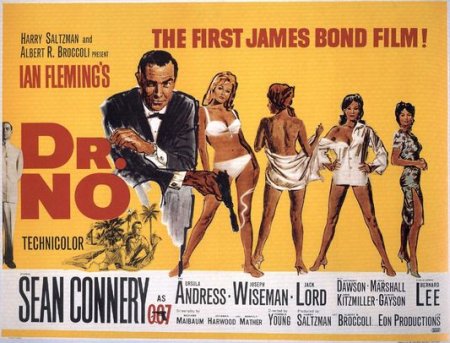
Dr. No (1962) Director: Terence Young. I remember seeing this twice in the space of a week in the summer of 1963 at a small theater in Iowa, so something about it obviously got my attention. As far as I know, there hadn’t been many secret agent/spy movies before Dr. No, and certainly none like this, with a chain-smoking protagonist who enjoyed booze, women, casinos, fast cars, beating the crap out of bad guys, and to top it off, had a license to kill. There’s a scene in Dr. No where Bond executes a man who has come to kill him. It’s very cold-blooded and matter of fact. I doubt that Bond’s pulse rate increases a single beat. I also don’t remember Bond ever being quite this ruthless in the subsequent films (though he seems just as tough in From Russia with Love). What got my attention was when he fires a second slug into the guy, who seems quite dead already. Here’s a clip of the scene. The sound is low, but it was the best one I could find.

And who can forget (at least if you were a teenage boy) the first sight of Ursula Andress as she emerged from the sea, like a goddess. Her bikini caused a serious increase in the sale of two-piece swimwear, though I’ve always thought there was something odd about the wide belt that held her knife sheath. Maybe it was the buckle, I don’t know.

Many of the elements that became regular features, catch phrases, in the subsequent films were introduced here. For example, Bond’s way with those came to be called “Bond girls” is established almost immediately; a supremely self-confident, wise-cracking command of women, most of whom are beautiful, some deadly and trying to kill him, but almost all sooner or later susceptible to his somewhat thuggish, heavy-lidded charms. These were definitely pre-feminism years. We see for the first time Bond’s flirty banter with Miss Moneypenny when he comes to M’s office to get his new assignment, which is repeated in nearly all the films. His relationship with M is also established, that of an errant schoolboy always in danger of being dressed down by the headmaster. Desmond Llewelyn as “Q,” the head of Q Branch, doesn’t appear until the second film, but his sarcastic disapproval of Bond was a fixture from then on.

Of course, one of the most iconic trademarks of the series occurs in Dr. No when we first see Bond in the casino and he delivers the line, “Bond… James Bond,” which cues the “James Bond Theme” to rise in the background. This line, endlessly quoted and parodied, was voted the “best-loved one-liner in cinema” by British filmgoers in 2001. And in 2005, it was picked as the 22nd greatest quote in film history by the American Film Institute. Something I hadn’t picked up on before, until seeing it noted in a Wikipedia entry on Dr. No, is that Bond actually seems to be mimicking the woman across from him at the baccarat table, who introduces herself as “Trench… Sylvia Trench.” But Connery saying it had a terrific impact in the film. It sounded great, and was used thereafter by all the Bonds. Here’s a compilation of the Bond actors saying the line. This gets old fast, but it’s nonetheless interesting to see the differences.

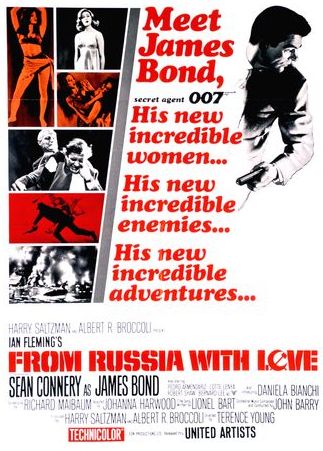
From Russia with Love (1963) Directed by Terence Young. This is the one. Many people consider this to be the best Bond film, and I’m inclined to agree. After From Russia with Love the films began to get bigger and jokier, more outlandishly spectacular. The story takes place in something like the real world, and is somewhat more believable. Ken Adams’ sets are starting to get bigger, but nothing like the incredible spaces they’ll be in later films. The nominal mastermind behind a plot to steal a Russian decoder device for SPECTRE is referred to only as “Number One” (he’s Blofeld in later films). His face is never seen in the early films, though we do see him slowly stroking a large, long-haired white cat that sits smugly in his lap. He’s not larger than life in the way that Auric Goldfinger is in the next film, but Lotte Lenya as Rosa Klebb, and especially Robert Shaw as the assassin Red Grant, more than make up for that. When you consider Lotte Lenya’s background as a well-known stage and film actress in Germany during the 1920s, often in Brecht-Weill plays (she was married to Kurt Weill – twice!), her appearance in a James Bond film seems almost surreal.

My most vivid memory from this film has to be Bond’s fight to the death with Red Grant in a cramped train compartment. This wasn’t the first time I’d seen Robert Shaw, though it felt like it (I’d forgotten until recently when I looked up his credits that he’d been in a 1956-57 British TV series called The Buccaneers, which I watched as a kid). He doesn’t say a word in From Russia with Love until he meets Bond on the train. I remember being jolted by his voice, which didn’t sound right for the lethal figure we’d followed through the film. But the fight itself was amazing. We know Bond will survive, because he has to, but this fight really takes him to the edge. There may not have been anything quite like it in movies before, nothing this brutal and claustrophobic. It still packs a punch.

Goldfinger (1964) Director: Guy Hamilton. This is the Bond film that really sets the tone and style for the ones that followed. In the pre-credit sequence, Bond emerges from the water of a marina in frogman gear with a prop seagull attached to the top of his head as “camouflage.” After attaching explosives to something that needs blowing up, he unzips his wet suit to reveal that he’d been wearing a white dinner jacket and evening wear underneath, ready to go to the nightclub next door to check out the ladies and light a cigarette. This can only be taken as a joke. With Goldfinger, overt humor and satire become frequent features.

Goldfinger has a killer theme song, though, maybe the best of all the Bonds, and a great score throughout. The main title sequence is also one of the best, incorporating many images from the film itself, which creates a sense of expectation for what’s to follow.

Though From Russia with Love is, for me, a much better film, I’d bet that Goldfinger is the one that comes most immediately to mind when people think of Sean Connery and the Bond films. As portrayed by Gert Fröbe, Auric Goldfinger is one of the stronger Bond villains, a powerful, threatening presence, down to his gold-plated pistol. Yet also someone who cheats at cards to make sure he wins. Memorable scenes and images from the film include Goldfinger’s Korean bodyguard, Oddjob, his deadly bowler hat, and the way he rattles Bond by crushing a golf ball to dust in his bare hand; Shirley Eaton covered in gold paint, dead on the bed, one of the most iconic images from any Bond film; the introduction of Honor Blackman’s character, Pussy Galore, and wondering how they got away with that. But perhaps the scene that comes most to mind is Bond captured by Goldfinger, strapped spread-eagle to a metal table with a laser beam burning its way through the table toward his crotch, capped by one of the greatest Bond dialogue exchanges. Bond: “Do you expect me to talk?” Goldfinger: “No, Mr. Bond, I expect you to die!”

It’s interesting that in 1963, in the midst of the releases of Dr. No and From Russia with Love, John Le Carré’s novel The Spy Who Came in from the Cold was published. Two years later, 1965, a film version was released, directed by Martin Ritt and starring Richard Burton in one of his best performances. The Spy Who Came in from the Cold could not have been any more different from the James Bond world. And it was great. In it, the work of a spy was plodding and grubby, and likely to end with a bullet in the back. This may not have been any more “real” than Bond’s world, but it felt like it was. The same year saw Michael Caine as secret agent Harry Palmer in The Ipcress File. While not as bleak as the world of The Spy Who Came in from the Cold, Caine’s Harry Palmer nonetheless turned the image of James Bond on its head.

Seeing the first three films over two days was an educational experience. I realized that, with the strong exception  of From Russia with Love and parts of Goldfinger, the Bond films, even the later ones with Sean Connery, are pretty disposable. After Goldfinger, the films came more and more to resemble theme park rides. Still, by now the James Bond films have the weight of a cultural insititution. My favorite Bond will always be Sean Connery. For me, he’s the real deal. For younger filmgoers, their first Bond may have been Roger Moore, or Pierce Brosnan, or Daniel Craig. Sean Connery may not mean the same to them as he does to someone with my point of view. But whoever your Bond is, I’m sure we’ve all practiced, at one time or another, saying the line. You know how it goes: “Bond… James Bond.” – Ted Hicks

Posted in Books, Film, Home Video, TV | 4 Comments

What I Saw: Three New Films

The Bourne LegacyFriday, August 10 at AMC Loews 84th Street. Director/Co-Writer: Tony Gilroy. I’m a big fan of the Bourne films, especially the second and third directed by Paul Greengrass. I find them immensely watchable, repeatedly so. The immediate challenge for this fourth installment was doing a Bourne film without Jason Bourne. Despite the fact that Greengrass and actor Matt Damon weren’t involved, I had reasonably high expectations. Tony Gilroy had written (or co-written) the first three Bournes, which was a good sign, plus he’d also written and directed the excellent Michael Clayton (2007), though the physical scale of that film was much smaller, to say the least. Another hook for me, though, was Jeremy Renner in the lead role. He was terrific in The Hurt Locker (2008), and I looked forward to seeing him in this.

So did I like it or not? Mostly yes, but with reservations. I can definitely recommend it to those who have followed the Bourne films, or just like this type of film in general. It’s very well made, though I think it needed a stronger ending. There is at least one really great action sequence, and several more that are very good, though overall not quite up to the level of those in the earlier films. There’s also a workplace shooting that’s pretty disturbing, maybe a little too real, given what we hear about too often in the real world. Renner is perfect for the film, though it will be interesting to see if he can play other kinds of roles, characters who aren’t so professional, tough and confident, and capable of violence. What was lacking for me was the emotional depth and vulnerability that Matt Damon brought to the films. His Jason Bourne starts out by not knowing who or what he is. His goal throughout the first three films, regardless of whatever else is happening, is to unravel that mystery and find out who’s responsible for what’s been done to him. The pain and sense of loss that Bourne feels is heightened by the empathy Matt Damon makes us feel for the character.

In the Damon films, each death is personal. We don’t have that, for the most part, in the new film. Aaron Cross, Renner’s character, doesn’t have Bourne’s identity issues. He knows exactly who and what he is, and understands the training he underwent to get there. That this mainly comes down to drugs (one pill makes him smarter, another makes him stronger) is a little disappointing and somewhat old hat; i.e. The X-Files’ super soldiers, among others. But okay, I can go with it. What he doesn’t understand at the outset is the level of duplicity of those controlling him. Aaron Cross’ main problem here is one of not-so-simple survival. He spends most of the film on the run from government forces (headed by Edward Norton, ruthless and dead-eyed) trying to kill him. Cross is aided in this effort by Rachel Weitz, an excellent actress who brings a lot to the film. The bottom line is I liked The Bourne Legacy, despite my objections, and could see it again.

Hope Springs – Saturday, August 11 at AMC Loews Lincoln Square. Director: David Frankel (The Devil Wears Prada – 2006). This film is mainly counter-programming for a somewhat older audience who wants to see something other than superheroes, car chases, and stuff blowing up over and over in slow-motion. And let’s face it, the real draw here is seeing Meryl Streep and Tommy Lee Jones in a movie together (just as it was seeing Judi Dench, Bill Nighy, Maggie Smith, Tom Wilkinson et al in The Best Exotic Marigold Hotel, another instance of a really great cast in a so-so film). Meryl and Tommy Lee play a couple, Kay and Arnold, whose marriage, after 31 years, is in a rut, to put it mildly. At least Kay definitely sees it that way, though Arnold doesn’t have a clue. Kay, in desperation, books a trip to Hope Springs, Maine for sessions with a couples therapist, Dr. Feld. Arnold doesn’t want anything to do with this whatsoever, but goes along in the end; otherwise there wouldn’t be a movie.

The issue of how to revive a marriage of many years that has fallen out of intimacy and into deadly routine is an important one, but this is a talky, talky movie. Steve Carell plays Dr. Feld, who doesn’t get out of his office chair once, though he is apparently on his feet in scenes we see during the closing credits. This role is a real change of pace for Carell. I imagine the main attraction for him was the same as for most of us in the audience: Meryl Streep and Tommy Lee Jones. Arnold is also quite a different character for Jones; it’s interesting and fun to see him in a part like this. Streep and Jones are both such pros, and plainly enjoyed working together. The ending is never really in doubt, but they keep it interesting along the way. I just wish it was a better movie.

CosmopolisFriday, August 17 at the Walter Reade Theater. Director/Writer: David Cronenberg. Starting with his science fiction/horror films, David Cronenberg has had my complete attention. These early films include They Come from Within (1975), Rabid (1977), The Brood (1979), Scanners (1981), and the awesome Videodrome (1983), all very original and disturbing with their icky body-horror concerns. I don’t think anyone else at the time (or since) was doing this kind of thing with the same level of skill and vision. The Dead Zone (1983), is, for my money, the best film version of a Stephen King novel to date, while The Fly (1986) is a remake that totally blows away the original 1958 film. He was also the ideal director to tackle William Burrough’s novel Naked Lunch, long considered unfilmable, which he did in 1991.

Even when he’s veered away from more fantastical storylines, as he has with A History of Violence (2005), Eastern Promises (2007), A Dangerous Method (2011), and now Cosmopolis, Cronenberg’s films give off a sense of strangeness, of unpredictable and different ways of seeing the world. I know of no other director, with the possible exception of David Lynch, who can create a sense of dread from something as ordinary as a slow track-in on a cast-iron tub in an empty loft slowly filling with water from a dripping faucet (Spider, 2002).

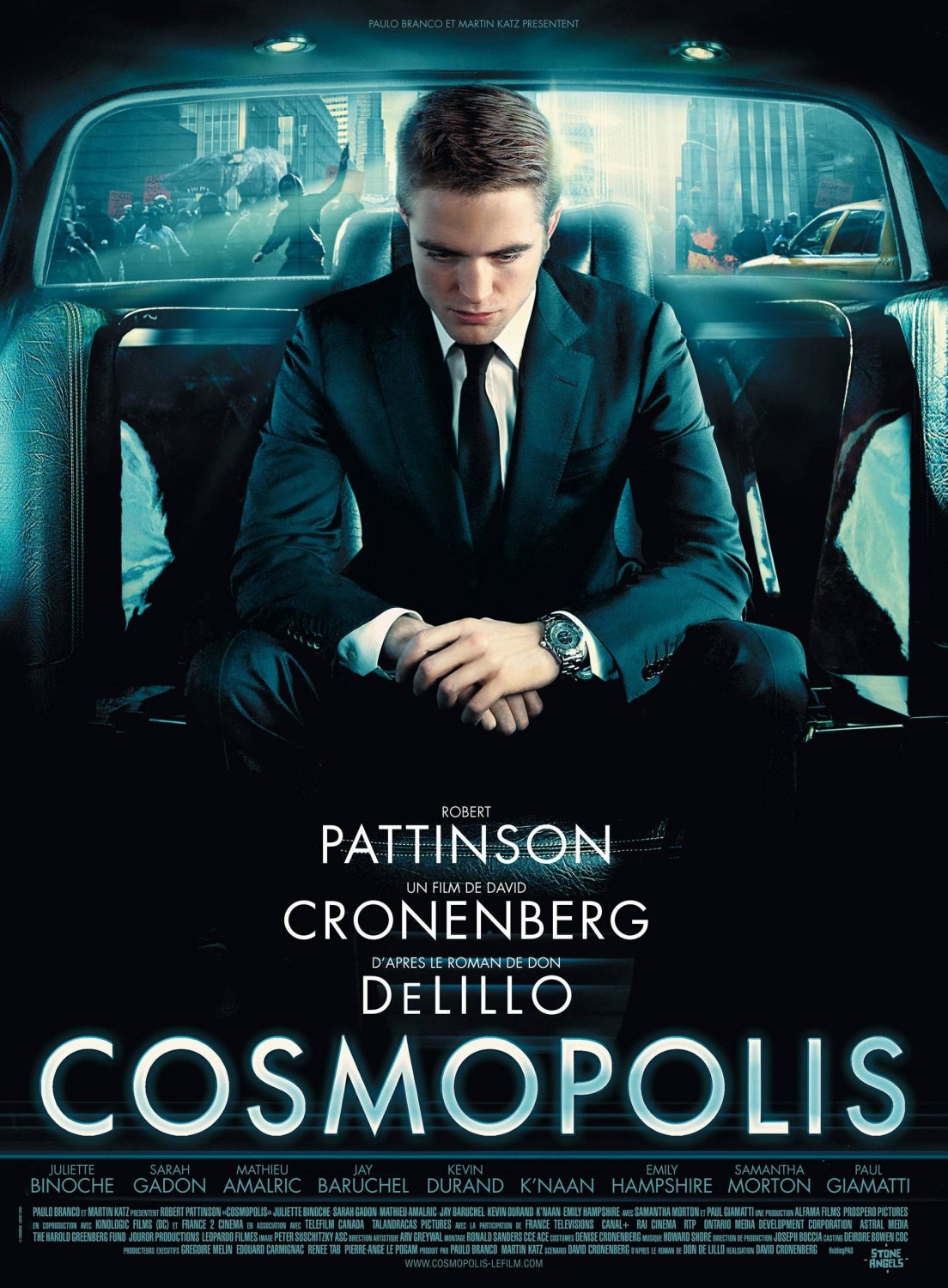
Of the new films I’ve seen in the last several weeks, Cosmopolis is definitely the most interesting, the most engaging, the one that’s stayed in my head the most. Though set in something like the present, it feels like science fiction. I haven’t read Don Delilo’s novel, so I can’t speak to how much of the tone comes from that, but the title alone certainly has a sci-fi vibe. The film takes place largely inside the white stretch limo of Eric Packer (Robert Pattinson, excellent in a role that has him in virtually every scene), a young financial wizard. His main goal as the day begins is to cross Manhattan to get a haircut, while trying to deal with the probable loss of millions of dollars due to a risky gamble involving Chinese currency, the mechanics of which I couldn’t begin to understand, and don’t think I was supposed to. The level of financial techno-speak in this film will make your head spin, but in a cool way. During the slow crawl across town, Eric takes multiple meetings in the limo with his financial advisers, has sex a couple of times, is warned of a “credible” threat on his life, and watches as protesters (some dressed as rats) fill the streets, rock and spray paint his limo as he inches by, and on and on.

The limo is a self-contained sarcophagus, claustrophobic yet expansive, with shiny dark surfaces, leather and chrome, numerous computer screens glowing in the cool light. It suggests a submarine, a tomb, a rocket ship. Events take on an increasingly surrealistic feel as the day progresses. Eric projects a flat affect throughout, is tightly wrapped, bored, looking for something new, and seemingly amused by some private joke as he moves closer and closer to something much more than a haircut. – Ted Hicks

Here’s the trailer, followed by very interesting interviews with David Cronenberg and Robert Pattinson:

Posted in Film, Home Video | 1 Comment

Smashed: Alcohol and Drugs in Film and TV

The portrayal of alcoholism and drug addiction in film and television has evolved over time. Early depictions of drinking in films tended to be comic and unrealistic. W. C. Fields is one example. Another is The Thin Man series (1934 – 1947), in which Nick and Nora Charles drink basically non-stop, but never seem impaired. At most they get mildly tipsy, which only makes them wittier, more charming and attractive.

As recently as 1981, in Arthur, Dudley Moore’s character is of the “lovable drunk” variety. His constant drunkenness is seen as comic rather than a source of concern. In Cat Ballou (1965), Lee Marvin won an Academy Award as a washed up gunfighter, a falling-down drunk played for laughs; even his horse got drunk.

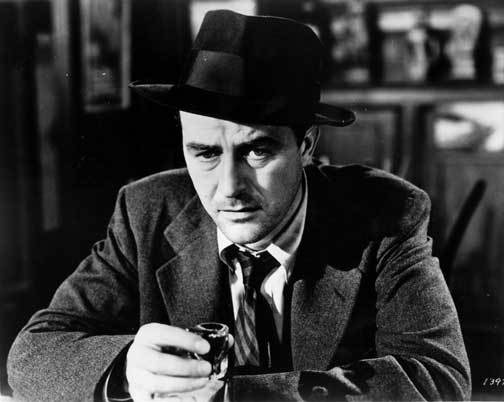
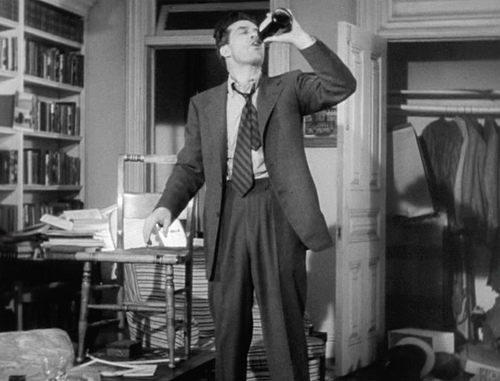
The Lost Weekend (1945) was, to my knowledge, the first dramatic film to deal seriously with alcoholism. Don Birnham, an aspiring writer in New York City, is a drunk. His girlfriend and brother are enablers despite their desire to help him. Though Alcoholics Anonymous isn’t mentioned, the disease concept is acknowledged when Don’s girlfriend states that he has a sickness. The film was a major success, winning Academy Awards for Best Picture, as well as Director (Billy Wilder), Actor (Ray Milland), Screenplay (Wilder and Charles Brackett).

Ten years later, The Man with the Golden Arm (1955), the first American film to deal openly with drug addictionwas released without the MPAA seal of approval, as this had been a taboo subject for films since the 1930s. And while this film opened the door, films depicting substance abuse continued to be mainly about alcoholism until the 1970s.

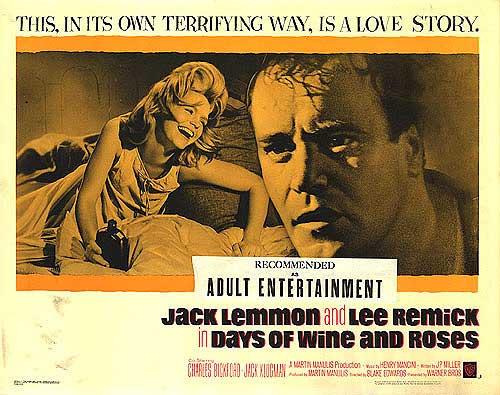
Since then many films have dealt with alcoholism and drug addiction in a variety of ways. In films of the 1950s, substance abuse is almost always the main subject of the story, which usually ends with the protagonist either being destroyed by his or her addiction or in recovery from it (often not a 12-Step program of recovery, though Alcoholics Anonymous progressively becomes more of a presence). Days of Wine and Roses (1962) gives us both of these endings, with Jack Lemmon’s character surviving in recovery, while his wife (Lee Remick) continues her downward spiral.

Over the last twenty-five years or so, there have been real changes in the way alcoholism and drug addiction have been portrayed in film and television. This may be due largely to a greater awareness of the realities involved, as substance abuse becomes less stigmatized and stereotyped, and the public learns more about 12-Step recovery programs, rehabs, the disease concept, etc. One result of this is that a character’s alcoholism often becomes less the main subject of the story and more a part of the character’s background, often a critical determining factor of his or her behavior.

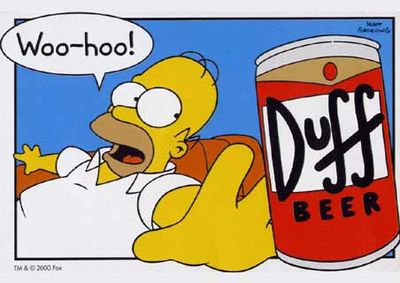
Alcoholism or drug use is presented as a lifestyle in films such as Ironweed (1984), Barfly (1987), and Factotum (2005). Recovery is not an issue or an option. We certainly see the effects alcohol and drugs have on these characters, but this is presented as a fact of life for them. This is even true on the long-running TV series The Simpsons. Homer is addicted to food and booze, and proud of it. His friend Barney is presented as a totally terminal alcoholic, but no problem, it’s just the way he is.

Trees Lounge (1996), with Steve Buscemi as writer, director and star, is a particularly strong film. It takes the subject of a drinking life head on. The world that Buscemi’s character Tommy inhabits feels totally accurate. Tommy literally lives above the Trees Lounge bar in suburban Long Island, and seemingly spends every waking moment hanging out in the bar, when he’s not at his day job driving an ice-cream truck. The details of his day-to-day existence are at once tragic and mundane. Charles Bukowski would be at home here.

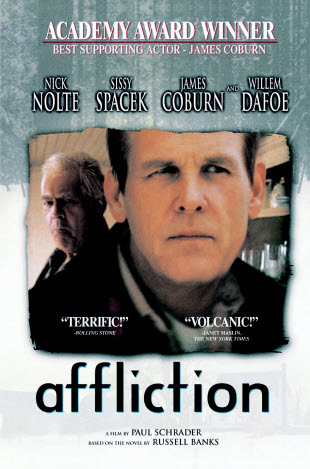
While not about addiction per se, in Affliction(1997) a key component of the story deals with generational alcoholism, set in a snow-covered New Hampshire town. In the film, the alcoholism and behavior of Glen Whitehouse (James Coburn in a truly powerhouse performance) is passed down to his son Wade (Nick Nolte), and is seen as the root cause of dysfunction in the family. We see how Wade’s often-disastrous actions, large and small, are the direct result of his totally stunted upbringing by an alcoholic father.

In a telling scene, Wade’s younger brother Rolfe (Willem Dafoe) has returned from Boston for their mother’s funeral. He remembers an incident from their childhood when Glen had physically injured Wade. Rolfe says, “After I heard, I became real careful around Pop. I was a careful child. I became a careful adult. At least I was never afflicted by that man’s violence.” To which Wade responds, laughing, “That’s what you think.”

Since the 1990s, alcoholic characters have appeared on TV shows with increasing frequency. For example, on NYPD Blue, the alcoholism of Andy Sipowitz and Diane Russell is key to their character development, and important to the plotlines. For Lenny Briscoe on Law and Order, Capt. Cragen on Law and Order: Special Victims Unit, and Fritz Howard on The Closer, it functions more as background for their characters.

In some instances, giving characters alcoholic histories may simply be a device, an easy way to make them seem more interesting. But it can also be integral to the character and the story. In either case, I think it reflects the greater awareness and understanding of substance abuse I mentioned earlier. To the extent that these characters are seen as recognizable human beings instead of stereotypes is a definite step forward.

Other films and TV programs worth checking out that depict alcohol and drug use to one degree or another include the following:

  • Come Back, Little Sheba (1952)
  • The Country Girl (1954)
  • I’ll Cry Tomorrow (1955)
  • On the Bowery (1956)
  • Who’s Afraid of Virginia Woolf (1966)
  • The Panic in Needle Park (1971)
  • Born to Win (1971)
  • Fat City (1972)
  • Tender Mercies (1983)
  • Under the Volcano (1984)
  • Withnail & I (1987)
  • Clean and Sober (1988)
  • Drugstore Cowboy (1989)
  • My Name Is Bill W. (1989 – TV)
  • Shakes the Clown (1991)
  • When a Man Loves a Woman (1994)
  • Leaving Las Vegas (1995)
  • Drunks (1995)
  • Trainspotting (1996)
  • Fear and Loathing in Las Vegas (1998)
  • My Name Is Joe (1999)
  • Requiem for a Dream (2000)
  • The Sopranos (1999 – 2007, HBO)
  • The Wire (2002 – 2008, HBO)
  • You Kill Me (2007)
  • Crazy Heart (2009)

More information about these and the many other films and TV programs that deal with substance abuse, and their availability on home video, may be found online. I know I’ve just skimmed the surface in this piece, so let me know what I’ve left out. – Ted Hicks

Posted in Film, Home Video, TV | 9 Comments

Terrific Documentaries

Earlier this week I finally saw Jiro Dreams of Sushi, a documentary that’s been showing in NYC since early March. I had intended to see it before now, but other films always got in the way. For instance, I saw Battleship before seeing this, a film that’s about nothing and means even less. What can I say? In any event, Jiro Dreams of Sushi is a really great film about 85 year-old Jiro Ono, who manages Sukiyabashi Jiro, a 10-seat sushi-only restaurant located in a Tokyo subway station. Which might not sound like much, but Jiro is thought by many to be the greatest sushi chef in the world, and his restaurant has 3-star Michelin status. Reservations need to be made at least a month in advance. Foodies come from around the world  just to get one of the ten seats at the counter. A whole world is packed into the film’s 82-minute running time. We learn about Jiro’s approach to life, work, and preparing the best sushi possible. He believes he can always improve; this is what he strives for daily, and he passes this work ethic on to his apprentices in the sushi bar. The film, a first feature directed by David Gelb, is a true pleasure to experience. The soundtrack (music by Tchaikovsky, Mozart, Bach, Max Richter, and a lot of Philip Glass), and the way it’s utilized, along with frequent slow-motion in close-ups of the sushi preparation, play a big part in the effect the film has. (Jiro Dreams of Sushi will be released on DVD on July 24, 2012.)

What’s interesting to me is that I don’t eat fish, cooked or raw, but I was completely captivated by Jiro Dreams of Sushi, mainly by the presence of Jiro himself. This has me thinking about what makes a great documentary, and for me it’s almost always when there’s a strong central character at the heart of it. Yes, I like films that tackle big subjects, such as An Inconvenient Truth and Fahrenheit 9/11, but when the focus is on someone like New York Times photographer Bill Cunningham, Formula One race driver Ayrton Senna, or Elmo puppeteer Kevin Clash, it’s more human, more personal, and I can get engaged on an emotional level.

Sometimes I go in knowing virtually nothing about the person the film is about, or what they do. It’s pretty cool when I can come out of the theater having learned something new, and feeling better for having seen the film. That definitely happened last year with Senna, a British film about Brazilian race-car champion Ayrton Senna. I don’t follow Formula One racing, don’t know much about it, and had never heard of Senna. But this didn’t matter, because Senna himself is so charismatic, so alive, a great driver, a national hero in Brazil, and so young, really, that even though I knew going in that the film was leading toward his death, I was hoping it wouldn’t happen. I got very caught up in his story. The film consists almost entirely of existing footage, put together in a way that feels very immediate.  (Senna is available on DVD, Amazon Instant View, and streaming from Netflix.)

Gerhard Richter Painting is another example of my knowing basically nothing going in. I’d never heard of Gerhard Richter before, which says more about my own unawareness than anything else, as I’ve since learned that he’s quite famous in the art world. The film, directed by Corinna Belz, lives up to it title as we watch Richter painting for long stretches. This might sound boring (like watching paint dry, so to speak), but believe me, it’s not. Richter is a fascinating personality, someone who speaks very articulately about what he does. For him, painting is a process of discovery. As he says, the painting tells him when it’s finished. (A DVD release is not yet scheduled, as far I can find; the film is still in theaters.)

Pina, Wim Wenders’ extraordinary film about choreographer Pina Bausch and her dance company also took me to a place I hadn’t been before. When I think of dance, my points of reference have been Gene Kelly, Fred Astaire, Broadway musical numbers, and maybe ballet. Modern dance has been a bit beyond me; I’ve never understood it. Pina really turned my head around. There is a lot of performance in this film, performance staged specifically for the film in locales outside a theater where they wouldn’t otherwise take place. Wenders shot it in 3D, and it’s one of the best uses of that format I’ve seen to date. Bausch died during the film’s preparation, but she’s still the central character, present in archival footage, the interviews with her collaborators and dancers in the company, and in the performances themselves. The effect of the dances is hypnotic, exciting, dynamic, and at times deeply strange and unsettling. In other words, definitely worth seeing. (Pina is currently available on Amazon Instant View; I can’t find any other sources at this time.)

There were three documentaries released last year that I absolutely loved. All three are excellent examples of having a strong central character, someone you come to care about and would like to know. The first is Buck, directed by Cindy Meehl, about real-life “horse whisperer” Buck Brannaman. His life and work are extraordinary. He treats horses with the greatest respect, the same way he deals with the people in his life. He seems to come from a place of such patient calm and understanding that he’s almost too good to be true. (Buck is available on DVD, Amazon Instant View, and streaming via Netflix.)

Bill Cunningham New York, directed by Richard Press, profiles photographer Bill Cunningham, noted for his “On the Street” and “Evening Hours” spreads in the New York Times Style section. Eccentric and immensely likable, Cunningham at age 83 gets around the city on a bicycle, and still shoots 35mm film, which he has developed at a small photo shop down the block. In addition to his candid photos of celebrities at events, he’s noted for his ability to spot styles and trends via his street photography. There’s an interview near the end, in which he’s asked about, among other things, his religious views and his relationships, which is quite moving. (Bill Cunningham New York is available on DVD, Amazon Instant View, and streaming via Netflix.)

Being Elmo: A Puppeteer’s Journey, directed by Constance Marks, focuses on Kevin Clash, the puppeteer behind Elmo on Sesame Street, and how he came to realize a childhood dream. As a boy in Baltimore he began building his own puppets and putting on shows for friends. He then got work on a local television station, which led to time on the Captain Kangaroo series, where Muppet designer Kermit Love noticed him, and Kevin’s dream of working for Jim Henson finally came true. One of the film’s strongest moments is near the end when Kevin is on the phone encouraging a young, aspiring puppeteer, inviting her to come to New York to visit the studio, which she does. It’s always inspiring to me to see someone who’s “made it” pass his or her knowledge on to someone younger. Kevin Clash is a teacher and an inspiration in the strongest sense. (Being Elmo is available on DVD, Amazon Instant View, and streaming via Netflix.)

Finally, to wrap up this little survey of recent documentaries I’ve liked, I want to mention one I enjoyed immensely, Corman’s World: Exploits of a Hollywood Rebel, directed by Alex Stapleton. I saw this last fall at the New York Film Festival, with Roger Corman in attendance for a Q&A with the director after the screening. I hadn’t known he would be there, and was startled when I nearly ran into him head on as I was rushing out to get popcorn before the film started. Quite a kick. It’s hard to believe he’s now 86, as he appears youthfully vibrant, with his mellifluous voice intact, and he’s still working today, producing TV movies for the SyFy Channel.  His career as a writer/director/producer of low-budget genre films kicked off in the mid-1950s with such titles as Swamp Women, It Conquered the World, Attack of the Crab Monsters, and The Wasp Woman.

I vividly remember his series of films based (very loosely) on the works of Edgar Allen Poe, which began with House of Usher in 1960, a film in color and wide screen that got a lot of attention at the time for Corman and American-International Pictures. A film of his that has a legitimate claim to “seriousness” is The Intruder (1962), starring a very young William Shatner (before he’d acquired many of his mannerisms) as an outside agitator stirring up racial hatred in a Southern town on the eve of integration in the high school. Corman has said that this is the only film of his to ever lose money.

He has been enormously influential as a producer and mentor to new talent. Some of the directors and writers who got their starts with Roger Corman include Francis Ford Coppola, Martin Scorsese, Ron Howard Jonathan Demme, James Cameron, and John Sayles, as well as actors Jack Nicholson, Dennis Hopper and Robert De Niro, among others. Many of these are interviewed in Corman’s World, including Jack Nicholson in an amazing segment, appearing totally open, candid, and relaxed. The film is also a treasure trove of clips for those of us who grew up with Corman’s films, and an eye-opener for those who didn’t. (Corman’s World is available on DVD and Amazon Instant View.)

Below is a clip of Corman at the New York Film Festival screening of the documentary, introducing the film with the director,  and the Q&A following.

I realize I haven’t talked much about these documentaries as films. While I think that the subject of a documentary is the most important element — everything comes from that — it’s obviously necessary that the film be well made if it’s going to have much impact. Suffice it to say that all of these films are definitely well made, and artfully so. – Ted Hicks

Posted in Film, Home Video | 7 Comments

Famous Monsters and Me

I’ve often wondered how and why my interests developed as they did. I grew up on a small farm in Iowa in the 50s, and experienced all that went with that. So maybe it’s odd – or maybe it makes perfect sense – that from an early age, as early as I can remember, I was totally in love with science fiction and horror (monsters!) via all their delivery systems; i.e.  books, magazines, comics, TV, and movies. Mainly movies, probably because films are so immediate.

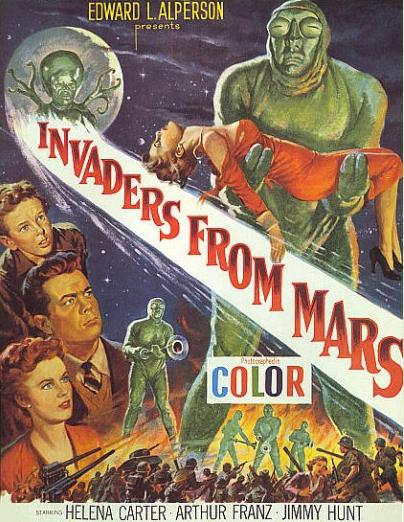
I was an only child, and with no kids in my age range nearby, I was basically by myself until I started grade school. I developed an elaborate fantasy life, which fed directly off of all this stuff. My head was working overtime, mainlining every film and comic that crossed my path. My mother loved movies, so we went a lot. There was a glut of science-fiction monster movies in the 1950s, which now I see had a lot to do with post-war anxieties and fears of being vaporized by Commie nukes. But at the time all I saw in those films were giant insects buzzing around in the desert, mutated dinosaurs rising out of the ocean, and Martians in flying saucers wiping out national landmarks.

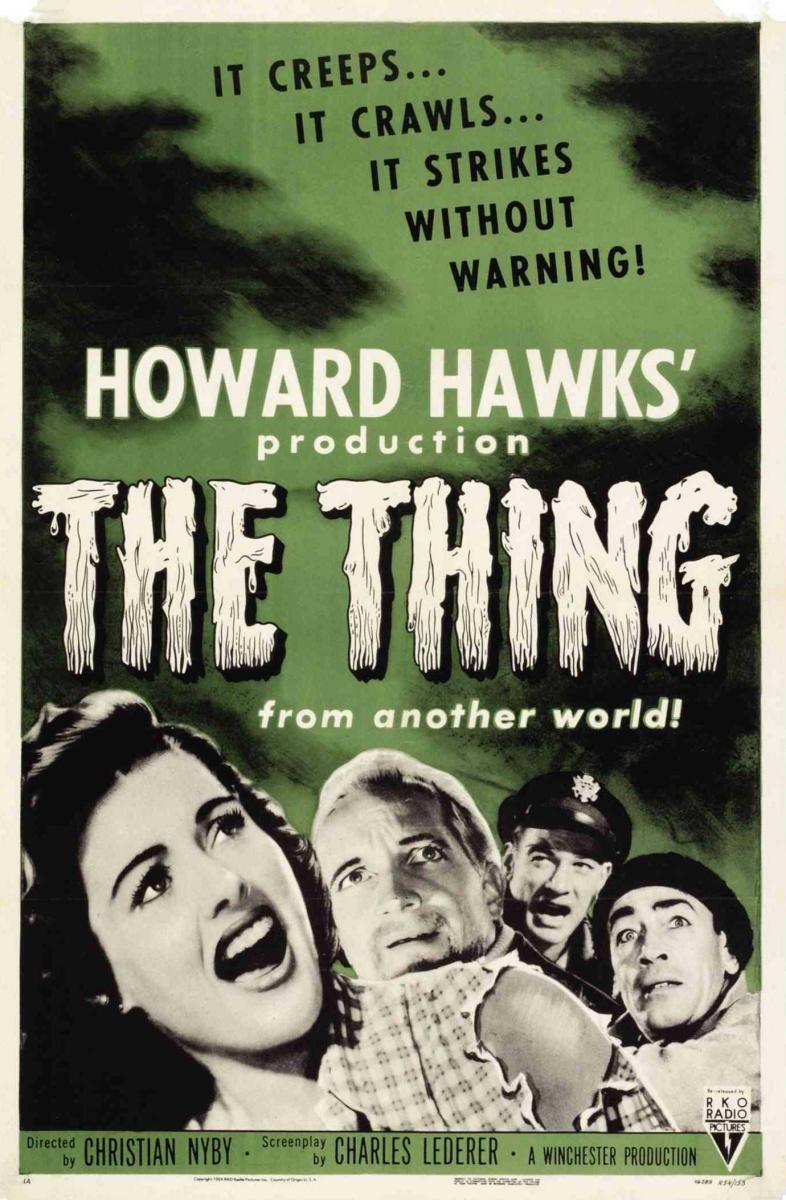
I loved all these films. One of the earliest I can remember is The Man from Planet X. In retrospect it’s not that great, but at the time I found it ineffably strange and sad, frightening and enthralling. My favorite, and certainly the most traumatic, was The Thing from Another World, which completely freaked me out when I saw it in 1951. Totally inappropriate for a six-year-old, but my mother apparently wasn’t paying enough attention. Which was a good thing, as far as I’m concerned. I was seriously scared for months, but it was worth it. Most of these were pretty disposable, but some hold up well today, such as Them!, It Came from Outer Space, The War of the Worlds, The Day the Earth Stood Still, and The Creature from the Black Lagoon (My mother got the manager of the theater in Sac City, Iowa to give me a one-sheet poster for The Creature from the Black Lagoon. It seemed like an incredible gift at the time, and it was.)

 Horror of Dracula poster3And then three things happened that created a kind of perfect storm in my life. First, the British film studio Hammer Films burst on the horror scene with The Curse of Frankenstein in 1957, which got a lot of attention, followed the next year with The Horror of Dracula, which got even more. All that blood and gore and heavy breathing in vivid Technicolor. More films followed, and I saw as many as possible. This wasn’t always easy, since by the time they reached our area, might be playing only as a midnight show, or at the local drive-in. I’m probably the only person I know who would go to the drive-in by himself, if necessary, to see the latest horror film. You do what you have to do.

Second, “Shock Theater” hit the scene in October 1957, a syndicated package for TV showings of 52 horror films of the 1930s & 40s from Universal Studios. That more than a few of them turned out to be mere mysteries instead of supernatural horror made little difference to me. This was my first exposure to the classic horror films: Frankenstein, Dracula, The Bride of Frankenstein, The Invisible Man, The Wolf Man, and on and on. A problem was that “Shock Theater” was carried locally by WOI-TV, a station in Ames, Iowa (one of three channels that we could get), which had the most problematic reception of them all. Of course, that didn’t make any difference. I’d sit there glued to the set regardless of how much interference there might be. It was great anyway. Snow, rolling picture, so what? All these films I’d had limited awareness of actually existed, and I could see them (when I could finagle staying up late enough to watch).

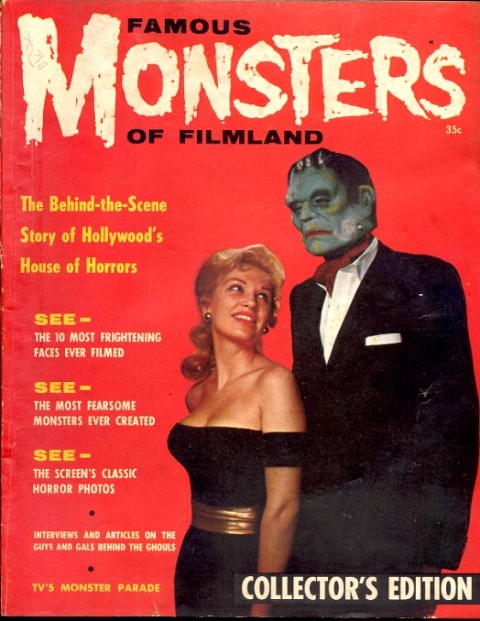
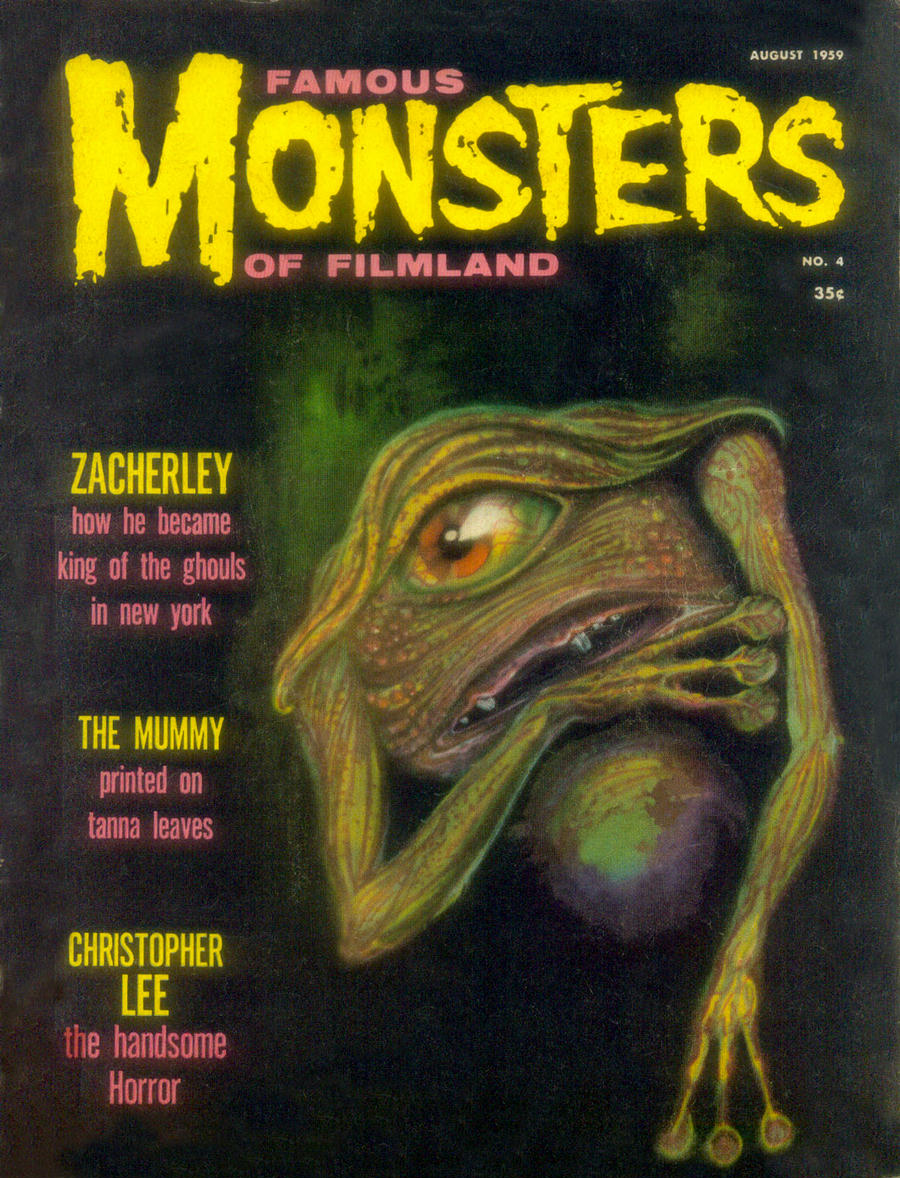
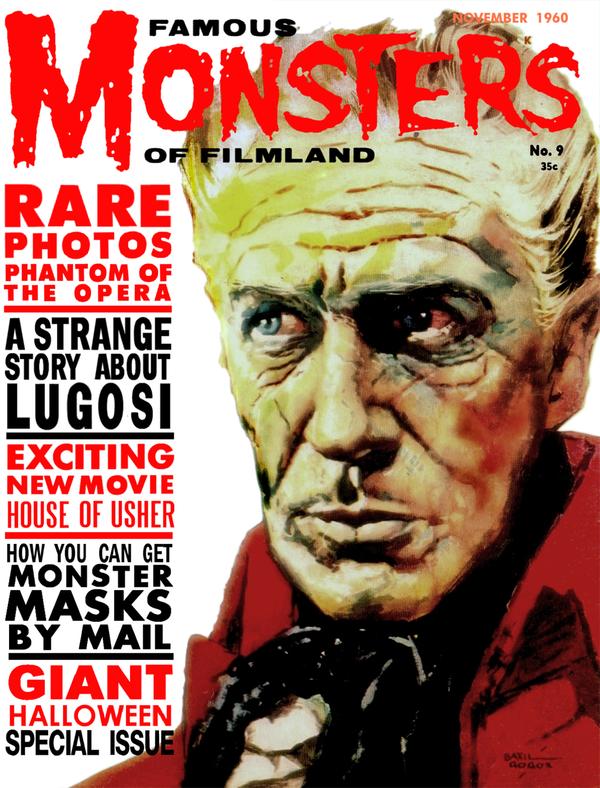
The third, and in many ways most important event was when I discovered the first issue of Famous Monsters of Filmland at a newsstand in February of 1958 and actually had enough money (35 cents!) on me to buy it. I couldn’t believe that such a magazine existed, but to me the fact that it did justified my love of these films and their world. This was something tangible I could hold in my hands. Famous Monsters was created, written and edited by Forrest J Ackerman, who for some reason didn’t punctuate his middle initial. It was intended as a one-shot, but proved so popular that 191 issues of the initial incarnation of the magazine were published between 1958 and 1983. I bought every issue between 1958 and 1962, when I started college, and then sporadically thereafter, until, in an act of stunning stupidity and lack of foresight, sold my entire collection for something like $20. I probably needed beer money.

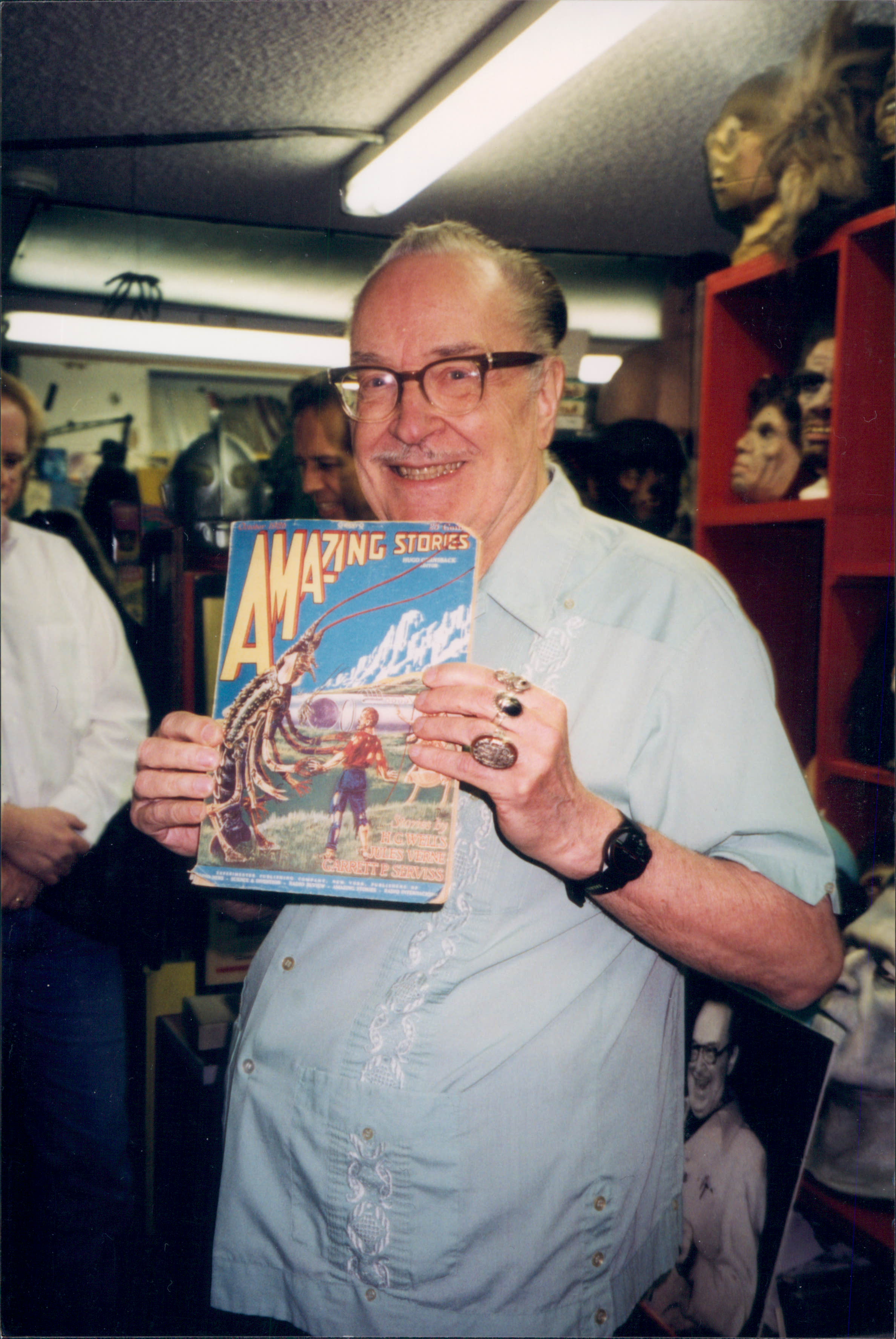
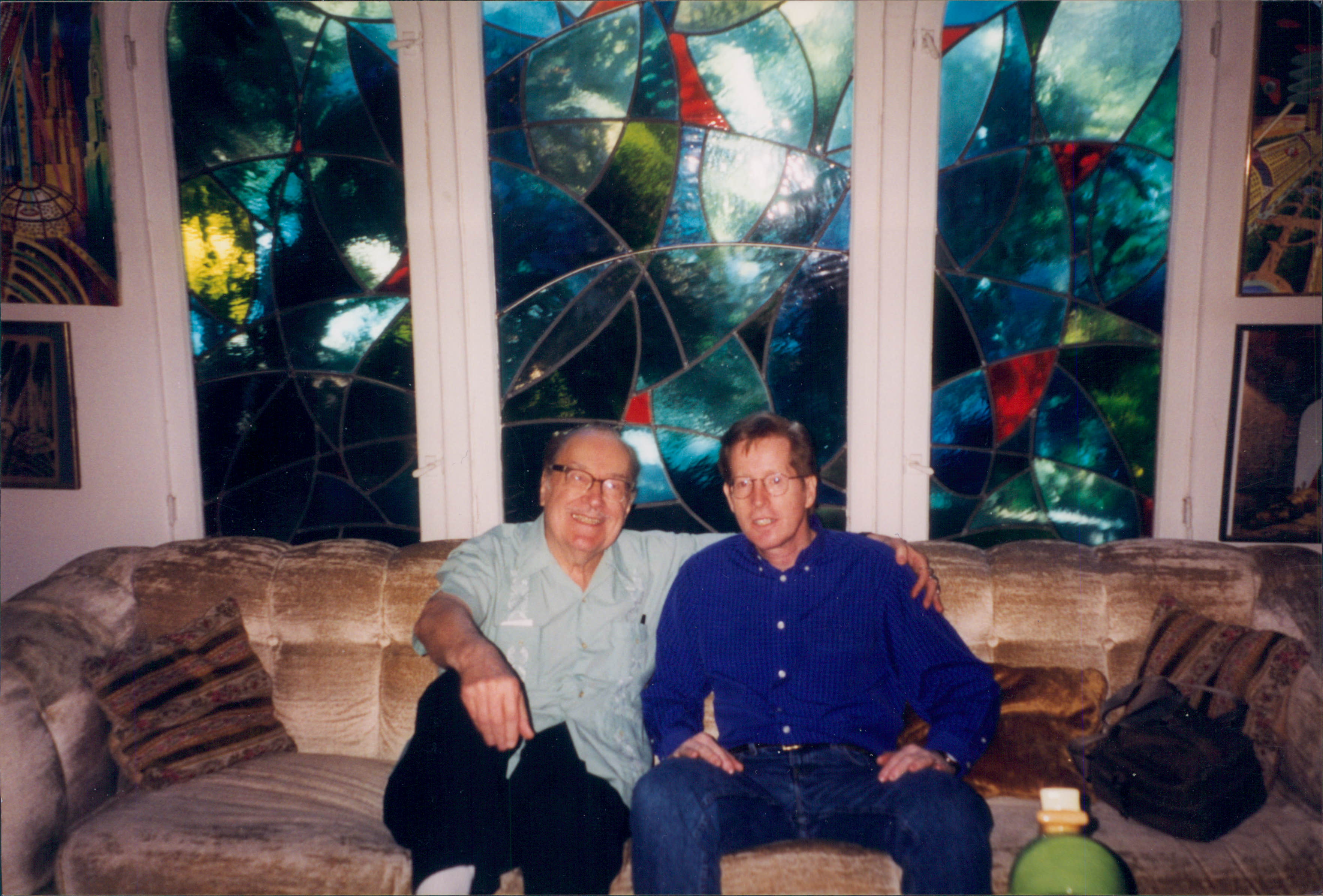
“Forry” Ackerman was quite a character. He was born in 1916 and died in 2008 at age 92. In between he’d been deeply involved, to put it mildly, in the science-fiction world as an agent (Ray Bradbury was a client), author, editor, actor, one of the strongest boosters ever of science fiction & fantasy in print and film (he coined the term “sci-fi”), and was a major collector of sci-fi/horror memorabilia of all kinds in amazing quantities. But he’s probably best remembered for Famous Monsters, which was an acknowledged inspiration for filmmakers and writers such as Steven Spielberg, Joe Dante, Peter Jackson, Tim Burton, Stephen King, Danny Elfman, and many others. (Check out his Wikipedia entry for much more, including the priceless detail that when he was very ill he told Joe Dante that he couldn’t die until he voted for Obama for president, which he did.)

The first time I got to meet Forrest Ackerman was in December 1987 when he decided to auction a large chunk of his collection in New York to raise money for, as I recall, his wife’s considerable medical expenses. I went to a preview night at the Puck Building, where he was scheduled to give a talk. It was amazing to be there. Besides rare posters, manuscripts, stills, props and costumes, I also saw – and was able to handle – items such as Bela Lugosi’s drivers license and SAG card. It seemed amazing, and a little sad, that this ephemera of Lugosi’s life was now up for sale. Later I stood in line to be received by Forry. It was like waiting to see Santa Claus at Macy’s, or maybe the Pope. What I remember when my turn came was when he pointed out that a ring on his finger had been worn by Boris Karloff in The Mummy. I was awestruck. It was a great night, seeing all these pieces of movie history and Forrest J Ackerman in the flesh.

The second time I saw him was in 1998 when I flew to Los Angeles for a job interview. The interview was Thursday and Friday, with Saturday a free day before returning to New York on Sunday. I remembered reading that Ackerman usually held open house on Saturday mornings at his home, the “Ackermansion.”  Before coming out I called and heard a recorded message with the details, so I knew he was still hosting these events. Despite being nearly as freaked out by having to drive a rental car on California freeways as I was when I saw The Thing years before, I somehow found my way to his home in the Hollywood Hills, and managed to park safely on the narrow, winding street.

There were twenty or more people gathered outside his house waiting for 11am, when the open house was scheduled to begin. At the appointed time an appropriately spooky recording invited us to go around to the back entrance. As we walked to the door, I saw Forry through a side window, moving clothing from a washer to a dryer. He was doing his laundry! I thought this was really great.

Soon he came to the door and invited us in. We were in the lower level of the house, which was stuffed wall to wall and floor to ceiling with props, posters, death masks, books, models, everything. He gave us the full tour. Between 1951 and 2002, Ackerman welcomed some 50,000 fans like myself into his home on such tours of his world. Eventually he said to follow him upstairs and he’d tell us some stories. Which he proceeded to do as we gathered around, listening and asking questions as he related anecdotes about his encounters with Karloff and Lugosi and many others.

At one point I asked if it was true that Bela Lugosi had been buried in his Dracula cape. He replied that there had actually been three capes. Lugosi was indeed buried in one, and his brother had the second. Then Forry’s eyes lit up and he proclaimed, “And I’ve got the third!” He jumped up, went to a closet where he pulled out the cape and whipped it on in classic vampire style. True story.

I was sad when I heard of his death on December 4, 2008. Because of failing health, he had stopped giving tours of his home some years before, so I felt lucky to have been included. He brought a kid’s enthusiasm to what he loved, and passed that on to thousands of people. I was one of them. – Ted Hicks

Posted in Film, Home Video, TV | 117 Comments

What I Saw Last Week – 5/6 to 5/12/12

Sunday, May 6. First Position at the Elinor Bunin Monroe Film Center. Director/Producer: Bess Kargman. This award-winning documentary, which follows six young ballet dancers as they prepare for the final round of the Youth America Grand Prix dance competition, intends to be inspiring, and it is. It’s impossible not to get involved with these young people. They come from vastly different backgrounds, and range in age from 10 to 17. The filmmakers followed them for a year, in their homes and rehearsal studios in locales around the globe. There are tears and set-backs, as you would expect, and the final competition at City Center in New York is a nail-biter, but it all pays off in the end. A DVD release is expected in the fall, and it’s available now on Video on Demand, if you can’t see it in a theater.

Monday, May 7. Climates (2006) at the Walter Reade Theater. Director/Writer: Nuri Bilge Ceylon (Distant – 2002, Once Upon a Time in Anatolia – 2011). I first saw this at the NY Film Festival in 2006, and was really knocked out by it. Climates was being shown last week as part of a Turkish film series at the Walter Reade Theater, so I thought I’d see it again. It holds up well. The film opens with Isa, a college professor, and his girlfriend, Bahar, who works on a television series, on vacation at the sea shore. From the start it’s obvious their relationship is in trouble. They break up on the way back to Istanbul, and the film follows Isa as he attempts to get back together with Bahar. Ceylon favors long takes, entire scenes shot with single-camera set-ups. The pacing is deliberate, though I didn’t find it slow. Ceylon is one of a number of very interesting Turkish directors working today. Besides Ceylon’s films, I especially like those of Fatih Akin. I’ve seen three of his films, Head-On (2004), The Edge of Heaven (2007), and Soul Kitchen (2009), each of them excellent. They have a different kind of energy — punchier, faster — than Ceylon’s, which are more cerebral. Climates is available on home video through Amazon Instant Video and Netflix.

Tuesday, May 8. Bernie at Lincoln Plaza Cinemas. Director/Co-Writer: Richard Linklater. Jack Black can be too much for me at times, but he’s great as the title character in this film, which is based on a true story set in Carthage, Texas in the mid-1990s. Bernie Tiede is an assistant funeral director, and the best-loved man in town, always helping others in every way possible. He befriends recently widowed Marjorie Nugent (Shirley MacLaine, very convincing as possibly the most-hated woman in town) and becomes her close companion before shooting her four times in the back, then stuffing her body in a food freezer in the garage, where she was found nine months later. Matthew McConaughy plays Danny Buck Davidson, the DA who brings Bernie to trial. His performance seemed a bit exaggerated at first, but didn’t bother me later on (McConaughy was terrific in last year’s Lincoln Lawyer). Interviews with actual residents of Carthage commenting on the story are interspersed throughout, comprising approximately 40% of the running time. The mixture of documentary with dramatized events has an unusual effect. What is this we’re seeing, really? I found the movie fascinating.

Thursday, May 10. Polisse at the Broadway Screening Room. Director/Co-Writer: Maïween (full name: Maïween LeBesco). This film (the title is a child’s spelling of “police”) focuses on the Child Protection Unit (CPU) of the Paris police department. Since the CPU investigates cases of children who’ve been abused sexually, physically, and emotionally, the experience of the film is intense, to say the least. There are no extended car chases, no shootouts; it’s not that kind of cop movie. The members of the CPU, male and female, form a close-knit family. We see them at work, at meals, after hours in bars and at parties, and sometimes at each others’ throats. The film really takes you through all this. We get to know these people, empathize with them and care about them. Polisse might sound like a downer, but it wasn’t for me. I’m exhilarated by filmmaking like this, that pushes me back in my seat and really gets my attention. ** Polisse opens on Friday, May 18 in New York.  UPDATE: Polisse will be available via Video on Demand starting May 25. Also, here’s a link to an interview with the director about the film: http://www.tribecafilm.com/news-features/Polisse_Maiwenn.html#.T7QArL_R2oA 

Friday, May 11. Dark Shadows at AMC Loews 84th Street. Director: Tim Burton. As a big fan of the original Dark Shadows TV series, as well as Tim Burton and Johnny Depp, I obviously had no choice but to see this new version. I was apprehensive, though, since the trailers indicated a jokey, campy approach. As laughable as the series could sometimes be — shot live on tape with no retakes, with every miscue, shaky tombstone, and exposed mic boom preserved for posterity — the intentions were still serious. But I always trust Tim Burton to bring something special to the party, especially in his films with Johnny Depp. Theirs is one of the great director/actor collaborations. Okay, so how was this one? I liked the first half quite a lot, and Johnny Depp is great throughout. But after a promising set up, the story lets down badly, becomes rushed and chaotic. That said, there’s still a lot to like. After being turned into a vampire and chained in a coffin for 200 years, Depp’s Barnabas Collins is released to find himself in 1972. This undead-stranger-in-a-strange-land premise is probably the most interesting thing about Dark Shadows, and Burton uses the period for all it’s worth. I just wish it had been a better movie overall.

Saturday, May 12. Grand Illusion (1937) at Film Forum. Director: Jean Renoir. One of my all-time favorite films, and one of the greatest films ever made. Seriously. The print being shown was made from a digital 4K restoration of the original nitrate negative, long thought lost, but which had been in a film archive in Moscow since 1945. The negative was used for the previous restoration in 1997, which was excellent, but this one is even better. Grand Illusion follows three French flyers (Jean Gabin, Marcel Dalio, Pierre Fresnay) in World War I through their captivity and attempts to escape from German prison camps. Erich von Stroheim plays the commandant of their final prison, a castle in the mountains. The performances are excellent. The anti-war message never hits you over the head, but is implicit in the humanity that permeates the film. There’s little I can say about Grand Illusion that hasn’t already been said. You’ve probably seen it at least once, so you already know how good it is. If you haven’t seen it, it’s showing at Film Forum through May 24, and is also available on DVD. I envy anyone seeing this film for the first time. – Ted Hicks

Posted in Film, Home Video | 5 Comments

“Teddy Bear”

I have some hesitancy writing about a film that’s not opening in NYC until late August, but I liked Teddy Bear so much when I saw it this past March at the New Directors/New Films series that I wanted to post something about it now. It’s about a Danish body builder named Dennis, who still lives with his mother at age 38. Dennis is played by Kim Kold, a real-life body builder (it would be pretty difficult for a regular actor to appear this pumped up without CGI). He’s as developed as Arnold Schwarzenegger was when he was in Pumping Iron (1977). In other words, really impressive, but a little freakish.

He’s a hulking figure, quiet, shy, and nervous around women, though he’d like to have a girlfriend in his life. His mother, Ingrid (Elsbeth Steentoft), possessive and controlling, obviously hasn’t given much support in this regard. Tiny and seemingly fragile, she wants Dennis all to herself, and becomes petulant when he has plans to go out or do anything that doesn’t include her, laying on passive-aggressive guilt trips (“You haven’t done your chores,” etc).

It treads close to cliché, that of the sad, gentle giant, basically a child, dominated and infantilized by his mother and regarded as something of a freak by those around him who often want to see him pose and show his muscles. The title Teddy Bear would seem to reinforce this image, but the film has a more dry-eyed, objective point of view. I felt sympathy for Dennis, but not pity.

The film opens with Dennis on an increasingly awkward dinner date with a woman from his health club. On his return home, his mother demands to know where he’s been, and he tells her he saw a movie with a friend, the first of many lies he tells Ingrid during the film to avoid her anger and disapproval. She frequently accuses Dennis of being “just like your father.” We know nothing of the father, who is long gone when the film begins, but it’s doubtful this was ever a Leave It to Beaver household. A brief scene in their bathroom at home shows Dennis in the shower while his mother uses the toilet in the foreground. There’s nothing sexual about this; it’s just very weird and inappropriate.

Dennis and his mother attend a dinner party for his Uncle Bent, just returned from Southeast Asia with a Thai bride on his arm. Soon Dennis, with pointers from his uncle and information from the Internet, heads off to Thailand himself, telling his mother he’s going to be in a bodybuilding competition in Germany. His time in Thailand is central to the film. At first he encounters prostitutes, courtesy of Uncle Bent’s friend Scott, a rather gross expatriate who runs a bar. But when he meets a widow who manages a gym where Dennis goes to work out, it’s a different story.

Once back in Denmark, Dennis has to face up to the consequences of his choices and what to tell his mother. The film ends in a very satisfying way, but this is not your typical Hollywood romantic comedy, with everything wrapped up by the end. It doesn’t lead us around and tell us what to think. There are interesting twists and turns along the way.

Teddy Bear is a first feature directed and co-written by Mads Mattiesen, who received the Directing Award in the World Cinema – Dramatic category at the Sundance Film Festival earlier this year. It opens at Film Forum in NYC this August 22 for a 2-week run. This is definitely not a multiplex movie, and will probably be shown in art houses and smaller theaters in other cities. And there will be a home video release eventually. In the meantime, here’s the trailer:

Teddy Bear is based on a short film made by the director in 2007 called Dennis, which sets up the basic dynamic of the mother/son relationship and Dennis’ longing for something more. It’s about 18 minutes long, and here it is! – Ted Hicks

Posted in Film | 3 Comments

What I Saw Last Week – 4/30 to 5/5/12

Monday, April 30. The Raven at AMC Loews 84th Street. Directed by James McTeigue (V for Vendetta, 2006). Not so good. John Cusack is credible as Edgar Allan Poe spending the last several days of his life trying to track down a serial killer who is using Poe’s stories as inspiration. Cusack is a very good actor, and I would like to have seen him as Poe in a better movie. This one is all over the place. I saw it a week ago, and I can’t even remember what the killer’s motivation was. Brendan Gleeson is good as the antagonistic father of Poe’s love interest, as is Luke Evans as a Baltimore policeman employing some pre-CSI forensic methods, and there is some interesting atmosphere from time to time. But that’s not enough, I’m afraid.

Wednesday, May 2. Bonjour Tristesse (1958)at Film Forum. Directed by Otto Preminger. Didn’t like it as much as the first time I saw it, but it’s still a very interesting film. Starring Jean Seberg (a very strong presence in her second film role) and David Niven as her playboy father, with Deborah Kerr as the woman who threatens to upset their free-living life style on the French Riviera. This is a DCP (Digital Cinema Package) restoration, so the picture is clean and crisp to an almost surreal degree. Showing at Film Forum in NYC through Thursday, May 10. Also showing on TCM on Sunday, June 17 @ 10:00 am EST.

Thursday, May 3. I Wish at the Broadway Screening Room. Director/Writer: Hirozaki Kore-eda, 2011. This Japanese film is wonderful. Koichi, 12 years-old, lives with his divorced mother and grandparents, while his younger brother Ryu lives with their father many miles away. Koichi’s efforts to see his brother and reunite his parents motivate the story. I liked the film from the start, but it really kicked in for me at about the half-way mark, and then I was totally with it. An active volcano, a new bullet-train line, and the kindness of strangers play important parts along the way. I Wish opens this Friday, May 11 in New York and Los Angeles. The performances are amazing. I can’t recommend it enough.

Friday, May 4. The Avengers at AMC Loews 84th Street. Director/Co-Writer: Joss Whedon. It’s a little unwieldy at times, but I basically loved it. Joss Whedon was the main draw for me, as I’m a big fan of his TV work,  especially Buffy the Vampire Slayer. He’s great with dialogue and messing with genre expectations in very inventive ways. The strongest parts of The Avengers — more so than the action set-pieces — are when this mismatched group of superheroes, and the egos and anxieties they bring with them, are just standing around talking. Whedon can take what would be otherwise preposterous situations and make them believable through dialogue and real emotions. Okay, I know we’ve been overrun by too many comic book superhero movies with increasingly elaborate special effects, but this one is definitely several cuts above the rest. See it, and add to the $200 million dollars it’s already taken in this weekend. P.S. The end credits go on for a very long time, and you’ll want to leave before they’re over (as I nearly did). But try to hang in all the way through, because there’s a really great scene tagged on at the end. Trust me, it’s worth it.

Saturday, May 5. Marnie (1964) at the IFC Center. Directed by Alfred Hitchcock. Didn’t like it when I saw it in ’58, and seeing it again has done nothing to change my mind. Hitchcock has made some truly great films (Vertigo, Shadow of a Doubt, and Psycho, to name but three), but I think Marnie fails badly. Seeing Sean Connery in the midst of his James Bond career has its interest, but the psychology of the film is simplistic and heavy-handed. Not to mention Hitchcock’s penchant for obviously painted backdrops and rear-projection during scenes of people driving in cars and horseback riding. I know this was a common practice in the past, but its really distracting in this film. On the plus side, the digital projection makes it look like it’s brand new. That’s not enough reason to see it, though. But if you must, the Museum of the Moving Image in Astoria is showing it on the big screen on Saturday, May 12 @ 2:00 pm.

****************************************************************************************

Well, three good films out of five isn’t a bad average. See you next time. – Ted Hicks

Posted in Film, Home Video | 6 Comments

A Look Back at “The Station Agent”

If you saw The Station Agent when it was released in 2003, you know how special it is. This was Writer-Director Tom McCarthy’s first feature. He has followed up with two strong films since, The Visitor (2008) and Win Win (2011), writing and directing both, as well as having a story credit for the great Disney/Pixar animated feature Up (2009). I remember how surprised I was when I found out that he was the same Tom McCarthy I’d been seeing as an actor in many films, such as Good Night and Good Luck, Syriana, Flags of Our Fathers, The Lovely Bones, and especially the HBO series The Wire in it’s fifth and final season. This was also the film that gave Peter Dinklage what’s been described as his breakout role. His performance received many award nominations and wins, as did the film itself. He’s currently in the excellent HBO series Game of Thrones, where his character, Tyrion Lannister, has emerged as the star of the show, as well as winning him an Emmy and Golden Globe for the first season.

The Station Agent is a beautiful study of three people, each alone and alienated in his or her own way, whose paths cross in a lazy, wayward town in New Jersey where little seems to happen. Finbar McBride (Peter Dinklage), is a dwarf with a love of trains who has inherited a deserted railway station in Newfoundland, NJ from his employer at a model train shop in Hoboken.

Fin says little, is monosyllabic when he does, and is only too happy to keep to himself. Olivia Harris (Patricia Clarkson) is an artist – a painter – living alone in a large house, mourning the accidental death of her young son and the break-up of her marriage. Joe Oramas (a terrific Bobby Cannavale) is a young Cuban guy from New York who is running his father’s donut & coffee van while the father recovers from an illness.

Station Agent-trioIt’s Joe who gets the ball rolling as he tries to connect with Olivia, who buys coffee from him every day, and newcomer Fin, who is living in the nearby abandoned station. They both initially resist Joe’s motor-mouth personality.

Also figuring into the story are Cleo (Raven Goodwin), a young black girl who gets to know Fin and eventually breaks down his resistance to talking about trains when she persuades him to speak to her high school class, and Emily (Michelle Williams), the pretty town librarian who becomes Fin’s friend, and maybe his girlfriend.

The story is driven by character rather than plot. Scenes seems to drift from one to the next in a very quiet, understated way. It’s all very simple and spare, but I found the effect to be quite powerful. The character of Fin, and the performance of Peter Dinklage, solidly anchor the film. His face reveals little emotion, particularly at first, but we read it in his eyes. His life-long frustration at being defined by his dwarfism in most people’s eyes is obvious, but what’s great here is that none of the main characters mention it at all; it’s a non-issue for them.

Fin is a gentle, dignified, and decent man, and there’s something heroic about him, though he starts off wrapped pretty tight. The film touches on what I think is a very universal human need and desire to connect with other people. This is present throughout the film, the subtext of nearly every scene, and is occasionally felt in raw and heartbreaking moments. That said, The Station Agent avoids the sentimentality that could have been brought out by less subtle and creative filmmakers. There is drama and conflict, but it feels real and uncontrived, and things are not necessarily resolved or otherwise neatly wrapped up in a Hollywood feel-good way at the end. Though I certainly did “feel good” when it was over, a feeling I think was honestly earned by the film.

The values of friendship, respect, loyalty and love, are presented here in a very powerful way. The positive difference these characters make in each other’s lives, by reaching out, even if initially rebuffed, has an almost spiritual quality.

The following trailer conveys the tone of the film pretty well.

The Station Agent is available via Neflix and for sale at Amazon.com for the ridiculously low price of $6.99. If you haven’t seen it, you probably should. If you have, see it again. – Ted Hicks

Posted in Film, Home Video | 6 Comments

Starting Out

I realize the world hardly needs another blog about anything, but I’m going to take a run at it anyway. I plan to write mainly about movies, and also television, books, or anything else that gets my attention that I feel compelled to pass along. I love movies of all kinds, shapes and sizes, from truly great films, e.g. Children of Paradise, Tokyo Story, and Grand Illusion, to the truly bizarre, e.g. the totally inept yet strangely wonderful Plan 9 from Outer Space. I’ll try to be entertaining and informative, whether writing about old films or new. Hopefully readers (assuming there are any) will let me know how I’m doing with this goal.

Some of the directors and films I like include Stanley Kubrick (The Killing, Paths of Glory, 2001: A Space Odyssey, Barry Lyndon); Buster Keaton (all the silents, especially The General); Robert Altman, John Frankenheimer, Alexander Payne (The Descendants); Steven Soderbergh; Orson Welles; John Huston; Terrence Malick (The Thin Red Line & The Tree of Life); David Cronenberg; Michael Powell; Sam Peckinpah (Ride the High Country & The Wild Bunch); Martin Scorsese! And Warner Bros. cartoons, especially the ones directed by Chuck Jones. It goes on and on and on. But this should give you some idea.

I’ll start posting reviews soon, but in the meantime, films currently playing in NYC (and hopefully elsewhere, either now or soon) that I highly recommend include the following: Gerhard Richter Painting (fascinating documentary about a great painter); Footnote (father & son Talmud scholars with radically different approaches and their struggle – a thriller of sorts); A Separation (Best Foreign Film Oscar, a great Iranian film); Monsieur Lazhar (French-Canadian film about an Algerian substitute teacher in Montreal); The Cabin in the Woods (terrific genre-bending film that turns horror-film conventions inside out – several times, co-written and produced by Joss Whedon).

Also, Headhunters, a Norwegian film I saw at a screening earlier this year, is opening this Friday. It’s really good; I plan to see it again. Here’s a trailer:

Posted in Books, Film, Home Video, TV | 3 Comments