“Coherence” – No Exit

Coherence-posterCoherence, an impressive first feature from writer/director James Ward Byrkit, begins with eight long-time friends gathering for a dinner party on the night a comet is passing near the Earth. What follows is a fascinating, maddening mix of The Twilight Zone, Invasion of the Body Snatchers, It Came from Outer Space, The X-Files, the fiction of Philip K. Dick, as well as discussions of quantum decoherence and Schrödinger’s cat. The characters become progressively freaked out and destabilized over the course of a long dark night, and since we never know anymore than they do, it’s like we’re in their shoes. I’ve seen the film twice in two days and I’m still struggling to sort it out, which makes the inside of my head feel like an M. C. Escher drawing wrapped in a Möbius strip. Coherence has stayed with me, and I think it even got into my dreams a couple of nights ago. I love this kind of stuff, especially when it’s done as well as this is. But if you want a story to “make sense” or be resolved by the end, then Coherence is probably not for you. Watching Coherence I was reminded of two films by Shane Carruth, Primer (2004) and Upstream Color (2013). In a post I wrote last year about Upstream ColorI said that both films were “perplexing and demanding, but quite rewarding if you open yourself to them.” This holds true for Coherence as well.

The film opens with a tight over-the-shoulder shot of a woman (we later find out this is Em) driving at night. We don’t see her face, only her right shoulder and a part of her head. The image we see of her goes slightly soft while the dashboard remains in focus. She’s talking on a cell phone to a man, but what he says is unclear, difficult to decipher. She realizes she’s lost the call, then hears a sharp sound and sees with a start that the screen of her phone is now laced with cracks. There’s a struggle for coherence, both visually and aurally, right from the start.

The dinner party is at the home of Mike (Nicholas Brendon) and his wife Lee (Lorene Scafaria), located in the Willow Glen neighborhood of San Jose, California. Their guests are Em (Emily Foxler) and her boyfriend Kevin (Maury Sterling), Hugh (Hugo Armstrong) and his wife Beth (Elizabeth Gracen), and late arrivals Amir (Alex Manugian) and his date Laurie (Lauren Maher). We slowly get a sense of the various connections and tensions between these people.

The performances are excellent throughout, and the actors play it absolutely straight as they deal with panic and paranoia. The increasingly insane situation is all the more disturbing because of the conviction they bring to their roles. It’s nuts, but it feels real.  The cast was unfamiliar to me with the exception of Nicholas Brendon, who played Xander Harris for seven seasons (1997-2003) on Joss Whedon’s great television series, Buffy the Vampire Slayer (a joke in Coherence is that Brendon’s character Mike is an actor who had been on a popular TV series, Roswell – which was a real show, though Brendon was not on it).

Seeds are planted early that provide clues (possibly) to events that follow. At the dinner table the passing comet – “Miller’s Comet” – is mentioned. Em relates that after a comet passed over Finland in 1923, many residents didn’t know who they were, couldn’t find their homes, and that a woman called police to say that the man in her house was not her husband. She claimed she was certain of this because the day before she had killed her real husband, and this guy wasn’t him. Mike jokes that now she can kill him again. It turns out that the screen of everyone’s cell phone is cracked like Em’s, and that no one has cell service, nor is there Internet service. Then the power goes out. They look outside and see the entire neighborhood is dark, except for one house a few blocks down the road.

Events become increasingly strange and disturbing. Has the comet somehow created at least two sets of the same people and houses? As they struggle to make sense of what’s happening, cause and effect become totally scrambled. For these eight people it’s the worst acid trip ever as they try to figure out who are the “visitors,” them or us?

Coherence-still3Coherence is proof that filmmakers don’t need a big budget to do terrific work. The film was reportedly shot in chronological sequence in basically a single location with a cast of eight, one or two cameras and two sound guys. The actors were given limited information about what would happen next, resulting in performances and interactions that feel natural and authentic, almost like we’re watching a documentary. James Ward Byrkit has created a small gem, thought-provoking and challenging. I’m really looking forward to what he does next. – Ted Hicks

Coherence opens in limited release in New York City and Los Angeles this Friday, June 20, with additional theatrical dates to follow. It will also be available for instant streaming and HD downloads beginning August 5, 2014.

Posted in Film, Home Video | 6 Comments

Washroom Attendant to the Stars: My Technicolor Years

Technicolor logoWhen I graduated from the University of Iowa in the summer of 1973 (with an awesome “General Studies” degree), I moved to Minneapolis. Not long after arriving I managed to land a job with a motion picture lab that did work mainly for producers of TV spots and industrial films. I’d taken film studies and production courses at Iowa, but I think that what actually got me this job was having worked in a facility that processed and printed aerial reconnaissance film during the four years I was in the Air Force. Thus began my employment in a series of film labs over the next fifteen years or so, with my nine years at Technicolor being the most interesting by far.

For a long time I’d envisioned a life of making movies, of being involved with them in some way. But this was more of a wish, a fantasy, than anything that seemed remotely possible for an Iowa farm boy. Making short films and taking film studies courses in college fed that fantasy to a degree, but I think I was waiting for something to happen (rather than trying to figure out how to make it happen). Working in a 16mm lab in Minneapolis didn’t exactly fill the bill, but I was working with interesting people, many of whom became friends. And it was film, images on strips of celluloid. This was undeniably the film world (sort of), though I was on the periphery.

I moved to New York City in 1977 for another lab job, but this lab handled 35mm and occasionally made prints of feature films, some of them pornos (Inside Jennifer Wells, anyone?). This felt more like the real movie business, but the job turned out to be a disaster. The only time I’ve ever been fired from a job was this one, which was probably a good thing, since it would have taken me a lot longer to work up the nerve to quit on my own. But I’ve always thought, yeah, it was a terrible job, but it got me to New York, where I’ve been for 37 years.

I got the job with Technicolor a year later. The name itself had UA logostrong recognition value, and I felt that now I had a real connection to the film world. At the previous labs I’d been an expeditor as well as working in customer service. At Technicolor there were four or five expeditors who handled separate accounts. I was assisting a man from the Bronx named Joe Fratangelo, who had the United Artists account. I thought, “Wow! United Artists!” This felt like I was working for Cadillac instead of some place that made go-karts.

Joe Frat was an interesting guy. He really got my attention one day when Al Pacino was in the lab. Joe mentioned casually that years before, he and his wife would babysit Pacino in their home. I guess this is normal stuff and no big deal when you’re just part of it, but I was impressed.

Aside from the kick I got from being able to say I was working on the UA account at Technicolor, what I was really doing was writing up 16mm print orders of UA titles and helping Joe make sure schedules were met. This was before VHS had taken hold, let alone DVDs, so if a television station in Cincinnati was going to run Breakheart Pass, for example, they’d have to order a 16mm print from us. Super-8mm prints of features were also made to show on airlines. This all seems unbelievably bulky and inefficient now, but digital formats were still in the future.

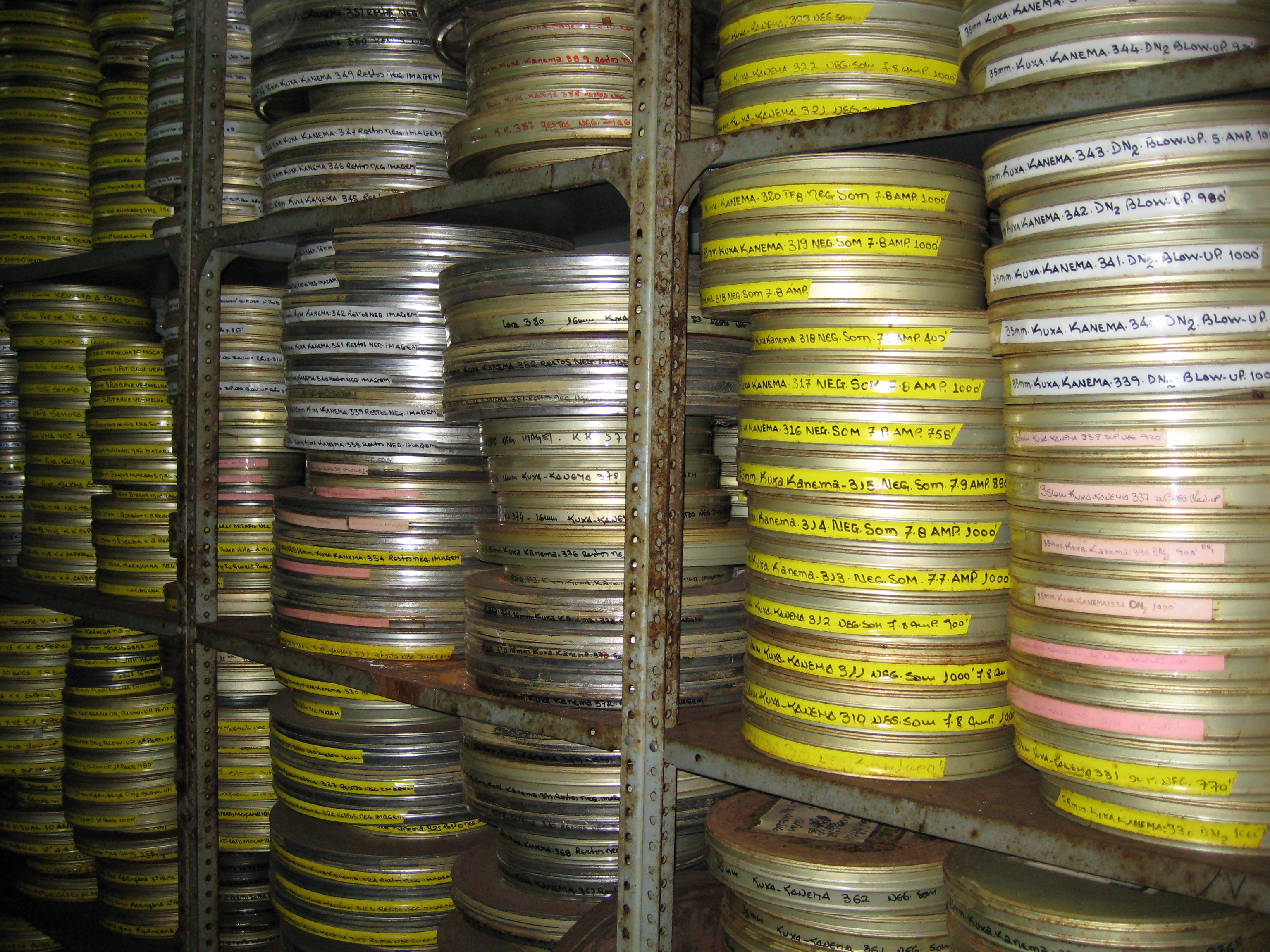
Print elements for films (35mm & 16mm picture negatives and sound tracks) were stored in a vault in cans on racks that looked exactly like those in the photo below. This doesn’t show Technicolor’s vault, but it could have been. The vault at Technicolor is also where I kept my bicycle, which I rode nearly everyday from my from my apartment on West 92nd Street down to the lab at 321 West 44th.

Film can neg storageAt that time there were at least seven other labs in the city. Most of them are now long gone. DuArt Film Lab, where I worked briefly after Technicolor, is still here, but stopped processing film entirely in late 2010. This is ironic, since DuArt’s motto — displayed on t-shirts and shopping bags, and I think even on the side of their building — was “Shoot Film.” Before digital all major features were shot on 35mm, and until the late 80s all feature dailies were printed on film.

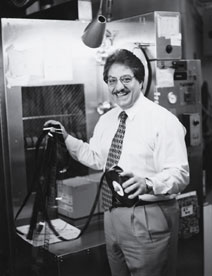
Joe Violante

Joe Violante

Maybe my end of it was the equivalent of working in a sausage factory, but across the hall from us was the dailies department office, which was run by Otto Paoloni and Joe Violante (aka “Joey V”). Any feature film that used Technicolor to process and print its 35mm footage went through this department. The printed footage, called “dailies,” would be shown to filmmakers in a small theater down the hall.

Otto and Joey V were great guys who befriended me and didn’t seem to mind all the time I spent hanging out in their office (which I did a lot of, despite Otto’s penchant for noxious-smelling cigars). I would have killed to be doing the work they were doing, and wanted to find out as much about it as I could. One of the biggest unofficial perks for me was that Otto and Joey V would let me read shooting scripts for features that were going through the lab. Another was being able to watch dailies before the filmmakers saw them. This was on the third floor where the processing and printing machines were, as well as negative cutting and assembly. There was a room with four or five high-speed projectors where Joey and Otto would view dailies fresh out of processing and printing to make sure there weren’t any technical problems. An older woman named Olga operated one of the projectors. She would often put her hand over the lens if there was any nudity in the footage, which was frustrating to the guys who had clustered in the doorway to watch. Everyone on the floor always seemed to know when such footage was about to be projected.

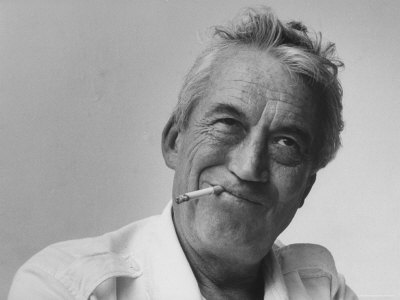
John Huston

John Huston

Sydney Pollack

Sydney Pollack

Having access to all of this was like having an inside track on at least part of the filmmaking process. This felt especially true when I’d catch sight of directors and actors who came in to screen dailies in the little theater down the hall. When John Huston was directing Annie (1982) I followed him out to the elevators and told him how much I loved his films. He thanked me with that voice of his and stuck out his hand for me to shake. Or when I spoke with Sidney Pollack while he waited outside the dailies theater. He was directing Tootsie (1982) at the time. I asked him how he liked the New Balance 990 running shoes he was wearing, hoping he’d think I was one of the guys instead of a nervous movie buff. The truth of it is that I was constantly amazed to be around these people and this world. I felt less intimidated approaching them in the lab than I would have on the street. It seemed somehow more legitimate.

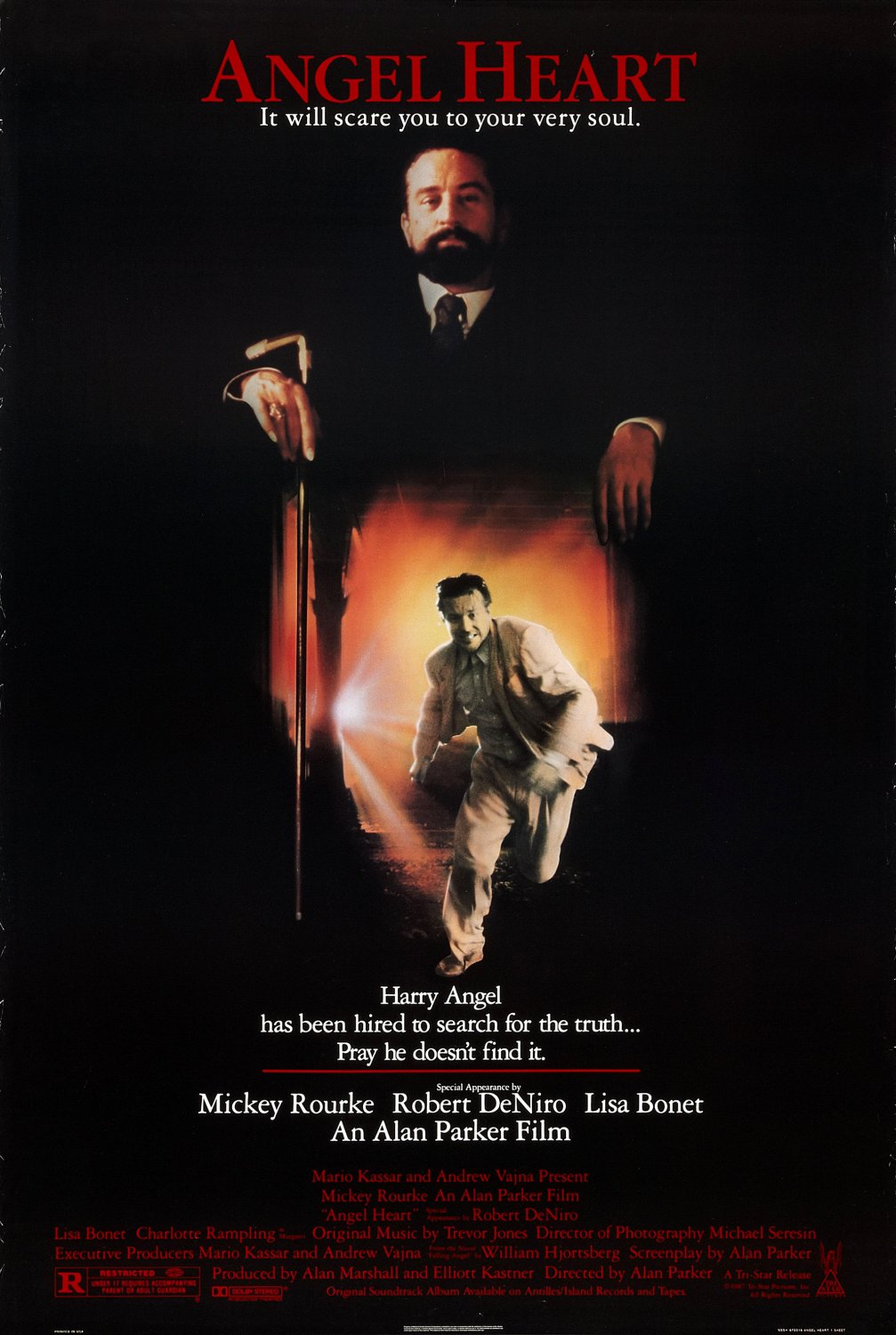
Angel Heart-posterI’d be reading shooting scripts usually months before the finished films would be released (obviously the idea of “spoilers” didn’t bother me too much). Except for the time I finished reading the script for Alan Parker’s Angel Heart (1987) just seconds before the lights went down at a screening of that film. This had a disorienting effect, as though there was the movie on one screen and the pages of the script on a screen right beside it. I don’t recommend this approach. Angel Heart wasn’t any good, but this didn’t help.

But it was always interesting and instructive to compare the shooting scripts with what ended up on the screen. This was especially true with Milos Forman’s Ragtime (1981). The screenplay by Michael Weller was one of the best I’d ever read. Besides being an excellent adaptation of the novel by E.L. Doctorow, it was a real pleasure to read just for itself. So it was quite a surprise when I finally saw Ragtime in a theater and discovered that every scene in the film was better than in the script. Milos Forman obviously made the difference. It takes a great director to improve on an already great script.

Milos Forman (R) directing Elizabeth McGovern in "Ragtime"

Milos Forman (R) directing Elizabeth McGovern in “Ragtime”

Otto lived in New Jersey and Joey on Staten Island, so they would usually give me invitations they’d received for evening screenings rather than come back to the city after having already gone home, especially since they’d been in the lab since 5:30 or 6:00 that morning to see dailies from the night before. I loved seeing films before they were released; it made me feel like I was ahead of the curve in some way that probably doesn’t really matter all that much. But there it was.

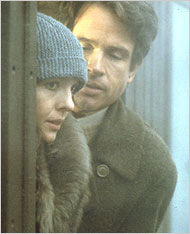
Diane Keaton & Warren Beatty - "Reds"

Diane Keaton & Warren Beatty – “Reds”

They’d also pass on invites to the wrap parties that would take place shortly after a feature had finished shooting. The wrap party for Warren Beatty’s Reds (1981) was different. It was was held a month or two after the film had been released in theaters. So it wasn’t really a “wrap” party, but it was definitely a party, and promised to be fairly elaborate. It was being held in a theater with a band (Southside Johnny and the Asbury Jukes, if you remember them), dancing, food, and a large area in the lobby space with an open bar. I saw a bearded Robert De Niro standing alone at the bar, totally unobtrusive. Usually at these wrap parties it was mostly just the crew that would attend, but this one was clearly a bigger deal. Diane Keaton was there, along with Maureen Stapleton, and the great film editor Dede Allen, to name a few. But something very interesting happened when Warren Beatty showed up. It seemed to me that everyone, without being obvious about it, was totally aware that he was there. It was like the center of gravity in the room had shifted.

For a hard core film buff like myself, seeing actors and directors on a regular basis was more than a little surreal. Sometimes very surreal. Like the time I rode up in the elevator at the lab with Meryl Streep and another person. As were getting off the elevator I suddenly realized this other person was Robert De Niro. They were shooting Falling in Love (1984) at the time. It was weird, but off-screen you hardly noticed him. Or the time Paul Newman appeared in the doorway to our office and asked if he could use the phone at the desk next to mine. His call was mundane stuff, like anyone would make – dinner arrangements, something like that. When he got up to leave I pulled out my usual “I really like your work” line (and meant it). He thanked me and I added, “Especially Buffalo Bill and the Indians.” A beat after he’d left the office he stuck his head back around, gave me a thumbs up and said, “You’re in a minority.” If you’re impressed by stuff like this, which I obviously am, you remember it.

Paul Newman, Sidney Lumet, Lindsay Crouse (left to right), shooting "The Verdict" 1982

Paul Newman, Sidney Lumet, Lindsay Crouse (left to right), shooting “The Verdict” 1982

I realize I still haven’t explained the “Washroom Attendant to the Stars” part of the title for this post. The men’s restroom was just around the corner from our office. The restroom was locked and the key hanging from a hook on the wall near my desk. Anytime someone wanted to use the men’s room, they got the key from me. This was pretty straightforward, but sometimes it got a little more interactive. Liza Minnelli was in the small theater down the hall, probably watching dailies from Arthur (1981). I was startled when she burst into our office and said she needed a restroom. I told her the ladies room was further down the hall near the elevators. She said she didn’t have time and wanted to use the men’s room, which was closer. So what the hell, I went into the restroom and verified that it was empty, then stood guard outside for Liza Minnelli. Anyway, I used to joke about writing something with “Washroom Attendant to the Stars” as the title, and now I’ve done it. – Ted Hicks

(I’ve probably exceeded any acceptable quota for shameless name-dropping in this post, but I hope it’s been interesting.)


Posted in Books, Film, Home Video, TV | 14 Comments

Christopher Walken & Talkin’ (& Dancin’)

Everyone knows Christopher Walken, or thinks they do. He is a singular presence in American film, largely due to his uniquely eccentric line readings and vocal mannerisms, filtered through a frequently deadpan affect. Walken has cultivated this over the years, to the point where I think most people now expect his characters (and Walken himself) to be definitely strange, genuinely weird, and predictably unpredictable. But it took him a while to get there, to go

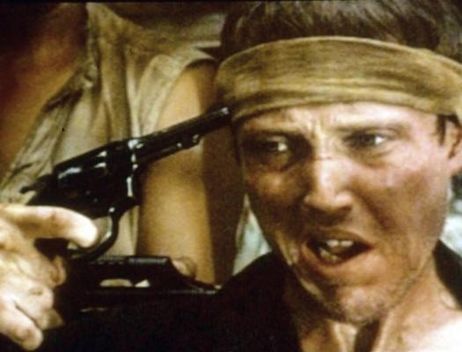
from this…                                               …to this.

Chris Walken3Chris Walken4Walken doesn’t turn down many parts, so he’s been in more than a few second-rate (or simply bad) films during his career, but even in these he gets your attention, because he brings something special to the table in interesting and compelling ways (and sometimes he’s just weird). Walken believes that making movies (whether they turn out good or bad) is always a worthwhile experience (in one way or another). He’s been quoted as saying, “I’ve enjoyed making movies for lots of different reasons. Sometimes, it was the other people. Sometimes, it was the fact that I was really good in it. Sometimes, it was the location. Sometimes, it was the paycheck. Sometimes, it can be lots of different things, or a lot of those things. Or there can be reasons why you’d like to avoid it the next time. Like the jungle. I’ve made a couple of movies in the jungle, and I don’t want to go back to the jungle.”

**************************************************************************************

This post is not intended to be at all comprehensive. I think I’m mainly using it as an excuse to display a variety of clips and stills from Walken films I really like that give a good sense of his range and show just how great an actor he can be when everything is in alignment.

**************************************************************************************

Chris Walken-Next Stop G'wich Village still1The first time I saw Christopher Walken on screen must have been in Paul Mazursky’s Next Stop Greenwich Village (1976), but it was his appearance in Woody Allen’s Annie Hall (1977) that really got my attention. As Annie’s off-kilter brother Duane, he brings an intensely odd vibe to a small but memorable role. Woody’s encounter with Duane culminates in one the funniest payoffs in that film. It’s a short, intense sequence where we can see the Walken persona begin to be defined.

Only a year later he starred, along with Robert DeNiro and Meryl Streep, in The Deer Hunter (1978), Michael Cimino’s epic film of the Vietnam War years. Regarding the impact that film and Annie Hall had on his career, Walken says, “I was already 35 years old, and I’d been in show business for 30-plus years, and suddenly there was this big Chris Walken5movie and I was getting an Oscar, and this enormous thing happened. In Annie Hall I played the strange brother who wanted to drive into oncoming cars. Immediately after that was The Deer Hunter, where I played this nice guy who shoots himself in the head. Something happened there. The fact that they came so close together, and they were both important movies, two big public things where I was simultaneously . . . ‘disturbed’. That got the ball rolling for me in terms of being an actor.” His role in The Deer Hunter earned Walken an Oscar for Best Supporting Actor. He would subsequently be nominated in the same category for his performance in Steven Spielberg’s Catch Me If You Can (2002).

Christopher Walken was born Ronald Walken on March 31, 1943 in Astoria, Queens to immigrant parents. His mother, Rosalie, came from Scotland and lived to be nearly 103. His father, Paul, was from Germany and operated Walken’s Bakery in Astoria; he died at age 97. Good genes. Walken and his two brothers were child actors on television during the 1950s. In 1953, credited as Ronnie Walken, he got a regular part on a series titled The Wonderful John Acton. In 1963 he changed his name to Christopher because a friend had said he thought that was a better name for him than Ronnie. Walken’s first role (as “The Kid”) in a feature film is with Sean Connery in Sidney Lumet’s heist film, The Anderson Tapes (1971).

Walken initially trained as as dancer before deciding to focus on acting. He’s often been able to utilize this skill in his films, as he ably demonstrates in the following showstopping scene with Bernadette Peters from Pennies from Heaven (1981), lip-syncing to “Let’s Misbehave” while he dances and does a striptease atop a bar. It’s a stunner. (Walken tries to put a little dance number or movement into all of his roles, whether scripted or not.)

In 1982 Christopher Walken appeared with Susan Sarandon in a 60-minute film of Kurt Vonnegut’s short story, Who Am I This Time?, directed by Jonathan Demme for American Playhouse on PBS. Walken plays Harry Nash, a shy, introverted man who works in a hardware store in a small town. He breaks out of his shell whenever he performs in local theater productions. For Harry this is acting out in extreme fashion. Sarandon is Helene Shaw, a new arrival in town working for the phone company. She’s attracted to Harry when she sees him onstage, but is thrown for a loop when she tries to get something going with him offstage. Her solution to this problem is worked out in a very charming way. I haven’t seen this for years, but remember being quite taken with it. Demme is a very humanistic director, and tells this story in a relaxed, respectful way. It’s quite a different kind of role for Walken, and he’s great in it.

In 1983 Walken starred in David Cronenberg’s The Dead Zone, which for my money, is the best film adaptation of a Stephen King novel that I’ve seen to date. Cronenberg is a great director, and he really puts his stamp on this. Walken brings humanity, heartbreak, and loss to the role of Johnny Smith, a mild-mannered school teacher who gains (or is cursed with) the ability to foretell future events, at great cost to himself.

"The Dead Zone" - 1983

“The Dead Zone” – 1983

In At Close Range (director: James Foley, 1986), Walken is the leader of a gang of thieves based in rural Pennsylvania in the late 70s. Sean Penn (almost unrecognizable) plays his son, who is trying to extricate himself from this life. Walken is deadly serious and pretty scary in the following scene from that film.

Christopher Walken has made four films with director Abel Ferrara, the most notable being King of New York (1990), in which Walken plays recently-paroled crime boss Frank White making moves to regain control and expand his turf. This is one of my favorite Walken performances, and a rare lead role for him. Ferrara’s strongest films have a take-no-prisoners approach, and Walken is definitely up to the challenge here. He vividly conveys the sense of threat, power, and control that this character has, which is well expressed in the following clip:

In 1993 Walken appeared in True Romance, written by Quentin Tarantino and directed by Tony Scott, where he makes a lethal impression as a lawyer and enforcer for the Sicilian Mafia in Detroit. Walken is in the movie for a single 10-minute scene with Dennis Hopper as he tries to determine the whereabouts of Hopper’s son, played by Christian Slater, who has made off with a suitcase packed with the mob’s cocaine. The interrogation takes place inside Hopper’s dark and smokey trailer, which only adds to the claustrophobic atmosphere, especially with several of Walken’s minions (including James Gandolfini) crowding the background. Walken and Hopper have never been better. I haven’t watched the entire film for a long time, but I frequently return to this scene to watch them give a master class in acting as they move toward a conclusion that was never in doubt. It’s a mini-movie within the movie.

Christopher Walken’s part in Quentin Tarantino’s Pulp Fiction (1994) is similar to True Romance in that in both films he appears in a single scene to great effect. The following scene is one of the many high points in the Pulp Fiction. Walken’s Air Force captain has come to the young Bruce Willis’ home to deliver the gold watch that had been passed on from his grandfather to his father and now to him. Walken carefully explains the ludicrous method employed by the father to safeguard the watch during his years of captivity in a Vietnamese prison camp.

A lot of affection for Christopher Walken has developed over the years. I don’t know anybody who doesn’t like him. He can be very entertaining and very funny. Walken hosted Saturday Night Live seven times from 1990 to 2008, where he most memorably appeared in the famous “More cowbell!” sketch. Anyone who does impressions has a “Christopher Walken” in their bag (Kevin Spacey and Kevin Pollak are two of the best at this). This is a measure of how familiar everybody is with Walken.

But he can still surprise us when he has the opportunity to move beyond the humor that exaggerations of his vocal mannerisms provoke. In 2012 Christopher Walken appeared with Philip Seymour Hoffman, Catherine Keener, and Mark Ivani in A Late Quartet, directed by Yaron Zilberman. Walken is Peter Mitchell, who plays cello in a classical string quartet that’s been together for 25 years. He announces at the beginning that he’s been diagnosed with Parkinson’s Disease, and that their upcoming concert will be his last. How everyone deals with this forms the substance of the film. This is acting at a high level for Walken and the rest of the cast. His performance is quiet, heartbreaking, and totally unsentimental.

In the following clip from A Late Quartet, Peter movingly describes meeting Pablo Casals when Peter was a young musician. The scene is subtitled (possibly in Polish, I’m not sure), which is only mildly distracting.

**************************************************************************************

I want wrap this up with another clip of Walken dancing, which I’ve always seen as a wonderfully playful aspect of his long and durable career. He’s a song and dance man! This is a music video for Fat Boy Slim’s Weapon of Choice (2001) directed by Spike Jonze. It’s simply amazing.

One more thing. Here’s a Walken quote I love that says a lot about his approach to language and dialogue: “I have this theory about words. There’s a thousand ways to say ‘Pass the salt’. It could mean, you know, ‘Can I have some salt?’ or it could mean, ‘I love you.’ It could mean, ‘I’m very annoyed with you’. Really, the list could go on and on. Words are little bombs, and they have a lot of energy inside them.”

And another thing (the last). Christopher Walken supposedly doesn’t use a computer and has never owned a cell phone. Strange, indeed. You gotta love the guy. – Ted Hicks

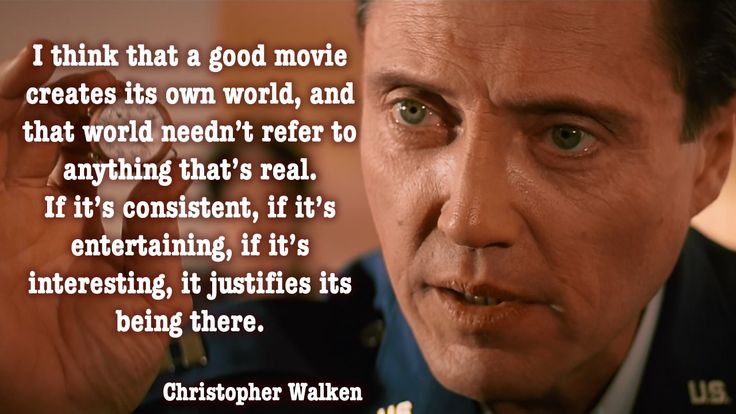
Walken "good movie" quoteAll of the films referenced here are available on home video via rental, streaming, or purchase. Use this link to see Christopher Walken’s complete filmography.

Posted in Film, Home Video, Music, TV | 2 Comments

Al Feldstein — Seriously Mad

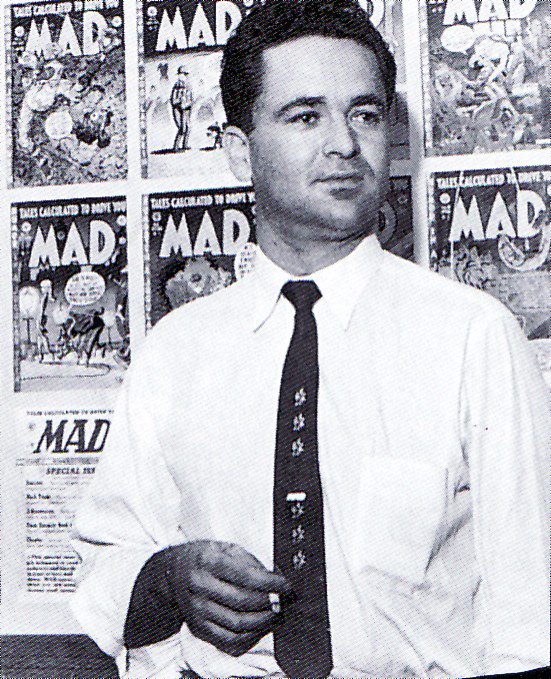
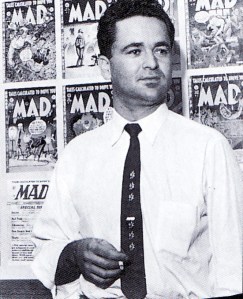
Feldstein-photo at Mad Feldstein & Alfred E. NewmanAl Feldstein died the week before last on Tuesday, April 29. The obituaries I’ve  seen since then focus mainly on his association with Mad magazine, which he edited for 29 years, from 1956 to 1985. Mad is likely to be what he’ll be most remembered for, but what I think of first is the incredible work Feldstein did with the EC horror, crime, and science-fiction comics during the early 1950s. According to Wikipedia, Feldstein started at EC in 1948, where he “began as an artist, but soon combined art with writing, eventually editing most of the EC titles. Although he originally wrote and illustrated approximately one story per comic, in addition to doing many covers, Feldstein finally focused on editing and writing, reserving his artwork primarily for covers. From late 1950 through 1953, he edited and wrote stories for seven EC titles.”

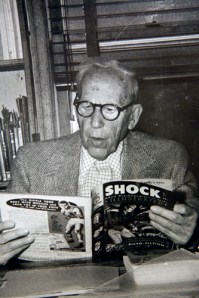
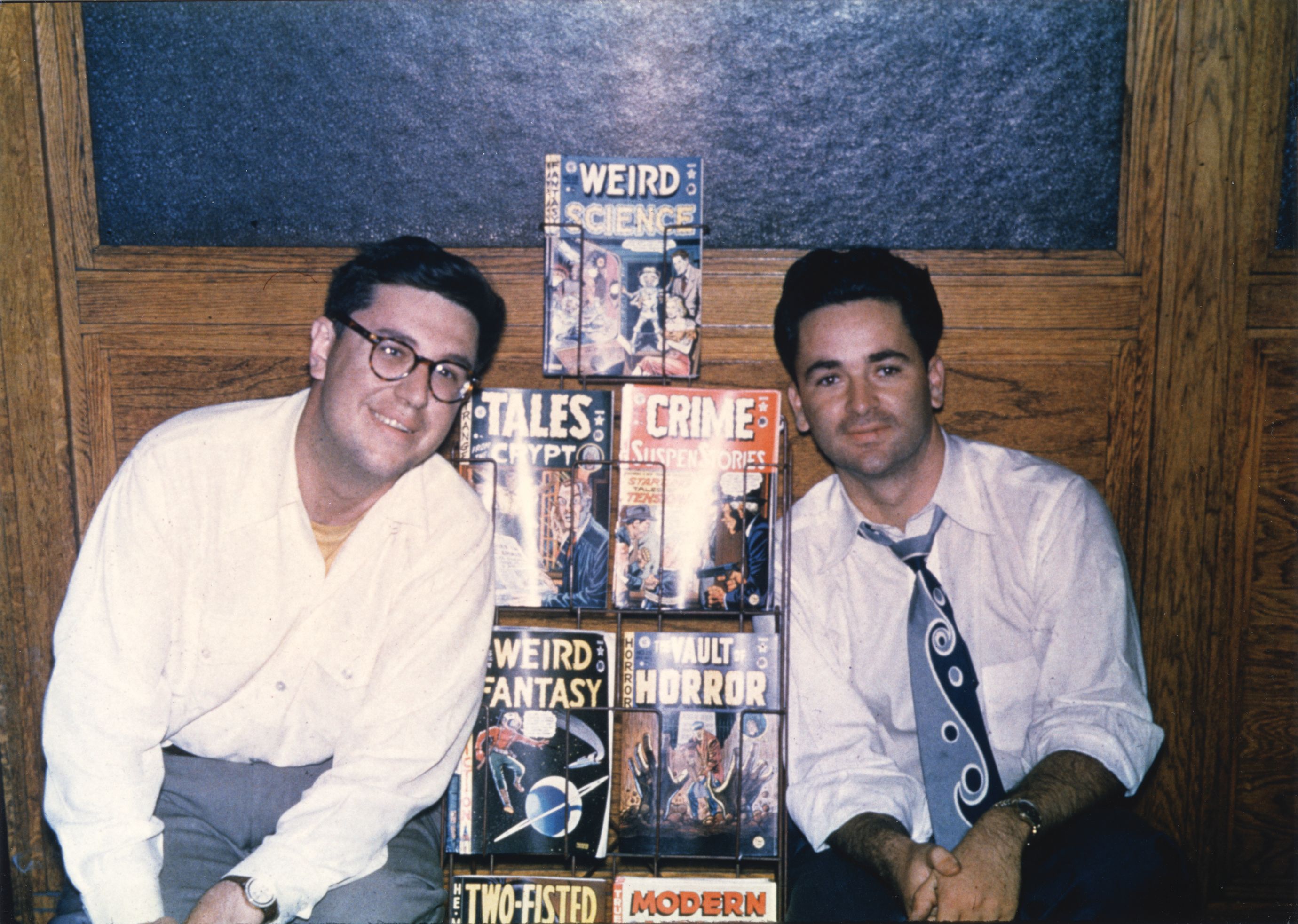
Bill Gaines (L) & Al Feldstein (R), 1950

Bill Gaines (L) & Al Feldstein (R), 1950

William M. Gaines became the publisher and co-editor of the EC line after his father, M.C. Gaines, was killed in a speedboat accident. EC originally stood for Educational Comics (later Entertaining Comics), which were best known for illustrated adaptations of Bible stories, as well as subjects such as world history and science. There’s a certain irony to that, given what came after. According to Feldstein, the elder Gaines was “losing his shirt, so he had to start putting out crime books and Western books. That’s what Bill inherited.”

The covers for these comics are what I would have remembered when I was a kid in the 50s. My dad was pretty strict about keeping me away from material like this. Superman and Batman were okay, but the closest I usually got to comics like Tales from the Crypt and The Vault of Horror was seeing them in magazine racks at news stands and drugstores. The covers were great and really fired my imagination, though of course I didn’t have any idea who the artists were. I also didn’t have a deep exposure to these comics until the mid-80s, when I started buying boxed-set reprints of all the EC titles. It was too late by then to turn me into the dope fiend and juvenile delinquent punk I obviously would have become had I started reading them earlier, though they probably set me back a few years anyway.

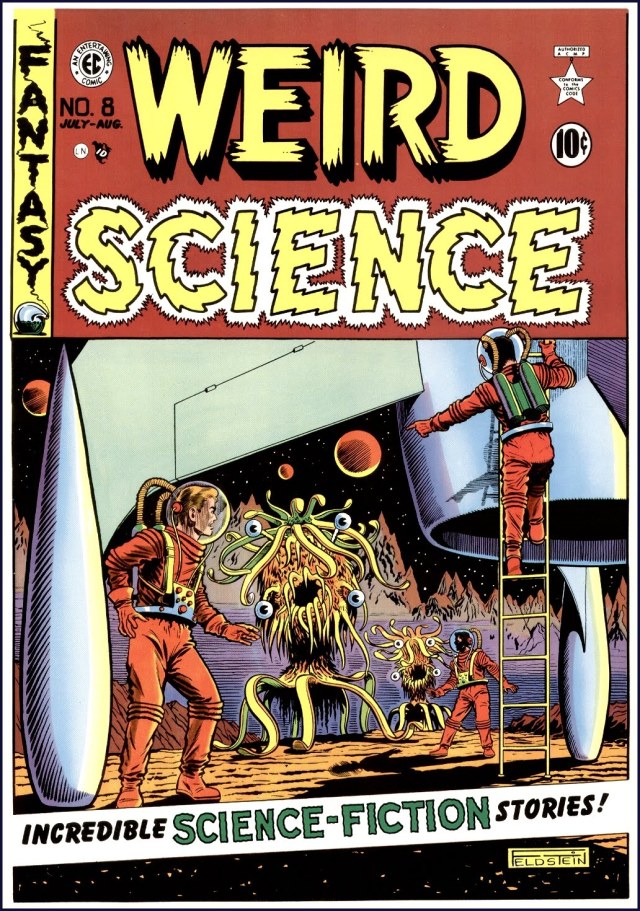
Here are two covers by Feldstein that reflect his distinctive style.

Shock Suspense Stories #12Weird Science '51The Weird Science cover above has a fairly juvenile sensibility, though no less engaging for that. This is the one I would have responded to at the time, more so than the Shock SuspenStories cover, which is something different altogether. How many comic books in the 1950s would showcase a depiction of drug addiction as graphic as this cover does? Per the Wikipedia entry on Feldstein, “In creating stories around such topics as racial prejudice, rape, domestic violence, police brutality, drug addiction and child abuse, he succeeded in addressing problems and issues which the 1950s radio, motion picture and television industries were too timid to dramatize.” Tackling these subjects within the comic book context of horror, crime, and science-fiction seems subversive in retrospect, and that’s not a criticism. This was probably also a motivating factor in the Congressional investigation of the comics industry a few years later.

Feldstein elaborates on the improvised way he and Gaines worked in an excellent career-spanning interview conducted by Jason Heller in the A.V. Club section of The Onion in 2007: “One day (Bill Gaines) came in and slapped two pulp magazines on my desk, and he said, ‘What do you know about science fiction?’ I said, ‘Absolutely nothing.’ And he said, ‘Well, I love it. Take this home and read it.’ I came back to Bill — greedy little me, I was a whore — and said, ‘I can write this stuff.’ (Laughs.) So we started putting out Weird Science and Weird Fantasy. Then we got into the political aspect of our society at the time: the fact that we had racial intolerance, anti-Semitism. What we went to World War II for, at least in my mind, was not getting taken care of. It was supposed to be a brave new world, but we were getting back into the old ruts, and we were in a cold war with Russia. We started this title called Shock SuspenStories, because it had these shock endings. Bill labeled them ‘preachies’ — they were stories that had to do with racial intolerance, politicians, corruption.”

Years before he started at EC, Feldstein, at age 15, began working in the Eisner & Iger studio, which was begun by Will Eisner, creator of the great Spirit comic books. Eisner had left the studio by then, but Jerry Iger gave Feldstein a job running errands and cleaning up pages for $3 a week. He was eventually given the opportunity to work on the Sheena Queen of the Jungle comic, painting leopard spots on Sheena’s top and loincloth. This awesome effort was his first published artwork.

Feldstein then spent some time in the Special Services branch of the Army Air Corp during World War II, where (per Wikipedia) he gained experience “creating signs and service club murals, decorating planes and flight jackets, drawing comic strips for field newspapers and painting squadron insignias for orderly rooms.”

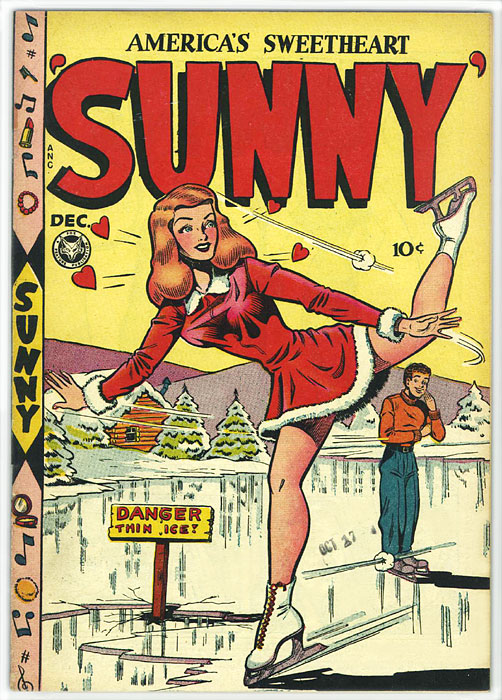
After his discharge, Feldstein began working for Fox Comics, where he wrote and drew two comic series called Junior and Sunny. I was somewhat amazed to find these rather jaw-dropping covers by Feldstein, both of which are extremely suggestive. Or is it just me?
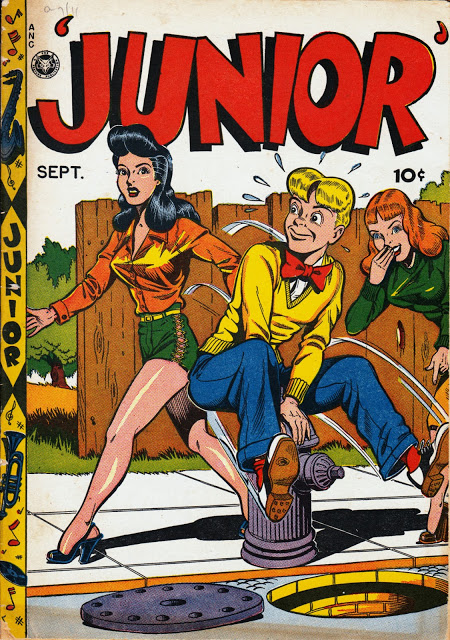
Junior - fireplug cover

Sunny skater coverFeldstein soon left Fox Comics to join Bill Gaines, with whom he worked with at EC for the next 35 years. It was during his tenure that EC began running into trouble in the early ’50s with organizations and parents concerned about the effect these comics were having on young Seduction of the Innocent-jacketFrederic Wertham-photopeople. Frederic Wertham, a German-American psychiatrist, was the leading proponent of the belief that this effect was seriously negative, and contributed to juvenile delinquency, a hot-button topic at that time. His book, Seduction of the Innocent: The Influence of Comic Books on Today’s Youth (1954), got serious attention and added to the growing alarm among parents and civic groups. At the time I remember getting a copy from either the school library or one of our local public libraries and reading it several times. What I don’t remember is why I read it more than once, or what I got out of it. It certainly didn’t dissuade me from reading comics. I think it may have interested me that a book had been written about comics and was treating them seriously, even though it was attacking them, which I clearly chose to ignore. (The photo above left shows Dr. Wertham at work, probably appalled by what he’s seeing. He does not look like an especially fun guy, and definitely not someone likely to appreciate comics with titles like Weird Science and The Haunt of Fear. Or any comics, really.)
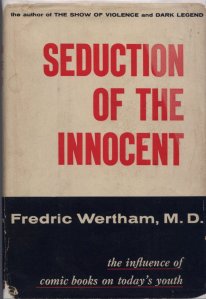
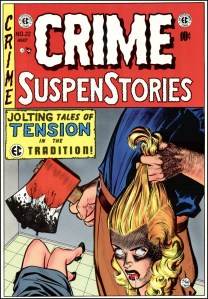
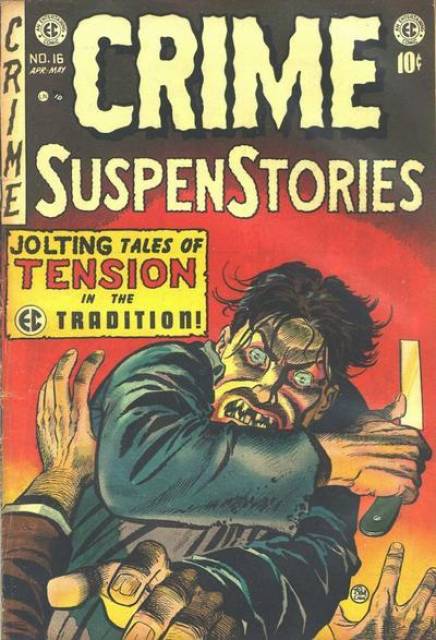
Due in no small part to the alarm created by Wertham’s book, a U.S. Congressional inquiry into the comic book industry was held in 1954. The investigation especially focused on EC Comics, which were more artistic and imaginative than just about anything else on the market, and this, if anything, made them that much more dangerous to the powers that be. EC’s sensationalistic approach frequently left good taste (however that’s defined) in the dust, making it an easy target (along with rock ‘n’ roll and Elvis Presley) for proponents of decency and morality. William Gaines’ testimony before the Senate Subcommittee on Juvenile Delinquency didn’t help his cause, nor did covers like the three below, drawn by Johnny Craig. They’re pretty extreme, but I have to say, living in New York City and being a frequent subway rider, I get a big kick out of this The Vault of Horror cover.
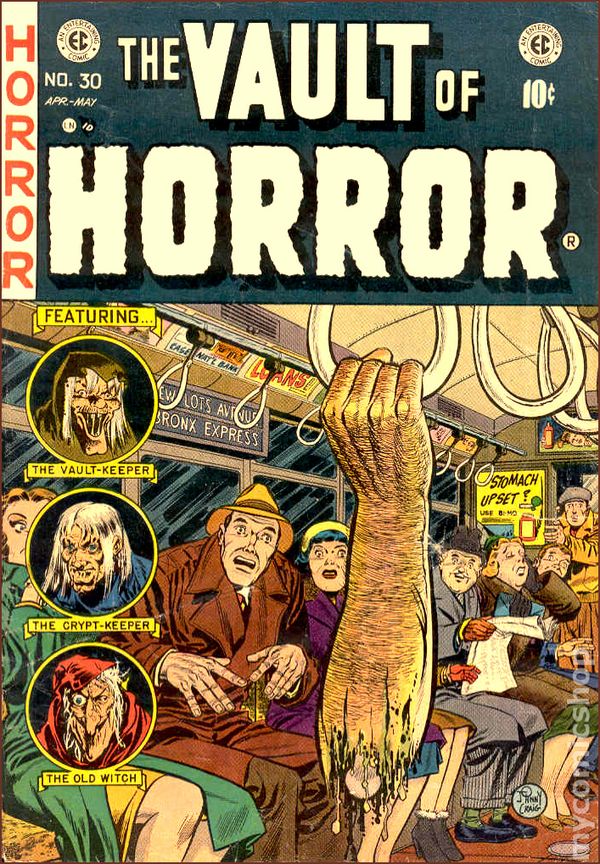
Vault of Horror-subway coverCrime Suspenstories-straight razorCrime SuspenStories-Head & axeThe cover at right became a flashpoint for Senate Subcommittee members. My original plan was to position it just below The Vault of Horror cover above, and in the same size. The more I looked at it at that scale, the more I thought, “Man, this is just too much, it’s overwhelming.” So I had a failure of nerve and reduced the size to what you see here. By comparison, the rather meta cover at left, with a maniac (one assumes) wielding a straight razor as he attacks (by implication) the person holding the comic, seems somehow more acceptable. Whew.

How does one defend this kind of material? It’s not easy. It’s like you’re either tuned into Comics Code logothis sensibility or you’re not. Gaines tried his best to defend and explain it, but failed, and was demonized in the national media. The result was the creation of the Comics Code Authority, which effectively drove EC out of business, except for one title, and that title was Mad. Harvey Kurtzman had joined EC in 1950 and had already established himself with his realistic war comics, Two-Fisted Tales and Frontline Combat, when he created Mad in 1952, writing most of the first issue and illustrating it, along with EC stalwarts Wally Wood, Will Elder, and Jack Davis, three artists who came to define the Mad‘s visual style.

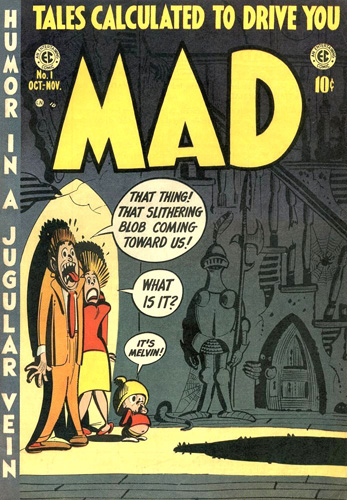
Mad's 1st issue, Oct/Nov 1952

Mad’s 1st issue, Oct/Nov 1952

Mad was a comic book for 23 issues until 1955, when Gaines changed it to a magazine format, mainly to avoid the restrictions of the Comics Code. Kurtzman continued as editor for another year, when Al Feldstein took over in ’56. Feldstein edited Mad for the next 28 years, until 1984.

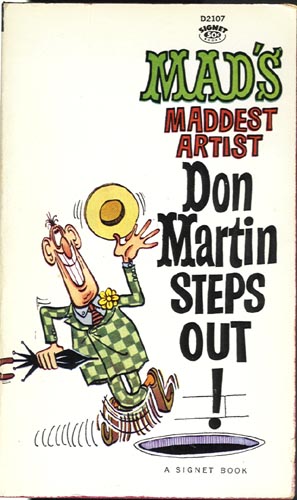
It was during Feldstein’s tenure, especially in the 60s, that I became a loyal Mad reader. Feldstein’s first issue as editor was also the first to showcase the incredible work of Don Martin Steps Out-PB coverDon Martin. Martin’s distinctive way of rendering figures became a signature feature of the magazine. (I wish I still had the first paperback collection of his strips for Mad.)

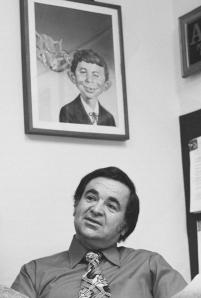
But the signature feature of Mad has to be Alfred E. Neuman. His distinctive image had been around for years, with sightings dating back to 1894. He made his first official Mad appearance on the cover of The Mad Reader, a paperback collection of material from the first two years of the comic published by Ballantine Books in 1954. This and the many subsequent collections (Utterly Mad, The Brothers Mad, etc.) were my first exposure to what had appeared in the original Mad comic. They were proud possessions in my library for years, becoming increasingly worn and frayed, until at some point they disappeared entirely.
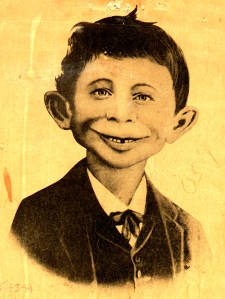
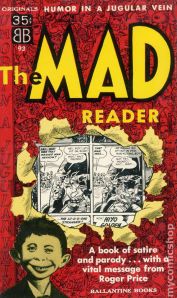
Proto- AE Neuman imageMad Reader-'54As Wikipedia puts it, after becoming editor of Mad in ’56, Feldstein “seized upon the face.” Per Feldstein: “I decided that I wanted to have this visual logo as the image of Mad, the same way that corporations had the Jolly Green Giant and the dog barking at the gramophone for RCA. This kid was the perfect example of what I wanted. So I put an ad in the New York Times that said, ‘National magazine wants portrait artist for special project’. In walked this little old guy in his sixties named Norman Mingo, and he said, ‘What national magazine is this?’ I said ‘Mad’, and he said, ‘Goodbye.’ I told him to wait, and I dragged out all these examples and postcards of this idiot kid, and I said, ‘I want a definitive portrait of this kid. I don’t want him to look like an idiot—I want him to be loveable and have an intelligence behind his eyes. But I want him to have this devil-may-care attitude, someone who can maintain a sense of humor while the world is collapsing around him.’ I adapted and used that portrait, and that was the beginning.” Mingo went on to paint a total of 97 Mad covers, all of which feature Alfred E. Neuman.

Under Al Feldstein, Mad became hugely successful, with circulation increasing more than eight times after he became editor, reaching a peak of 2,850,000 in 1974. It also became a much-loved institution. I especially liked the movie and TV parodies. An example of the affection that was felt for the magazine can be seen in an episode of The Simpsons titled “The City of New York vs. Homer Simpson” (airdate September 21, 1997), which had the distinction of being pulled from syndication after 9/11 because the World Trade Towers figure prominently in the storyline. Near the end of this episode, Bart visits the office of Mad magazine. He’s initially disappointed when it seems like just an ordinary office, but then a door opens and Alfred E. Neuman leans out, with all sorts of Mad shenanigans visible in the room behind him. Bart proclaims he will never wash his eyes again. It’s a lovely grace note in the episode.

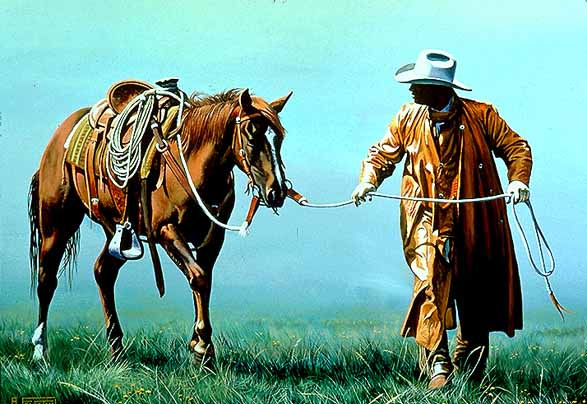
Feldstein retired from Mad in 1984, left Connecticut and moved to Jackson Hole, Wyoming, and eventually to Paradise Valley, Montana, near Livingston. During this time he began painting again. It’s ironic, and even a little weird, that his subjects were landscapes and wildlife, worlds away from the grotesque and often shocking covers he did for EC.

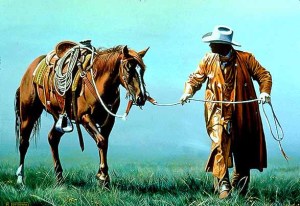
Feldstein-June '12 with landscapeCowboy & horseLion painting


Al Feldstein, October 24, 1925 (Brooklyn, New York) to April 29, 2014 (Livingston, Montana). 88 years of age. He left his mark and then some. Rest in peace, Al. — Ted Hicks
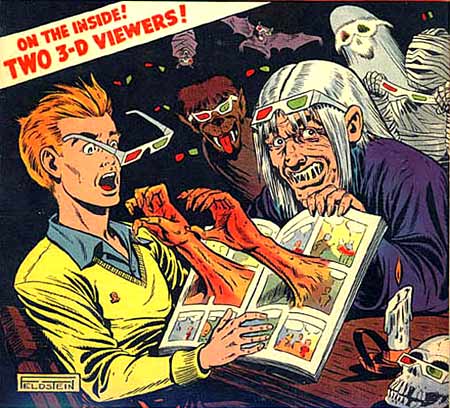
Feldstein-3D issueEC logo


Posted in Books, Comics, Fiction | 2 Comments

On the Radio — Movies, Zombies & “Homecoming”

Homecoming-banner still

Two weeks ago I traveled to New Jersey with Mark Svenvold, a published author of non-fiction and poetry who teaches creative writing and literature courses at Seton Hall University. Mark, who I’ve known for many years, also co-hosts a half-hour Saturday morning show called “Talk Art Radio” on Seton Hall’s campus station WSOU @89.5 FM. I got a kick out of the fact that WSOU (which proudly calls itself “Seton Hall Pirate Radio”) basically airs nothing but heavy metal throughout the week, and then there’s this weekly arts show where writers, musicians, and artists come on to talk about what they do. Mark had asked me a month or so earlier if I’d be interested in being on the show to talk about movies. Despite some reflexive panic and anxiety at the thought of doing something I’d never done before, I realized I’d be nuts not to give this a shot. Besides, Mark and I have a good rapport and share a love of movies and the bizarre in general, so that made it feel safer. The show doesn’t air live, which also lightened the pressure a lot. However long we talked would be edited down to a hopefully brilliant 28 minutes. So not to worry if in my excitement I let loose with an F-bomb or two (which, for the record, I did not).

OLYMPUS DIGITAL CAMERAI Walked with a Zombie-poster


________________________________________________________________

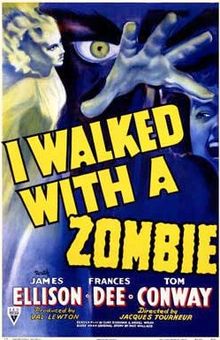
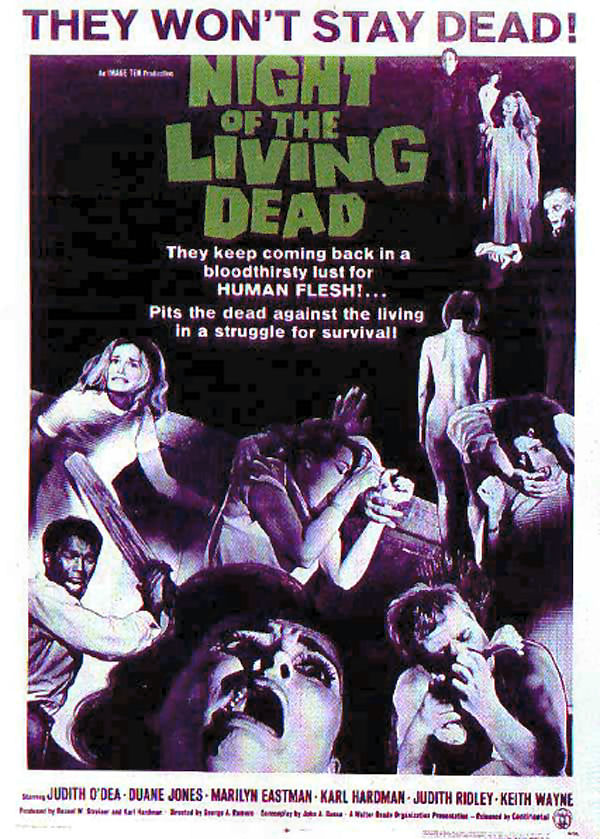
Mark follows this blog, so he’s familiar with what I write about. In preliminary discussions we decided I should talk about my background as an Iowa farmboy and how I fell in love with the films that hijacked my imagination at an early age (which was covered in one of the first pieces I posted, “Famous Monsters & Me”). On the drive from Manhattan to Seton Hall in South Orange, New Jersey, it became clear that Mark also wanted our discussion to focus on zombie movies. We were talking about the state of zombie movies before and after George Romero’s jaw-dropping Night of the Living Dead in 1968. Nobody had seen anything like this. It was a game-changing, watershed moment. There was a profound difference between zombie films before Night of the Living Dead and basically everything after. Films such as White Zombie (1932), with Bela Lugosi, and the Val Lewton production of Jacques Tourneur’s incredibly poetic I Walked with a Zombie (1943) followed the more traditional concept of zombies as being created for slave labor, generally a product of Haitian Vodou (aka Voodoo) practices. Zombies also appeared in comedies, such as The Ghost Breakers (1940) with Bob Hope, and its remake, Scared Stiff (1953), with Martin & Lewis. Romero’s flesh-eating, brain-chomping, highly contagious walking dead forever changed the template for zombies in films, television, fiction, and in the culture at large. Its influence cannot be over-estimated. The contagion aspect has a particularly metaphoric resonance in a pandemic world. And really, in addition to everything else, just think of that movie being released in 1968, a year as filled with domestic turmoil, assassinations, and general insanity on a national level as any in our recent history. It’s no wonder that Night of the Living Dead was such a freak-out, amped up as it was by all that anxiety and paranoia. As the evocative tag line for Romero’s 1978 sequel, Dawn of the Dead, put it, “When There’s No More Room in Hell, the Dead Will Walk the Earth.”

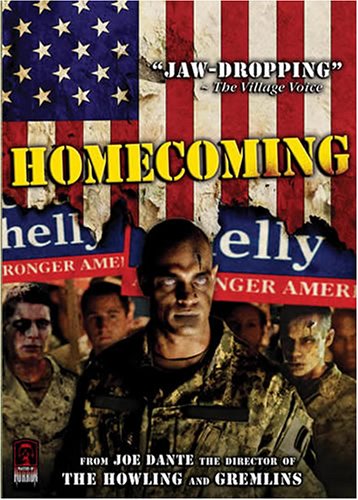
Night of the Living Dead-posterAt one point during the drive I mentioned Homecoming, a 1-hour film Joe Dante had made for Showtime’s Masters of Horror series in 2005, in which the bodies of soldiers being sent back from a war (unnamed, though obviously Iraq) start coming back from the dead in an election year in order to vote out of office the president (unnamed, though obviously George Bush) who started the war.  When I told Mark the premise he jumped right on it and said we had to talk about that on the show.

Homecoming-posterI first became aware of Homecoming in a review by Dennis Lim that appeared in The Village Voice in November, 2005. Referring to the film as “The dizzying high point of Showtime’s new Masters of Horror series, the hour-long Homecoming is easily one of the most important political films of the Bush II era.” Michael Sragow, writing in The New Yorker in April 2006, calls Homecoming “The best political film of 2005…” High praise, indeed. Lim goes on to write, “With its only slightly caricatured right-wingers, the film nails the casual fraudulence and contortionist rhetoric that are the signatures of the Bush-Cheney administration.” So Homecoming is not a traditional post-Romero zombie movie, though it utilizes the format to promote a very angry agenda which is clearly not meant to please anyone who was for George Bush and the Iraq war. There’s never a doubt where it’s coming from. It’s the kind of black comedy where the laughs are spiked with bile. (Another insightful review of Homecoming is by Grady Hendrix in The Slate online in 2005.)

Homecoming-"Vote Today"The Village Voice review made me really want to see Homecoming, but we didn’t have Showtime, so I was out of luck until it came out on home video. When I finally saw it, I was definitely not disappointed. It reflected my take on things, so naturally I liked it. But it’s not just that. I’ve always liked Joe Dante’s films. He started out, as did so many others (John Sayles, Francis Ford Coppola, James Cameron, Ron Howard, etc etc — the list is long) working for Roger Corman making low-budget exploitation films, getting paid very little and learning everything about filmmaking in the process. In 1978 he made Piranha, a Jaws knock-off written byJoe Dante-photo with gremlin John Sayles, who also wrote one of my favorite Dante movies, The Howling (1981), a werewolf film that paid homage to the basic tropes of the genre while reinventing them at the same time. Dante may best known to general audiences for the much-loved Gremlins in 1984 (which he followed up with an edgier, satiric sequel in 1990, Gremlins 2: The New Batch). Per Wikipedia, “Dante has cited among his major influences Roger Corman, Chuck Jones, Frank Tashlin, James Whale, and Jean Cocteau…” His filmography certainly reflects that range. Homecoming shows those influences in various ways, though the film is fueled by a serious anger I don’t think is seen in his other work. If you haven’t seen Homecoming and think you might be interested, I highly recommend it. It’s almost 10 years old, but Homecoming still resonates and still has a nasty jolt. — Ted Hicks

All of the films referenced here are available for sale, rental and/or streaming from Netflix and/or Amazon. Homecoming is available for rental from Netflix and for sale from Amazon, listed in both venues under the lengthy title “Masters of Horror: Joe Dante: Homecoming.”

WSOU logoP.S. “Talk Art Radio” programs are available as audio podcasts and iTunes downloads at the station’s website. When the show I was on (which has not yet aired) is available, I’ll put a link on one of my blogs for those who are interested. I had a really good time doing it, and it turns out this might become a semi-regular gig for me. Our next one is slated to focus on Film Noir. Stay tuned.

Posted in Books, Fiction, Film, Home Video, TV | 1 Comment

“The Departed” – Shoot ’em in the Head

Departed-poster3

It seems that my “Best of 2013” recaps keep getting pushed back by films that jump in my face and demand to be dealt with. That’s definitely the case with this one. Last Thursday through Saturday the Ziegfeld Theater here in New York, which has been showing The Wolf of Wall Street in a regular run, presented all five films that Martin Scorsese has made with Leonardo DiCaprio. In addition to Wolf, these include Gangs of New York (2002), The Aviator (2004), The Departed (2006), and Shutter Island (2010). Of all these, I most wanted to see The Departed again, especially in a theater  like the Ziegfeld, which has the second-largest screen in the city (not counting IMAX screens), and with digital projection the image was as sharp as a razor. I’m here to report that The Departed does not disappoint. If anything it surpasses what I’d remembered.

The Departed is a remake of a 2002 Hong Kong film Infernal Affairs. Brad Pitt andInferno Affairs-poster producer Brad Grey had obtained the remake rights in 2003. William Monahan was hired to write the screenplay, which located the story in Boston. Scorsese read the script and liked it, and signed on as director. Pitt, who was a producer on the film, and was initially set to also star with Leonardo DiCaprio, stepped aside in favor of a younger actor, Matt Damon. Jack Nicholson played Boston mob kingpin Frank Costello, a character based on the Irish gangster Whitey Bulger. Nicholson invests the character with a sense of menace that frequently becomes volcanic.

Departed-Nicholson stillIn The Departed DiCaprio’s character, William Costigan Jr., is recruited out of the police academy to go undercover in Costello’s gang. Likewise, Damon’s character Colin Sullivan is recruited by Costello to go undercover inside the police force. This might sound like a contrivance, but it works beautifully.

The Departed hits the ground running and does not let up. I hadn’t seen it for several years, and was struck by the freshness of it, the fierceness of it, and of how tight and controlled it all is. The following scene is a good example. Leonardo DiCaprio as Billy Costigan, Jr. is ostensibly minding his own business in a convenience store in Boston until two hoods from Providence start shaking down the proprietor. Nobody does this like Martin Scorsese. Let ‘er rip.

Notice how the music that flares up when the fight starts supercharges the scene and takes it to another level entirely (the cut is “Nobody but Me” – The Human Beinz). Scorsese has used pop/rock songs in his features from the very beginning, starting with Who’s That Knocking at My Door in 1967, his first film with Harvey Keitel (as well as Keitel’s first credited role in a motion picture). What surprised me when I saw it again was that I’d somehow forgotten about all the music in The Departed, but as soon as “Gimme Shelter” came up on the track at the beginning under Jack Nicholson’s voice-over, I was back in it.  The Departed also has a score written by Howard Shore, but I don’t remember that at all, though I’m sure it’s fine. What I remember are the Stones, the Allman Brothers, and Roy Buchanan. I think it was Easy Rider (1969) that really put across the idea that you could score a movie entirely with rock songs. For me, it was when I’d first heard Bill Haley and the Comets’ “Rock Around the Clock” under the main title credits of Blackboard Jungle (1955) that I knew something was shifting. The excitement I felt was very personal, and continues to be that way. The associations we have with music that we’re now hearing re-purposed by a filmmaker like Scorsese in a violent scene, for example, create a connection to the film that’s stronger and more personal than if we weren’t familiar with that music.

The Departed doesn’t need any help from me at this point. It appeared on thirty-seven top-10 lists of Departed-Baldwin & Wahlbergfilms of 2006, and won four Academy Awards: Best Picture, Best Director, Best Adapted Screenplay, and Best Editing. Additionally, Mark Wahlberg was nominated for Best Supporting Actor. It’s obvious that everyone in the cast and crew was operating at the top of their game, and even above that. The acting is amazing from top to bottom. Martin Sheen, Ray Winstone, Vera Farmiga, and especially Alec Baldwin and Wahlberg are stand outs.

The Departed may not be as expansive as Goodfellas or as personal as Mean Streets (1973) or Taxi Driver (1976), and it may not contain as many F-words as The Wolf of Wall Street (237 vs. a record-breaking 506 for Wolf), but I think it’s definitely one of his strongest films, a tightly focused, uncompromising piece of work that gives us everything he does best.

***********************************************************************************

The first time I ever heard of Martin Scorsese was in a film class taught by Dr. John Kuiper at the University of Iowa in 1964 or ’65. My memory is a little unclear on this, but I think Dr. Kuiper knew Scorsese at NYU. In any event, he showed two of Scorsese’s student film shorts in our class, The Big Shave and It’s Not Just You, Murray (1964). They seemed amazing to me at the time, particularly the inventive playfulness of Murray. A mystery at present is that The Big Shave is listed as a 1967 film in nearly every source I’ve checked except one, which has it as 1963. Maybe it wasn’t released by NYU until ’67, but I know I saw it in ’64 or ’65, unless I was time traveling. In any event, The Big Shave, which has become somewhat famous, is particularly interesting in that it foreshadows Scorsese’s use of music and fondness for blood, lots of it. Here are the shorts.

All of the films I’ve referenced, with the exception of The Wolf of Wall Street, are available on home video via a variety of venues. – Ted Hicks


Posted in Film, Home Video, Music | Leave a comment

“The Broken Circle Breakdown” – Beauty, Sadness & Bluegrass

Broken Circle Breakdown-poster2The Broken Circle Breakdown has been playing in New York since last November, and though initial write-ups made me very interested, mainly because of the bluegrass-in-Belgium angle, I didn’t get around to seeing it until a week ago. I went into The Broken Circle Breakdown without knowing much about it, other than that it was about the relationship over a period of years of a man and woman who play in a Belgium bluegrass band. I’d scanned some early write-ups, but had basically forgotten any details. Generally, the less I know about a film before I see it, the better.  As it turned out, there were many moments in The Broken Circle Breakdown that really took me by surprise, so much so that I was glad I hadn’t known too much beforehand. It’s a challenge to write about any film – and especially this one – without giving too much away, but I’ll give it a shot.

I was completely knocked out by The Broken Circle Breakdown, most powerfully by a final scene that completely bypassed my “intellect,” went straight to my emotions and hit me square in the gut. I see a lot of movies, but rarely have a reaction this intense or sudden, something that slips by too fast to get filtered through my brain. The last time I can remember this happening was during the investigation hearing at the end of Flight (2012) when Denzel Washington finally comes clean.

The advertising refers to The Broken Circle Breakdown as “A Bluegrass Love Story,” which it is, but it’s also much more than that. The film concerns Didier, who loves bluegrass music and plays in a local Broken Circle Breakdown-still2band; his wife Elise, who works in a tattoo parlor and sings in the band; and their young daughter Maybelle, named for Maybelle Carter. It opens with the three of them in a hospital, then cuts back seven years to the time when Didier and Elise first meet. The film continues to cycle back and forth in time in a way that slowly reveals how the characters get to where they do. This looping temporal structure is one of effect and cause, rather than a more sequential cause and then effect. A scene will show us where they are today, then we jump back in time to see the roots of that. This is not a new technique, but the way it’s used here feels different. The layered narrative is revealed in stages; this takes awhile, so it grows on you.

Bluegrass music is at the heart of The Broken Circle Breakdown in much the same way that jazz permeated David Simon’s great HBO series Treme, but that’s not what it’s about. That would be how a family either endures a tragedy or is broken by it. There’s a heartbreaking darkness here, and the music weaves in and out to comment on that and also lift it. For as much as death hangs over this film – we see 9/11 coverage on TV in a flashback, for example – it’s also filled with joy, love, and life, which makes the heartbreak even more intense. The film itself is like a bluegrass song. The music often has a mournful quality, as in the following clip, which features Veerle Batens (excellent as Elise), with Didier watching from the side. (This clip has several shots that require a SPOILER ALERT, so use your own discretion.)

The Broken Circle Breakdown was directed and written by Felix Van Groeningen, and based on a play co-written by lead actor Johan Heldenbergh. Heldenbergh, tall and bearded, brings a strong and sometimes anxious, wounded presence to the role of Didier. When Didier first meets Elise in the tattoo parlor where she works, he’s living a rustic, quasi-hippie lifestyle in the country on a sort of farm with chickens on the loose and assorted livestock wandering about. He and Elise hit it off right way – it’s basically love at first sight. In short order she falls in love with both Didier and bluegrass, and becomes the lead singer in his band.

Broken Circle Breakdown-still7There’s a great moment from a flashback to early in their relationship when Didier is breaking down the genealogy of bluegrass instruments for Elise. I wish I could remember what he says more clearly. He talks about each instrument, how the fiddle has a Celtic source, that the banjo evolved out of an African instrument, and how he loves the way the banjo “snarls.” He speaks with the focus and enthusiasm of someone who truly knows and loves a subject.

The Broken Circle Breakdown is one of the five films nominated for the Best Foreign Film Academy Award this year. I’ve seen two of the other four films: The Great Beauty from Italy (an amazing, almost phantasmagorical immersion with echos of Fellini) and The Hunt from Denmark (a teacher is falsely accused of molesting a girl in kindergarten). Both of these films are “bigger” than The Broken Circle Breakdown, especially The Great Beauty. I obviously can’t speak for the two remaining films that I haven’t seen, but The Broken Circle Breakdown seems to be the dark horse of the bunch. I liked The Great Beauty and The Hunt very much, but Broken Circle gets into the subjects of sex and death and passion in ways I don’t recall seeing before. There’s a kind of cathartic effect to watching it.

Broken Circle Breakdown-still4

The following synopsis of the film at the IMDB site really nails it.

“Elise and Didier fall in love at first sight. She has her own tattoo shop and he plays the banjo in a bluegrass band. They bond over their shared enthusiasm for American music and culture, and dive headfirst into a sweeping romance that plays out on and off stage – but when an unexpected tragedy hits their new family, everything they know and love is tested. An intensely moving portrait of a relationship from beginning to end, propelled by a soundtrack of foot-stomping bluegrass, The Broken Circle Breakdown is a romantic melodrama of the highest order.” Written by Tribeca Film

Broken Circle Breakdown-stillI strongly recommend this film. It will lift you up and it will wipe you out. I promise. How often do you get that combination in one film? – Ted Hicks

The Broken City Breakdown is still screening in theaters, as well as available now on iTunes and Amazon Instant Video. A DVD will be released for sale and rental on March 26.

Posted in Film, Home Video, Music | 3 Comments

Gunfights at the O.K. Corral

My Darling Clementine-still2John Ford’s My Darling Clementine (1946) just ended a one-week run at Film Forum here in New York, presented in a stunning digital restoration, clean and crisp, like the first time anyone had seen it. I’d seen the film only once, many years ago, and wasn’t sure I was going to see it during this run. But my interest was indirectly sparked by a book I’d recently read by Glenn Frankel, The Searchers: The Making of an American Legend, about the actual story of Cynthia Ann Parker, whose capture by the Comanches inspired the Alan LeMay novel that in turn became the basis of John Ford’s monumental film, The Searchers (1956). The production history of that film is covered in the last half of Frankel’s book. Throughout Ford is seen as a great film director, but also a deeply flawed and rather horrible human being. I finally decided to see My Darling Clementine because now Ford was on my mind and I wanted know if I could get past all that negative personal stuff and just see what he had put on the screen, which is, indeed, really something.

There have been many films depicting Wyatt Earp’s time in Tombstone and the iconic gunfight at the O.K. Corral. My Darling Clementine is probably the most lyrically beautiful of them all, as well as the most historically inaccurate. Though there was a shootout at the O.K. Corral in 1881, and many of the characters existed in real life, including the Earp brothers, Doc Holliday, and the Clantons, almost everything else is the film has been entirely made up. The Earps were never working cowboys or cattle owners, though Clementine begins with the brothers – Wyatt (Henry Fonda), Virgil (Tim Holt), Morgan (Ward Bond), and James (Don Garner) – driving a herd of cattle through Arizona on their way to California. They encounter the Clantons, led by Walter Brennan as Old Man Clanton in a truly menacing performance, thoroughly mean and malevolent, which comes as a shock if you only know him from The Real McCoys on TV (1957 – 1963) or as Stumpy in Rio Bravo (1959). After repeated offers to buy the Earps’ herd are rebuffed, he tells the them that the town of Tombstone is nearby. Wyatt, Virgil, and Morgan ride to Tombstone through heavy rain, leaving younger brother James to keep watch over the cattle. When they return they find the cattle gone and James dead in the mud, shot in the back.

My Darling Clementine reduces the entirety of the Earp’s stay in Tombstone to the single goal of finding the men who murdered their brother. They don’t seem to care much about their rustled herd. I don’t think it’s ever mentioned again. The Clementine of the title is an entirely fictional character, though the Wikipedia entry on the film says she “appears to be an amalgam of Big Nose Kate and Josephine Earp,” both of whom actually existed and appear as characters in more recent film versions of the story.

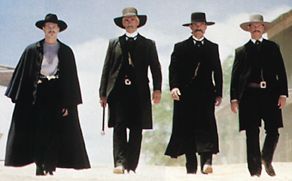
By all accounts I’ve read, the actual O.K. Corral gunfight lasted only 30 seconds (which was probably long enough if you were in it). Earlier films, including this one and Gunfight at the O.K. Corral (1957) have extended the event. I guess if everything in your film has been leading up to this gunfight, you’d want it to last longer than half a minute. More recently, Wyatt Earp (1994) and the superior Tombstone (1993) have kept closer to the historical record, especially where the gunfight is concerned. Let’s compare some of them. (The film studies portion of this post now commences.)

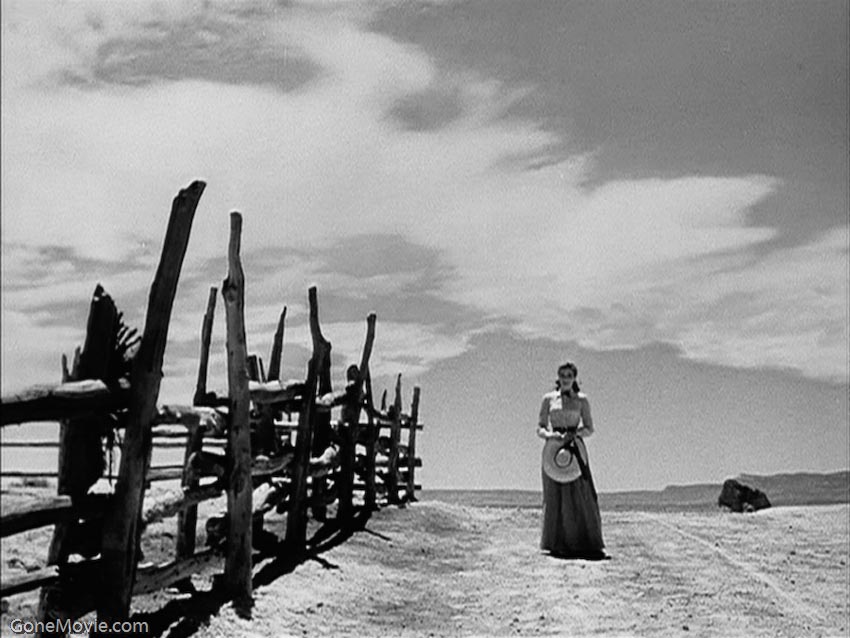
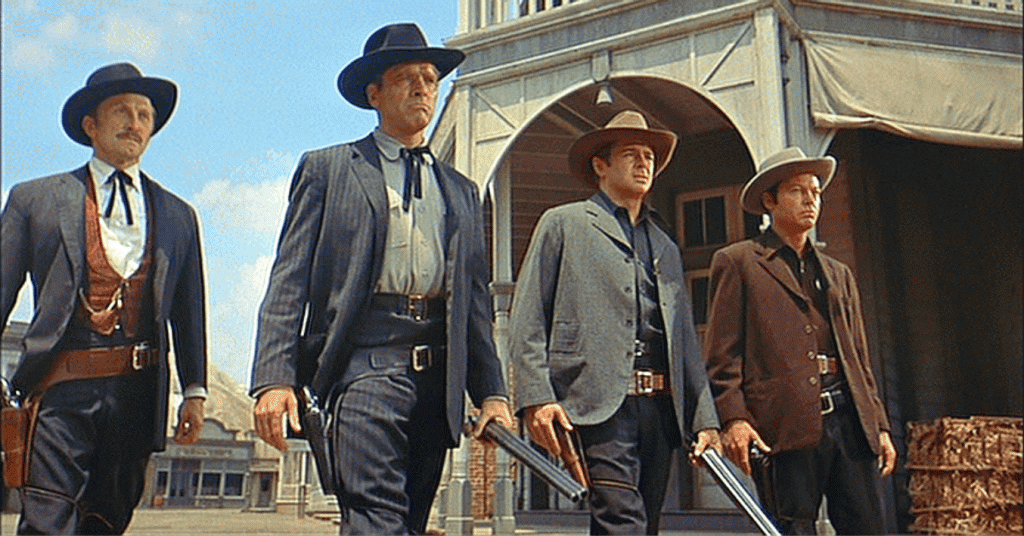
The O.K. Corral gunfight sequence in My Darling Clementine is extraordinary. I just watched it again and was struck by how beautifully it was shot and put together. It’s a masterful episode that reflects Ford’s expansive use of landscape, with white clouds against a sky that seems almost like the vaulted ceiling of a cathedral. The crisp black & white photography is quite stunning. Music is not used at any time during this sequence, which is unusual, especially for films of the time. The absence of music emphasizes the quiet, almost meditative feeling of these scenes. Earp, Holliday, and the others exit the building where they’ve been preparing for their confrontation with the Clantons. Earp stops, looks around, and almost casually says, “Let’s go.” This reminds of the scene near the end of Sam Peckinpah’s The Wild Bunch (1969) when Pike (William Holden) says, “Let’s go!” somewhat more dramatically before he and the three others who are left of his gang take the walk to their final shootout. In nearly all these films it comes down to four men with guns heading to a shootout. Here’s how John Ford does it:

Note: When you click to play this, a message appears saying “Embedding disabled by Request. Watch on YouTube.” Click on that and the clip plays nicely.

Here’s how director Lawrence Kasden handles the gunfight in his overloaded epic Wyatt Earp (1994). The theatrical release version was 3 hours long, with the extended DVD version 3 1/2 hours. I have no problem with lengthy running times unless the film turns out to be as leaden and unwieldy as this one was. Though Dennis Quaid makes a great Doc Holliday.

Tombstone (1993), directed by George Cosmatos,  is a film I can watch repeatedly. It’s Tombstone-Sam Elliottincredibly well cast, especially Val Kilmer as Doc Holliday (though I think Dennis Quaid’s Holliday has the slightest edge), and even more especially Sam Elliott as Virgil Earp. Sam Elliott was born to play in Westerns (so were Ben Johnson and Randolph Scott). He never feels less than totally authentic. And the Earps have great moustaches! Tombstone also correctly has Virgil becoming the marshal, not Wyatt, who didn’t want the brothers to become the law in Tombstone, but ends up putting on a deputy’s badge anyway. The O.K. Corral gunfight here is very well done, though a bit longer than 30 seconds. I won’t fault them for that.

******************************************

My Darling Clementine (1946)French critic Georges Sadoul has called My Darling Clementine “The most classically beautiful Western of the ’40s,” while director Peter Bogdanovich, who knew Ford and interviewed him a number of times, judges it to be “Ford’s most poetic and most personal Western.” I wouldn’t disagree.

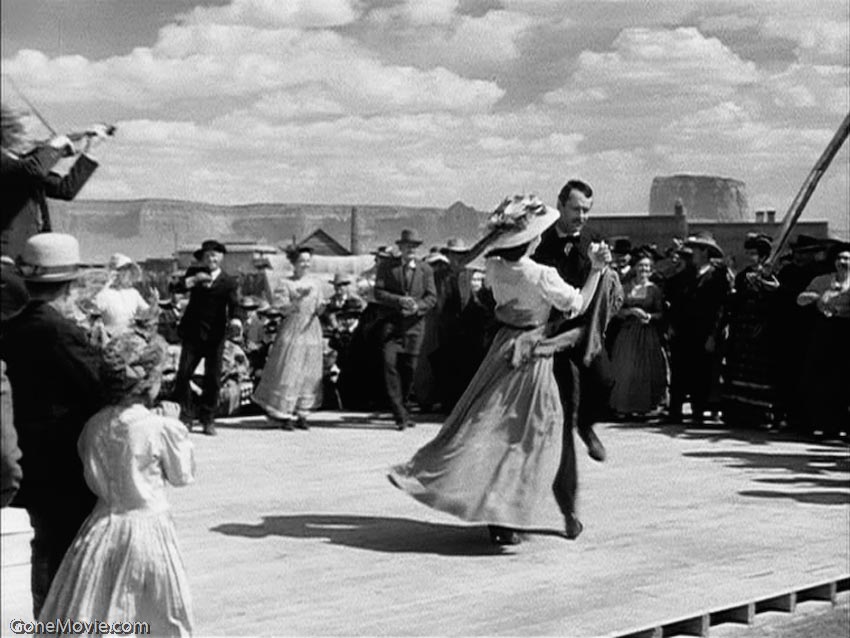
There are many iconic shots and moments in the film. Henry Fonda as Wyatt Earp in the shot at the head of this post is one, his boot resting on the porch column, tilting back in the chair while he quietly watches life go on around him. Earp’s open-air dance with Clementine (Cathy Downs) on the floor of an unfinished church on a quiet Sunday morning is another, the big sky filled with clouds above them.

My Darling Clementine (1946)Probably more than any other moment in the film, this sequence conveys the growth of community and civilization in Tombstone, and by extension, in the West itself. It’s a wonderful scene, with Earp’s shy awkwardness towards Clementine transformed into the gracefulness of their solo dance.

Victor Mature is a strong presence as Doc Holliday, though he seems rather too robust My Darling Clementine-posterto play the consumptive dentist (a surgeon in this version), but the film makes a point of showing us a number of his debilitating coughing fits in spite of his otherwise healthy, though haunted, appearance (contrast Mature with Dennis Quaid and Val Kilmer’s physically wasted Doc Hollidays in Wyatt Earp [1993] and Tombstone [1993], respectively). Mature is probably more associated with films such as Samson and Delilah (1949) and Demetrius and the Gladiators (1954), and may not have been the greatest actor, but when he’s well-cast, as he was in this film and especially in the great film noir, Kiss of Death (1947), he can make quite an impact. It’s interesting that the focus in the poster at left is on Mature rather than Henry Fonda, ostensibly the hero of the film.

My Darling Clementine-still6Doc Holliday has always been a more interesting character than Wyatt Earp. He’s a tubercular ex-dentist with a death wish who was a card sharp and a gunman. Many actors have played the role. Jason Robards was excellent as Holliday in The Hour of the Gun (1967), director John Sturges’ follow-up to his Gunfight at the O.K. Corral (1957), which has the distinction of opening with the gunfight. Stacey Keach played the title role in Doc, Frank Perry’s revisionist 1971 film that portrayed Holliday and Earp (Harris Yulin) in particularly grubby, post-Wild Bunch terms. I haven’t seen Doc since it came out, but I don’t remember any good guys. As mentioned earlier, Dennis Quaid and Val Kilmer each put distinctive brands on their Holliday versions.

Hour of the Gun-Doc HollidayDoc-still

Tombstone-Val KilmerWyatt Earp 1994-Doc Holliday

________________________

Jason Robards (upper left), Stacey Keach (upper right), Dennis Quaid (lower left), Val Kilmer (lower right)

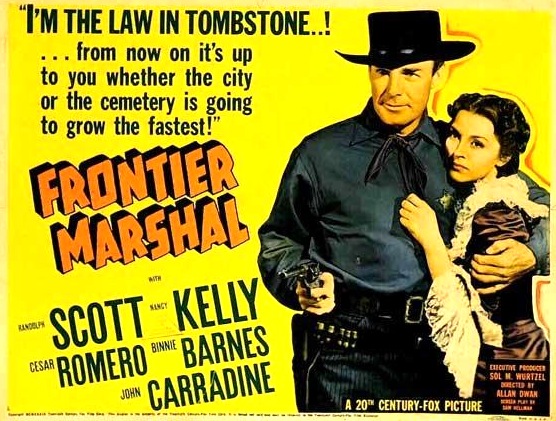
My Darling Clementine was based on Stuart Lake’s 1931 biography, Wyatt Earp: Frontier Marshall, which turned out to be largely fictional. The book was the basis for the 1939 film Frontier Marshall, with Randolph Scott as Earp and Cesar Romero as Holliday. I’ve not seen this film, but I intend to. I’ve always liked Randolph Scott, and as I mentioned earlier in reference to Sam Elliott, Scott always appears completely as home as a Western character.

Wyatt Earp "Frontier Marshall" book2Frontier Marshall-poster

________________________________________

John Ford got to know Wyatt Earp, who died in 1929 at the age of 80, when Ford was working as a prop boy in Hollywood. Earp would often visit the set. Ford says that Earp “told me about the fight at the O.K. Corral. So in My Darling Clementine we did it exactly the way it had been.” Well, maybe not, but it makes a nice story. And as far as all the historical inaccuracies are concerned, at the end of the day they’re not that important. In the universe created in the film, this is how it happened. Taken on its own terms, My Darling Clementine is a great film, one of John Ford’s best. I hadn’t realized that before, but I do now.   – Ted Hicks
Supplemental: Some examples of “The Walk.”

Gunfight at O.K. Corral-stillHour of the Gun-still

**************************************************

Tombstone-stillWild Bunch-the Walk2

Gunfight at the O.K. Corral (upper left), Hour of the Gun (upper right), Tombstone (lower left), The Wild Bunch (lower right)

My Darling Clementine-end titleNote: To the best of my knowledge, all of the films referenced in this post are available on home video for rental and/or streaming.

Wyatt Earp postage stamp

Posted in Books, Film, Home Video, TV | 14 Comments

Back in the Saddle (almost)

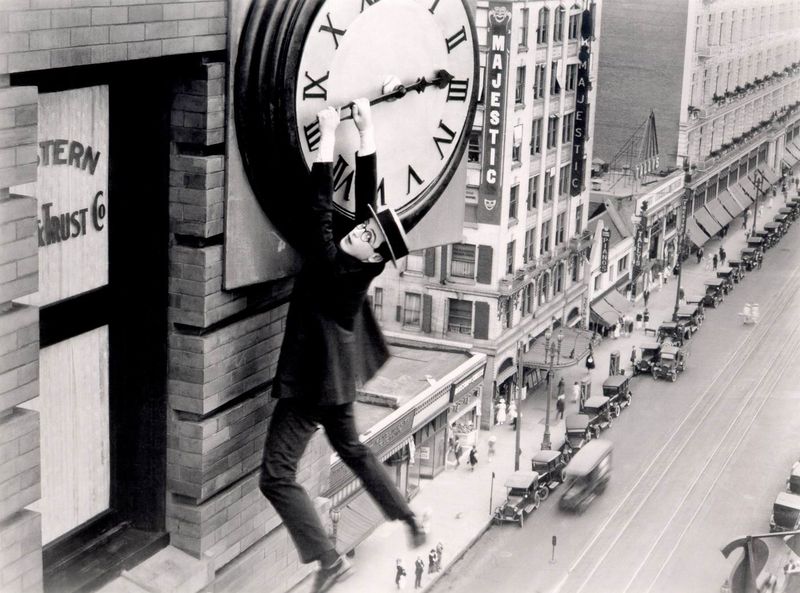
Safety Last-ClockI know I’ve been quiet for an unusually long time, but two days after my last post on October 24, I was run over by an airport shuttle van while crossing the street at the intersection of 94th & Amsterdam Avenue here in NYC, so I think I’ve got a pretty good excuse for the inactivity. Recovery from the accident has been progressing pretty well, but it will take awhile longer before I’m back to “normal” (so to speak). Apparently getting flattened in the street wasn’t enough to pay off whatever karmic debt I’ve accrued, because two weeks ago I also came down with a case of shingles to boot. Man, what next?

One thing this little episode made me realize was that most violence in movies is unrealistic (duh). When the protagonist, while chasing someone on foot, runs into the street and gets hit by a car, tossed onto the hood and bounced off the windshield, then gets up and continues the chase, well, I don’t think so. The same for scenes of people crashing through plate glass windows or skylights. You don’t just walk away from this stuff so easily. At least, I didn’t.

But I’m feeling better now (in spite of the shingles, which are very distracting, believe me), and plan to start putting up posts again. I saw 236 films in 2013, and I’ve got plenty of stuff to write about. For starters, I’ll be posting my “Best of” picks for films and TV within the next week or two. In the meantime, to take us out of 2013 and into 2014, here’s the Johnny Burnett version of one of my favorite rock songs of all time, “The Train Kept A Rollin’.” A version of this song was performed by the Yardbirds in Michelangeo Antonioni’s classic Blow Up in 1966. This is followed by the opening credits sequence of Richard Lester’s great Beatles movie, A Hard Day’s Night (1964).

And finally, just because it perfectly captures a kind of pre-punk attitude, here is a key moment I love from one of Marlon Brando’s definitive films, The Wild One (1954).

Keaton-The GeneralHappy New Year! See you at the movies in 2014. – Ted Hicks
That's All Folks-title

Posted in Film, Music, TV | 7 Comments

“All Is Lost” — Unique & Amazing

All Is Lost-poster2I’m still fresh from the impact of seeing All Is Lost several days ago. I think it’s a really great movie, and might be the best film I’ve seen so far this year. The story is as basic as it gets: a man alone, adrift in a damaged sailboat on the ocean, struggles to survive. It’s as simple as that. But saying that All Is Lost is about a man trying to survive alone in the ocean doesn’t begin to convey what it’s like watching the movie.

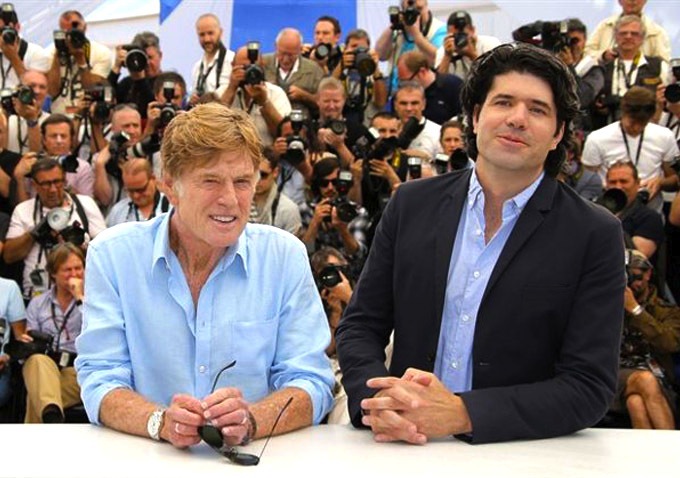
This is only the second feature written and directed by J.C. Chandor. His first film, Margin Call (2011), has a large ensemble cast of great actors and lots of talk; the action is in the dialogue. It’s a very smart, terrific film. At first glance it couldn’t be more different from All Is Lost, but it, too, is about survival, as members of a large investment firm struggle to save the company over the course of a long, dark night.

All Is Lost opens with a close-up of the side of a shipping container. The motion and sound of water lapping indicate it’s afloat somewhere. We hear a voice — Robert Redford’s — reading what sounds like a letter that’s been written his family, probably, though this is never specified.  He says that he always tried to be good and do right, apologizes for his failures and the disappointments he’s caused, and says “I’m sorry” several times. His voice is tired, resigned, sad, and nearly broken. And that’s it. Those are nearly the only words we hear him say during the entire film, as well as the closest we get to any kind of backstory on this guy and why he’s here.

At the end of the letter, there’s an on-screen title stating “Eight days earlier.” We see Redford in his cabin waking up to water pouring into the boat through a breach in the hull. A shipping container carrying a cargo of sneakers has rammed his sailboat, the Virginia Jean, the sea water damaging his communications and navigation equipment. On deck, we see sneakers bobbing in the water.

In a recent piece in the New York Times by Maureen Dowd on Redford and the film, he says of his understanding of the character: “He’s got a conscience. Clearly he has a family. He’s not a bad person, but he’s failed in some way. So maybe this journey has to do with him sorting all that out.” Redford also says he didn’t think about dying while making this film; he thought about enduring.

I don’t think I’ve ever seen anything quite like this in a theatrical motion picture. It’s practically experimental, especially for an American film, totally stripped down. The script was only 31 pages long and the film cost under $10 million to make (which is considered very low budget these days). Story and character are reduced to the most basic elements. The film doesn’t give us anything beyond what’s on the screen. There’s no voice-over, no narration; he doesn’t talk to himself or, like Tom Hanks in Castaway, to a soccer ball named Wilson. A more conventional film might have included flashbacks to fill out the story, tell us who this guy is and why he’s by himself in the middle of the ocean. He doesn’t even have a name. It’s only in the closing credits that we see Redford’s character is called “Our Man.” Not “A Man” or “The Man,” but “Our Man.”

I only have two minor reservations about All Is Lost. One is that there were times as I watched him go from one exhausting task to the next, one after the other, I wished for something more, or maybe different, from the film, which by its very nature it wasn’t going to provide. The other is that I really liked the music score by Alex Ebert, but there’s a song with lyrics under the closing credits, which felt wrong for a film with virtually no spoken words. But as I say, these are minor.

All Is Lost-still2Redford’s Our Man has nothing but himself to count on, which is also true for Redford as an actor. He can’t rely on the Redford charisma in this film, or at least not the charisma we’ve come to know. Both actor and character are all alone in All Is Lost, which nothing to fall back on, no dialogue, no other characters or any kind of backstory. It’s a performance that’s almost like an act of survival in itself. Robert Redford is 77 years old. He’s been a huge movie star, an Oscar-winning film director, and founder of the Sundance Institute and the annual Sundance Film Festival. At this point in his life, it’s amazing that he would be willing to put himself on the line like this. He certainly didn’t have to do it. The result is probably the best performance of his long career, and totally different from anything he’s done before.

It’s been pointed out elsewhere that All Is Lost shares its survival theme with three other excellent films currently in theaters: Captain Phillips, Gravity, and 12 Years a Slave (I’ll leave it to others to speculate on what it is in the zeitgeist that might account for this.) Earlier films in this vein include 127 Hours (2010), Into the Wild (2007), and Cast Away
(2000). These are all terrific films, but none of them are as pure in their approach and style as All Is Lost (Gravity probably comes the closest). Survival is boiled down to life or death, nothing else. There is a total focus on staying alive, with no distractions of any kind.

Redford’s character is a man who doesn’t lose his cool under pressure. When he discovers water pouring into his boat, he takes steps to repair the hull and bail out the water. His communications are shot, except for a brief moment when the radio stutters to life and he tries sending an SOS. “This is the Virginia Jean. Can anyone hear me?” is one of the few times we hear him say anything. We see him reading a book called Celestial Navigation for Yachtsmen, and unpacking a sextant, which has obviously not been used before. But he knows what to do, he’s prepared, he’s capable. Though there comes a point, in the face of an approaching storm, when he takes the time to shave, as though to ward off the uncertainty he must now be feeling. This is an extraordinary moment in the film.

We learn from the charts he consults that he’s somewhere in the Indian Ocean. He manages eventually to cross into the shipping lanes,  but the two ships he sees pass by despite his efforts to signal them. (The first is a Maersk Line container ship, which is a bit of a jolt, since that’s the same shipping line that Tom Hanks’ character works for in Captain Phillips). It’s as though he’s invisible.

Our Man is in desperate straits nearly all the time, and at some point must realize his chances of surviving are all but non-existent. This is probably when he writes the letter we hear at the film’s beginning. A moment that really got to me is when he folds the letter and puts it in a jar, but hesitates to throw it overboard, as though reluctant to let it go. Then he almost casually flips the jar out of his hand into the sea.

Despite the nuts and bolts physicality of this film — everything is in the moment — there’s finally a spiritual, or metaphysical, aspect here (if you want to see it that way) that reminds me of the transcendent ending of The Incredible Shrinking Man (1957), as weird as that may sound.

His life becomes one of damage control, having to deal with one problem after another, as things get worse and worse. It’s not just about survival; every minute Our Man remains alive is a kind of victory. Whatever happens, he will have done everything he could. — Ted Hicks

_______________________________________________________________

Extras:

Robert Redford & J.C. Chandor - Cannes 2013

Robert Redford & J.C. Chandor – Cannes 2013

 Here’s a segment from a press conference at the Cannes Film Festival earlier this year:

And from an interview from earlier this month (neither of these contain spoilers):

Finally, there’s a piece on the Slate website by Forrest Wickman that definitely does contain spoilers. It’s a discussion of the ending. I strongly advise not reading this if you haven’t seen the film, but the piece is very interesting if you have.

Posted in Film | 5 Comments