For those who want to take a deeper dive into some of the films on my Best Features list, here is a selection of interviews, press conferences, and more. Many of these films were shown at last fall’s New York Film Festival before being released theatrically. – Ted Hicks
“Show the Monster” — an article on Guillermo del Toro by Daniel Zalewski published in the February 7, 2011 issue of the New Yorker can be accessed here. It gives a good look inside del Toro’s head. Note that this predates The Shape of Water.
Wind River is my top pick for the year, with A Ghost Story as a close second. They’re quite different, but they really got to me. I had a deeper emotional response to these two films than all the others. These are the ones that mean the most to me. That’s saying something, because I think all the films on this list are excellent, each in their own way. The Shape of Water, Call Me by Your Name, and Dunkirk, especially, are singular achievements. The films that stood out for me last year, out of the 339 I saw, are listed below, in alphabetical order (except for two). There’s no way I can stick to a traditional Top 10 list. For me it’s more like Top 30, and even then I have to allow for a few more. This post took on a life of its own.
Note: I wrote about seven of these titles last July in “The Year So Far: Feature Films.” I’ve copied those entries here, with slight revisions.
The Big Sick (Michael Showalter, director) Looks and sounds like a rom-com at the outset, but becomes something much deeper and more authentic by the end. The film is written by Kumail Nanjiami and his wife Emily Gordon, based on their real-life romance. Nanjiami plays a version of himself and Emily is played by Zoe Kazan. Anyone who’s followed Nanjiami on HBO’s Silicon Valley knows how special he is. A stellar Holly Hunter and Ray Romano play Emily’s parents who rush to Chicago when she falls ill. The Big Sick is very funny and very moving as it looks at family relationships and the messiness of falling in love, as well as the dynamics of being a Pakistani in today’s America.
Blade Runner 2049 (Denis Villeneuve, director) The original Blade Runner (1982) has such iconic status that attempting a follow-up is a high-risk venture, even for a director as skilled as Villeneuve. I think the new film succeeds more than it doesn’t. It’s long, nearly 2 hours 45 minutes, but I saw it twice — the second time in IMAX — and didn’t feel the length. This is a film that really justifies the IMAX format. The sequel has a number of clever connections to the original. Ryan Gosling is a terrific actor, and it’s great seeing Harrison Ford back as Rick Deckard. But as powerful as it is at times, nothing here quite compares to Rutgar Hauer’s “Time to die” moment in the rain from the first film. If you’ve seen it, you know what I mean.
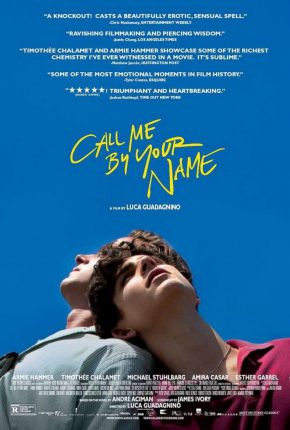
Call Me By Your Name (Luca Guadagnino, director) This film has a very lush texture, as you would expect from the director of I Am Love, the film he made with Tilda Swinton in 2009. The feel of a sensuous summer in the sun at a country estate in northern Italy is sharply conveyed. Armie Hammer plays a graduate student from the States in Italy to assist Michael Stuhlbarg, a professor of antiquities. Timothée Chalamet as Elio, Stuhlbarg’s son, falls in love with Hammer over the course of the summer. A conversation Elio has with his father near the end of the film is a stunning high point. Chalamet was also in Hostiles and Lady Bird in 2017; Stuhlbarg was in The Shape of Water, The Post, and the third season of Fargo on FX.
Coco (Lee Unkrich & Adrian Molina, co-directors) This film gave me a huge amount of pleasure. I had a smile on my face throughout. Setting the story in the context of Mexico’s Day of the Dead celebration certainly helped. Pixar is the greatest.
Columbus (Kogonada, director & writer) John Cho is Jin, a Korean translator who has come to Columbus, Indiana, where his father, an architecture scholar, has fallen ill. Hayley Lu Richardson is Casey, a high school graduate living with her mother, a recovering drug addict. Jin and Haley meet by chance and become friends during the next several weeks. They have a series of fascinating conversations, usually in the context of visiting architectual landmarks in the city. Haley is a self-styled expert on these buildings and their history. It was news to me, but Columbus is the site of many buildings and structures designed by famous architects. In this, the film has a documentary aspect. The buildings are there, they exist in the real world, they’re not merely background. The architecture is crucial to the story and crucial to the characters. I found this aspect really interesting. It doesn’t hurt that John Cho — Harold in the Harold and Kumar films and Sulu in three Star Trek films since 2009 — and Haley Lu Richardson — who I don’t recall seeing before — are very appealing and engaging actors. They make me care about what happens to them.
Downsizing (Alexander Payne, director & co-writer) The advertising for this might make you think it’s a comedy. It certainly has comedic elements, inherent in the premise of shrinking people as a way of dealing with overpopulation, but that’s just part of it. Payne, whose films include Nebraska (2013) and Descendants (2015), is great at creating quirky, oddball characters. That’s true here, but Downsizing also resonates with many issues today, such as immigration and class divisions. There’s even a wall!
Dunkirk (Christopher Nolan, director & writer) Seeing this in IMAX is an overwhelming experience. I’m sure it will work in any format, though probably less so on your phone. I’ve seen it twice. The first time I was thrown by Nolan’s use of time in telling the story. One segment takes place over a week, another during a day, and the third in one hour. He cuts in and out of these throughout until the end, when they all more or less come together. I came out impressed by the production, the sound and visual, but not sure if I liked it very much, or understood why he was doing what he was doing. That was last July. When Dunkirk returned to the IMAX screen at the Lincoln Square multiplex in the fall, I saw it again. This time I was blown away, much more so than before. I was able to focus on the film without trying to figure out where I was in it. The final image of a Spitfire fighter burning on the beach is exquisitely beautiful and moving.
Foxtrot (Samuel Maoz, director & writer) A couple in Tel-Aviv are told that their son has been killed while stationed at an army outpost. Later they receive some different news. Then the film shifts to the outpost location. I saw this film at a press screening prior to a week’s Oscar-qualifying run in December and really liked it. It opens for a limited release on March 2nd. Foxtrot is different, insightful, and very human.
Get Out (Jordan Peele, director & writer) Jordan Peele (of Key & Peele) has done something extraordinary and cleverly subversive here. In the guise of sci-fi horror films such as Invasion of the Body Snatchers and The Stepford Wives, he’s given us a study of race relations as deep and insightful as the documentaries I Am Not Your Negro, O.J.: Made in America, and 13th.
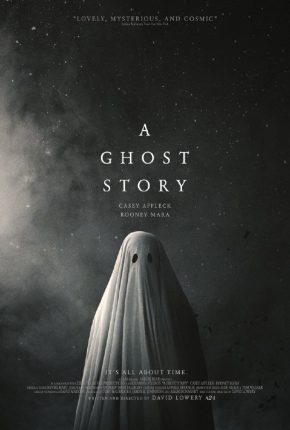
A Ghost Story (David Lowery, director & writer) This is one of the saddest films I’ve ever seen. At the beginning we see Casey Affleck and Rooney Mara in and around their house on land that might be in Texas. They’re married and in love. She wants to move; he doesn’t. Then he dies. And is resurrected as the classic kid’s idea of a ghost, as someone in a sheet with two blank eye holes, the least-expensive Halloween costume ever. The ghost stays in the house, haunting it, silently watching Mara dealing with grief as her life goes on. He remains in the house after she moves out and as a succession of families move in. The film is a strong evocation of loss, loneliness, existence, and time. That’s a heavy load for a film to carry, but I think A Ghost Story more than does it. The film suggests why ghosts might hang around at all, why objects in haunted houses suddenly fly off shelves, and gives new meaning to the expression “giving up the ghost.” This shouldn’t work at all, but it does. Or maybe it doesn’t, I don’t know. You’ll either go with it or reject it entirely. It’s hard to describe the effect it had on me. A Ghost Story left me feeling lonely and alone, but also exhilarated. At dinner the day I saw it, I was telling my wife Nancy about the final moment in the film and I got choked up trying to get it out. I didn’t expect this, but I can’t ignore something that provokes a reaction this strong. Maybe I identified too much with the ghost. Hah. You might wonder why someone should want to go through that. The answer is because it’s beautiful. Maybe I’ll see it again and it won’t work at all. But I strongly doubt it. *** I was right. I saw A Ghost Story again a few weeks ago and it’s still great. The only reservation I had this time is a scene at a party where someone is presuming to explain the existential absurdity of existence. It’s jarring because it takes place in what is otherwise a very quiet movie, and also because this guy is such a pompous windbag. Don’t know why this didn’t bother me the first time, but it didn’t.
Happy End (Michael Haneke, director & writer) Everyone has secrets in this film. Jean-Louis Trintignant plays Georges Laurent, patriarch of an affluent bourgeois family that owns a construction company. Isabelle Huppert is his daughter Anne; Mathieu Kassovitz is his son Thomas, recently remarried; Fantine Harduin is Eve, Thomas’ 13-year-old daughter who may have poisoned her mother; Franz Rogowski is Pierre, Georges’ unpredictable and violent son. Characters and their actions in Haneke’s films are often seen coldly with a clinical eye. My favorite film of his is The White Ribbon (2009). Happy End can be seen, in a way, as a sequel to his Oscar-winning Amour. It can also be seen as a comedy, but one laced with acid. I liked this a lot.
Hostiles (Scott Cooper, director & writer) Anyone looking for a traditional Western might have a problem with Hostiles. It’s unsentimental and brutal, much in the way of Robert Aldrich’s great film with Burt Lancaster, Ulzana’s Raid (1972). There’s nothing light about it. I quite liked it. Christian Bale plays a dour U.S. Cavalry officer ordered in 1892 to escort a dying Cheyenne war chief (Wes Studi) and his family to their tribal land in Montana. Bale would sooner kill Studi than carry out this order. Along the way he picks up a woman (Rosamund Pike, perhaps a bit too beautiful for the setting and circumstances, but effective) whose husband and children have been killed in an attack by a Commanche war party on their homestead. The story plays out in some predictable ways and others not so predicatable. This is Scott Cooper’s fourth feature since Crazy Heart (2009), which featured Jeff Bridges in an Oscar-winning role.
In the Fade (Fatih Akin, director & writer) I’ve liked Fatih Akin’s films ever since seeing Head-On in 2004 and The Edge of Heaven in 2007. He’s a Turkish director who tells stories of people caught up between cultures and countries. In the Fade is ostensibly a thriller. Diane Kruger gives a totally committed performance as a woman determined to see justice done after her husband and young son are killed in a bombing by neo-Nazis. It may be a cliché to describe something as “gripping,” but that definitely applies here.
Lady Bird (Greta Gerwig, director & writer) Terrific coming-of-age story written and directed by Greta Gerwig. She’s received a lot attention for her work on this film, and deservedly so. Though I’d seen Saoirse Ronan in The Lovely Bones (2009) and Hanna (2011), it was with Brooklyn (2015) that I really took notice of her. She’s excellent here as Lady Bird McPherson, a high school senior in Sacramento, unsure of what to do with her life. Laurie Metcalf is also very strong as Lady Bird’s flinty mother. Tracy Letts is truly wonderful as her father. He’s always effective, but this is a character unlike any I’ve seen him play before.
Lady MacBeth (William Oldroyd, director) This is a nasty little film that I liked a lot. I’ve seen it twice so far; once at a press screening and again when it was screened in last year’s New Directors/New Films series. A plot synopsis from IMDB sets it up more concisely than I probably could: “Rural England, 1865. Katherine is stifled by her loveless marriage to a bitter man twice her age, whose family are cold and unforgiving. When she embarks on a passionate affair with a young worker on her husband’s estate, a force is unleashed inside her, so powerful that she will stop at nothing to get what she wants.” Set in a desolate landscape, the film has echos of Wuthering Heights, but with a fairly modern sensibility. Florence Pugh’s Katherine is smarter and deadlier than anyone around her, determined to survive no matter what.
Last Flag Flying (Richard Linklater, director & writer) Linklater is a director who has worked to do something different in his films. He hit the scene with his no-budget indie Slacker in 1991. With his Before Sunrise/Sunset/Midnight trilogy (1995/2004/2013) he followed the relationship of Ethan Hawke and Julie Delphy, with each film taking place during a 24-hour period. He used a new method of rotoscoping in his animation features, Waking Life (2001) and A Scanner Darkly (2006). Most significantly, in Boyhood (2014), Linklater filmed the same actors over 12 years to tell the story of a boy as he grows from age 7 to 19. No one had made a film like this before, and is unlikely to again. Last Flag Flying is more traditional, but no less effective for that. In a sort-of sequel to The Last Detail, Steve Carell is a man who seeks out Bryan Cranston and Laurence Fishburne, who he served with in Vietnam, to help him bury his son, a Marine who was killed in Iraq. This is a more subdued character for Carell than he usually plays, less exaggerated and more realistic. It’s a journey, a road movie, comical at times, but quite moving by the end.
Logan (James Mangold, director) Hugh Jackman is the title character, aka Wolverine, from Marvel Comics. He’s played this character many times before in X-Men and Wolverine films. But this one is different, a superhero movie that’s not really a superhero movie. It’s R-rated, down and dirty, and very violent. Logan shows the bloody consequences of violent actions that are played for thrills in conventional PG-13 action films where it’s more about the body count than it is about the bodies. This one feels real, even if it’s not. There’s more at stake. Life, death, redemption. Not everyone walks away.
Loving Vincent (Darota Kobiela & Hugh Welchman, co-directors) A young man investigates the last days of Van Gogh’s life in an effort to determine the circumstances of his death. This is the first fully painted animation feature, and it feels unique. One hundred artists worked to hand paint each frame of the film in the style of Van Gogh. The trailer below gives a sense of the look and feel of the film. Loving Vincent is emotionally involving and quite beautiful.
Margorie Prime (Michael Almereyda, director) In the near future, technology exists that enables a deceased loved one to be resurrected as a hologram. Lois Smith plays a widow in the early stages of Alzheimer’s who has chosen a younger version of her husband, played by Jon Hamm. He’s been programmed with memories and has the ability to learn more. Geena Davis and Matthew Robbins play Smith’s daughter and son-in-law. This film has a gentle touch as it deals with loss and acceptance.
Maudie (Aisling Walsh, director) I didn’t know before seeing this that Maude Lewis was an actual person who became a well-known Canadian folk artist in the 1940s and 50s. Sally Hawkins is simply wonderful in the title role, as is Ethan Hawke as the lonely, extremely gruff (to put it mildly) fishmonger who becomes Maude’s initially unwilling companion. They’re an odd couple if there ever was one. This is a film with a lot of human feeling, but not maudlin or sentimentalized. It earns the emotional response you’re likely to have for it.
The Meyerowitz Stories (New and Selected) (Noah Baumbach, director & writer) Noah Baumbach’s films often have a literary feel. This one is no exception, most obviously in the title. It’s refreshing that Adam Sandler and Ben Stiller are playing more realistic characters than they usually do. Dustin Hoffman is excellent as their father, Harold, an embittered artist who feels he’s never gotten his due. The entire cast is very good. The film is funny, but I wouldn’t call it a comedy. There’s real pain beneath the surface.
Mudbound (Dee Rees, director) Based on a novel by Hillary Jordan, Mudbound tells the story of two young veterans, Jamie (Garrett Hedlund) and Ronsel (Jason Mitchell), who return home after the end of World War II to rural Mississippi. Ronsel’s father Hap is a tenant farmer on Jamie’s brother’s farm. Jamie is white, Ronsel is black. They warily become friends and have to deal with pervasive racism and their own wartime trauma. Besides Hedlund and Mitchell, the excellent cast includes Jason Clarke as Jamie’s brother Harold, Carey Mulligan as Harold’s wife Laura, Jonathan Banks as their virulent racist father, Rob Morgan and Mary J. Blige as Ronsel’s parents, Hap and Florence. An interesting feature is that the characters take turns doing voice-over narration. This lends a novelistic feel to the film. Mudbound is epic in scope, from scenes of incredible hardships on the farm to flashbacks of the war with Jamie as an Air Corps pilot and Ronsel as an army tank commander who falls in love with a young French woman. Mudbound has received an astonishing number of award nominations — 76 by my count — in various categories from many regional and national organizations. Among those, cinematographer Rachel Morrison is the first woman to be nominated for an Oscar in that category, which is significant.
On the Beach at Night Alone (Hong Sang-soo, director & writer) This is a mesmerizing film about a young Korean actress and the married film director she previously had an affair with. That the film’s lead actress, Kim Min-hee, and the film’s director, Hong Sang-soo, actually had an affair adds an interesting meta-level. Details are revealed slowly. A more complete picture begins to emerge, the way images appeared on Polaroid film. Not everything is clear by the end, and that’s okay. I saw it a second time with my wife, who hadn’t seen it. Afterwards she had a lot of questions. We talked about it the entire trip home, discussing the whats and whys and maybes of what we’d seen. Anything that can provoke that much discussion has something going on. Whatever else, On the Beach at Night Alone is the most poetic title I’ve heard of for a long time. As befits the film.
The Other Side of Hope (Aki Kaurismäki, director & writer) All the Kaurismäki films I’ve seen are about immigrants to one degree or another. As with Fatih Akin, Kaurismäki’s characters are caught up in countries and cultures. Khaled is a Syrian refugee who stowed away on a freighter to Helsinki, where he applies for asylum. Waldemar Wikström is a frustrated traveling salesman who uses poker winnings to open a restaurant. With immigration officials on his trail, Khaled is taken in by Waldemar. Kaurismäki’s films often involve makeshift communities made up of oddballs and outsiders. There’s always music in his films, such as bands of street musicians playing rock and roll that the film pauses to watch. Before we saw this film, Nancy and I had seen an earlier film, The Man without a Past (2002), at Film Forum, which we really liked. Then The Other Side of Hope opened and we loved it. In short order we’d watched La vie de bohème (1990) and Le Havre (2011) on Amazon. His films have a deadpan quality similar to those of Jim Jarmusch. Kaurismäki is a singular director, a humanist all the way.
Phantom Thread (Paul Thomas Anderson, director & writer) Anderson is nothing if not ambitious, as he’s shown with Magnolia (1999), There Will Be Blood (2007), and The Master (2012). He creates incredibly detailed worlds that have texture and heightened reality. Daniel Day-Lewis is Reynolds Woodcock, a famous clothing designer in London during the 1950s. His performance is extraordinary, as you’d expect. The actor has said that this is it, he’s retiring from film acting. If so, it will be a loss. Leslie Manville is excellent as his sister, Cyril, as is Vicky Krieps as Alma, Woodcock’s muse and lover. I’d not heard of Krieps before and was impressed by how she more than holds her own with Day-Lewis. Music is very important in this film. The score by Jonny Greenwood is used in nearly 70 per cent of Phantom Thread, 90 minutes out of 130. That’s a lot, and it works. Sound is also used in a subjective way, as in a breakfast scene where the sound of Krieps buttering toast and pouring tea is heightened to show how much it irritates Day-Lewis. There’s also a Hitchcock vibe to some of the story. Pay attention to the mushrooms from the woods. I wasn’t sure what I felt about Phantom Thread the first time I saw it, but I loved it the second time around.
The Post (Steven Spielberg, director) It was only yesterday that I realized The Post wasn’t on this list. It’s a good film, but not a great one. The story of the Washington Post’s role in publishing the Pentagon Papers is a timely one, but I think All the President’s Men and Spotlight are better newspaper films. Still, it deserves to be here because of its pedigree. Spielberg has long since proven his worth as a director. Meryl Streep and Tom Hanks always deliver the goods. Tracy Letts and Bob Odenkirk are standouts in an excellent supporting cast.
The Shape of Water (Guillermo del Toro, director & co-writer) With 13 Oscar nominations, this is obviously a heavyweight contender. We saw it opening day with Del Toro, Octavia Spenser, Doug Jones (who plays the amphibian man), and Michael Stuhlbarg there for an interview after. This was special. Appearances by filmmakers and cast members always add a lot to the experience. I saw it again a week later. It was just as strong, or stronger, the second time around. Del Toro has said that the initial inspiration for this film came from the scene in The Creature from the Black Lagoon (1954) when the Gill Man is swimming beneath Julie Adams, matching her movements. It’s a sensuous, erotic moment. The Shape of Water is basically the story of a mute cleaning woman who falls in love with a Gill Man. In 1962, in the midst of the Cold War, a humanoid amphibian creature has been captured and brought from the Amazon by a tightly-wound Michael Shannon (excellent as usual) to a NASA lab in Baltimore for study. Sally Hawkins is wonderful in her Oscar-nominated role, as are Octavia Spenser, Richard F. Jenkins, and Michael Stuhlbarg. Del Toro brings a unique and innovative vision to all of his best films. From his first film, Cronos (1993), to Devil’s Background (2001), and Pan’s Labyrinth (2006), he’s proven his ability to amaze, delight, and creep us out. He shows us things we haven’t seen, or even thought of before. The Shape of Water, from its poetic title to the deeply moving score by Alexandre Desplat, is a beautiful fairy tale that feels very real.
The Square (Reuben Östlund, director & writer) You have to see this one to believe it. I thought it was great, but I’ve been apprehensive of seeing it again. I wrote that last year’s Toni Erdmann was my top pick of 2016, but when I saw it again a couple of months later, I had a negative reaction. Both films are very unusual, so I’m concerned that The Square might not work a second time. Of course, it received the Palme d’Or at Cannes last year, but you never know. That said, I was really knocked out when we saw it at the New York Film Festival. Östlund is a rather confrontational filmmaker. He puts us in situations that make us uncomfortable, that throw us off balance. He certainly did that in his last film, Force Majeure (2014). Peter Bradshaw in The Guardian describes The Square as “…high-wire cinema.” Claes Bang plays Christian, the chief curator of a contemporary art museum in Stockholm. Early in the film his wallet and mobile phone are stolen in a crowded square near the museum. His efforts to retrieve his property result in humiliation, chaos, and damage. Elizabeth Moss is Anne, a journalist who Christian has a brief involvement with. His night in her apartment is marked by a large chimpanzee that appears without explanation in the next room. From the bedroom, Christian watches as the ape crosses to a couch, where it sits and begins examining an art print. This is later followed by a post-sex tug of war over possession of a used condom. The high point is a formal dinner for wealthy museum patrons in which a performance artist pretending to be an ape freaks everyone out with his threatening behavior. The atmosphere in this scene is one of escalating fear and danger. After writing this, I realize I definitely have to see it again.
My previous post on Force Majeure may be accessed here.
Three Billboards Outside Ebbing, Missouri (Martin McDonough, director & writer) This film has gotten a lot of attention, mainly due to the performance of Frances McDormand as a mother who puts up billboards demanding that the police do more to solve the rape and murder of her daughter months before. Her character is foul-mouthed and unrelenting in her determination to see justice done. She’s incredibly entertaining to watch, though the grief that drives her is underneath it all. The terrific cast includes Woody Harrelson, Peter Dinklage, John Hawkes, Clarke Peterson, and Sam Rockwell, who really scores in this one.
Wind River (Taylor Sheridan, director & writer) As I indicated before, this is my favorite film of the year. Seeing it a third time last November made me certain of how good it is. My previous post on this film can be accessed here.
Wonder Woman (Patty Jenkins, director) Enormously successful at the box-office, and for good reason. Wonder Woman is a knockout. It may not carry the real-world weight that Logan aspires to, but it’s pretty great, and raises the bar for the superhero (or superheroine) genre. This is largely due to the casting of Gal Gadot as Diana Prince, aka Wonder Woman. She’s a stunning, dynamic presence. The climactic showdown is a special-effects blowout we’ve seen many times before, but the film works like gangbusters in spite of that.
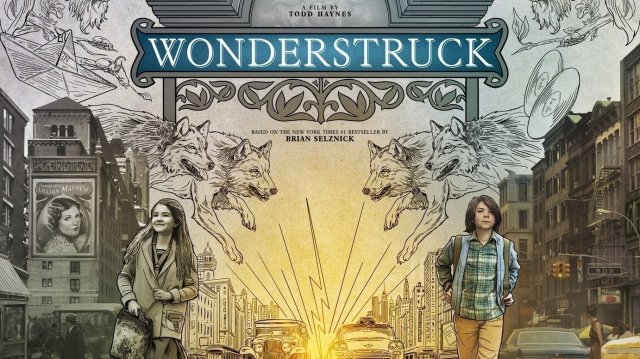
Wonderstruck (Todd Haynes, director) This film, based on Brian Selznick’s illustrated novel, has a magical, almost fairy-tale quality. There are two interconnected storylines, set 50 years apart. In Minnesota in 1977, 12-year-old Ben, obsessed with finding out who his father was, loses his hearing in a freak thunderstorm accident. Following clues, he strikes out for New York City. In Hoboken, New Jersey in 1927, 12-year-old Rose, apparently deaf since birth, runs away to New York in search of her mother, a silent film star. Ben and Rose’s stories are interwoven throughout the film and finally converge at the end when all is revealed. Wonderstruck is a wonderful movie. Todd Haynes, working with his long-time cinematographer Ed Lachman, has created an incredibly detailed world. There’s a sense of discovery in every scene. The cast includes Julianne Moore and Michelle Williams, with Oakes Fegley as Ben and Millicent Simmons as Rose.
These are extremely violent, stylish films that you’ll either find appalling or think they’re great. I know where I stand.
Blade of the Immortal (Takashi Miike, director) Japanese director Miike has directed 100 theatrical, video and TV productions since 1991, and he’s only 57. Audition (1999), a phenomenally disturbing film, was the first one of his that I saw. I’ve never quite worked up the nerve to see it again. He makes gangster films, horror, samurai, children’s films, teen dramas, and more. The “hero” of Blade of the Immortal is a wandering samurai who has been cursed with immortality. The kicker is that while he can’t be killed, he can still suffer grievous bodily damage and pain until his body repairs itself, which it does quickly, but still. He wants to die, but hasn’t figured out how to do that yet.
The Villainess (Byung-gil Jung, director & co-writer) A young woman trained to be an assassin by a secret organization develops her own agenda and proceeds to wreak havoc. This has a La Femme Nikita vibe pushed beyond the limit. Where else are you going to see a sword fight on motorcycles? The protagonist is in the tradition of other films in recent years that featured extremely lethal women, such as Hanna, Haywire, and Electric Blonde. I’m not sure if these qualify as examples of female empowerment, but it’s refreshing to see the tables turned.
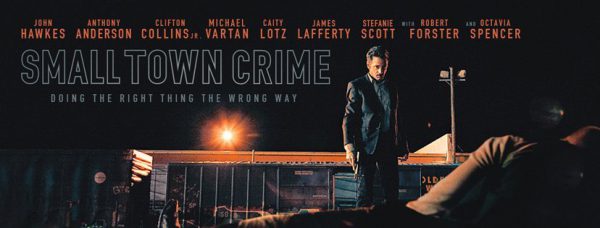
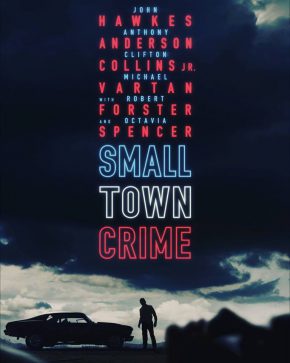
Small Town Crime is a nasty neo-noir with an off-kilter sense of humor that tells the story of an alcoholic ex-cop as he tries to redeem himself by solving the brutal murder of a young woman left for dead by the side of the road. I was totally unaware of this film until I read Manhola Dargis’ review in the New York Times last Friday morning. She had some reservations, but I’m generally drawn to this type of film. When I saw that John Hawkes was in it, I got even more interested. Then I watched the trailer and that sealed the deal.
There’s nothing particularly new here, but it’s all in the telling, and Small Town Crime goes off-road enough to make it more than interesting. This isn’t a great film, but I liked it a lot. It honors genre conventions, but messes with them, too. A key factor is the casting of John Hawkes as the tarnished hero, Mike Kendall. Hawkes is a terrific actor. I’d seen him before, but he really got my attention as Sol Starr in the great HBO series Deadwood (2004-2006). His feature films include Miranda July’s Me and You and Everyone We Know (2005), Winter’s Bone (2010), playing a Manson-like cult leader in Martha Marcy May Marlene (2011), in The Sessions (2012) as a 37-year-old poet paralyzed from the neck down by polio who hires a sex-surrogate to help him lose his virginity, and Three Billboards Outside Ebbing, Missouri (2017). He’s one of those actors who always feels authentic.
Mike’s drinking is taken as a given in the film. He’s totally unapologetic about it, even going out of his way to tell a job interviewer about his “drinking problem.” Which he does after having been offered the job. Needless to say, he doesn’t get it. Everyone in his life seems to know. You don’t get the sense he has any intention of cutting back. Early in the film, Mike comes to face down in the middle of a field littered with trash. When he manages to get to his feet, you can tell he’s wondering where the hell he is, and you know this isn’t the first time.
The rest of the cast is equally good. Octavia Spenser and Anthony Anderson play Mike’s sister and brother-in-law. Wait — sister? For a while I thought they weren’t going to explain it, but we eventually find out that Mike was adopted into Kelly’s family. It’s an intriguing detail. Robert Forster plays the grandfather of Kristy, the murdered woman. She’d had a troubled life, and had been a prostitute. Clifton Collins Jr. plays Mood, who was Kristy’s pimp, or “manager,” as he likes to call himself. Collins is oddly likable in the role. Mike, passing himself off as a private investigator named Jack Winter, convinces Forster to hire him to find Kristy’s killer. Both Forster and Collins end up standing with Mike in the inevitable shootout that climaxes the film.
Another piece of sharp casting in the film is the black Chevy Nova that Mike drives throughout, laying rubber whenever possible. This car has a lot of personality.
I forget exactly how blood ended up splattered on the passenger-side window, but there must have been a good reason.
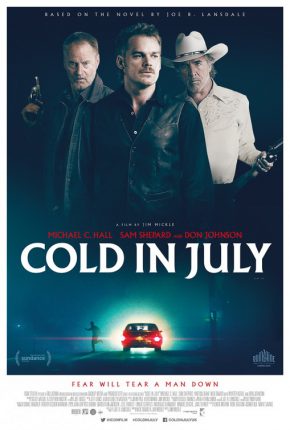
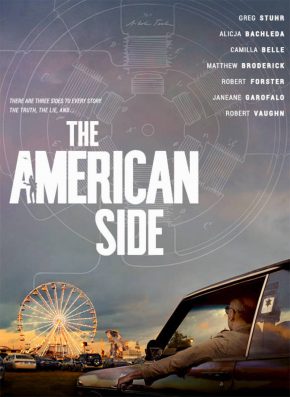
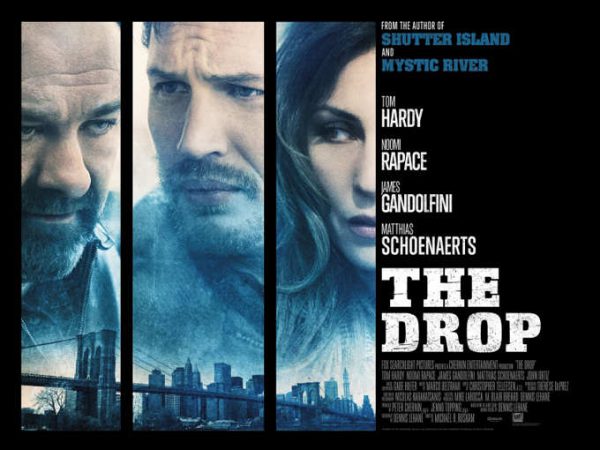
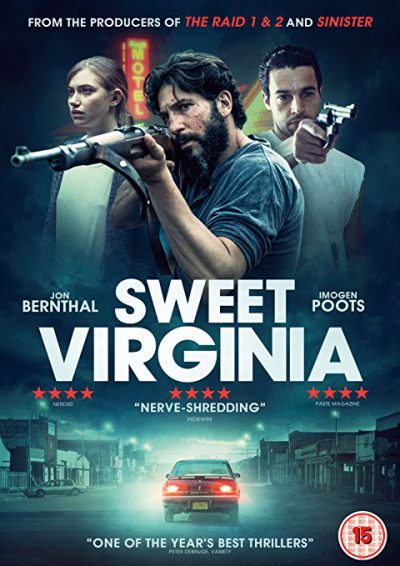
Small Town Crime was written and directed by the brothers Eshom and Ian Nelms. I’m sure they were influenced here by Quentin Tarantino, the Coen Brothers, and especially Elmore Leonard, but how many films of this type haven’t been? I’ve not seen their two previous features, Lost on Purpose (2013) and Waffle Street (2015), but based on this one, I’m interested. Small Town Crime is in the tradition of other blunt and brutal neo-noirs that have appeared in recent years. These include Cold in July (2014), The Drop (2014), The American Side (2016), and Sweet Virginia (2017). I’m sure there are many more, but these are the ones that come to mind.
I was surprised to find so many different posters online for Small Town Crime. It’s interesting to see the approaches that were taken. Here’s the one that was on display in the theater, so I guess this is what they’re going with. The others are below that.
Small Town Crime is currently playing at just one theater here, the City Cinemas Village East on Second Avenue and 12th Street. There’s frequent turnover at that theater, so it may not be there long. It’s also available for streaming via Direct TV and YouTube Movies.
All of the films referenced in this post are available for rental or streaming on either Amazon or Netflix.
An article on Small Town Crime and John Hawkes’ career by Mary Kaye Schilling in Newsweek online can be accessed here.
A piece in the NYT Sunday magazine on John Hawkes and his performance in The Sessions can be accessed here.
Finally, here’s a conversation with the cast of Small Town Crime.
As I write this, it’s a brisk 16 degrees above zero on the last day of the year here in New York City. 2017 was seemingly a scenario for an end-of-days disaster movie, with hurricane after hurricane and one mass shooting after another, punctuated by daily insults to our sensibilities Tweeted by a former reality-show host from his Oval Office sandbox. It’s not easy dealing with all of this.
But there were a lot of good films to help us out. One can only hope that 2018 will bring films half as good as Wind River, The Square, A Ghost Story, and The Shape of Water, among many others.
Tonight we’re seeing Happy End, Michael Haneke’s new film at Film Forum. He’s a great director, as evidenced by Amour (2012) and The White Ribbon (2009), to name but two.
The following clip is a montage of scenes from Universal horror films. It was initially designed as a promo for Universal’s proposed “Dark Universe” films, which would be reboots of these classic films. If The Mummy with Tom Cruise from earlier this year is any indication, they should drop these plans immediately. It rightfully tanked, so we may be spared. But I love this clip and am including it here for no particular reason other than it makes me feel really good.
Stay tuned for recaps of my favorite feature films, documentaries, and TV & cable shows for 2017. In the meantime, here’s Ralph Kramden and Ed Norton to take us out in exquisitely joyous fashion. Happy New Year! – Ted Hicks
On November 21, 2017, there was an auction of movie memorabilia called “Out of this World,” sponsored by Turner Classic Movies. It was held at Bonhams, an art-auction house here in New York City. The centerpiece was the original Robby the Robot from Forbidden Planet (1956). In addition to Robby, there were film posters, lobby cards, scripts, costumes, and other artifacts from a wide range of classic movies. As soon as I heard about the auction, I checked for preview dates, because I had to see this. I went the day before the auction and took photos of whatever caught my attention, including the one below of Robby.
As it turned out, Robby sold for a record $5.375 million, the most ever paid for a movie prop or costume. Marilyn Monroe’s white dress from The Seven-Year Itch and the Batmobile from the 1966 television series had tied for the previous record of $4.6 million each.
In 1957, Robby was featured as himself in MGM’s The Invisible Boy. I haven’t seen this film, but from what I’ve read, despite the depiction above, Robby is actually a good guy who helps defeat an evil super-computer. He became a science fiction icon in subsequent years — the most recognizable robot in the world — appearing in TV shows and commercials. Robby even has his own IMDb page listing his many credits.
Here is Robby’s entrance in Forbidden Planet.
Below are a few of Robby’s TV appearances: The Perry Como Show, Hazel (in which Robby suffers the indignity of wearing a maid’s cap and apron), Mork & Mindy, and a commercial for Charmin bathroom tissue.
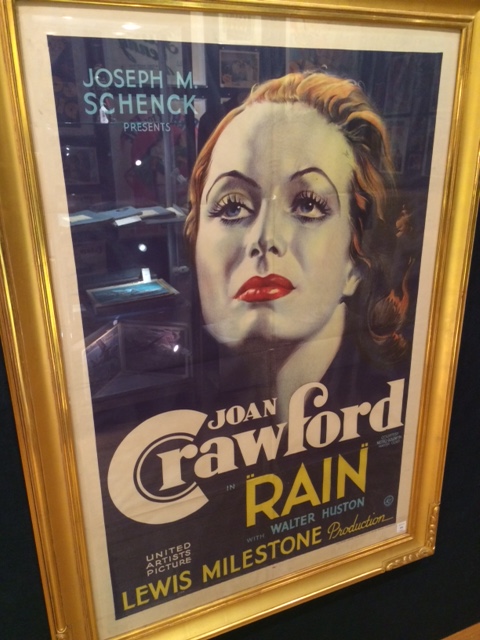
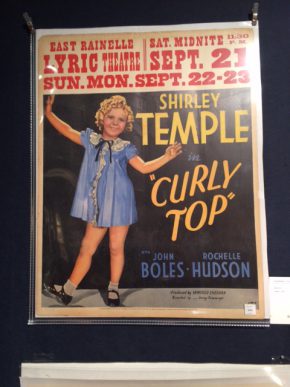
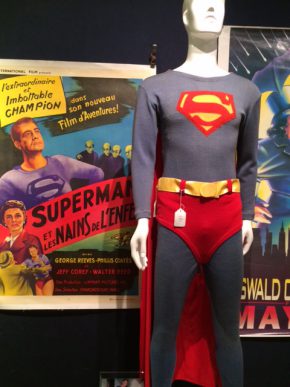
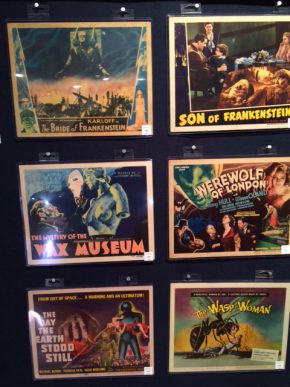
Besides posters, there were also costumes, such as the Superman suit George Reeves wore in Superman and the Mole Men (1951), as well as film scripts (many of them directors personal copies with notes and annotations). Many of the posters on display were part of another TCM auction of vintage movie posters held the day before. Illustrations and information regarding all of the items in both collections may be seen in these catalogs: “Out of This World!” and “Vintage Movie Posters.”
Here is a selection of the photos I took at the auction preview. Some of these are quite stunning.
Note the credit for Ted Healy and His Stooges in the poster above for Dancing Lady (1933). I believe this was an early film appearance of Larry, Moe, and Curly, aka The Three Stooges.
In retrospect, the most important film I saw in 1955 was Blackboard Jungle, written and directed by Richard Brooks, adapted from a novel by Evan Hunter. Hunter later wrote the screenplay for Alfred Hitchcock’s The Birds (1963). Under the name Ed McBain he wrote the popular 87th Precinct crime novels. As Richard Marsten he wrote Danger: Dinosaurs!, published in 1953 in the John C. Winston series of science-fiction books for young readers, which I burned through in our school library in ’55 or ’56. It was my favorite book from the series. Several years ago I purchased a copy from a used-book seller at 62 times the original purchase price, but it was worth it.
Blackboard Jungle stars Glenn Ford as a new teacher in an all-boys vocational high school in New York City. The cast includes Anne Francis as Ford’s wife, with Sidney Poitier, Vic Morrow, Paul Mazursky, and Jamie Farr as students. This was Poitier’s fifth feature film, Morrow and Farr’s first. Vic Morrow went on to appear in the television series Combat!. He was killed in 1982 at age 53 in a controversial helicopter accident while filming a scene for Twilight Zone: The Movie. Jamie Farr became well-known as the cross-dressing Corporal Klinger in the TV series M*A*S*H. Paul Mazursky became an excellent director and screenwriter, with features such as Harry and Tonto (1974); Next Stop, Greenwich Village (1976); An Unmarried Woman (1978).
In the following scene, Richard Kiley plays a teacher whose prized collection of jazz records is destroyed by students led by Vic Morrow. Given the condescending way he speaks to them, one can almost understand why.
While Blackboard Jungle is a powerful look at juvenile delinquency in the classroom in the 1950s, its true significance for me then, as it is now, was its controversial use of “Rock Around the Clock” by Bill Haley and His Comets under the opening credits. This was reportedly the first rock song ever used in a Hollywood feature. It made a lot of people — adults, not young people — very nervous and caused quite a stir. Rock ‘n’ roll, for many, was the devil’s music, promoting sex and — God forbid — race-mixing. Combining “Rock Around the Clock” with a movie about violent juvenile delinquents in an inner-city high school was too much to handle. Many communities tried to ban the film for fear it would incite delinquency. At the urging of Clare Booth Luce, then Ambassador to Italy, Blackboard Jungle was withdrawn as the U.S. entry to that year’s Venice Film Festival.
I didn’t know any of this at the time. To me it was a powerful story kicked off by an incredible song I could relate to. Try to imagine hearing this in a movie theater for the first time in 1955. This was something new. It felt like a seismic shift, and it was. I knew something had changed.
(Bosley Crowther’s review of Blackboard Jungle in the New York Times doesn’t even mention “Rock Around the Clock.” It’s like he wasn’t geared to hear it.) _________________________________________________________
My mom’s mother and step-father lived in Saginaw, Michigan. We would visit every year or so, an 800-mile trip by train or car. When we were there in the summer of ’55, I saw in the newspaper that This Island Earth was about to open in a theater downtown. I knew about this film and was desperate to see it. I knew it wouldn’t get to our local theater for several months, so the thought of seeing it here had me very wound up. The only problem was that the film was opening the night before we were due to head back to Iowa. My parents said I couldn’t possibly see a movie the last night we’d be there. This seemed totally unfair to me; they didn’t understand how important this was. This Island Earth was in color and everything, and promised to be fantastic. Then my grandmother took me aside and calmly talked me down. I resigned myself to my fate and knew I’d eventually see the movie back home at the Vista Theater, but this was a cruel disappointment. I mean, just look at this ad!
So I finally saw it and was thrilled. My disappointment in Michigan was forgotten (well, obviously not entirely). In the movie, scientists are being recruited by aliens with bulging foreheads to help prevent the pending destruction of their home planet, Metaluna. The first three-quarters of the film is terrific. This Island Earth takes its time setting things up. It has mystery and alien presence. But once scientists Rex Reason and Faith Domergue are taken aboard a spacecraft bound for Metaluna, events become very rushed. Worse still, the special effects at this juncture are very tacky. The Metalunan mutant that appears on the ship is pretty cool, though, as can be seen below in an illustration by Basil Gogos, who did many great covers for the magazine Famous Monsters of Filmland. Okay, the mutant is a big humanoid bug wearing pants, with pincers for hands and an exposed, bulging brain. I can’t remember if its function was ever explained.
I think it was on this same trip to Michigan that I bought a copy of Dracula in the Modern Library edition seen here. This was a serious artifact for me to acquire. I avidly read the first section, Jonathan Harker’s diary. But I found the rest of it difficult and tedious, comprised as it was of various journal entries and seemingly inconsequential newspaper clippings. I re-read Harker’s diary several times, but it was years before I was able to read and appreciate the entire book. I have never been able to get through Mary Shelley’s Frankenstein, however. Maybe someday.
I wrote at the end of Part 1 that I basically liked every movie I saw when I was a kid. I think I already knew, though, that some films were better than others. But it wasn’t until I saw Chief Crazy Horse that something really bothered me. As was the norm at this time, the major Native American roles were portrayed by white actors, so Victor Mature played the Sioux Indian warrior, Crazy Horse. Okay, no problem, but the entire film builds up to Custer’s last stand at the Little Big Horn, and when it finally gets there, the camera tilts up to the sky. We just look at the clouds while we hear the fighting on the soundtrack. To me, this was a huge cheat. Some might see it as a bold choice, but I suspect the filmmakers simply didn’t have the money to actually shoot the battle itself. I don’t know if this is when I became critically aware, but it was a start.
Deserts in the Southwest were frequent settings for science-fiction films of the 1950s, such as Them! and It Came from Outer Space. Tarantula is no exception. The result of experiments involving a radioactive super-nutrient (of course), a spider the size of a golden retriever gets loose from the research lab and terrorizes the desert countryside as it continues to grow. Oddly enough, a gigantic tarantula stomping houses and killing cattle is the least interesting thing in the film. Three scientists, led by Leo G. Carroll, have been infected by the super-nutrient, resulting in advanced stages of acromegaly and finally death in a matter of days. This is probably more compelling and frightening because it’s more human than a 100-foot tall spider. Tarantula was directed by Jack Arnold, who made a number of effective science-fiction films in the 50s, including It Came from Outer Space (1953), The Creature from the Black Lagoon (1954), Revenge of the Creature (1955), and my favorite, The Incredible Shrinking Man (1957). Working in television, he went on to direct episodes of Peter Gunn, Dr. Kildare, Rawhide, Gilligan’s Island, The Brady Bunch, and Love Boat. An interesting career.
Tarantula was also the second film appearance of Clint Eastwood, then a contract player at the studio, Universal-International. In the scene below, he plays a jet pilot leading the attack on the spider as it advances on a town. Clint wears a helmet and oxygen mask, but he’s still easily recognizable.
The first incarnation of Walt Disney’s Disneyland was from 1954 to 1958, and that’s when I was watching it. I couldn’t miss an episode. Davy Crockett hit the scene in ’55, and I was as obsessed as any other kid. I loved the three-episode series, especially the last one, Davy Crockett at the Alamo. All three were edited into a single feature released later in the year, Davy Crockett: King of the Wild Frontier. Disney exploited the merchandising of the Crockett craze to the limit. I didn’t have a coonskin cap (too old for that), but did get the comic books.
Violent Saturday is a film that has stayed with me. I saw it again a few years ago and it holds up well. It’s a good example of a narrative with multiple characters and plot lines that converge at the end. There have been many films with this type of structure since. Violent Saturday is set in a small mining town in Arizona where a group of men have come to rob the local bank. Victor Mature made a lot of sword and sandal films such as Samson and Delilah, The Robe, and Demetrius and the Gladiators. He could chew the scenery with the best of them, but when he was well cast, as he was here and in Kiss of Death (1947), he could be quite good. He plays an executive in the mining company who stands up to the criminals at the end. Violent Saturday was directed by the underrated Richard Fleischer, who made good films in a variety of genres, including Armored Car Robbery (1950), The Narrow Margin (1952), Barrabas (1961), The Boston Strangler (1968), and Soylent Green (1973).
Fewer films in 1956 made a lasting impression on me than in some of the previous years, but Attack! and Invasion of the Body Snatchers definitely did. They’re as good today as they were then.Attack!, directed by Robert Aldrich, is a brutal war film that has lost none of its corrosive power. It concerns a company of army soldiers fighting in Belgium in 1944. Jack Palance is Lt. Joe Costa, a platoon leader; Eddie Albert is Capt. Erskine Cooney, the incompetent and cowardly company commander; Lee Marvin is Lt. Col. Clyde Bartlett, the battalion commander. Costa hates Cooney, whose incompetence has already caused the deaths of several men. When the Battle of the Bulge begins, Cooney’s company is ordered to take the village of La Nelle. Afraid, Cooney opts to first send Costa to lead a reconnaissance patrol into the town. Things go badly and Costa is determined to make Cooney pay. Made on a low budget without Defense Department cooperation, Attack! is blunt and bitter. I was knocked out by it as a 12-year-old, and still am.
Even those who haven’t seen Invasion of the Body Snatchers are probably familiar with the term “pod people.” It’s become part of our language. The film, directed by Don Siegel, has a potent concept. Aliens progressively take over the human population of a small California town, replacing people with exact duplicates grown in large seed pods. You become convinced that your wife or husband or friend is not that person, even though they look and sound exactly like that person. Kevin McCarthy, in a career-defining role, plays the doctor who first dismisses those who come to him with their fears, but slowly becomes convinced with a horrible certainty that it is true. Siegel wanted to end the film with Kevin McCarthy shouting “You’re next! You’re next!” into the camera, but the studio imposed a more positive, upbeat ending. Despite that, it’s McCarthy’s desperate warning that stays with you. Invasion of the Body Snatchers has been remade several times, though the 1978 version directed by Philip Kaufman is the only decent one. I’ve seen the original many times. It always works for me. Jack Finney’s novel is also excellent. I still have the Dell paperback copy seen above. It’s a great film, well made and well acted by all, and much more subtle than the following trailer would have you believe.
The electronic music under the main titles of Forbidden Planet is appropriately other-worldly.
And for those living in New York City, the original Robby the Robot from the film will be auctioned off next Tuesday, November 21 as part of a TCM “Out of This World” auction at Bonhams on Madison Avenue. Previews are this Friday through next Tuesday morning.
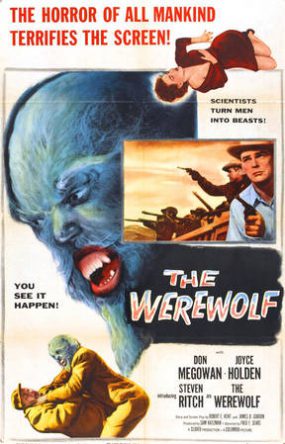
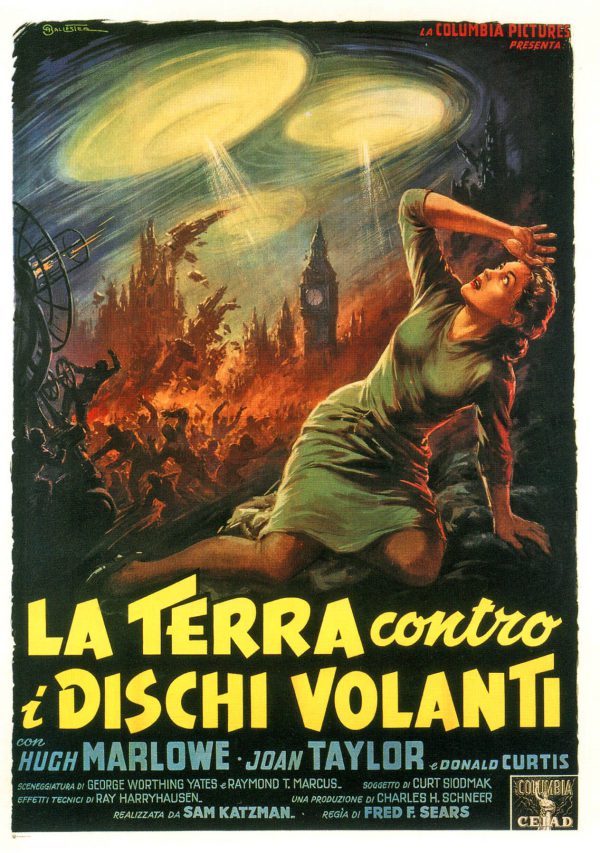
These two films were directed by the same man, Fred F. Sears, but they couldn’t be more different. Earth vs. the Flying Saucers has excellent stop-motion work by the justly-revered Ray Harryhausen, and it’s always fun seeing landmarks in Washington D.C. being destroyed, but otherwise it’s not very good. I think I knew that even then. The Werewolf has the distinction of scaring me so much I had to leave the theater before it was over. It might be that there was something a little too real about it. Werewolves are traditionally supernatural creatures governed by specific genre rules (full moon, wolfsbane, “Even a man who is pure in heart…”, yadda yadda) but this was wasn’t that at all. In it, a stranger from a car accident is injected with an experimental drug containing irradiated wolf’s blood by two scientists trying to find a cure for radiation poisoning. This has the result of transforming this poor guy into a werewolf. Of course it does. Not much real about that, I know. So what was it? The film is set in a small town near the mountains somewhere in the Northwest during the winter. There’s a scene that takes place in the alley outside a seedy bar where the protagonist in werewolf form, though we don’t see him, is attacking a man. All we see are their legs and feet thrashing about, and sounds of struggle, groaning, growling. I found this really upsetting. Maybe it was too easy for me to imagine that anybody could be attacked like this, though probably not by a werewolf. I think the film, up to the point where I left, was too close to the everyday. And with one exception, I didn’t know anyone in this film. It was like they weren’t actors. Whatever was going on with me, I left shortly after this scene. I finally saw The Werewolf on television a couple of years ago. It’s no masterpiece, but there’s still something uncomfortable about it.
Like everyone else in this country, I first saw Godzilla in the Americanized version with Raymond Burr edited into the storyline. It was years before I saw the original Japanese film, Gojira, released in 1954. For the American market, all references to atom bomb testing being responsible for the creation of Godzilla were removed. When the Japanese made Gojira, less than ten years had passed since the atomic bomb had been dropped on Hiroshima and Nagasaki. The firebombing of Tokyo was still a recent memory. The original film is dark and disturbing. But yes, it has a giant dinosaur destroying entire cities, so that’s the same.
And of course I saw The Ten Commandments. I’m sure I was suitably impressed. This is a film that renders criticism almost moot. It’s been shown on television every Easter since forever. I think you just have to surrender to it in all its cheesy, overblown, overacted glory. Whatever else, Yul Brynner is great as Rameses. I always remember his delivery of the line, “His God is God.”
Time to lower the curtain on this. These were my formative movie-going years. Early on I developed a love of science-fiction and horror, films of the fantastic. I also saw Westerns, war films, period epics, knights-in-armor, you name it. None of these films took place on an Iowa farm. I didn’t see a foreign film until I started college in 1962. That’s just the way it was. I think I’m still that kid in a lot of ways, waiting in expectation as the theater lights go down and the screen lights up.
This series is dedicated to my mom, Jean Hicks, who took me to the movies and started me on this path, and to the Vista Theater, which is still in operation in Storm Lake, Iowa, where most of this happened. – Ted Hicks
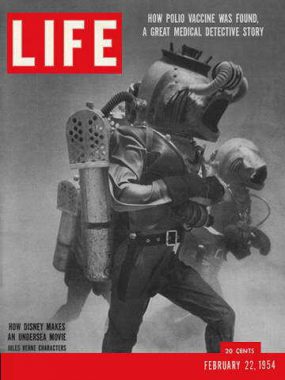
I was already hooked on Walt Disney films and cartoons by the time Disneyland premiered on ABC television on October 27, 1954. I didn’t know it at the time, but the television program was produced expressly to finance the construction of the original theme park in Anaheim, California (which I finally visited in the summer of 1970). As such, it was a promotional vehicle for Disney films and TV shows. It was there that I saw features on the upcoming 20,000 Leagues Under the Sea, which would be released that December. I couldn’t have been more wired for this film. By the time the curtain went up at the Vista Theater, I must have been hyperventilating in the seat after weeks of anxious anticipation. I lived for movies; nothing else came close. 20,000 Leagues delivered beautifully. This was a big production in CinemaScope and Technicolor with a great cast of international stars, including Kirk Douglas, James Mason, Paul Lukas, and Peter Lorre. It felt totally believable to me. I loved the design of Captain Nemo’s Nautilus submarine, and still do. I had little awareness then of who did what behind the camera in the films I saw, but learned later that 20,000 Leagues was helmed by Richard Fleischer, an underrated director who made solid films in a variety of genres, such as Armored Car Robbery (1950), The Narrow Margin (1952), Violent Saturday (1955), The Boston Strangler (1968), and Soylent Green (1973).
To view the trailer, click on the message “Watch this video on YouTube” when it appears.
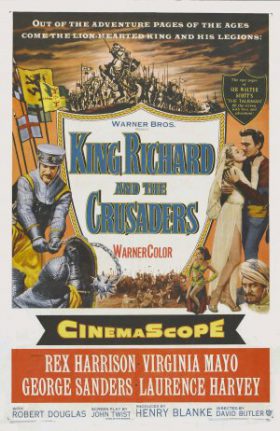
I liked knights-in-armor stories and other swashbuckling films. Here are several that captured my attention that year.
In retrospect, these were standard-issue films, with little to distinguish them, though that didn’t stop me from thinking they were great. Prince Valiant, however, is an exception, but only in retrospect. It’s pretty much what you’d expect, except for the climactic sword fight between Prince Valiant (Robert Wagner) and the bad guy, Sir Brack (James Mason). It has a very different style from the way scenes like this were usually done, though I wouldn’t have been conscious of that when I first saw it. It’s not conventionally edited; the takes are longer; there are no close-ups of the participants or reaction shots of the observers, only medium and long shots to cover the action. There’s no leaping about à la Erroll Flynn, nothing heroic. It’s not even thrilling. This is just two guys with broadswords and shields slamming away at each other until one of them drops. It’s like a demolition derby. The scene lasts a hair over three minutes. There’s no music until the final minute, which is also unusual. Films of this period are usually heavily scored.
Update: At this point in the original post I had a clip of the entire sword fight scene, which was later taken down by either YouTube or 20th Century Fox. That was unfortunate, because the actual scene is far more impressive than my description of it. I’d check from time to time to see if the clip had become available, but had no luck until today, the day after Thanksgiving, 2023. The clip runs 2:56. It ends abruptly before Valiant has triumphed over Sir Brack, but rest assured that he does. But there’s more than enough of it to give a good sense of how it played out.
The Robe, which introduced CinemaScope the year before, had been a big hit. No time was wasted making a sequel, Demetrius and the Gladiators, starring Victor Mature, an actor well suited to the sword and sandal genre.
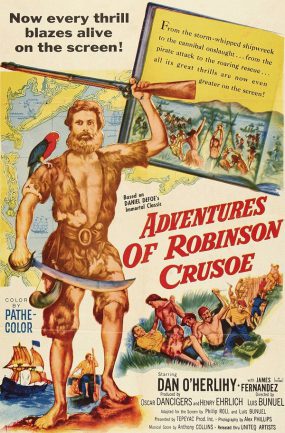
The notable thing about Adventures of Robinson Crusoe is that it was directed by the great Luis Buñuel. Again, this isn’t something I would have been aware of at the time, but knowing he directed it, I’d like to see it now. It seems like such an odd film for Buñuel to have made. The other three above were also made by strong directors; Douglas Sirk for Magnificent Obsession; Samuel Fuller for Hell and High Water; and Anthony Mann for The Glenn Miller Story. Speaking of The Glenn Miller Story, it takes a fairly standard bio-pic approach, but the music is great. My folks loved big band music, so I was primed for this one.
The High and the Mighty is a film with multiple storylines playing out on an airliner piloted by John Wayne. I remember nothing about the picture except the theme music by Dimitri Tiomki.
To play the following, click on the message “Watch this video on YouTube” when it appears.
For the most part, The Bridges at Toko-Ri , adapted from the novel by James A. Michener, is a competent, by-the-numbers war film with William Holden, Grace Kelly, Frederic March, and Mickey Rooney in the lead roles. What makes it stand out from the pack is the ending. *SPOILER ALERT* Holden is a jet pilot stationed on an aircraft carrier during the Korean War. He’s shot down after a bombing mission to blow up the titular bridges. Mickey Rooney is a helicopter pilot sent to rescue him. They both end up dying in a sewage ditch, killed by enemy troops. It’s an ending that’s as grubby and unglamorous as any you could imagine. There’s a final scene back on the carrier with the admiral, Frederic March, delivering a stirring speech (“Where do we get such men?”) after he learns of Holden’s and Rooney’s deaths. But it doesn’t change what we’ve just seen. I’m sure at the time I just saw exciting aerial footage, carrier takeoffs and landings, the comic relief of Mickey Rooney, and so forth. I would like to have included the sequence here, but the only clip I could find has poor image quality and is out of sync to boot. Too bad, though this lobby card shows them in the ditch in their final moments.
My love for horror and science-fiction films was rewarded in ’54 with Them! and especially Creature from the Black Lagoon. Giant ants and a prehistoric fish man — what more could a farm boy want?
Arguably the greatest moment in Creature is this scene of the Gill Man swimming beneath Julia Adams, mirroring her movements. It was a powerful stimulus to a young boy’s curiosity and imagination.
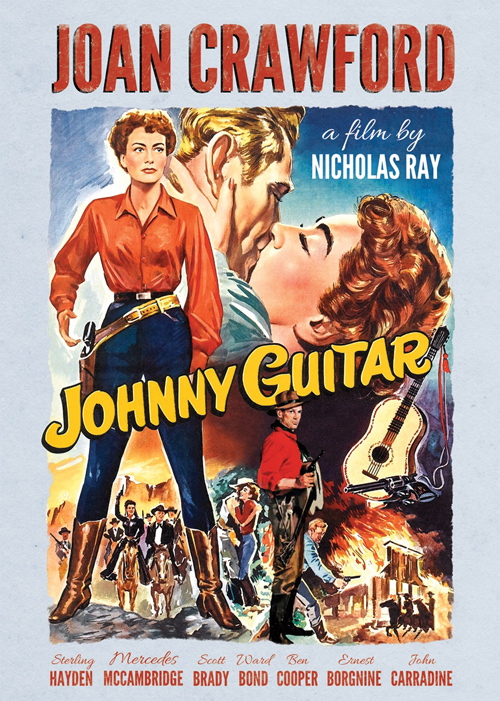
When I saw Johnny Guitar, I enjoyed it as a Western, but certainly didn’t have a clue as to how twisted, overheated, and operatic it is. I identified with Ben Cooper’s character, probably because he was the youngest, but then he ended up getting hanged. That was disturbing. The film builds to a traditional climactic shootout, but with Joan Crawford facing Mercedes McCambridge in a butch showdown. Weird. Nicholas Ray’s films have a unique strangeness to them, and this one is no exception. The trailer attempts to sell it as a regular Western, but don’t believe it.
Of the films on my list for this year, Johnny Guitar has stood the test of time the best. It’s not on the same level as High Noon, Shane, The Day the Earth Stood Still or The Thing from Another World, and I don’t love it the way I do those films , but I don’t think it needs any apologies, either.
As I stated in Part 1, I saw hundreds of films while I was growing up. These are some of the ones I remember from 1953.
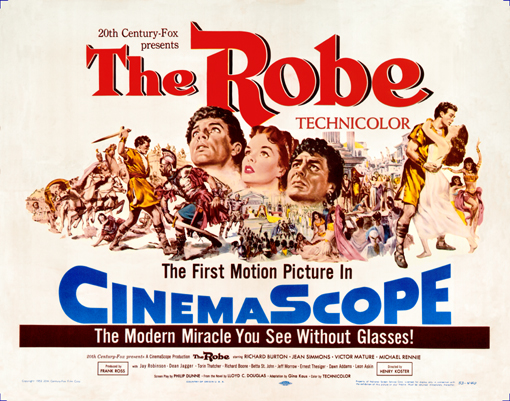
This was the year of 3D and CinemaScope. I remember when the Vista Theater installed a new screen for the opening of The Robe in September of ’53. This was a big event.
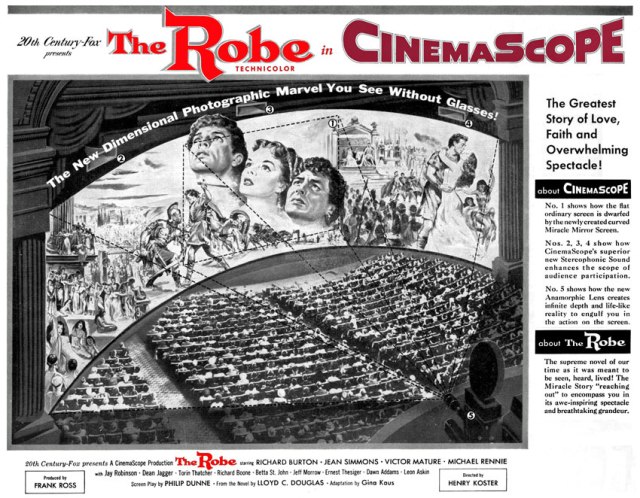
A promotional ad touted the wondrous features of this new format.
I saw The Robe again a few years ago and was struck by how static it is. There were few close-ups and very little camera movement. Filmmakers hadn’t yet learned how to use the wide screen frame. The Robe kicked off a flood of ‘Scope productions. Almost all of the ads for these films contained some variation on the excited statement, “You see it without glasses!” 3D films were very big at the time, but you had to wear glasses, so this was playing against that. Both formats were obviously an anxious reaction to the growing threat of television.
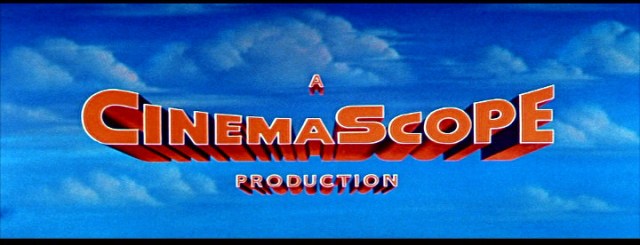
I always got a kick out of hearing the CinemaScope fanfare at the beginning of 20th Century Fox films. I still do.
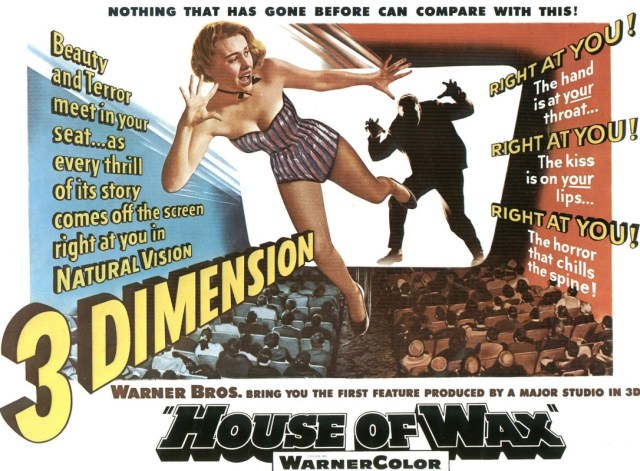
The 3D craze exploded in ’53. One of the most effective uses of the process was House of Wax, which is ironic when you consider that the director, Andre De Toth, had only one eye. The poster below gives you some idea of the subtlety of the film’s marketing.
I wouldn’t have seen this Italian poster for House of Wax in the 50s, but I couldn’t resist including it here. It’s beautiful.
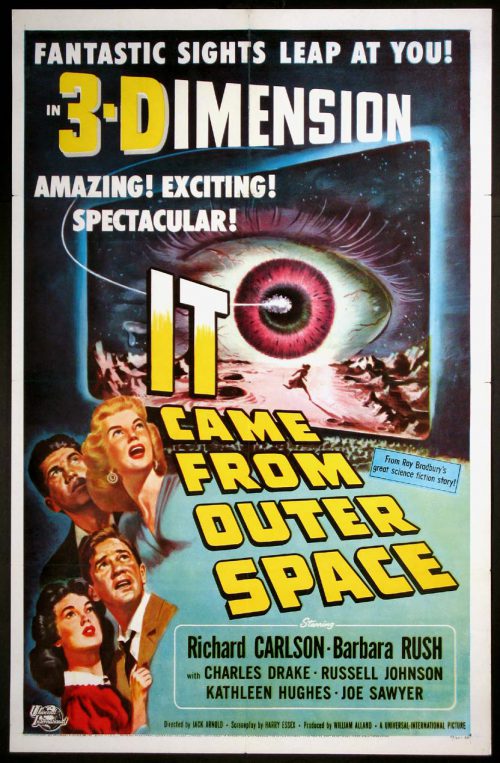
It Came from Outer Space, directed by Jack Arnold, was one of the more literate science-fiction films of the period, though I doubt I appreciated that aspect at the time.
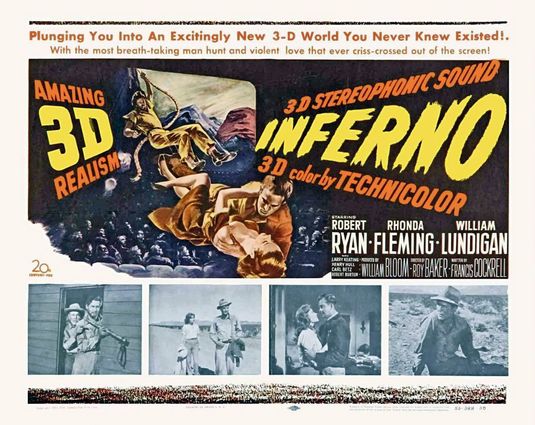
The use of 3D in most of these films was just a gimmick, but not always. Inferno shows the struggle to survive of a man (Robert Ryan) who is left to die in the desert by his wife (Rhonda Fleming) and her lover (William Lundigan). I remember seeing Inferno in 2D at the Vista Theater. A few years ago I saw it in a 3D series at Film Forum, and was struck by how 3D was used in a non-gimmicky way to draw the audience into the space depicted on the screen, rather than throw stuff out of it. Though the poster below makes sure you know it’s in 3D. It’s only in the last reel that chairs and torches start flying out of the screen, as though the filmmakers suddenly remembered they were making a 3D film.
A film I was particularly enthralled by was The Beast from 20,000 Fathoms. It was one of the first of the creature-on-the-loose movies that I saw (generally revived dinosaurs or giant insects). I didn’t know who Ray Harryhausen was at the time, but his stop-motion work in this and many other films was quite magical. Here is a clip from the film that captures the hand-made charm of this technique. It shows the dinosaur picking a policeman up in its jaws and swallowing him, then stomping a car flat and casually brushing it aside. I love it.
I was 8 years old when I saw Invaders from Mars, about the same age as the protagonist, David, a young boy who sees a flying saucer land in a field beyond his house and burrow into the ground. The Martians begin taking over the local human population via implants in the back of the neck. David’s parents are among the victims. He’s the only one who has a sense of what’s going on, but who’s going to believe him? He’s just a kid. Eventually a scientist and his girlfriend do believe him and somehow enlist the army to thwart the Martians. I saw Invaders from Mars again a few years ago, and it’s pretty bad. But what does work is what worked then — having David’s parents, previously loving and supportive, become something “other.” The film exploits a fear that your parents are not who you thought they were. Invasion of the Body Snatchers would explore this theme much more powerfully in 1956. But until then, this one did the job.
My anticipation for Peter Pan and The War of the Worlds was intense. I couldn’t wait to see them. They did not disappoint. There was a lot of merchandising related to Peter Pan. Disney really exploited this market. The Little Golden Book below looks very familiar, so I’m sure I had a copy.
Of all the films in this post, Shane is the one that has stood the test of time. It’s a truly great film. I didn’t know that when I first saw it, I just knew that I liked it tremendously. George Stevens directed many fine films; Shane is one of his best. The music score by Victor Young, leisurely majestic and deeply moving, is crucial to the feeling I have for this film.
The cast is stellar from top to bottom, with Alan Ladd in the title role bringing humanity and decency to the character of a gunfighter who’d rather not use his gun. But of course, the Western genre dictates that he must, and we wait in anticipation of the inevitable. Jack Palance (billed as Walter Jack Palance) brings a reptilian deadliness to the role of Jack Wilson, a hired gun for the cattle baron trying to drive homesteaders off their land. Here’s a key scene with Wilson confronting the hotheaded “Stonewall” Torrey, played by Elisha Cook, Jr.
Shane was based on a 1949 novel by Jack Schaefer. After seeing the movie, I bought a paperback edition for the princely sum of 25 cents and doubtless read it several times. I was a bit thrown by the depiction of Shane on the cover, since his appearance was a radical departure from that of Alan Ladd in the film.
My wife Nancy doesn’t like most genre films, including Westerns. Some years ago I kept pressing her to watch Shane with me. I was convinced that its obvious excellence would win her over. I told her that if she didn’t like it, I would never ask her to see another Western. So we watched it. When it was over, I turned to her and hopefully said, “Well, what did you think.” She shrugged and said, “It was okay.” I was taken aback. Shane was just okay? But a deal’s a deal, and that was that. Too bad, though. I still haven’t been able to get her to watch The Bride of Frankenstein. I have a feeling that’s not gonna happen.
I had initially thought to finish “My Movie Life” in two parts. That’s neither manageable nor practical, considering I have three more years to cover. My intent is to wrap it up in two more parts, ending with 1956. Please bear with me. – Ted Hicks
One of my earliest movie memories is of seeing Bambi and being totally traumatized by the death of Bambi’s mother. Who wasn’t? It fact, that’s the only thing I remember about the film. Since Bambi was originally released in 1942, I must have seen it after it was re-released in December of 1947. I was born in 1944, so I would have been three or four years old, and very susceptible to being freaked out by the prospect of losing a parent. I grew up on a small farm in northwest Iowa. I’m an only child, so my mother was my main companion until I started grade school. She loved movies and we went a lot, mainly to the Vista Theater in Storm Lake, my mother’s home town, 12 miles north. Besides the Vista, Storm Lake had the Corral Drive-In on the east side of the lake. There was another movie theater in town at the time. I’ve forgotten its name, but it’s where I saw The Man from Planet X in 1951, a film that had a great impact on me. I recalled recently that it’s also the theater where my dad first met my mom. She was working at the concession stand and he was buying popcorn. At least, that’s the story. This was probably in 1940 or ’41. It’s not lost on me that Nancy and I also met by chance at the movies here in New York in 2002. I wrote about that a couple of years ago, and you can read it here.
All of the films referenced in this piece are ones I recall seeing. Some I remember in detail; others only that I saw them. But of all the films I saw during the 1950s, these registered for one reason or another. In one of my first blog posts, “Famous Monsters and Me,” I wrote “…from an early age, as early as I can remember, I was totally in love with science fiction and horror (monsters!) via all their delivery systems; i.e., books, magazines, comics, TV, and movies. Mainly movies, probably because films are so immediate.” I was strongly attracted to these kinds of films, but also Westerns, Biblical epics, war movies, Martin & Lewis comedies, and all things Disney. I didn’t see a foreign film until 1962, when I went to the University of Iowa. Before that, it was Hollywood all the way. Here are the movies I remember.
________________________________________________
1949
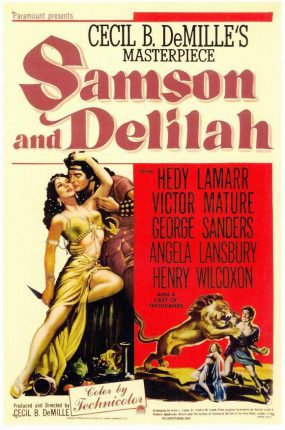
Samson and Delilah was my first sword-and-sandal movie. There were many such films in the 1950s, usually Biblical epics, with Cecil B. DeMille leading the way. The U.S. posters for Samson and Delilah weren’t nearly as risqué, or as artistic, as the German poster above. Here are the posters I would have seen.
_________________________________________________
1950
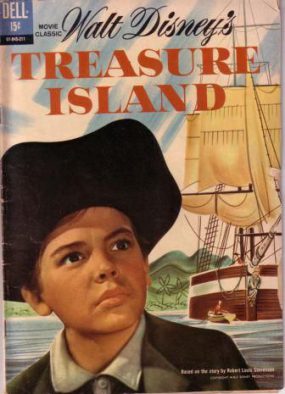
Disney films really kicked in for me in 1950. I loved Treasure Island. My identification with Jim Hawkins (played by Bobby Driscoll) was strong, as I’m sure it was for many young boys. Robert Newton as Long John Silver was both friendly and frightening. He was the definitive pirate. Bobby Driscoll went on to be the voice of Peter Pan in the 1953 Disney film, which I hadn’t known until I looked him up for this piece. Things didn’t go well for him later on. He began using drugs and was sentenced to a California narcotics rehabilitation facility in 1961. He moved to New York City in 1965, where he became part of the scene at Andy Warhol’s Factory. His body was found in a deserted East Village tenement in 1968, four weeks after his 31st birthday. With no identification on the body, he was buried in an unmarked grave in Potter’s Field on Hart Island. A fingerprint match in late 1969 finally identified him. Pretty grim. A long way from Disney.
I’m sure Destination Moon would look fairly hokey today, but in 1950 it was great! Its semi-documentary approach to telling the story of a privately-funded moon shot is a little dry compared to the flying saucers and monsters that were to come, but this was something different. Harvey might have been too grown-up for me at the time, but I liked James Stewart, probably because he seemed like a child in the film. And I wanted the rabbit to be real!
Samson and Delilah, David and Bathsheba, and Quo Vadis were among the first Biblical epics I saw. I recently saw Samson and Delilah for the first time since 1949. It was quite bad, but typical of the era. I ended up fast-forwarding through most of it just to get to the part where Samson brings down the temple with his bare hands. That scene is still exciting. Two years ago I saw Quo Vadis at the Museum of Modern Art, for the first time since 1951. It seems stilted and absurd now, though I’m sure I totally bought into it at the time. Apparently, so did a lot of people. It was a huge box-office success, reportedly the most successful MGM film after Gone With the Wind. But Gone With the Wind is still watchable, while Quo Vadis is a bit harder to take. The sets were very impressive, however, as seen below. Remember, this was before CGI, so all this stuff was built and the crowds were real.
The only real burst of energy in the film is the overwrought and over-the-top performance by Peter Ustinov as Nero, seen below in a typical moment of restraint.
When I saw it at MoMA, I realized the only thing I remembered was the scene where Peter is crucified upside down on an inverted cross. This was pretty potent, especially for a kid who went to Sunday school. I no longer go to Sunday school, but it’s still a powerful image.
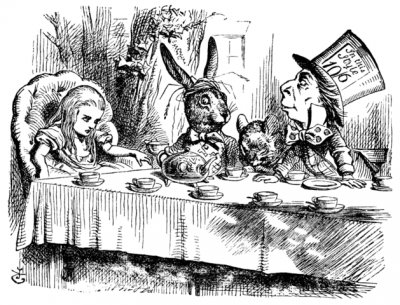
I’m probably not alone, but my first exposure to Alice in Wonderland and other children’s classics was through Walt Disney. The films fixed the way I pictured the characters. This was how I thought Alice, the Mad Hatter, and all the other characters should look. I was jolted the first time I saw the John Tenniel illustrations for the Alice books; they were wrong. But they don’t seem that way now. The Tenniel tea party (below the Disney version) is somewhat disturbing, and much more interesting.
I think I started connecting with the films more in 1951. I was, after all, a sophisticated 1st-grader. The two films I saw that year that had the biggest impact on me were The Day the Earth Stood Still and The Thing From Another World. They’re both great films. They’re just as good now as they were then, and I’ve seen them many times. For years after moving to NYC in 1977, channel 9 or 11 (I don’t remember which) would show King Kong and The Thing back-to-back every Thanksgiving afternoon. Seems like a strange holiday choice, but it worked for me. The music for both films used theremins. I didn’t know what a theremin was then, but it’s a sound forever associated with outer space weirdness. Day is literate, intelligent, and thrilling. I made a model of the robot Gort out of modeling clay and covered it with aluminum foil for realism. I also fashioned a woman for Gort to carry in his arms, à la Patricia Neal in the film. Sadly, no photographic evidence of this creative effort remains, but a shot of Gort is in the banner of all my blog posts. The Thing scared me deeply for months. A mother taking her 7-year-old son to such a film today would probably be charged with child abuse, but I loved it. Hell, even the opening titles are frightening!
Fewer films in 1952 made a strong impression on me. I know I saw Bwana Devil, but can’t remember if it was in 3D. Our local theaters sometimes showed 3D films in flat prints, so I don’t know. Ivanhoe began an obsession with knights-in-armor movies. Son of Paleface was a lot of fun. Bob Hope was great at that time, but I was an easy laugh. I liked The Greatest Show on Earth for obvious reasons. It was a circus! This was before clowns became creepy and nightmarish. But the clear standout from this year was High Noon, another film I never tire of seeing. In retrospect, it seems insane that High Noon lost out to The Greatest Show on Earth for the Best Picture Oscar that year, but at least Gary Cooper got Best Actor.
Up to this point, I liked everything I saw. It was wonderful just being in the theater and being transported when the lights went down. I enjoyed all of it. It would take a few more years before I began to develop any kind of critical faculty, before I would see something and think, “Hey, wait a second.” During these years, movies became an extremely important part of my life. They still are.
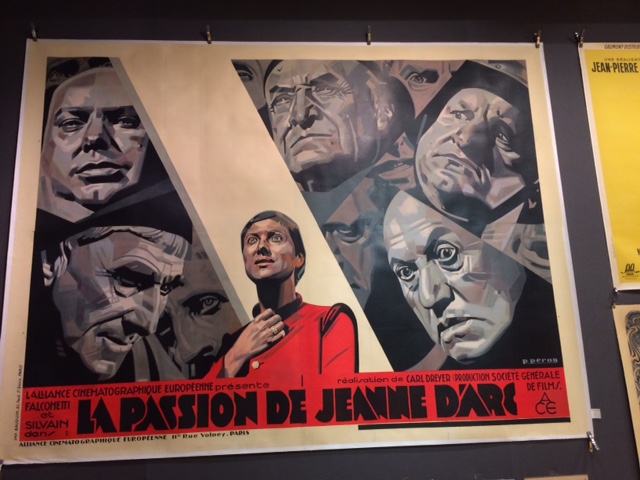
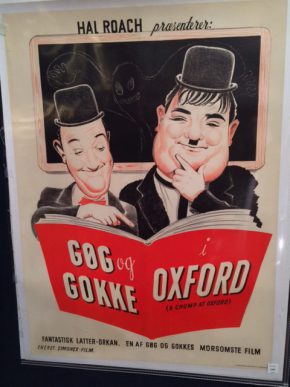
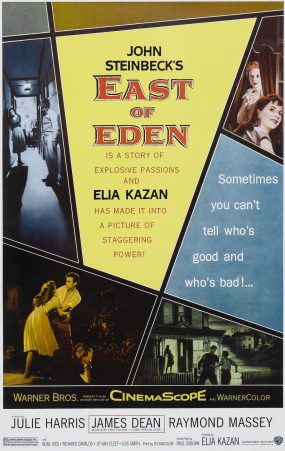
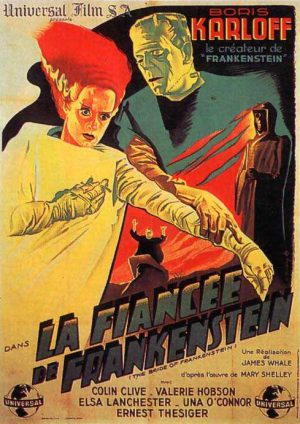
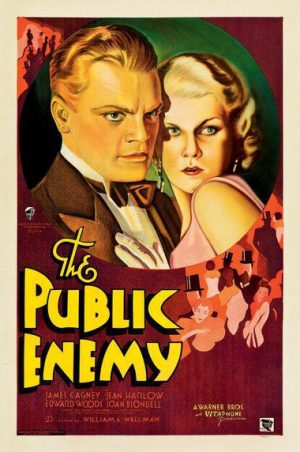
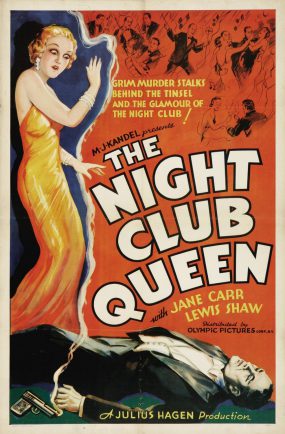
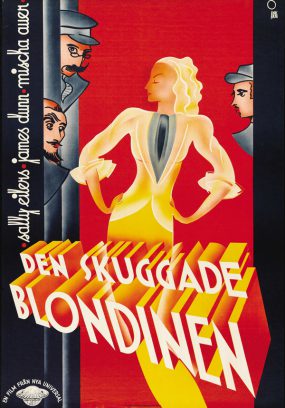
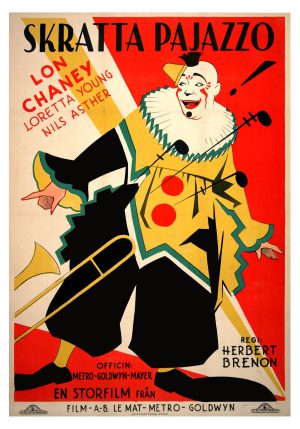
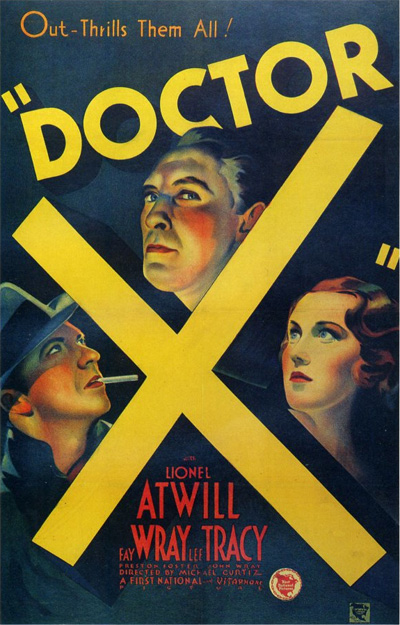
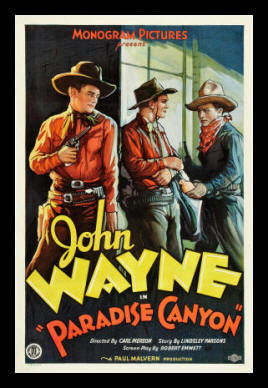
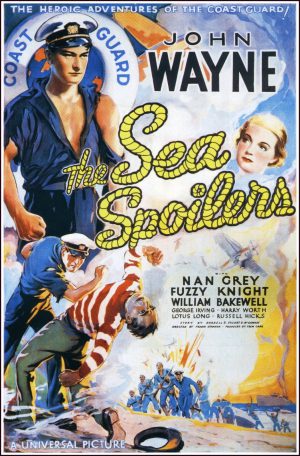
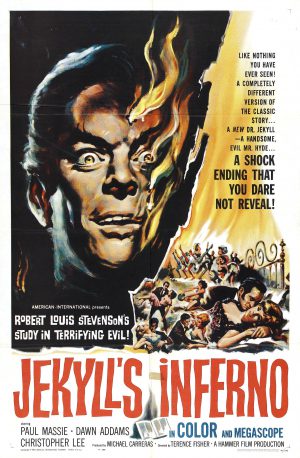
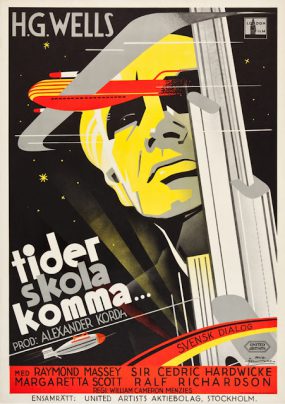
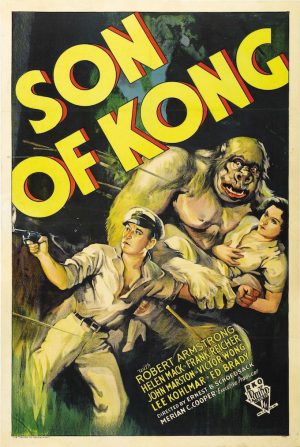
There’s no particular theme or category for this collection of film posters, other than they’re dynamic and dramatic. Some are foreign posters for American films, some are for films both well-known and obscure, and some are just weird, but they’re all pretty cool.
Title and year for films are listed below in the order they appear above (countries for foreign posters are also indicated):
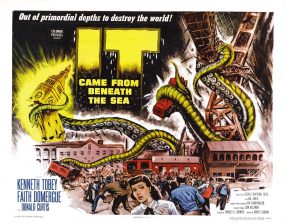
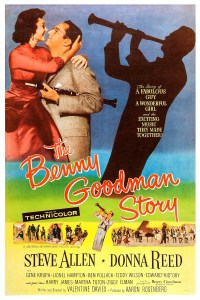
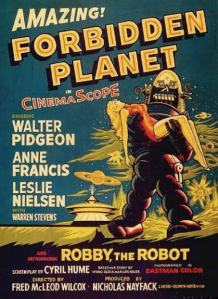
Frankenstein (1931, Sweden), The Bride of Frankenstein (1935, France), The Public Enemy (1931), Pickup (1951), 42nd Street (1933, France), The Nightclub Queen (1934), The Devil Is a Woman (1935), We Have Our Moments (1937, Sweden), Trouble in Paradise (1932, Finland), Woman (1918, Sweden), Laugh Clown Laugh (1928, Sweden), Doctor X (1932), Paradise Canyon (1935), The Sea Spoilers (1936), The Loves of Edgar Allan Poe (1942), Jekyll’s Inferno (1960), The Hideous Sun Demon (1959), Son of Kong (1933), Things to Come (1936, Sweden), The Chase (1966, Spain), Earth vs. the Flying Saucers (1956, Italy).

 ______________________________________________________




















































 Films etc.