Friction Fiction #5 — “Missing Vietnam”

The Nam-comic cover3Bobby Olay was chasing a pig in the clearing when a shot knocked his helmet from his head and he dropped to his knees with blood spurting from his temple. I saw this as I came out of the hootch where I’d found a tattered, muddy copy of “Mad” magazine. The pig was squealing, and there were sounds of the rest of us taking cover, then nothing but the pig.

“Eddie, is Bobby still alive?” Keefer asked me. We were crouched behind a broken down cart. I peered around the side. Bobby was still on his knees, one hand held to the side of his head. As I watched there was a second shot and a puff of dust on Bobby’s chest where it hit him. This bent him over backwards from the waist. He was still on his knees. It looked like some yoga pose.

“Jesus, I don’t know now,” I said. “One in the head, one in the chest. Who the fuck knows?” I turned to Keefer. “You see anything in the tree line? Where’s it coming from? Anybody else get hit?”

“I don’t know, I don’t know. What do we do now?”

It was quiet like we were the only ones there, just me and Keefer and Bobby out there bleeding. Where was the rest of our patrol?

“Fuck it,” I said. “We’ve got to go get him. Maybe he’s dead, but we’ve got to get him before that pig eats him.”

Keefer gave me a look. “Yeah, you’re right. Who’s going out there? You going? Eddie?”

I took a deep breath. “Yeah, okay. Give me your shotgun.” I handed Keefer my M-16 and took his shotgun. “Cover me as well as you can. I don’t know where the other guys are.”

It was about twenty yards. There was no point fucking around. I took another deep breath and ran from behind the cart as evasively as I could. Behind me, Kiefer began firing.

Bobby hadn’t moved. I reached him in a low crouch, grabbed him by the wrist and began dragging him back across the clearing. Except for Keefer’s stuttering cover fire there was no other shooting. On the way back I saw that Keefer had shot the pig.

The rest of the patrol had taken cover in the jungle behind the hootches on our side of the village. Lieutenant Pippin had already called in choppers for a dustoff, and ten minutes later we were on our way back to base camp. Bobby Olay would live, but he’d be blind forever from the shot he’d taken in the head. At base camp we drank beer and joked about Keefer shooting the pig. I guessed I’d get a medal.

******

No, it didn’t happen that way. It was like this:

Bobby Olay was in the clearing beating on the pig’s snout with the butt of his rifle.  He’d shot the pig’s front legs away. It was squealing in deep pain and scrambling its hind legs trying to get the fuck away. I could identify with that.

Keefer looked up from the “Mad” magazine I’d found in the hootch. “What’s Bobby doing to that pig?”

“Jesus, I don’t know,” I said. “Maybe he thinks it’s a Viet Cong. There’s nothing else alive in this ville.”

Suddenly a mortar round exploded in the clearing. They began going off all over.  Keefer and I huddled behind a broken down cart. We looked at each other.Then the mortars stopped. We heard Bobby cursing and moaning. I peered around the side of the cart. Bobby was on his knees by the pig, holding his hands to his bleeding face. It looked like part of his jaw was missing. Blood bubbled from between his fingers when he tried to speak.

I turned to Keefer. “Christ, he’s hit in the face. What’ll we do? You see anything in the tree line?”

It was quiet like we were the only ones there, just me and Keefer and Bobby out there bleeding next to the squealing pig. Where was the rest of our patrol?

“I don’t know. Fuck it,” Keefer said, “we’ve got to get him. Who’s going?”

“Keefer, man,” I said. “I don’t know, maybe, maybe…”

“Okay, okay. I’ll go.” Keefer shook his head and moved around me. “But you’ve got to cover me. Eddie? Eddie!” I nodded. He took a deep breath and began a zig-zag run toward Bobby. I started firing into the jungle at the other side of the clearing.

Keefer reached Bobby in a low crouch, grabbed him by the wrist and began dragging him back across the clearing. Except for my cover fire there was no other shooting. I stopped firing.

Keefer shouted, “Keep firing, for Christ’s sake!  Keep firing, you asshole!” Then a shot hit Keefer in the back and brought him sharply upright. He collapsed backwards on top of Bobby. The sniper could be anywhere. I fired several times in frustration, then stopped.

“Eddie!  Come on! I can’t move,” Keefer said. He was lying on his back on top of Bobby. He must have been hit in the spine. I could hear Bobby’s gurgling moans and curses. The pig kept squealing from where it lay stuck on its shattered front legs.  “Eddie! What the fuck!” Keefer’s voice was pissed and desperate and afraid.

I shot the pig.

******

No, that’s not it, either. Nothing like that. More like this:War Fury-comic cover

I was on guard at the base perimeter. It was pitch black, the middle of the night.  Everybody was keyed up, but nobody said anything about it. We knew something bad was going to happen soon. There was a bad voodoo feeling. Patrols had come back with weird reports. One didn’t come back at all.

At the first sounds I froze. I didn’t know what to do, couldn’t remember what to do. I wanted someone to tell me. No, I didn’t want to know anything. I hid in the bottom of the foxhole, and heard low rustling sounds as the gooks slipped by. I expected to feel a bayonet in my back at any second. I didn’t want to be hurt. I didn’t want this to be it.

You’d think they’d have been able to smell the crap in my pants, but I was invisible in my fear. I heard the firing start behind me, explosions and scattered screams. A lot of our guys got killed that night. That wasn’t my fault. Not all of it. But I knew. Eventually there was a court-martial. Then everybody knew.

******

None of that happened. None of it. I was never in Vietnam, not really, but for years I tried to imagine it. I’d read all the books, seen all the movies. I’d gone to the Wall. I dreamed of it, wished for it, longed for it in a way that only someone who hadn’t been there could. I felt that people who’d been there during that war knew something I didn’t. And they probably did, though maybe they’d rather not.

Maybe it’s a guy thing, I don’t know. But you wonder how you’d do. In combat, under fire. Would you be brave? A coward? Would you survive? Would you get killed or captured or get your balls shot off? Would you be like the guy in old war movies who panics and gets a lot of good men killed? What would you do? If you saw someone being attacked on the subway, someone being raped, what would you do? What would people say about what you did? Would it be like in the books? Would it be like the movies?

The truth was, that was bullshit. Yeah, you might wonder how you’d do, but you didn’t actually want to know. Not if in your gut you knew the worst image of yourself was the true one. My dreams of Vietnam, our acid rock war, the books and movies and deeply moving PBS specials, that was as close as I ever wanted to get.

Because I knew what I’d do. Anything to save my skin, that’s what. They say you never know until it happens, but I know. Look the other way, keep my mouth shut, eat a ton of any kind of shit, give up every friend I’ve ever had, you name it, I’d do it.

But if I wasn’t there, then why was I dreaming about Bobby Olay, Keefer and the rest? Why did I dream about the pig? One night, on the No. 2 train up from Fourteenth Street, I thought I saw Keefer at the far end of the car, trying to drag Bobby down to where I sat. But it wasn’t Keefer and it wasn’t Bobby. It was just a bum with a bag of empty soda cans.

Carla thought I should see someone, a therapist, a shrink, someone. She thought I might want to think about going to AA. This was in 1995. I’d met Carla in the laundry room of my building a couple months before, and we’d started going out. It made her nervous when I talked about this stuff or showed her what I’d written. She didn’t like it when I drank too much. Carla meant well, but I don’t know. She was just someone I met in the laundry room.

******

Carla and I were walking up Eighth Avenue in the Forties in the rain when a wild haired guy in dirty clothing blocked our way. He stared fiercely at me and I saw he was about my age.

“Can you help a vet?” he said. It was more a demand than a request. He made me feel funny. I looked sideways at Carla.

“Were you in ‘Nam?” he said. “Weren’t you in ‘Nam? You were in ‘Nam.”

“No,” I said. “I mean, I was in Thailand. In the Air Force.” I saw Carla looking at me. It was like they were both waiting.

“Thailand, huh?” he said. “A flyboy.”

He was standing too close. “I didn’t fly,” I said, taking a step back. “I was on the ground.”

“Hey, man,” he said, his voice rising, “I was on the ground, too. Really on the ground. Come on, you know how it is. You were there.”

I took Carla’s arm and started to move around this guy.

“Come on, man,” he said. “You know how it is. I need some help.”

“I’m sorry,” I said. “I’m sorry.” I tried to hurry us up the street. I wanted to be far away. He was muttering angrily behind us, but I didn’t look around. Carla and I didn’t speak for several blocks. I felt like I’d done something wrong.

“You can’t give to everybody,” I finally said. “Besides, there was something about that guy.”

“Yeah,” she said, “I noticed.”

******

Couple out of focusWe were in a coffee bar. I wanted a beer, but it was a coffee bar. Carla looked at me and said, “Why do you need to write these stories? Like you told that homeless guy, you weren’t even there. Write about Thailand if you’ve got to write about something.”

I’d been in Thailand a year, drinking and chasing whores as much as possible and making a fool of myself. I didn’t want to write about that. I hated coffee. I looked down into my cup of hot chocolate. I didn’t want this. I wanted a beer. “It’s not like I need to write them. I’m just trying to imagine what it was like. They’re just stories.”

She drank her coffee and looked at me. “Well, I don’t know, Eddie. It seems that enough of the men who were there have written about it, and they were there.

I thought about that. “What does that mean? That I can’t write about something I haven’t done? You ever hear of fiction?”

The corner of her mouth twisted down and she stirred her coffee. “It’s just that, well, sometimes you talk like some Rambo wannabe. You ever talk to any real vets about this?” She paused. “Anyway, do you think people care about that war the way they used to? It’s history, Eddie. We’ve got other wars now.”

I put my hands on the table decisively, trying to hide how pissed off she was making me. “Listen, it’s still early. Let’s go to that new place on Amsterdam, the one with the great jukebox.”

She frowned and drank her coffee.

******

There was a large black man, a really big guy, I’d often see on Broadway in the lower Eighties who was always dressed in camouflaged combat fatigues and a poncho that reached his knees. He wore this jungle gear rain or shine and used a large push broom and a trash can on wheels to clean the sidewalk and street near the curb. As far as I could tell he’d taken it upon himself to perform this duty. I wondered what had happened in Vietnam to put him on this mission here, because he’d clearly been there and just as clearly hadn’t come all the way back. Then again, what did I know? Maybe he’d never been in the army or any war. Maybe he was just nuts. There was plenty of that.

Carla and I had come out of Barnes & Noble and were walking uptown when we heard angry voices. The guy in fatigues was slowly sweeping near the curb where another man wanted to park. He stood in front of his double-parked car with a woman at his side. They were both yelling. The black man said nothing and continued to sweep.

I wanted to see this. Carla pulled on my arm. “Let’s go, Eddie. I don’t want to stay here.”

“Wait a second,” I said, not looking at her. Just then this guy walked up to the black man, said something I couldn’t hear, and pushed him. He held his balance and continued sweeping.

“That’s not right,” I said to Carla.

“What’s the point?” she said. I looked at her and saw a pained, annoyed expression on her face.

“Hey!” I called out. “Stop it. Leave the guy alone.”

“Eddie, shut up!” Carla said as I took a step toward the street.

The man turned and looked at me. “What? You should mind your own business, mister. Keep out of this.”

“Yeah,” the woman with him said. “Mind your own fucking business! Tommy, who is this fucking guy?”

I took another step toward the street. “Look, just leave him alone, okay? What’s the big deal anyway? This isn’t necessary.”

Tommy’s eyes narrowed and he stepped toward me. He looked like a gangster, some thug on TV. I was scared. Carla was right, this was stupid.

“Listen, pencilneck, this retard’s fucking with my parking place. What’s necessary is that I might have to fuck you up if you don’t shut the fuck up and get out of here.”

“Eddie,” Carla said behind me. “What are you trying to do?” I looked back. A small crowd had gathered. I wondered if any of them would help me.

“Look,” I said to Tommy, “I don’t want to fight. This guy’s not hurting you. This isn’t necessary. There’s some parking spaces across the street.”
He came up to me. “I don’t want to park across the street. I want to park right fucking here! And I’ve listened to you long enough.”

He pushed me in the chest with both hands. I stumbled back and fell. As I got up he hit me twice in the face, very fast. It just made a quick slapping sound. I fell back and sat on the sidewalk, holding a hand to my face. He looked down at me, then turned back to see that the black guy had finished sweeping the spot and was moving down the street.

Carla helped me up as Tommy backed his car into the space. I took my hand away from my face and saw blood on it. Carla handed me some tissues. “Here,” she said. “Wipe your face. Christ, you should see yourself. Are you alright?”

“Yeah, I’m okay,” I said, wiping my face where I was bleeding from the mouth. I looked at the bloody tissues as we started to walk up the street.

“Do you like that, Eddie? That’s your blood,” Carla said. “Are you happy with that? Just what were you trying to do? Be a tough guy?”

“Carla, let’s just stop somewhere for a drink, okay?”

She started to walk ahead of me.”No, I’m going home. You should go home, too. You should go home and watch one of your war movies.”

******

“This isn’t working,” Carla said. “I don’t think we should see each other any more.”

We were in my apartment. Carla was sitting on a swivel chair by my desk. I stood looking out the window. It had been raining earlier in the evening. The street wetly reflected the lights on the block.

“I like you a lot, Eddie. You’re a nice guy and I have a good time when you haven’t been drinking, but you get into this thing and it’s like I’m not even there.” She sounded tired. I heard her let out a breath. “I don’t like talking to your back. This is what I mean.”

I turned and leaned against the window sill. I didn’t want her to leave, but I didn’t know what to say.

“I mean, this whole Vietnam thing, what’s that about? Christ, Eddie, that was thirty years ago, and you’re what, almost fifty? I’ve never heard of anybody being this fucked up over it who didn’t go.”

Blurry streetShe sat there looking at me, waiting for me to say something. Then she slowly got up and went to the door. She paused with her hand on the door knob and said, “I’m not sure what you’re looking for, but I don’t think I want to be there when you find it.” Then she left. I stayed at the window for a minute, looking at my feet, then got another beer. All this while I hadn’t said a word. I wondered when I’d see her again.

******

I’m in a booth near the back of the bar. This is an old place, a real tavern, with a long dark wooden bar that smells of years of soaked-up beer and cigarettes. It’s ten in the morning and nearly empty. The jukebox is playing the Rolling Stones and I’m drinking beer. Outside the sun is shining.

The front door opens and sunlight spills across the floor.  Bobby Olay and Larry Keefer come in the bar, Bobby pushing Keefer’s wheelchair.  They’re late.  Keefer removes his sunglasses, sees me in the back and waves.  He says something to Bobby and Bobby starts pushing Keefer toward my booth.

Keefer tells Bobby to stop when they get near the booth. He wheels himself closer to the table in the booth. Bobby feels his way into the seat across from me.

“Glad you guys got here,” I say. “I’ll get some beers.” Keefer watches as I get up and go to the bar. I return with three long-necked bottles and set them on the table.

“Well, Eddie,” Keefer says after taking a drink from his bottle, “she dumped you, huh?”

“Yeah, well.  What else is new?” I look across at Bobby with his sightless eyes.  “I’ll survive.”

“Well, hell,” Bobby says. “We’ll all survive. You survived.” He pauses. “You got fucked in that court martial, man.”  He is drunk. So is Keefer. Bobby bangs his head back against the booth and laughs. I see the bartender look our way.

“Hey, Eddie,” Bobby says. “I got a question. Tell me again. Who was it shot that fucking pig?”

Keefer and I look at each other and laugh.  We look at Bobby and say together, “We all did!

I order another round.  We’re laughing hysterically. It’s a beautiful day outside, but I’d rather be in here. 

Beer + shotby Ted Hicks

Posted in Comics, Fiction, Film, Home Video, TV | Leave a comment

Superman at 75

Superman 75 logo4Superman, created by two Jewish kids in Cleveland, Jerry Siegel and Joe Shuster, first appeared in the June 1938 issue of  Action Comics #1. In the 75 years since then, this “strange visitor from another planet” has gone through many iterations in comics, films, and television. Warner Bros. Animation has put together a terrific 2-minute short to commemorate this anniversary. Produced with style and wit by Zack Snyder (director of Man of Steel and the forthcoming Batman vs. Superman) and Bruce Timm (co-creator of Superman: The Animated Series), the short depicts the evolution of Superman’s appearance through the years.

The Superman I knew from comics in the 1950s, drawn variously by Wayne Boring, Curt Swan, and Al Pastino, was solid, plus-size, like John Wayne. I was always struck by how massive his neck was, as thick as a bull’s.

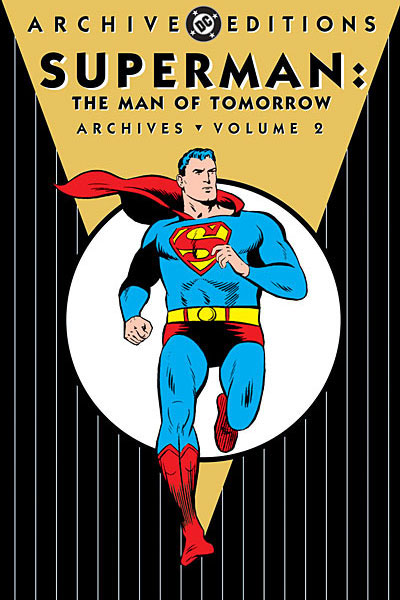
Superman-comic panelSuperman-Wayne BoringSuperman-Wayne Boring2

******

Essential Trivia:

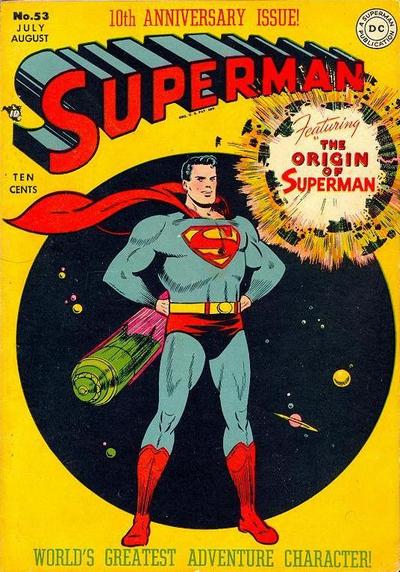
Action Comics #1-cover2Action Comics #1 is arguably the Holy Grail of comic books. Copies sell for staggering amounts. Two years ago Nicolas Cage sold a copy in an online auction for the record price of $2.16 million. A pretty good return, considering that he’d bought the same copy for $110,000 in 1997. He reportedly only sold this truly rare item in order to pay tax liens and other debts. I think we can safely assume Cage is a major Superman fan, since in 2005 he named his newborn son Kal-El. I guess that’s not quite as indulgent as Frank Zappa naming his kids Dweezel and Moon Unit, but it’s in the ballpark.

******

I’m trying to imagine the context for the following panel. Think of the uproar there would be if these images appeared in a comic book today, or anywhere, for that matter.

Superman comics-Cigars******

Superheroes: A Never-Ending Battle, a 3-hour history of superhero comics was shown on PBS on Tuesday, October 15. I haven’t been able to find out if it will be rebroadcast, but the documentary is available on DVD and Blu-ray from Amazon. I haven’t watched all of it yet, but based on what I’ve seen, it’s very well done. Here is a segment dealing with Superman.

******

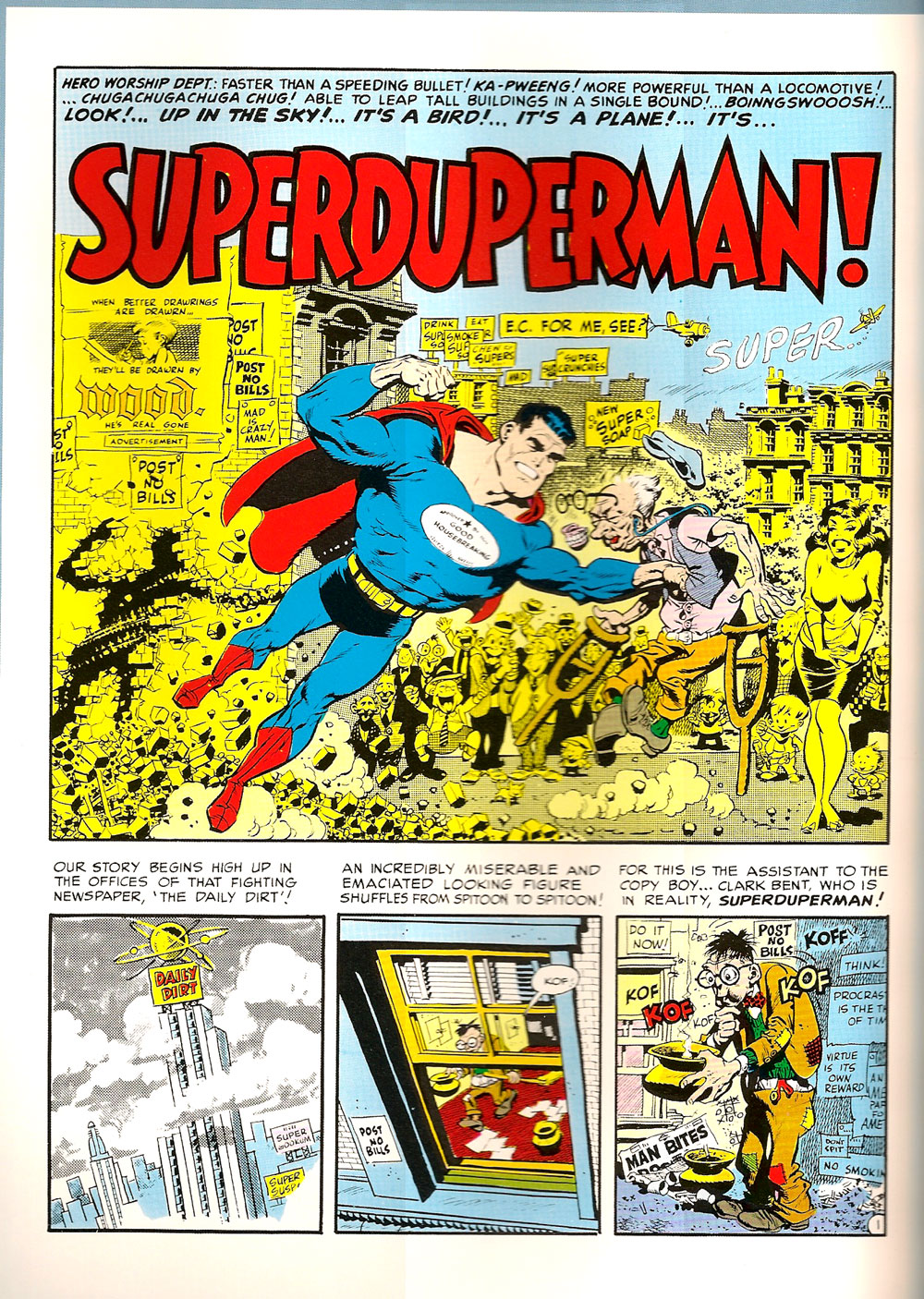
But as comprehensive as this documentary attempts to be, I doubt that it includes the appearance in the fourth issue of Mad of “Superduperman,” written by Harvey Kurtzman and drawn by the great Wally Wood. This helped to boost the popularity of Mad, and set a precedent for the hundreds of parodies that would follow, after a threatened lawsuit by the publisher of Superman comics was never filed. I first read Mad comics in a series of paperback reprints, and especially loved these often totally bonkers parodies. Behold the first page!

Superduperman-Mad******

Superman seems more than able to survive Mad magazine and as many reboots as filmmakers want to throw at him (see my take on the latest reboot, Man of Steel, in a post from last June). He’s been a powerful part of the popular culture since before I was born, and will doubtless still be here long after I’ve been shipped off to the Phantom Zone. — Ted Hicks

Superman 75 logo

Posted in Comics, Film, Home Video, TV | 3 Comments

New York Film Festival Diary – #1

NYFF 51-posterSince moving to New York in 1977, the New York Film Festival has been the big annual film event for me. At my first festival, the 15th NYFF in ’77, I remember seeing Handle with Care (d. Jonathan Demme), The Man Who Loved Women (d. François Truffaut), The American Friend (d. Wim Wenders), Padre Padrone (d. Paolo & Vittorio Taviani), and in a sidebar animation program, several great cartoons directed by Chuck Jones and Tex Avery. I realized this was one of the reasons I’d moved to New York. Actually, I came out here for a job with a motion picture lab, which turned out to be terrible and mercifully ended after 10 months, but it got me to New York. I soon realized this was where I was supposed to be.

I’ve attended every year since then, with a couple of exceptions. Film Society members can buy tickets in advance of public sale. These are reserved seats at Alice Tully Hall, then and now the primary venue. One year I was upset with where my seats were (having indicated my seating preferences when I submitted my order, which were obviously ignored) and returned all the tickets for a cash refund. I ended up not seeing anything, but I made my point. Right. Another year I quit the Film Society entirely because my issues of “Film Comment” magazine (a subscription is included with membership) weren’t arriving on time. In both cases, I’m sure I really showed them. I’d like to think I’ve evolved a little since then.

For many years, the NYFF, which began in 1963, screened predominantly foreign films. That has changed over time, and now there’s a good mix of foreign and English-language films. Additional screening venues at Lincoln Center have allowed the festival programming to expand greatly. In the 80s it was possible for me to see everything if I wanted. That’s impossible today, but it’s an embarrassment of riches. I’m seeing 14 films from the Main Slate of 36, and 2 from the Revivals  program of 11 films. I plan to write briefly about all of them every few days as I see the films. Here goes.

Friday, September 27. Opening night kicked off with Captain Phillips. I didn’t think I’d be seeing this, because both scheduled screenings at Alice Tully Hall were either too expensive ($75 members’ price @ 6:00 pm) or invitation-only (9:00 pm). But additional screenings were added and I was able to see it for $15 at the Elinor Bunin Munro Film Center just down the block. I had high anticipations for Captain Phillips, and was basically not disappointed. Tom Hanks’ performance, especially in the last 10 – 15 minutes, is amazing. The film is worth seeing for those moments alone. Paul Greengrass is one of my favorite directors. I love his two Bourne films (The Bourne Supremacy – 2004 & The Bourne Ultimatum – 2007) and find them to be endlessly repeatable. Captain Phillips is similar in many ways to his United 93 (2006), which I watched on the next night via the miracle of Netflix streaming. The new film made me want to see United 93 again, a film I like a lot, though it’s not an easy ride. Both films share a semi-documentary approach of great precision and detail in setting and performance, as well as focusing on individuals operating under great stress. There’s nothing casual about the way he puts his films together, a trait Greengrass shares with Ridley Scott and Michael Mann, two other excellent directors.

Captain Phillips-stillTom Hanks in the title role is excellent, as you would expect. He brings great commitment to the part. It’s like you can see him thinking in the pressure of the moment. His eyes tell a lot. Hanks is an immensely engaging actor. I can’t imagine anyone not liking him, though I’d like to see him play a bad guy sometime. He’s been compared to Jimmy Stewart in terms of appeal, but to me Stewart was more interesting in Hitchcock’s Vertigo, and especially in the series of Westerns he made with director Anthony Mann. Stewart brought out a darker, obsessive quality to these films. It would be interesting to see Hanks like this as well, though who knows, audiences might not accept it.

It would also be interesting to see Captain Phillips in double feature with A Hijacking, a Danish film released last year that also features Somali pirates boarding a ship and taking hostages in demand for ransom. That film treats the similar scenario in a totally different way. It’s less amped up than Captain Phillips, conveys the tense, anxious boredom of captivity over several months with a constant threat of violence.

The performances in Captain Phillips are uniformly excellent. With the exception of Hanks and a few others, Chris Mulkey to name one, we haven’t seen most of the actors before, or at least not very much, which adds to the documentary feel of the film. Catherine Keener, playing Hanks’ wife, has basically a cameo with maybe 5 minutes of screen time at the beginning. She’s very good, as usual, but barely there. The leader of the four pirates who board Hanks’ ship is played by Barkhad Abdi, a member of the Somali community in Minneapolis/St. Paul. He’s never acted before, but he’s terrific here, a very intense presence.

This film opens on October 11th. Here’s a NYFF press conference with Paul Greengrass, Tom Hanks, and Barkhad Abdi.

Saturday & Sunday, September 28 & 29. Saw two films on Saturday: The Wind Rises, from the great Japanese animation director, Hayao Miyazaki, and At Berkeley, Frederick Wiseman’s 4-hour documentary shot at UC Berkeley. The Wind Rises started at 12:30 pm and was out a little after 2:30, so I had some time to come home to feed the cats and recharge before At Berkeley at 4:30. On Sunday I didn’t see any films, but attended an HBO Directors Dialogue with Fred Wiseman in the afternoon.

Wind Rises-stillIf you’ve seen any of Miyazaki’s films, you know how amazing they are. I haven’t come close to seeing all of them, but my favorites so far are Spirited Away (2001), which won the Oscar for Best Animated Feature in 2003 (the film was released in the US in 2002), and Porco Rosso (1992), the incredibly inventive story of a WWI pilot in Italy in the 1930s who has been turned into a humanoid pig and rescues children kidnapped by flying pirates. His many other features include Castle in the Sky (1986) and Princess Mononoke (1997). The Wind Rises is different in that it’s the biography of Jiro Horikoshi, a real-life figure who designed airplanes for the military in 1930s Japan, most notably the Zero fighter. I thought it unusual that Miyazaki would focus on a real-world subject, but his imagination takes flight, so to speak, in Horikoshi’s dreams and fantasies, which are quite elaborate and involved. It’s a wonderful film, with a touching love story and an understated anti-war message. This trailer gives a good sense of Miyazaki’s visual style.

Fred Wiseman’s At Berkeley is something else again. I was apprehensive because of the 4-hour running time without intermission, especially on top of the earlier film, but found that I settled into a groove after the first hour or so, and the rest of it seemed to go by rather quickly.

Wiseman in the Walter Reade Theater lobby, 9/28/13

Wiseman in the Walter Reade Theater lobby, 9/28/13

Wiseman is a great documentary filmmaker, or filmmaker, period. He studied to be a lawyer, didn’t like that, and began his film career at age 30. He’s now 83, but doesn’t seem ready to stop making films. The subject of his next film is the National Gallery art museum in London.

Wiseman’s earlier films include Titicut Follies (1967), High School (1968), Basic Training (1971), Welfare (1975), Public Housing (1997), Domestic Violence (2001), and Boxing Gym (2010). You can tell from this sampling of titles that his subjects are almost always institutions (For a complete filmography, see his Wikipedia entry). I don’t know how he gets the access he does, but with a three-man crew he gets into the guts of how these places work. There’s no exposition, no on-screen titles to identify people or places, no narration or interviews. It’s the very definition of fly-on-the-wall observation. Though Wiseman doesn’t like terms like  “cinéma vérité,” which he once called a “pompous French term that has absolutely no meaning as far as I’m concerned.” He has said, “What I try to do is edit the films so that they will have a dramatic structure.” He has also said his films are “based on un-staged, un-manipulated actions… The editing is highly manipulative, and the shooting is highly manipulative…What you choose to shoot, the way you shoot it, the way you edit it and the way you structure it… all of those things… represent subjective choices you have to make.” His films have a point of view, but you don’t get hit over the head with it.

In a 1991 interview with Frank Spotnitz in American Film, Wiseman said, “All aspects of documentary filmmaking involve choice and are therefore manipulative. But the ethical… aspect of it is that you have to… try to make a film that is true to the spirit of your sense of what was going on… My view is that these films are biased, prejudiced, condensed, compressed but fair. I think what I do is make movies that are not accurate in any objective sense, but accurate in the sense that I think they’re a fair account of the experience I’ve had in making the movie.”

At the excellent HBO Directors Dialogue on Sunday, Wiseman said he doesn’t start with a particular point of view, but begins to collect footage to see where it leads. For At Berkeley he shot on digital cameras for 12 weeks, resulting in 250 hours that was edited over a period of 8-10 months down to 4 hours. Watching the film is a bit disorienting at first, because we spend time in conference rooms and classrooms without knowing who the people are (though you pick that up) or what exactly is going on (you pick that up, too). There are wonderful moments throughout. My favorite is almost a throwaway. We’re in a robotics lab watching a machine with robot arms fold a towel over and over. Each time it ends with motions of the arms that suggest elegant “Et voila!” gestures.

Many of the meetings we see deal with financial matters such as budget cuts due to reduced state funding. In one of these meetings, Chancellor Robert Birgeneau is astonished to learn that they now have only one guy who mows the campus lawns with Berkeley’s single lawnmower. “He does a pretty good job!” Birgeneau says.

A powerful sequence has students who are military veterans talking about what it’s like to be back in school. In another we see administration officials discussing security for a planned demonstration by students against tuition hikes. Mario Savio and the Free Speech movement of the 60s have created a proud tradition of protest at Berkeley. We see the protest march, followed by the occupation of a library for several hours by students who make speeches, then peacefully leave.

I think the goal in his films is to get inside institutions like UC Berkeley to show how they work, how they function.  After seeing all the administration meetings, classroom discussions, students going to and from classes, etc etc, I felt like I had a sense of the ongoing life of the university. This is Frederick Wiseman at his best.

At Berkeley will have a limited theatrical run, followed by showings on PBS and a subsequent DVD release. I know 4 hours seems like a long haul, but this one is well worth the time. – Ted Hicks

Fred Wiseman & Kent Jones on Sunday, September 29, 2013

Fred Wiseman & Kent Jones on Sunday, September 29, 2013

Posted in Film, Home Video | 1 Comment

“Enough Said” — Sweet, Funny, & Sad

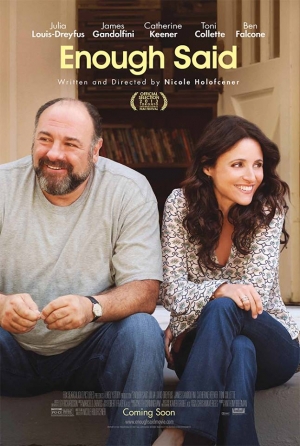
Enough Said-poster The title of director/writer Nicole Holofcener’s 2001 feature, Lovely & Amazing, is an apt description of her new film, Enough Said, starring Julia Louis-Dreyfus and James Gandolfini. Holofcener’s films, which include Walking and Talking (1996), Friends with Money (2006), and Please Give (2010), tend to be small-scale and quirky. She’s more interested in the ways people struggle with their lives and relationships than she is in plot. That’s not to say her stories aren’t neatly constructed, but that the emphasis is more on character.

Louis-Dreyfus is Eva, a masseuse living in Los Angeles, divorced ten years, with a daughter about to leave for college. Gandolfini is Albert, who works as an archivist at the Library of Television (a job I’d dearly love to have), also divorced and with a daughter heading off to college. Like Eva, he’s anxious about his daughter leaving the nest. They meet, hit it off, and begin a tentative relationship that has its ups and downs, embarrassments and misunderstandings. If you have to categorize it, Enough Said is a romantic comedy, but one that definitely doesn’t follow the usual rom-com predictability.

This is obviously due to the writing and direction, and especially the actors. Eva is the central character — and Julia Louis-Dreyfus is great in the role — but it’s Gandolfini’s presence and performance that really elevates this film. They both bring the weight of having been in two hugely iconic television series, Seinfeld and The Sopranos. They’ve been largely defined by their roles in those shows. Louis-Dreyfus’ Eva may be similar to characters we’ve seen her play before, but Enough Said takes her to dramatic moments that feel painful and real. The acting she does with her face alone in some scenes is amazing.

Gandolfini’s Albert, on the other hand, is about as far from Tony Soprano as one could get.  He hasn’t had an opportunity to play a role like this before, someone as gentle and empathetic as he is here. Sure, Tony Soprano could show a sensitive side with Carmela and his assorted girlfriends — or the ducks in his swimming pool — but he could just as easily beat a guy to death and chop him up in the bathtub. He has frequently been cast as gangsters or tough guys, though even there he often brought something extra. Check out his scenes with Patricia Arquette in True Romance (1993) and Julia Roberts in The Mexican (2001). And he created a genuinely sad character with just his voice in Where the Wild Things Are (2009). But he’s something else again in Enough Said. It’s a measure of his talent as an actor that he could bring someone like Albert to life, and make us feel that’s who he’s always been.

It’s ironic that Gandolfini had serious doubts he could play this part, and kept telling director Nicole Holofcener that she should recast it. He said Alec Baldwin would do a much better job. With all due respect to Alec Baldwin, who I like a lot, it’s hard to imagine anyone but Gandolfini in this film. Baldwin would have done a good job, but it would have been quite different. Gandolfini opens himself up emotionally in Enough Said in ways I don’t see that often — though Sean Penn in Milk (2008) comes to mind. When Albert says to Eva, “You broke my heart,” he expresses a painful vulnerability that’s quite moving, and a feeling I’m sure many people can identify with. He’s also really funny. We know Julia Louis-Dreyfus can be comic — that’s what she does — but it’s a revelation to see how relaxed and funny Gandolfini is as Albert. While it’s great seeing him in this film, it’s a bittersweet feeling, since he would have given us so much more.

Enough Said-stillGandolfini and Louis-Dreyfus have great chemistry in Enough Said. It feels genuine in a way that’s hard to fake. They seem to really enjoy being in each other’s company. Albert and Eva connect through humor; it’s a key component of their relationship. Of course, always being funny can be a cover for anxieties and insecurities, and that comes out here, especially with Eva. Eva’s new friend and client, Marianne (played by Catherine Keener, who has been in all of Holofcener’s features), turns out to be Albert’s ex-wife. She doesn’t hesitate to unload detailed accounts of Albert’s many failings to Eva. Once Eva realizes this is the same guy she’s dating, she feels conflicted, but can’t help but keep listening. Problems ensue as Eva tries to handle this information without Albert or Marianne finding out about Eva’s involvement with each of them. This is a contrivance, to be sure, and one that was revealed in all the trailers, so it’s not exactly a spoiler. It could have been farcical or forced, but the movie’s too smart for that. I think the way it plays out works, and that’s what counts.

This is a film about relationships. Toni Collette and Ben Falcone are very good as Sarah and Will, Eva’s close friends, whose marriage is spiked with passive aggression — maybe a warning about relationships? A fair amount of time is devoted to Eva’s fears and anxieties about her daughter, Ellen, going off to college on the East Coast. Tracey Fairaway is excellent as Ellen, as is Tavi Gevinson as her best friend, Chloe. These characters seem like real people rather than plot points. The scene where Eva and her ex-husband see Ellen off at the airport is as strong as it gets. The emotion is powerful and authentic. Holofcener gives the scene, and the entire movie, room to breathe. — Ted Hicks

**********************************************************************************************

Extras —

Manohla Dargis’ sharp appraisal of James Gandolfini’s feature film career from The New York Times.

Interview with Julia Louis-Dreyfus on Enough Said, playing a masseuse, and working with James Gandolfini.

A clip of Nicole Holofcener talking about Enough Said:

Though it’s been referred to as Gandolfini’s final film, he has one more scheduled for release in 2014, Animal Rescue, a crime drama.

We saw Enough Said at an advance screening at the Museum of the Moving Image here in New York a few days before it opened. Afterward, there was a terrific Q&A with Julia Louis-Dreyfus, Nicole Holofcener, and producer Anthony Bregman, moderated by Chief Curator David Schwartz. Q&A sessions always add a lot to the experience, and this was no exception.

David Schwartz, Julia Louis-Dreyfuss, Nicole Holofcener, Anthony Bregman

David Schwartz, Julia Louis-Dreyfus, Nicole Holofcener, Anthony Bregman

Posted in Film, Home Video, TV | 2 Comments

My “Butler” Problem

Butler-poster2Lee Daniels’ The  Butler – Sunday, August 18 at AMC Loews Lincoln Square. Director: Lee Daniels. Writer: Danny Strong. I had something quite different in mind when I first thought of writing about this film. Though I recognized that the film had strong performances from the leads, and was well made in a straightforward, traditional style that was effective, my initial reaction was much more negative than positive. The story of Cecil Gaines, who served as a White House butler during four turbulent decades, is a strong one. But the fact that Cecil is a largely fictional character was very problematic for me.

This feeling was only reinforced when I read this excerpt from Lee Daniels’ foreward to The Butler: A Witness to History by Wil Haygood, published as a companion to the film: “While the movie The Butler is set against historical events, the title character and his family are fictionalized, we were able to borrow some extraordinary moments from Eugene’s real life to weave into the movie.”

The film states in the credits that it is “inspired by a true story,” which gives filmmakers a lot of leeway. Screenwriter Danny Strong’s inspiration came from a short article by Wil Haygood, “A Butler Well Served by This Election,” which appeared in The Washington Post in November of 2008. The piece sketches the story of Eugene Allen, a black man who served as a White House butler during eight administrations for over three decades (1952-1986). This is a powerful, timely premise for a movie, and it’s easy to see why it would appeal to Hollywood.

The Butler does not present itself as fact, but I think it may have been initially perceived that way. At least, after first hearing about the film and seeing the early trailers, I assumed the butler’s story was more factual than it turned out to be. I was surprised and troubled when I learned that most of the details of Cecil Gaines’ life were fiction. It seemed the filmmakers felt that they had to make more of a movie out of the story; that they had to pump it up with drama. It wasn’t enough that The Butler‘s Cecil was a witness to all this history, he had to have a personal connection, via his activist son Louis, to events during the formative years of the Civil Rights movement, as well as Vietnam and Black Power.

(If you haven’t seen the film, there are some spoilers from this point on.)

I think what bothered me the most was what was fabricated for Cecil’s background and his family. Eugene Allen did grow up on a plantation (in Virginia, not Georgia), but by all accounts, his mother was neither raped by the plantation owner nor his father shot dead in front of him, as Cecil experiences in the film. Eugene’s wife Helene was not an alcoholic, nor was she sexually involved with a sleazy neighbor (played by Terrence Howard), as is Cecil’s wife, called Gloria in the film. In The Butler, Cecil and Gloria have two sons: a younger son Charles who is killed in Vietnam, and Louis, who becomes actively involved in Civil Rights, evolving from being arrested as a Freedom Rider in the South to becoming militant as a Black Panther. Cecil’s struggles with Louis’ actions are the main source of conflict in the film. Eugene and Helene Allen had only one son, also named Charles. He did go to Vietnam, but survived. It should be noted that the real-life Charles, who works as an investigator in the State Department, has endorsed the film. ____________________________________________________________________

It was only when I read an interview Jay A. Fernandez conducted with screenwriter Danny Strong that I began to see The Butler in a different light. In the interview Strong says:

“It’s important to understand, there’s a reason why the character’s name is Cecil Gaines. Because this is not the Eugene Allen story. It’s not just about him. We were hoping to capture the essence of Eugene Allen, and I think we did. But it’s not just about him. It’s about several other people I spoke to that worked at the White House as well so that the film would create this universal truth for many people of what that experience was like.”

When asked how the narrative came together, he says:

“There were two big breakthroughs. It was a story that took place over many administrations. As soon as I realized that this was going to be a story about the Civil Rights movement, and that was going to be the spine of the film, that was the first breakthrough. In all these administrations, there will be a common theme going on as we travel through the eras. And then the second breakthrough was [creating] a son who was a Civil Rights activist so that we could actually be in the center of the action while those events were happening. That created this really great triangle of the butler trying to get his son out of the Civil Rights movement and the presidents dealing with the crises that his son is in the middle of as the butler is serving those presidents. It made the story emotional even when the butler wasn’t speaking in the White House, and it created what I thought would be a very interesting generational story between father and son. It keeps everything personal and emotional as opposed to a history lesson.”

I found this reasoning to be persuasive; it changed the way I saw The Butler. I finally realized that, duh, this is a movie, and the goal is to find the most effective way to tell the story. To that end, I think they did a good job, even though the way the narrative is constructed to highlight the basic outline of the Civil Rights movement is a bit didactic and schematic at times. A definite plus is that The Butler is very strong in its casting and THE BUTLERperformances. Forest Whitaker and Oprah Winfrey are quite extraordinary as Cecil and Gloria Gaines. This is Oprah’s first major role in a feature film since Beloved in 1998, and she’s terrific. It doesn’t take long to forget that she’s Oprah. David Oyelowo is very strong as Louis Gaines. He’s an excellent actor, and was especially good in last year’s grossly underseen Middle of Nowhere. Cuba Gooding Jr. and Lenny Kravitz are stand-outs as Cecil’s co-workers in the White House kitchen. The roles of the various presidents Cecil served under are more like a parade of cameos, some more successful than others. Robin Williams barely registers in his brief time on screen as Eisenhower, while John Cusack seems weird and off the mark as Nixon (though maybe that’s appropriate). Alan Rickman probably fares the best as Ronald Reagan, with Jane Fonda good as Nancy in a few short scenes.

It’s hard not to be stirred by Lee Daniels’ The Butler (to give it its full, unwieldy title), even as you know you’re being manipulated. President Obama says he “teared up” when he saw it. There’s been a firestorm of debate about the film, mainly focused the issue of accuracy. But audiences don’t seem to care about that; they made The Butler number one at the box-office for three consecutive weeks, which almost never happens. The Butler may not have as much to say about race in America as did Brian Hegeland’s Jackie Robinson film 42 (2013) or Quentin Tarantino’s Django Unchained (2012), for example, but I think it does what it sets out to do, and it does it pretty well. The final scenes of Cecil Gaines are very moving, whether they actually happened or not. — Ted Hicks

_____________________________________________________________________

End Notes:

It was a bit of a disconnect for me to realize that screenwriter Danny Strong played a recurring character, the dweebish Jonathan Levinson, in 29 episodes of one of my favorite TV series, Josh Whedon’s Buffy the Vampire Slayer. Strong went on write two very good HBO movies, Recount (2008) and Game Change (2010). He’s on a roll with The Butler, and is already writing the next two films in the blockbuster Hunger Games series, Mockingjay Part 1 & 2 (2014 & 2015).

The controversy over the title was caused by Warner Bros. claiming that if the new film was called The Butler, it would somehow infringe on an obscure 1916 short film of theirs which has the same title. Unaccountably, the MPAA agreed with Warners and made The Weinstein Company add Lee Daniels’ name to the title. This is especially absurd since motion picture titles have been repeated at least 122 times so far, probably more. For example, there have been films called Heat in 1986, 1994, and forthcoming in 2014. No one seems too upset about that. It makes you wonder what Warners’ real agenda was.

Finally, there’s a theater owner in Kentucky — a former Korean War vet who later trained pilots to fly in Vietnam — who refuses to show The Butler because Jane Fonda is in it. He makes a point of not showing any films with “Hanoi Jane” in them, because of her anti-war activities, which included a trip to North Vietnam during the war. This is America, it’s his theater and he can do what he wants, but — seriously?

Posted in Film, Home Video, TV | 2 Comments

Friction Fiction #4 — “Shucks & Puffer Come to Town”

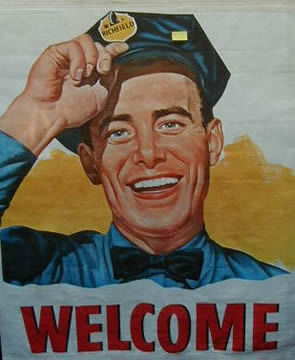
Welcome gas station sign

by Ted Hicks

Drive three miles east of Highway 71 on county road 14 and you’ll come to Arcadia (pop. 187), which lies roughly in the southeast corner of northwest Iowa, in the midst of rich farmland that’s slightly rolling but mostly flat. As you approach the town there’s a school on the left, a solid three-story building made of fading red brick set back from the road on a slight rise above the half-moon driveway. The top of the grandstand that anchors the ball field behind the school is just visible.

After the stop sign at the intersection just past the school there’s Wally Beever’s double-pump gas station. Right now Wally’s wearing his usual uniform of baggy bib coveralls over a greasy black tee shirt, sitting on a straight-backed wooden chair outside under the awning that covers the pumps, drinking a beer on a hot September morning and waiting for Kenny to come back out.

Standard gas stationInside the station Kenny pulls a bottle of Coca Cola from the icy water in the battered pop cooler. He opens it and takes a swig, looking at the calender above the cooler, beneath the shelves of motor oil. It’s been there five years at least, the edges curling up on the picture of Marilyn Monroe naked against a red background. Kenny sighs, steps outside and squints.

“Christ almighty,” he says, “this is just as bad as August.”

“Yeah, you’ll be bitching when it’s winter,” Wally says as he nudges a rock with his boot, then leans forward to pick it up.

Kenny grunts and moves to sit in the empty chair on the other side of Wally. He sits a minute, then says, “The kids sound pretty good today.”

It’s only nine o’clock, but already the marching band from the school is practicing in the streets. The drum beat and the faltering sound of the school fight song is several blocks away. The town is quiet except for the music from the band and the sounds of insects.  Occasionally you can hear a screen door slam.

“Yeah, well,” says Wally, studying the rock in his hand,  “it’d be nice if we won some games this year.”

A car stopped at the intersection revs its engine and squeals around the corner, rocketing past the station. A piece of gravel thrown by the car ricochets off one of Wally’s gas pumps.

“I don’t much like that,” says Wally evenly.

The thick dust slowly settles. In the morning sunlight it looks to Kenny like someone has been shaking rugs out.

Kenny leans forward and looks down the road after the receding car. “Who was that?  That Cooney kid?  Where’s he going?”

Wally gives his rock one last look, then tosses it away between the pumps. “Naw, it wasn’t him.”

Kenny jerks his head around. He knows Jim Cooney’s car if anybody does. “Oh yeah?” he says. “Who was it then? Looked like Cooney.”

“Maybe it was one of those Hollywood hotshots,” Wally says with a bitter laugh.

Kenny’s forehead wrinkles slightly as he ponders this. “Huh.  I heard they were coming back. Do you think it’s them?”

Wally feels himself working up some steam. He looks to his left toward the large white sign displayed beside the street that branches off the blacktop and into town. “Arcadia – A Mighty Small Town” is painted in red script above an outline of the state with a dynamic arrow pointing to a star approximating the location of Arcadia itself.  On a newer sign board nailed to the old one is written in a more modern graphic style, “Home of TV’s SHUCKS & PUFFER!”

“Shucks and Puffer my ass!” Wally says under his breath, shaking his head.

“Come on, Wally,” Kenny says, “who’d ever thought somebody’d do a TV series here?  Don’t you think it’s great?”

“What’s so great about it?” Wally says as he tosses his empty beer bottle into the fifty-gallon trash drum by the pumps. “They come here just to shoot the outside stuff, tramp on everybody’s yards and act like they own the place.  What’s so great about it? Besides, I bet they ain’t coming back anyway. Be cheaper just to build a town out there.”

Kenny enjoys seeing Wally get worked up. It reminds him of Dave Boyer’s pickup truck boiling over. “Come on, what about that thing on Entertainment Tonight? What about those tee shirts they’re selling down at the cafe?”

Wally makes a fist of his right hand and slams it into the palm of his left. “That’s exactly what I’m talking about. Entertainment Tonight!  How come the Hobbs were on that?  And that loony kid of theirs? Standing like idiots in front of their store. You’d think there wasn’t anybody else living in this town!”

Kenny laughs. “I guess you’d feel different if folks across the country had seen Beever’s D-X on TV, huh?”

Wally is really angry now. “Boy, Kenny, you’re completely screwed up, you know that?  Everybody in this town thinks they’re gonna be a celebrity now. All because of some stupid show about a kid and his genius pig saving people week after week. An 800-pound pig that opens doors and rescues babies!”

You have to go three blocks away from Wally’s station to find Hobbs’ Groceries on a corner of Main Street, the only grocery store in Arcadia. There’s only one of anything here, and not many of those, though the residents are hoping the television series will somehow rejuvenate the town.

Sweating in the hot morning sun, Sonny Hobbs, thirty years old, mentally impaired and wearing a Shucks & Puffer tee shirt, stands in front of his parent’s store and slowly sweeps the sidewalk. The high school marching band rounds the corner and heads down Main Street. Sonny stops sweeping and slowly waves at the majorette, Debbie Jensen in her short skirt, as the band goes by. Sonny thinks of TV shows and Debbie’s knees.

Shucks

Posted in Fiction | Leave a comment

Civil Rights Roundtable — a Time Capsule from 1963

March on Washington button

August 28th marked the 50th anniversary of what was originally called the March on Washington for Jobs and Freedom. In the years since then, the name has lost “Jobs and Freedom,” and most people, myself included, have always thought of it simply as the March on Washington. I wasn’t aware of the full name until I found this image of a button online.

The event was a watershed moment in the history of the Civil Rights movement in the United States, but I knew little about it other than the Rev. Martin Luther King, Jr.’s seminal “I have a dream” speech, which became emblematic of the entire struggle, and still has the power to inspire.

The civil rights leader Martin Luther KI

It was a revelation when I saw the “Civil Rights Roundtable,” a 30-minute television program broadcast from a CBS studio in Washington, DC later in that day on August 28th. It turns out this video has been widely available online via YouTube at numerous sites, but I only recently became aware of it.

What gets me is the immediacy of the discussion; it’s happening in the moment rather than looking back, and therefore more alive. I had a similar experience some years ago when I read The Frontier World of Doc Holliday, a biography by Pat Jahns that contains newspaper articles written at the time. I was struck by how much more vibrant and real this felt than more traditional historical accounts.

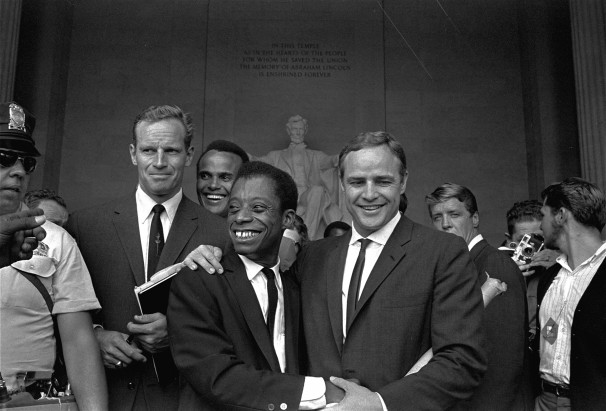
The roundtable is moderated by David Schoenbrun, a veteran newsman who had worked with Edward R. Murrow at CBS. The panelists include Harry Belafonte, Charlton Heston, Sidney Poitier, film director and screenwriter Joseph L. Mankiewicz, Marlon Brando, and author James Baldwin, all of whom had come to Washington specifically for the march. Those who find Charlton Heston’s presence here curious because of his staunchly pro-gun position  (he was a five-term president of the NRA from 1998 to 2003) and conservative politics might be surprised to learn of his prior political activism as a Democrat, supporting liberal candidates and causes, and a strong supporter of Civil Rights. Heston and the other panelists, especially Harry Belafonte and James Baldwin, come off as very smart, extremely articulate,  and passionate in their beliefs.

Heston+Belafonte+Baldwin+BrandoHeston+Poitier+Belafonte

_____________________________________________________________________

I’ve watched the video several times, and moments that stand out include the following:

Marlon Brando saying the March on Washington is “one step closer to understanding the human heart.”

Joseph L. Mankiewicz saying he’s concerned with “human rights” rather than “civil rights.”

Sidney Poitier referring to the “Negro question” rather than the “Negro problem.”

Charlton Heston saying that even though he had picketed restaurants in Oklahoma two years before, he’d mainly expressed his support of Civil Rights by talking about it at cocktail parties. But earlier that summer (1963), he realized he could “no longer pay lip service to a cause that is so urgently right and in a time that is so urgently now.”

Mankiewicz saying “True freedom is not given by governments. Freedom is taken by the people.”

Heston, speaking of the March, “…the end is not yet, but perhaps this is a beginning,” and that “the importance and difficulty of the times ahead cannot be over-emphasized.” He goes on to quote from memory a passage written by Thomas Paine during the early months of the American Revolution: “These are the times that try men’s souls. The summer soldier and the sunshine patriot will, in this crisis, shrink from the service of their country; but he that stands it now, deserves the love and thanks of man and woman.”

Much of this discussion seems so timely and relevant to our times. The effect of what is said is both chilling and exhilarating, none more so than this stunning closing statement from James Baldwin: “The nature of the problem is so complex that one can’t simply say ‘jobs’ or ‘schools’ or ‘houses.’ It’s a whole complex of things. Jobs alone won’t solve it; schools alone won’t solve it. It’s in the social fabric. It isn’t anything, it’s everything. The first step has to be somewhere in the American conscience. The American white republic has to ask itself why it was necessary for them to invent the nigger. I am not a nigger. I have never called myself one. The world decides that you are this…for its own reasons. It is very important for the American that he face this question… that he needed the nigger for something.”

I don’t think this question has ever been answered, but it’s inspiring to watch this program — a moment in history — and see people trying to grapple seriously with issues that are still with us today. See for yourself.   – Ted Hicks

Posted in Books, Film, Home Video, TV | 3 Comments

Breaking Bad — “The Perfect Batch” Panels

To end their week of Breaking Bad events, the Film Society of Lincoln Center hosted “The Perfect Batch: Breaking Bad Cast Favorites” at the Walter Reade Theater on Thursday, August 1, and Friday, August 2. There were two programs each night, with cast members selecting two episodes to be shown at each, followed by discussions on stage. I was unable to get tickets to these screenings, which sold out within minutes of going on sale. So far I haven’t been able to find out which episodes were shown, but the Q&A sessions with cast members are now online. These weren’t available in time to include in my previous Breaking Bad post last week, but I wanted to add them here. – Ted Hicks

Note: If you haven’t seen the first five seasons yet, these discussions contain spoilers.

Posted in Home Video, TV | Leave a comment

Friction Fiction #3 — “The Return of Doktor Flesh”

Parental Advisory2I don’t want to offend anyone’s sensibilities, so please be aware that this story would probably get an R-rating if it were a movie. If that’s not a problem, then here you go!

********************************************************************************

THE RETURN OF DOKTOR FLESH

by Ted Hicks

Doktor FleshDavid Chandler, Jr. sat alone in his living room, watching the snow drift down outside, large flakes illuminated by the streetlights and reflected in the headlights of vehicles slowly moving up and down the unplowed street. He was still badly hungover from the night before. A pain throbbed and pressed behind his eyes. Another beer might help.

He rose and walked slowly to the kitchen where he took a can of Bud from the refrigerator. A movement caught his eye and he stopped dead. A cockroach was crawling up the side of the sink. Keeping his eyes on the roach, Chandler very slowly reached for a paper towel. He smashed the roach in one swift, decisive movement, looking quickly to see that he had in fact gotten the little bastard, then crumpled it  tightly in the paper towel.

He returned to the living room and sat at his writing desk, the unopened beer in one hand and the wadded paper towel in the other. Chandler wanted the beer, but he had to get rid of the roach first. He squeezed the paper ball as hard as he could. He believed you couldn’t kill them enough. No matter how crushed, they might return to life, so he always flushed them down the toilet. They might live on in some maimed, crippled fashion in the sewers, but he didn’t have to see them.

He turned from the window and the falling snow. He looked past the kitchen and down the hall. Light from the bathroom cut into the hallway. Chandler knew he’d have to go there sooner or later, and not just to flush the cockroach. For that matter he could open the window and throw the roach out into the snow and it would be just as gone from his life.

Reluctantly Chandler began to rise, then sat back down. Earlier that evening there’d been an argument, then something happened, an accident, and now his mother lay dead on the bathroom floor. They’d been arguing, as always, over Doktor Flesh.

****

            His mother is peering intently into his bathroom mirror. She has her eyes and nose squinched up in a way that drives Chandler crazy. She is doing something to her eyebrows. “You could use better light in here,” she says.

He stands in the doorway watching her. She stops and turns to face him. She has removed her blouse. She is wearing a bra with openings that expose her large nipples.

“Listen, Junior,” she says, “you can stand there all night, but I’m not giving you the rights. I’ll never give you the rights, I’ll never sell you the rights. How many times do I have to tell you?” She turns back to her work in the mirror.

“But why?” he asks, trying not to beg. “Why not? What would be so terrible?”

She turns again and gestures with a silver tweezer that makes him think of a weapon. “Look,” she says more sharply, “try to understand this. You’re not going to turn your father’s work into a bunch of comic books. You’re not a good enough writer to begin with, even if they’d let you write them, which they probably wouldn’t. But it’s not happening.”

But this is my big chance! he wants to say, but doesn’t. He knows she’ll say that at forty-four it’s a bit pathetic to see writing comic books as his last chance to be somebody. She’ll tell him once again that none of his writing has ever been successful, not even in those workshops he keeps taking, and that maybe he should just grow up and try to be the best data-entry clerk he can be. She’ll tell him that the late, great David Chandler, Sr. is the one and only writer in the family.

****

Chandler stared at the rows of worn paperbacks on the shelves above his desk. The joke was that his mother talked as though his father had been some sort of fucking William Faulkner. In the late Forties and Fifties, David Chandler, Sr. had written forty-seven paperback originals, each featuring Doktor Heinrich Flesh, an evil, bloated genius, a bloody monster whose fiendish exploits became as popular as those of Sax Rohmer’s Fu Manchu.

Chandler took one of the books from the shelf and looked at its cover. It was typical of the series, a lurid scene rendered in garish colors turned slightly muddy by the printing process. Doktor Flesh, dressed in black, eyes hidden by small, round  glasses, the mirrored lenses shining in the light, stands leering over a half-naked woman with long blonde hair who is bound tightly with wide, studded straps. Doktor Flesh is pulling on a leash attached to a metal collar around the woman’s neck. At his side is his mistress in black leather, Lydia Chelm, caressing an elaborate torture device. In the background, chained to the wall beneath a burning torch, Inspector Nigel Baskett of Interpol looks on in abject horror.

Chandler knew this was crap, but the books had a trashy appeal that was undeniable. They were periodically re-issued, and currently were back in vogue.

On the desk was the latest letter from Martin Bobb at Necro Comics. They were impatient to clear the rights to use the characters. When that was done there’d be a contract for Chandler to sign. They understood that he wanted to write the stories himself, and they’d give him a shot at that, but they’d pay him just to use his name. It was a hook – the new adventures of David Chandler, Sr.’s famous characters, written by David Chandler, Jr.

Jesus. For this his mother was dead in the bathroom. What a fuckup. He put the paper towel containing the roach into the waste basket by the desk. So what. It was only a roach. Maybe he didn’t have the right to kill it anyway. One of God’s creatures and all that. He snapped the tab off the can of Bud and began to drink.

The hell with it. Chandler stood and walked straight toward the bathroom. Then his resolve faltered. He hesitated several steps from the doorway. He felt a coldness spreading in his chest. Chandler stepped slowly forward and looked around the door frame.

His mother was still on the tile floor by the toilet. Where else would she be? Her head was propped at an awkward angle against the tub. A thin line of dried blood ran from her nose. There was blood on her bra. Her eyes were open. Chandler let out his breath. He felt unsteady for a moment, then straightened up. Time to man up, he thought.

He went to the bedroom and got his jacket from the closet. He was on his way out the front door when he stopped and went back to his desk. He fished the wadded paper towel from the waste basket and opened it. The cockroach was still inside, one of its legs moving feebly, or was it? He returned to the bathroom, leaned over his mother, and flushed the roach down the toilet.

Chandler went downstairs to the bodega on the corner where he bought four large bags of ice. The man behind the counter said, “Hey, Mr. Chandler.  It’s snowing!  What you want ice for?”

Chandler said nothing and waited for his change.

“Maybe you’re having a party? Girls, huh?”  The man laughed, making a fist and pumping his forearm slowly back and forth.

Yeah, right, Chandler thought. Asshole.

“My refrigerator’s on the blink,” he finally said. He took his change and left.

Back in the bathroom he emptied two of the bags into the tub. He turned to his mother. He felt funny about picking her up without her blouse on. He looked around and found it hanging on a hook behind the door. After a couple minutes of trying to get his mother’s arms into the blouse and avoid her glassy eyes, he gave up and put it back on the hook. Those guys in funeral homes knew how to do this. Must be some trick to it. They weren’t kidding about dead weight.

With a clumsy effort he put his mother in the tub. Thank god she wasn’t stiff yet. He emptied the remaining ice over her. Chandler sat on the edge of the tub and packed the ice around her as carefully as he could. He remained sitting there, drumming his fingers on the side of the tub, and turned to look out the open bathroom door. Now what? He needed to think about this.

Chandler went to the kitchen and got another beer. In the living room he sat at his desk looking out the window into the night. It was still snowing. A snowplow was making its way slowly down the street. He saw his own reflection superimposed on the window, looking back at him like some fucking ghost. Maybe he shouldn’t get too hammered. There was too much to do. Christ, maybe he definitely should get hammered and stay that way.

The beer began to create the frequent need to pee, and for awhile he used the kitchen sink to avoid returning to the bathroom. The next time he said fuck it and strode purposefully into the bathroom.

He tried to focus only on the toilet bowl, but out of the corner of his eye he thought something was different. He turned. His mother’s jaw had dropped and her mouth was gaping open as if in surprise. Still holding himself, the image flashed through Chandler’s mind of pissing into her open mouth. He began to laugh, then stopped short as he saw his mother’s staring eyes. How could he think such a thing? He turned back to the toilet and as he peed, rapped the knuckles of his free hand against the wall above the toilet. Rat-a-tat-tat.  Those eyes. Those eyes. Windows to the soul. Where was her soul? Where was his?

Chandler rushed across the hall to his bedroom and came back with a pair of sunglasses, wrap arounds from his hipster days that he didn’t have the balls to wear anymore. He positioned them on his mother’s face and stood back. Weird effect, but at least he didn’t have to see her eyes.

He left the bathroom and got another beer. He began to take the Doktor Flesh books from the shelves above his desk and carefully arrange them on the living room floor.  When he’d finished he pulled up a chair and stared at the grand design spread out before him. Chandler leaned forward and the nearly full can of beer slipped from his hand. He tried to catch it with his other hand, but it had already hit the floor. Beer began to soak into the row of books closest him. Oh hell, he had to be more careful. These books were original editions. He stood suddenly, and the chair fell over behind him.

****

            David Chandler moaned and twisted in the bed. In his nightmare blood dripped from the knife gripped in his hand onto the naked body of his mother lying at his feet, and he was shouting. He woke with a start and anxiously turned on the light beside the bed. His throat was dry and he was very thirsty. He became aware that the sheets and his naked body were spotted with blood. In his sleep he had given himself many small cuts and nicks with the knife he saw was gripped in his right hand.

As he brought the knife closer to his face, a hand gloved in black leather reached out and took it from him. He looked up and saw Lydia Chelm kneeling by the bed. She turned to smile at him, her eyes dark and piercing, her hair drawn tightly back from her face, stretching the skin on her skull. She threw the knife over her shoulder where it stuck in the floor, then reached forward and cupped his balls in her leather glove, gripped and twisted.  Chandler gasped as she looked at him and brought the index finger of her free hand to her lips and whispered “Shhhhhh.” She smiled sweetly, and opened her mouth. Chandler saw that her teeth were filed to perfect razor points.

She dipped her head to take him in her mouth and bit down hard. Chandler screamed as she twisted her head savagely back and forth. Over the curve of Lydia’s shuddering back he saw Doktor Flesh in the dim light, smiling back at him, his lenses glittering.

***********

Chandler slowly woke lying on his bed, nauseous and disoriented. He suddenly jerked awake, sat upright and reached down to grab at his crotch. The sudden movement caused brutal pressure in his brain. He lay back and let his eyes go out of focus. He realized he’d pissed the bed. There was that familiar smell and wetness. Hadn’t done that for a long time. Fuck it. What the hell. He lay there and tried to think.

Ugly fucking dream, that’s for sure. It occurred to him that maybe everything from the night before was a dream. Just another drunken binge. He had a moment of hope. His mother was still alive and he was still in the dead end of his life. Well, that was better than the way he remembered it.

He struggled out of bed, pulled on his flannel robe and slippers and stepped across the hall to the bathroom doorway. He knew he was fucked before he got there. There was a bad smell, getting worse, something turning sour. She was lying in the tub like he’d left her, gaping jaw, the wrap-around shades, looking like she’d just been thrown from a motorcycle.

As he leaned forward to close her jaw he saw that a mushy substance had partially filled her mouth and run down her chin. What the fuck was that? More blood had run from her nose and had turned black. He took some toilet tissue to wipe her chin clean, then tried to close the jaw. He couldn’t budge it. He poked the flesh of her bare arms and shoulders.  Stiff as a board.

Chandler turned and shuffled down the hall. It had stopped snowing during the night and now the living room was filled with harsh sunlight. He saw the Doktor Flesh paperbacks spread across the floor.  He had forgotten doing that.  The pages of two of them were wet and swollen. He bent and carefully picked them up. Something had spilled on them. Beer. He hoped they weren’t ruined.

In the kitchen he opened the refrigerator door slowly, expecting to be screwed there as well, but there was one beer left, thank god. He went back to the living room and looked at the books still on the floor. He put on a Beatles album. Chandler began picking the books up from the floor. When he’d finished replacing them on the shelves, he sat down at his desk.

What was he going to do? He couldn’t just sit here drinking beer.  That’s what he wanted to do, but there was the smell, for one thing. He didn’t know anything about decomposition. He never thought he’d need to know anything about it, except maybe for some story he might write, but he could just make that up. What about his mother? Doktor Flesh had an acid vat in his cellar for this kind of thing. That guy in that teenage Frankenstein movie had an alligator in a tank. Yeah, well, this was a New York apartment.

Maybe he could get some acid, sulfuric acid. Where would he get it? Could anybody get it, just walk in off the street and say “Give me ten gallons of acid”? She was already in the tub. He could do it right there. But would it fuck up the plumbing? Eat through the tub? Maybe he could cut her up and take the pieces out in small garbage bags like on The Sopranos.

He shook his head. He knew he couldn’t do any of that. He was fucked and he knew it. His mother’s housekeeper would start wondering where she was pretty soon.  Somebody, the cops probably, would come around to check with him pretty soon, someday, any day, whenever. What was he going to do then?

He sat up straight in the chair. Okay, the first thing was to call in sick. He obviously wasn’t going to work today. He laughed. Maybe never. Then get more beer, some food, more ice, maybe some deodorizers, etc etc etc, blah blah blah.

Chandler made the call to his job. He brushed his teeth at the kitchen sink, fuck shaving, later for that, got dressed and went out into the fresh snow and sunlight.

****

            He felt better by the time he returned to his apartment. Braced by the cold of the winter day and the brightness of the snow, loaded down with his supplies, he felt a sense of some accomplishment, some purpose, even some hope. He began putting beer in the refrigerator.

Later, in the bathroom with his mother, he set out the dozen Air-Wick bottles that he’d bought. The final effect was a little heavy, to be sure, but Chandler felt it successfully masked the smell created by whatever bacterial processes were going on in his mother, or at least made it seem like something else. Something else.

Chandler sat down uneasily on the closed toilet seat. He’d become aware of a bowel movement pressing on him, and while he knew it wouldn’t make any difference, not really, he just couldn’t do it here with his mother in the tub beside him. Christ, he’d have to go out again, find some establishment that didn’t restrict its restrooms to customers only, or maybe he’d have to order something just to take a dump.

Grow up, grow up. Be a man about this. Your mother used to change your diapers.  She won’t care. Especially since she’s dead. He raised the seat and dropped his pants. He sat down on the toilet and began to cry.

****

            He was on his knees beside the tub, washing blood from his mother’s face with the almond soap she’d given him when he heard a knock at his apartment door. A rush of adrenalin surged through him. He didn’t move.  He waited. There was another knock, and a voice called out, “David? Are you there?”

Chandler couldn’t believe it. It sounded like his girlfriend, his ex-girlfriend. He knew it was her. He went out to the door and said, “Who is it?”

“David, it’s Annie. Hi!”

He tried to slow his breathing. He didn’t move.

“David?” she said again.

Leaving the chain in place, he opened the door a crack. He saw her heart-shaped face peering in at him. “Hi,” she said, then frowned. “Can’t I come in?  What’s wrong?”

What’s wrong? he thought. He wanted to laugh. Anyway, he hadn’t seen or heard from her in six weeks, and now she was at his door as though nothing had happened.

“This isn’t a good time,” he said. “I’m in kind of a mess here.”

He saw her fidget where she stood. “What are you talking about?  Please let me in.  This is silly. I want to see you.”

Chandler slowly unlatched the chain and opened the door. Fuck it, it wasn’t like this was the first stupid thing he’d done lately. She stepped inside, leaving little tracks of snow.  She was wearing jeans and cowboy boots and a leather bomber jacket with the collar turned up, and held a pair of furry ear muffs in her hand. He saw her nostrils flare.

“My god!  What’s that smell?” she said, looking around the living room.

“I told you I had a problem here. I’m cleaning something up.” He looked at her. She was beautiful as usual. “Listen, I’m surprised to see you. How’d you know I’d be home?”  He paused. “I didn’t hear the buzzer. How’d you get in, anyway?”

“Somebody was coming in, so I just followed. I just took a chance you’d be here.”

“Well,” he said, “it’s nice to see you.” What was he doing? He couldn’t let her stay here. “But believe me, this is a really really bad time. Can we get together later?”

“I guess so,” she said, “but since I’m here I need a favor. I need to use your bathroom, okay?”

“Oh no, no!” he said loudly. “It’s the plumbing. That’s the problem, it’s the plumbing.  You can’t go in there!”

“It’ll just take a second,” she said, giving him that look that told him how stupid and unreasonable he was being. And before he could stop her, she darted around him and went down the hall to the bathroom.

Chandler moaned and sat down at his desk. Man, she’d come up just to use his fucking bathroom. It just went from bad to worse. There was nothing he could do. He leaned forward, held his head in his hands and waited. He heard her shocked cry.

Chandler looked up as she ran from the bathroom and stumbled to a stop across the room from him. This was like some sitcom. Her eyes were wide and her jaw worked up and down until she finally spoke.

“That’s your mother! What happened? What did you do?”

He stood and made what he hoped were calming motions with his hands. “I can explain that, Annie. It wasn’t my fault?”

He took a step toward her and saw her catch her breath. “But what happened?  How long has she been there? She’s swelling up!

Chandler stopped and pulled his hand across his mouth.

“Have you called the police?” When he didn’t answer, she said more frantically, “David, you’ve got to call the police!”

“I think it’s too late for that, Annie,” he said. He saw the look on her face as he stepped forward.

****

            He knew enough this time to close the eyes and tie the jaw shut with a dish towel so it wouldn’t fall open later. He’d laid Annie on her back on top of his mother in the tub. Need more ice, he thought. He looked at her sadly, then picked up the small hammer he’d used. He was washing off the blood and hair when he heard his apartment buzzer, the one Annie should’ve used.

Chandler laughed shortly, shook his head, and went to the intercom by his front door.  He pressed the button and said, “Who is it?”

“Hey, David. It’s Martin Bobb! I need to see you about the contract. Can I come up?”

David Chandler, Jr. shook his head and took a breath. He balanced the claw hammer in his hand and spoke into the intercom. “Sure!” he said.  “Come on up!”

Doktor Flesh2

Posted in Fiction | 2 Comments

“Born in Chicago” — Black & White Blues

Howlin Wolf2TheSlowDrag-MuddyWaters

************************************************************************************** I recently saw Born in Chicago, a fascinating documentary that lays out how black blues musicians in Chicago during the 1960s, including Howlin’ Wolf (above left), Muddy Waters (above right), Willie Dixon and many others, influenced and mentored hungry young aspiring players, mostly white and Jewish, like Mike Bloomfield, Barry Goldberg, and Elvin Bishop, who went on to bring the blues to a wider, i.e. white, audience.

Chicago Blues Reunion-posterWhat became Born in Chicago was initially intended to be a DVD recording of a concert by the Chicago Blues Reunion, a band which includes Nick Gravenites, Barry Goldberg, Harvey Mandel, and Corky Siegel among its members, all veterans of the 60s Chicago blues scene. The filmmakers eventually realized there was a much larger story to tell, and the film grew from there.

Given its subject matter, Born in Chicago sounded like something I would want to see. When I read “Blacks and Whites Made the Blues,” Larry Rohter’s excellent article about the film in the New York Times the day before the screening, I was convinced of that. An added bonus was the news that record producer Marshall Chess, who narrates and appears in the film, keyboardist Barry Goldberg, and harmonica virtuoso Corky Siegel would be in attendance for a discussion following the screening. Siegel Schwall album cover3I was especially excited that Corky Siegel would be there. I first became aware of him in 1968, when I found an album by a group called the Siegel-Schwall Blues Band in the BX of an Air Force base where I was stationed in northern California. I hadn’t heard of them, but the energy of the blurred cover photograph got my attention. As it turned out, I was expecting something more like Cream or Savoy-Brown, and didn’t have the patience for the more authentic blues of numbers such as “Slow Blues in A” and “That’s Why I Treat My Baby So Fine.” I wasn’t ready then, but I really love them now.

Chess Records Best of albumI had a sketchy sense of the history this film covers, but nothing that put it together the way Born in Chicago does. Marshall Chess, who narrates the film as well as being interviewed on-camera, is a direct link to the Chicago-based record company, Chess Records, which has been called “America’s greatest blues label.” Chess Records was founded in 1950 by Marshall’s father, Leonard Chess, and his uncle, Phil. Its importance, like that of Sun Records, cannot be overestimated. Chess was home to such artists as Howlin’ Wolf, Willie Dixon, Chuck Berry, Muddy Waters, and Etta James, all of whom contributed to the distinctive Chicago blues sound and, along with Elvis Presley, Carl Perkins, Roy Orbison, Jerry Lewis, and Johnny Cash at Sam Phillips’ Sun Records in Memphis, Tennessee, to the growth of rock ‘n’ roll.

A prominent figure in Born in Chicago is guitarist Mike Bloomfield, who was among the first of the young white musicians who began hanging out in black blues clubs in the 60s, soaking up the music and learning as much as they could. I don’t think they were trying to be civil rights pioneers (that movement was just beginning); I think they just loved the music and wanted to get to the source. Bloomfield, who grew up in a wealthy Jewish family on the North Side of Chicago, fell in love with the blues when he was still a teenager, hanging out in blues clubs on Chicago’s South Side, a predominately black area. During these rounds he got to know Paul Butterfield, a relationship that would prove important to his career. Butterfield, like Bloomfield, came from a privileged background. He was the son of a lawyer and painter, had attended private school, and studied classical flute. But Butterfield wanted to play blues harmonica, and began frequenting the same clubs, where he met Bloomfield, Elvin Bishop, Nick Gravenites, and Charlie Musselwhite.

Charlie Musselwhite & Mike Bloomfield

Charlie Musselwhite & Mike Bloomfield

Paul Butterfield

Paul Butterfield

***********************************************************************************

As to why young Jewish guys would want to play the blues, Mike Bloomfield has been quoted as saying, “It’s natural. Black people suffer externally in this country. Jewish people suffer internally. the suffering’s the mutual fulcrum for the blues.” Marshall Chess says something similar in Larry Rohter’s New York Times article: “I think there’s something in the pain of the blues, something deep, that touches something ancient in Jewish DNA.”

The Paul Butterfield Blues Band was formed in 1963, and included guitarist Elvin Bishop, and two members of Howlin’ Wolf’s band, Jerome Arnold on bass and Sam Lay on drums. Bloomfield joined the band in 1964. The title cut of their second album, “East-West” (released in 1966) is a thirteen-minute instrumental tour de force, an early jazz/blues/rock fusion mixed with Indian raga that’s quite amazing.

Bloomfield met Bob Dylan at a club in Chicago. Dylan’s account of this meeting in Born in Chicago is quite amusing, and also reflects his high regard for Bloomfield’s playing. After hearing the Butterfield band play at the 1965 Newport Folk Festival, Dylan asked them to back him the next day for his first electric performance. With very little rehearsal, Bloomfield, Sam Lay, and Jerome Arnold played a four-song electric set with Dylan that became quite controversial. Bloomfield went on to record with Dylan, and is prominent on Highway 61 Revisited, especially on “Like a Rolling Stone.” Per the Wikipedia entry, “Bloomfield’s sound was a major part of Dylan’s change of style…”

*********************************************************************************

Through a deft mix of interviews and performance clips, Born in Chicago sharply conveys the strength and beauty of this music, which was very specific to a time and place. The interviews provide a kind of oral history and commentary from people who were there at the beginning, and those who came after. We hear from Marshall Chess, Nick Gravenites, Corky Siegel, Keith Richards, Eric Burdon, Jack White, and others. A standout is Mike Bloomfield’s interview segment, seen in an archival clip (he died in 1981 at age 37). Young white musicians learned from older black artists, most of whom came from South, and passed it on. Born in Chicago shows us what this music meant to those who played it, and to those who loved it. – Ted Hicks

Born in Chicago had a single screening on July 26 at a Film Society of New York theater near Lincoln Center. According to the film’s director, John Anderson, distribution plans are still being worked out. If you’re at all interested, watch out for it, as it’s a valuable document with a lot of great music to boot.

Posted in Film, Home Video, Music | 1 Comment