
 I don’t remember the first time I saw George Romero’s Night of the Living Dead. It was initially released in 1968 while I was still in the Air Force. It didn’t play anywhere I was stationed the next two years, so I might have seen the film in Iowa City when I returned to the university, or in Minneapolis, where I lived for three years before moving to New York City in 1977. No matter wherever or whenever I saw it, I know it had a big impact on me and everyone else. There hadn’t been anything like this before.
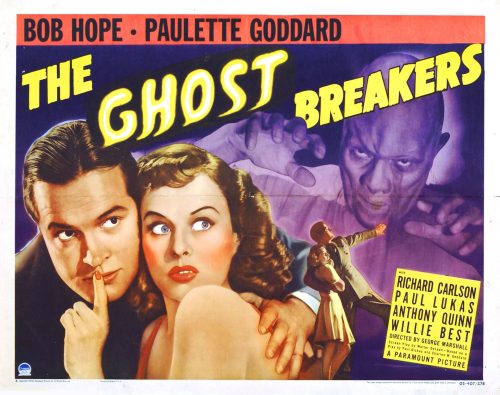
Romero’s film completely reset the template for how zombies were seen in films and fiction; it was a significant paradigm shift. Before Night of the Living Dead (in which the term “zombie” is never used), zombies in films were initially based on Haitian lore, relating to the Vodou (Voodoo) religion, often seen as literal slave labor on sugar plantations in the Carribean. Examples include the Bela Lugosi film, White Zombie (1932), and the sublime I Walked with a Zombie (1942), directed by Jacques Tourneur and produced by Val Lewton. Zombies figure in the Bob Hope comedy, Ghost Breakers (1940), and its Martin & Lewis remake, Scared Stiff (1953). There are many others.


 ___________________________________________________
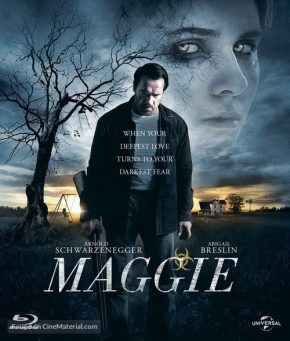
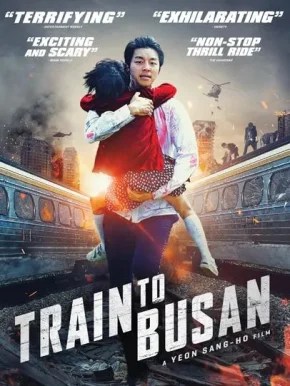
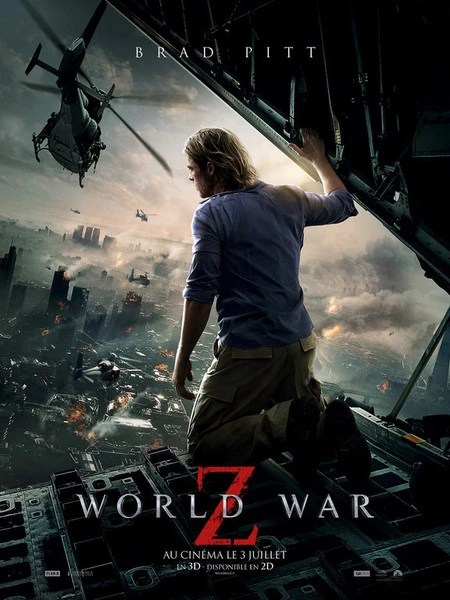
Made for $114,000 and reportedly grossing approximately $30 million, or over 263 times its budget, Night of the Living Dead is one of the most profitable independent films ever made. Some of that budget obviously went for the gallons of Bosco chocolate syrup that was used for blood, but the most significant thing about it is how it totally changed the game and didn’t look back. Romero zombies became the model. The Romero zombie was a cannibal, eating human flesh (in some later films, they were after brains; in others, they’d just kill you and move on). People killed by these zombies came back as zombies themselves. It would be difficult to overstate the influence Romero’s film has had on the zombie films, fiction, and television that followed. The Walking Dead would likely not have existed. Over the years since 1968, a flood of zombie movies has hit the screen with a splatter. Beginning with Dawn of the Dead in 1978), Romero has made five sequels to Night of the Living Dead. Eventually zombie films began evolving, with results such as Maggie (2015), where Arnold Schwarzenegger cares for his daughter Abigail Breslin, who has been bitten and is slowly becoming a zombie; the ferocious Train to Busan (2016); and the all-out zombie apocalypse of World War Z (2013).
 ________________________________________________
I was working at Technicolor in early 1979 when George Romero was in the lab Dawn of the Dead ready for its U.S. release. A version edited by director Dario Argento had already been released in Italy the previous September. The U.S. theatrical version, which Romero considered the definitive one, was released here in New York on April 20, 1979. I attended a pre-release screening during which audience members applauded and cheered the elaborate gore effects. One that sticks in my mind (so to speak) is when a helicoptor rotor blade neatly slices off the top of a guy’s skull. Crowd went wild, which felt a little weird. Have to admit, the poster has one of the greatest taglines ever: “When there’s no more room in Hell, the dead will walk the Earth.”
 ___________________________________________________

_____________________________________________________
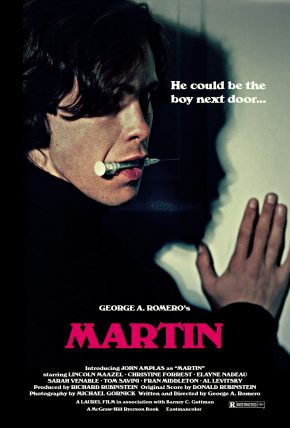
Before that I’d gone to a screening of two of Romero’s post-Night films, The Crazies (1973) and Martin (1977) in January ’79 at the Entermedia Theater on Second Avenue in the East Village (now a multiplex aptly named the Village East). Up to that point, I hadn’t had a chance to speak to Romero at Technicolor. I went up to him in the lobby after the screenings and introduced myself as working at Technicolor. I don’t remember what we talked about, though I’m sure I blathered on about his films and the horror genre in general. He gave me his address, and a short time later I sent him the following letter.
George Romeo
The Laurel Group
247 Fort Pitt Blvd.
Pittsburgh, Pennsylvania 15222
Mr. Romero:We met briefly during The Crazies screening at the Entermedia Theater last month. I currently work for Technicolor here in New York, across the hall, in fact, from Otto Paoloni and Joey Violante, so I’m familiar with your connection with the lab in preparing Dawn of the Dead for American release.
I also do free-lance writing on film, and am planning a piece on modern American horror films, which would concentrate on your work in particular. I was very impressed with your openness at the Entermedia screening, and by the fact that you’re extremely articulate about what you do. I’d like to meet with you, at your convenience, and talk more about your work and the genre in general.
In addition, I’m enclosing the premise for a film I’d like to do eventually. After seeing The Crazies, I realized that my idea has some obvious parallels to your film, which threw me off balance a little, since this is something I’ve been thinking about since 1973. Anyway, it seems like your sort of material, and I think I could learn from your reaction to it.
I hope we can set something up for the near future. It would be inconvenient, but not impossible, for me to come to Pittsburgh, though perhaps we could get together the next time you’re in New York.
By the way, I want to say that nothing prepared me for Martin. It’s quite an achievement. You’ve made the definitive vampire film for the Seventies, and you did it successfully without condescending to the genre, which I think is really something.
Thanks for your time. I hope to hear from you.
Sincerely,
Ted Hicks
(Address, etc.)
_____________________________________________________
Here’s the film premise I enclosed with that letter.
Notes for a film script:
A plague of laughing overtakes a town, spreads throughout the country, perhaps even the world. First signs are sporadic chuckling, then irregular barks of laughter, becoming increasingly violent, a steady escalation that finally brings death.
Genuine laughter would cease to exist. People would have to stifle a laugh for fear it would be taken as a sign of the disease. Real laughter would disappear, go underground, nothing could be directly funny anymore, even smiles would be suspect. The level of paranoia would rise and rise. And of course, there would be less and less to laugh at.
As a safety measure, comedy films, joke books, cartoons, the “funny papers,” anything with the slightest suggestion of humor is outlawed, confiscated and destroyed. Comics and comedy writers are out of work. A vast entertainment industry goes down the toilet.
Underground joke clubs are formed. Chaplin films are screened in secret.
Madmen begin telling jokes to promote laughter.
The President of the United States appears on television to inform the nation of the latest measures against the plague. Early in his address he begins to smile, then chuckle as though at some hidden, childish joke, and is dragged off camera by plague police as the screen goes black and a voice tells us there are technical problems.
There are many ways this could go, and while I haven’t yet worked on specific plot development, I think the possibilities are pretty much endless. I see it as basically a very black comedy. I’m not sure how I’d end it, but I think I’d want to leave people with at least a little hope. Because if you can’t laugh, you might as well commit suicide.
____________________________________________
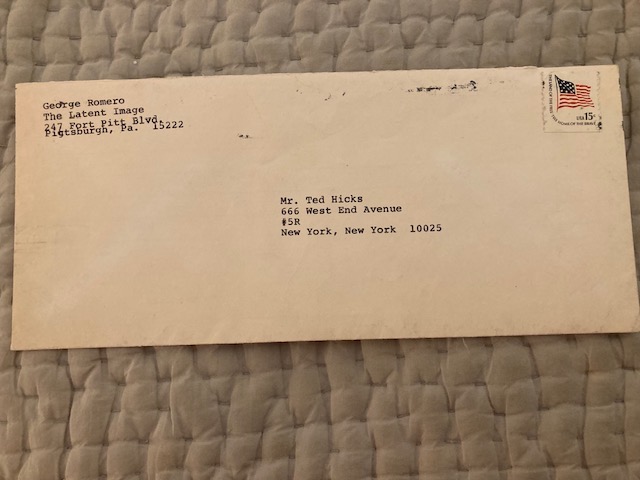
I was pretty jacked to get the following response from him. Note the 15 cent stamp on the envelope. Right, it was 44 years ago.

Ted,
Fantastic idea!
I love it – Really want to meet next time I’m in N.Y.
Please excuse the rough note –
Just writing between flights –
Expect to be in N.Y. starting March 7 to do final mix on DAWN at Trans Audio – probably be in the city for 3 weeks or so at that time and I’ll be in and out of the lab for the final printing etc.
Look forward to seeing you then.
Regards
George Romero
________________________________________________
It was definitely exciting to read his response. As it turned out, however, we never met when he was back in New York. I seem to remember there were some problems with the mix or something and he was busy dealing with that. I never made any real efforts to follow up later, though I wish I had. I saw him occasionally over the years at pre-release screenings of his films and at least once at the Museum of the Moving Image in Astoria, Queens. I was able to speak briefly with him there, but that ship had sailed, so to speak.
I’ve always valued the brief connection I had with George Romero. He was born in 1940 in the Bronx — a New Yorker! — and died on July 16, 2017 in Toronto at age 77. I’m glad we have his films. If a zombie apocalypse ever does come to pass, you can’t say we weren’t warned.

__________________________________________________
That’s it for this one. See you later. Meanwhile, sweet dreams. — Ted Hicks
_________________________________________________

 ______________________________________________

 Films etc.
Too bad your film never got made. It’s a great idea!
If somebody wants to do something with it, that’s fine with me as long as I get a story credit.
Awesome story Ted!!! I had no idea. How could you have let that one slip away. Where would you be today? (well, OK, LA!) Cheers Capn Blcklck
I think Night of the Living Dead is one of the best movies ever made. The story, the character development, the sub plots and the ending were great. I saw it the week after Filmore East closed. I was looking for a substitute for the rock concerts.