On Set, Off Camera Redux

This is a follow-up to “On Set, Off Camera,” posted on April 2, 2018, which can be accessed here. It mainly consisted of shots of actors caught in off-camera moments during the making of a movie. I’ve expanded the parameters to include directors as well as actors, sometimes off-set, at home and elsewhere. Some of these are candid and some are staged promotional photos. But I think they’re all interesting.

_______________________________________________
Charlton Heston as Moses on location for The Ten Commandments (1956).

____________________________________________

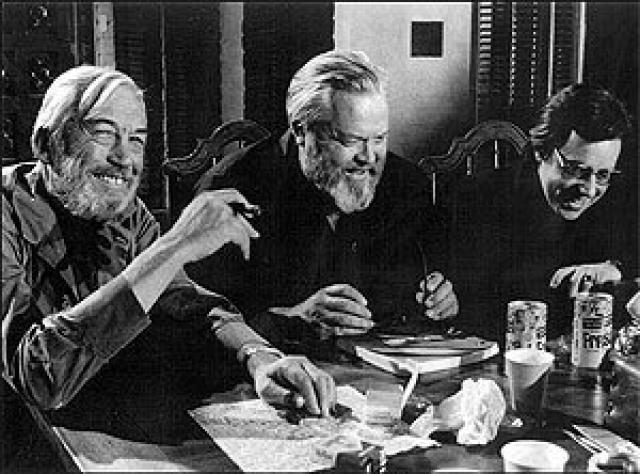
John Huston, Orson Welles, Peter Bogdanovich, maybe at lunch.

______________________________________________

Welles directing Too Much Johnson (1938).

__________________________________________________

Welles on Citizen Kane set, 1940.

____________________________________________

Welles and Charlie Chaplin. I wonder what two geniuses talk about. Probably everyday stuff.

________________________________________________
________________________________________________
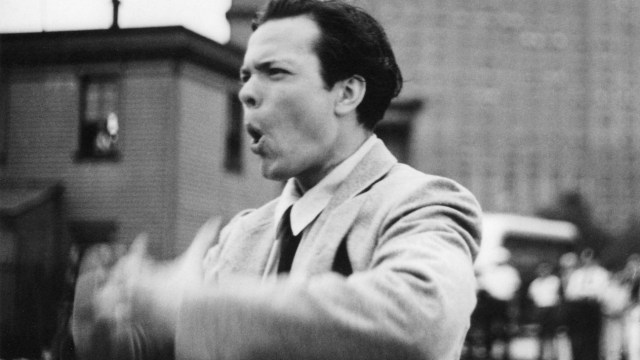
________________________________________________
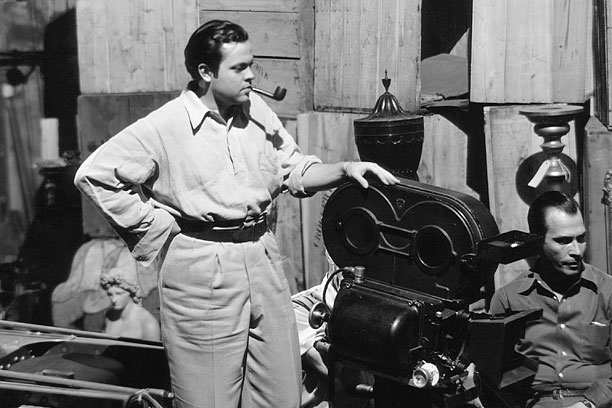
Lon Chaney Jr, Tor Johnson, and Bela Lugosi at lunch while shooting The Black Sleep in February, 1956. The film was released in June ’56. Lugosi died that August.

__________________________________________

Suzanne Pleshette and Rod Taylor on the set of Alfred Hitchcock’s The Birds (1963). Maybe a little bored sitting around, waiting.

______________________________________________

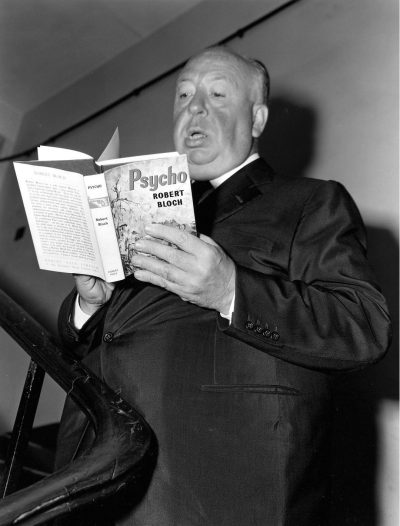
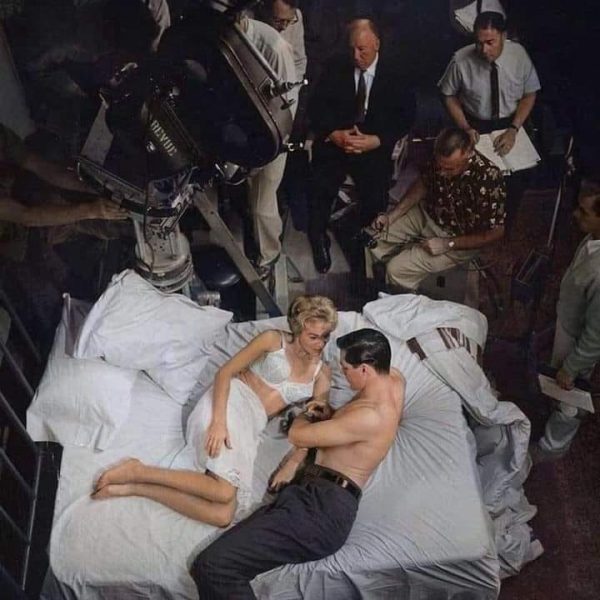
Psycho, 1960. Below this obviously posed shot of Hitchcock reading a copy of Robert Bloch’s novel is a shot on set with Hitchcock directing Janet Leigh and John Gavin in the first scene in the film.

______________________________________________

Steve McQueen visits Janet Leigh and Tony Perkins on the Psycho set.

__________________________________________

Leigh and Perkins, could they be any slimmer?

______________________________________

Martin Scorsese at left on the set of Taxi Driver (1976), and at right in his apartment with a stuffed bear as a seat cushion, overseen by Mick Jagger and Jimi Hendrix.

______________________________________

Scorsese and Robert De Niro while shooting Taxi Driver.

_________________________________________
Natalie Wood, James Dean, and director Nicholas Ray discussing Rebel Without a Cause (1955).

_________________________________________________
Clint Eastwood, Eli Wallach, and Lee Van Cleef at the location for the climactic shootout in The Good, the Bad and the Ugly (1966).

_____________________________________________

Tim Roth, Harvey Keitel, and Michael Madson take a break while shooting Quentin Tarantino’s Reservoir Dogs (1992).

___________________________________________________

Buster Keaton with Oliver Hardy and Stan Laurel.

_______________________________________
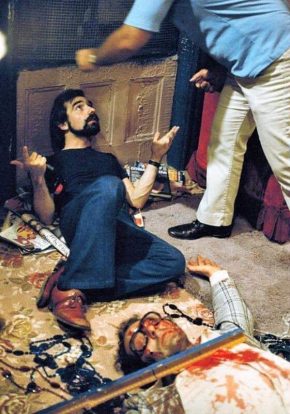
Harold Lloyd and Buster Keaton.

__________________________________________________

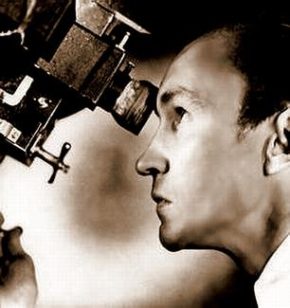
Karl Freund behind the camera on Fritz Lang’s Metropolis (1927)

________________________________________________
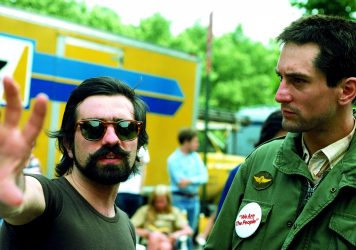
Karl Freund with Desi Arnaz and Lucille Ball on the set of I Love Lucy. Freund was director of photography for the show from 1951 to 1957

________________________________________________

Robert Ryan of the set of what’s probably a Western, though don’t know which one. Such a great actor. The Set-Up, Odds Against Tomorrow, On Dangerous Ground, The Wild Bunch, to name a few.

____________________________________________________

Ida Lupino directing.

________________________________________________

Jim Jarmusch and Iggy Pop at Cannes with Gimme Danger (2016), a documentary about Pop. Beneath that is an undated photo of a much younger, very intense Jarmusch.

______________________________________________
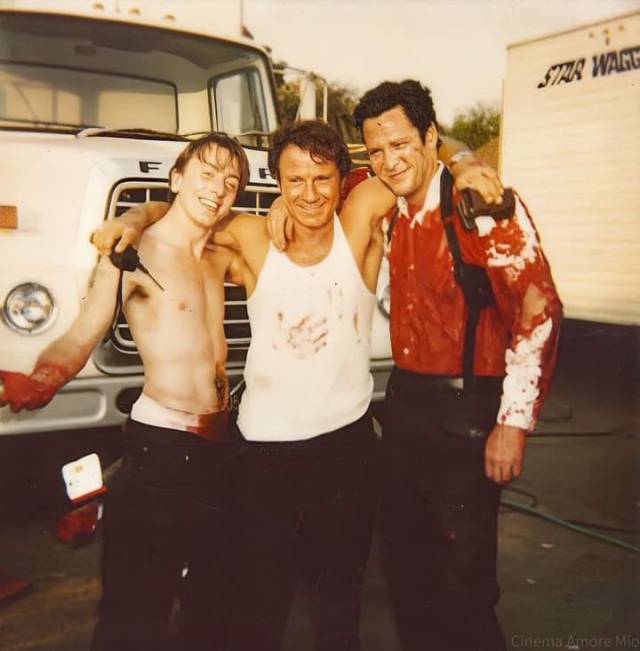
Make-up artist Jack Pierce turning Boris Karloff into the Frankenstein “Monster.”

_______________________________________________

Sean Connery with his son Jason.

___________________________________________________

Burt Lancaster at home, 1954.

_____________________________________________
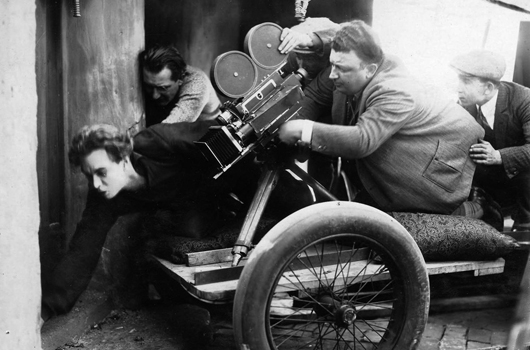
Cat casting call for The Black Cat episode of Roger Corman’s Poe film Tales of Terror (1962).

__________________________________________________

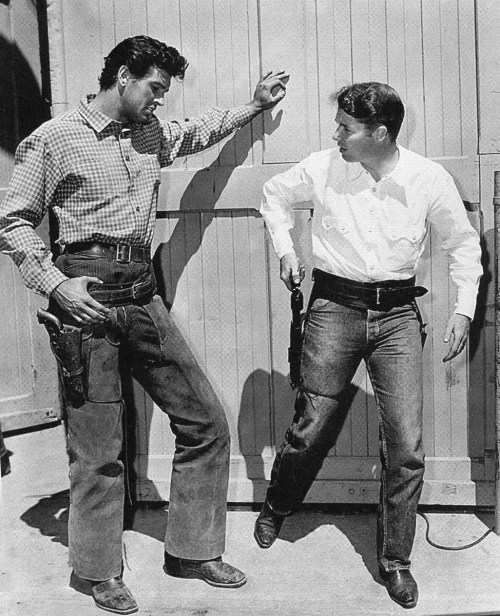
Rock Hudson getting a fast-draw lesson from Audie Murphy in 1952.

______________________________________________

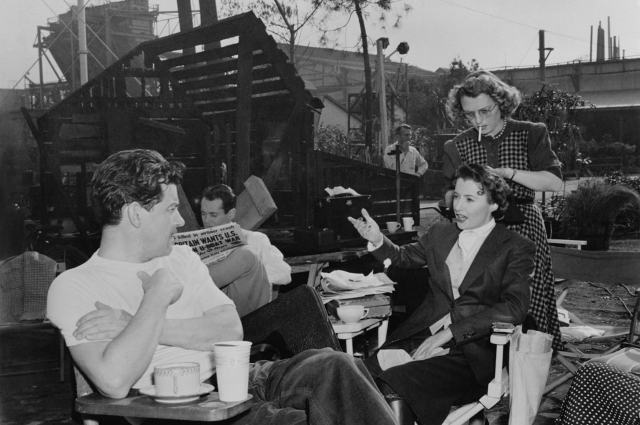
While shooting The Lady Eve (1941), Barbara Stanwyck with her favorite hairstylist Hollis Barnes, director Preston Sturges at left, Henry Fonda in background reading war news.

________________________________________________

Peter O’Toole, a long time ago.

____________________________________________

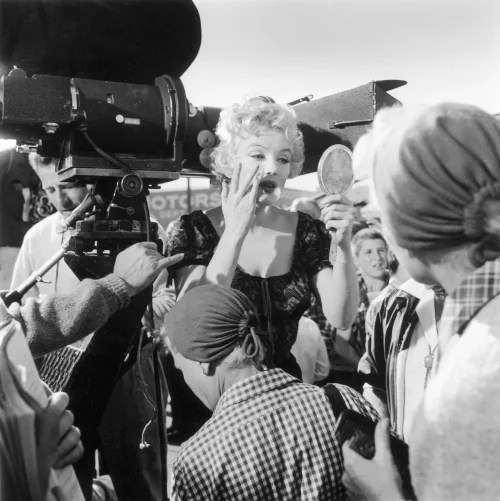
Marilyn Monroe getting camera ready.

____________________________________________

Well-known photo on the set of The Misfits (1961). Clockwise from Arthur Miller in back on ladder: Eli Wallach, director John Huston, Clark Gable, Marilyn Monroe, Montgomery Clift. Don’t know identity of the man at left standing under the ladder.

_______________________________________________

Lon Chaney with his make-up kit. Looks to be at the time of The Phantom of the Opera (1925).

_________________________________________

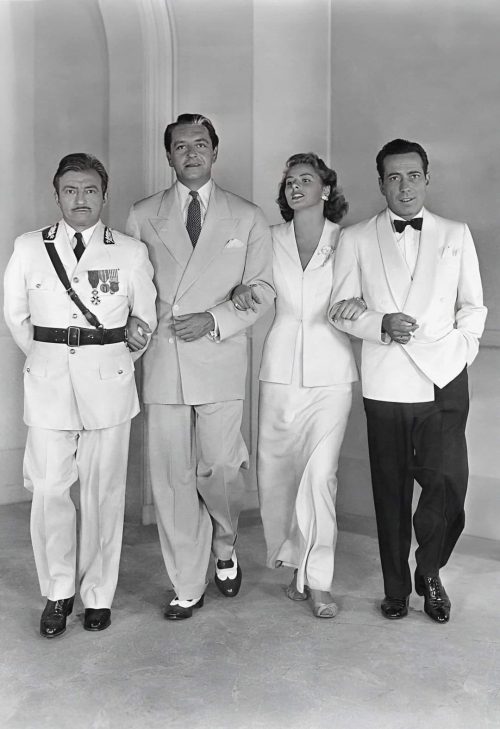
Cast photo in costume for Casablanca (1942).

_______________________________________________

This seemed very weird until I learned that it’s Humphrey Bogart’s daughter Leslie on the swing with him.

__________________________________________________

There’s something odd about this photo, or is it just me? Maybe it’s the shorts, maybe it’s the footwear, but this is not the John Wayne look we’re used to.

________________________________________________

Okay, that’s it for this one. See you next time. — Ted Hicks

_________________________________________________
Posted in Uncategorized | 7 Comments

Oppenheimer – Supplemental

For those who’d like to get into Oppenheimer a little more, here is a selection of interviews, articles, and behind-the-scenes videos. This is kind of cafeteria style, so just take what you want.

______________________________________________
Making of Oppenheimer (16:49)

__________________________________________

Cast interviews #1 (29:36)

_________________________________________________
Cast interviews #2 (29:07)

________________________________________________

New York Times interview with Christopher Nolan re the contradictions of J. Robert Oppenheimer can be accessed here.

_________________________________________________

Projecting 70mm IMAX film. (8:51)

_________________________________________________

Video interview with Ludwig Göransson (10:31)

_________________________________________________

A print interview with Ludwig Göransson can be accessed here.

Wikipedia entry on the soundtrack can be accessed here.

_________________________________________________

Full soundtrack (1:34:56)

________________________________________________

That’s all for now. See you next time. — Ted Hicks

_________________________________________________

__________________________________________________

Posted in Uncategorized | 2 Comments

Oppenheimer – Big Bang Theory

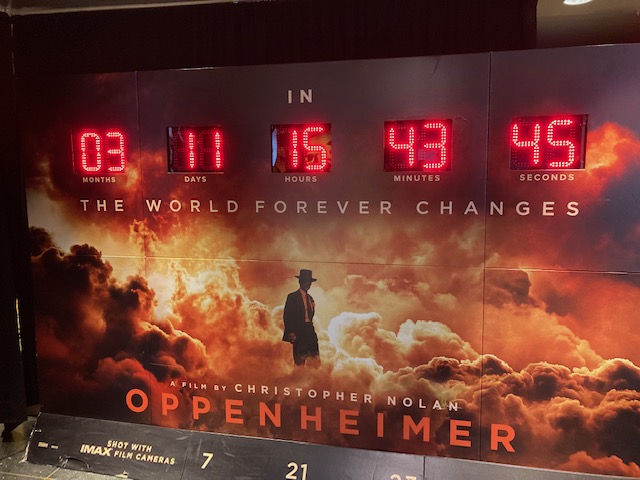
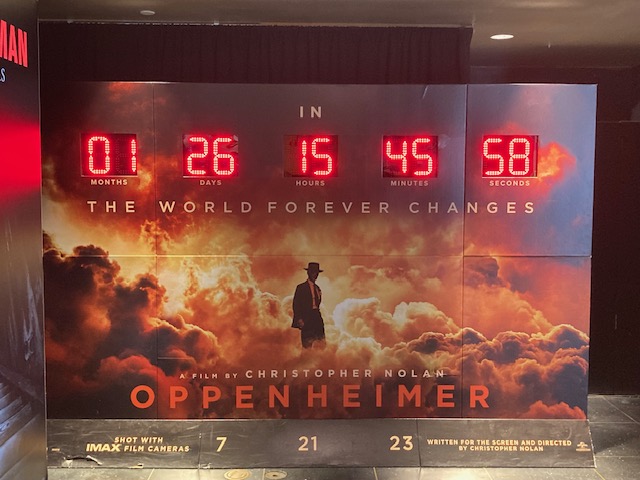
I’ve seen Oppenheimer twice now, but I suspect I’m not done with it yet, or it’s not done with me. Of all the films being released this year, this is the one I was anticipating the most. And with Universal’s extensive marketing campaign, I knew it was coming long before it got here. Going back months, a large stand-up advertisement with a digital clock counting down the months, days, hours, minutes, and seconds to the July 21 release date was in the lobby of the AMC Lincoln Square theater at 68th and Broadway here in Manhattan. This certainly created an “event” feeling. Every time you went through the lobby, you saw it.

_________________________________________________

Prior to this, I would have said Dunkirk (2017) was Christopher Nolan’s best film, but I think Oppenheimer is bigger, more important, and more of an achievement. I feel that he’s a director who has control over every aspect of what ends up on the screen. That’s especially true with Oppenheimer. I kept checking the AMC website on a daily basis, wanting to make sure I’d be able to order an IMAX ticket as soon as they went on sale. I was still a day or so late, but got a ticket on June 4, a full seven weeks before it opened. It’s a good thing I did, because a few weeks later, when my wife told me she was interested in seeing Oppenheimer, I checked for IMAX tickets and found that every show for weeks to come was basically sold out (and still is). We ended up seeing it in 70mm on another screen in that multiplex, but not IMAX. It was fine.

It turns out there are only 30 movie theaters in the world that are capable of projecting Oppenheimer in the full 70mm IMAX format, 19 of them in the United States, and one of those here in Manhattan. So I can feel like I belong to an exclusive club that gets to see this film in the optimal way Nolan intended, and the cachet that goes with that. Well, okay, but I’ve come to realize that any IMAX theater showing the film digitally would have the same screen ratio as in 70mm (at least I think so). But am I glad I saw it in this format? You bet I am. Though I know that’s also a status thing, and at the end of the day, so what?

Oppenheimer has so far grossed $188 million in the U.S. and $312 million overseas. Barbie, released the same day, has just surpassed $1 billion dollars globally. I suspect one reason both films are doing so well is because they aren’t sequels or superhero blowouts. They feel fresh and new, and aren’t tired retreads.


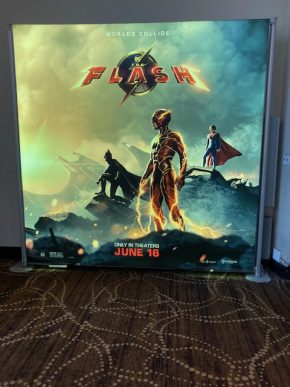
The Flash is (in my opinion) is a good example of everything that’s wrong with these Marvel/DC superhero spectaculars of late, i.e. bloated, incoherent, and meaningless. I should say that I’ve really liked the Nolan Batman films, Captain Marvel, Logan, the first Wonder Woman, and numerous others. My interest in The Flash was primarily Michael Keaton returning to his Batman role and hearing him say the line, “I’m Batman,” He provided the only spark, but it wasn’t enough. The gimmick of The Flash/Barry Allen going back in time to save his mother from being murdered and his father from being falsely convicted and going to prison for the crime has already been done in The Flash TV series and I think in the comics as well. I’d looked forward to seeing an 80-year-old Harrison Ford back in the saddle as Indiana Jones, but he seemed as tired as the idea of having Indy still fighting Nazis, plus I found Phoebe Waller-Bridge to be especially annoying. I was also looking forward to the new Mission Impossible film, having liked the last several, but other than several impressive set-pieces and Tom Cruise running, it really felt like been here-done that.

After that digression, I should also go on the record as liking Barbie a lot. When I first saw trailers, I had no intention of seeing it, but learning that Greta Gerwig was directing and co-writing (with Noah Baumbach), I got interested. Glad I did, because it’s sharp, edgy, and unexpected. There is some really weird stuff in Barbie.

______________________________________________

Back to Oppenheimer. It opens with these words on screen: “Prometheus stole fire from the gods and gave it to man. For this he was chained to a rock and tortured for eternity.” Whew! Tortured for eternity is pretty heavy duty. It does not bode well for J. Robert Oppenheimer. That feeling led me into the film.

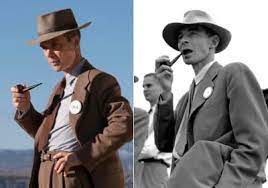
The performances are, without exception, outstanding. Everyone has brought their best, rising to the challenge of making this film. Cillian Murphy (below right) seems perfectly cast as Oppenheimer. His look is eerily evocative of the real Robert Oppenheimer. Murphy says that Nolan also sent him photos of David Bowie from the late 1970s as inspiration. More than that, he’s excellent in the role.

_______________________________________________
Matt Damon is great as General Leslie Groves, who picked Oppenheimer to head the Manhattan Project to develop the atomic bomb. He brings something extra to everything I’ve seen him in, from the Bourne films to Ford v Ferrari (2019) and Air earlier this year. He gets deep into every character he plays.

________________________________________________

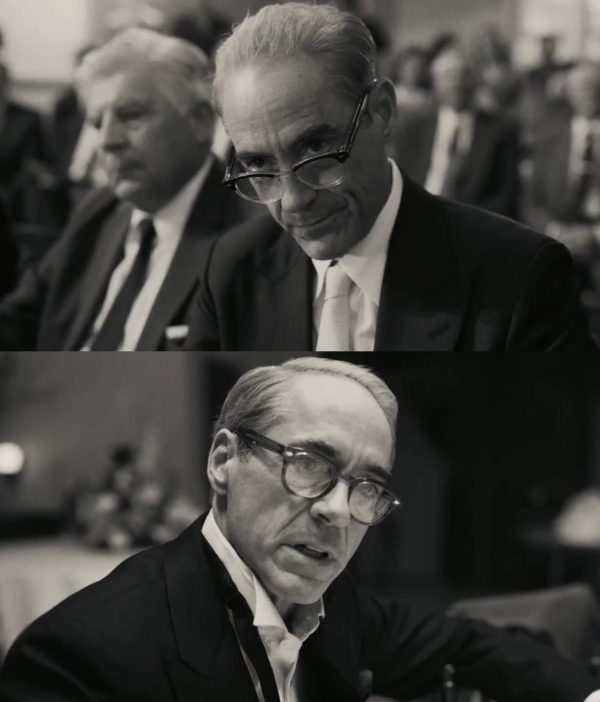
The most startling transformation in the film has to be Robert Downey Jr. as Oppenheimer’s eventual adversary, Lewis Strauss. His appearance makes him nearly unrecognizable and his performance is like nothing he’s done before. It’s blistering. He really inhabits the character, and dominates nearly every scene he’s in.

_________________________________________

Two key roles are played by Emily Blunt as Oppenheimer’s wife Kitty and Florence Pugh as Jean Tatlock, whose affair with Oppenheimer and her Communist Party connections cause serious problems for him later on. (Florence Pugh, left and Emily Blunt, right)

_________________________________________

Hoyte van Hoytema, a Dutch-Swedish cinematographer, had shot three previous films for Nolan: Interstellar (2014), Dunkirk (2017), and Tenet (2020), as well as Jordan Peele’s Nope (2022), Sam Mendes’ Spectre (2015), and Tomas Alfredson’s Let the Right One In (2008). As Bilge Ebiri wrote in New York Magazine, audiences aren’t used to the frame-filling close-ups of Cillian Murphy in IMAX, because the format wasn’t designed for that. Van Hoytema says, “You could never, ever put your camera as close as you wanted to your subject in order to get the close-up. So we started to build lenses that gave us that technical possibility to get much closer.” Many scenes in Oppenheimer are in black-and-white, for which Kodak created special stock for Imax.

___________________________________________

Hans Zimmer had scored seven films for Nolan prior to Tenet. When he was unavailable for that film, Nolan brought on Swedish film composer Ludwig Göransson, who has now created an amazing score for Oppenheimer. I don’t think I was as aware of just how important and integral his music was to the film until I saw it again. For one thing, there’s a lot of it — two and a half hours of the three hour running time. The music is as important as the actors, it’s like it is an actor. Nolan wanted the violin to form the basis of the score; violin is present throughout almost the entire film. A friend of mine in Minneapolis, Ed Hewitt, after seeing Oppenheimer there, texted me this: “It (the music) was there all the time, but it wasn’t there.” I like that. The music is practically wall-to-wall, but it’s never overwhelming, until it is.

The following selection of scenes, released by Universal a week before Oppenheimer opened, contains Göransson’s music.

______________________________________________

This cut, “Can You Hear the Music,” accompanies a scene early in the film when Niels Bohr (Kenneth Branagh) tells Oppenheimer that it’s more important to “hear the music” of theoretical physics instead of worrying about the math. This brief (1:50) piece has 21 tempo changes. I don’t know much about music, but I gather this is somewhat unusual. It took three days to record, and like the rest of the score, is pretty amazing.

_______________________________________________
I think this lengthy piece (7:52), “Trinity,” is the high point of the entire score. It accompanies the Trinity test itself, when the result of several years of planning and effort will be revealed. Will the “gadget” successfully detonate, will it be a dud, or will it detonate and set fire to earth’s atmosphere, destroying the world? This last was a theoretical possibility. The sequence is incredibly intense. Göransson’s music just keeps building and building and building, winding tighter and tighter. It actually makes me feel anxious just listening to it, even apart from the film.

____________________________________________
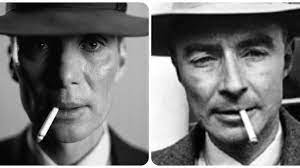
A scene I love is set at Los Alamos. For the first time, Oppenheimer is wearing an Army uniform. One of his colleagues, physicist Isidor Rabi (played by David Krumholtz), asks Oppenheimer why he’s wearing that and suggests he get rid of it. We cut to Oppenheimer standing in front of a mirror that’s part of his dresser. He’s now wearing a grey suit. He may also be holding his pipe; I can’t remember. On the dresser is what we’ve come to know as his trademark flat-brimmed hat, also gray. He picks up the hat and puts it on his head. For me this was a stunning moment that took my breath away. It’s like a superhero origin story, where we see Batman or Superman in his suit for the first time. So maybe Oppenheimer is a superhero movie after all.

______________________________________________

____________________________________________

“They won’t fear it until they understand it. And they won’t understand it until they’ve used it.” – Robert Oppenheimer

“It’s not a new weapon. It’s a new world.” – Niels Bohr (Kenneth Branagh) to Oppenheimer.

“Now I am become death, the destroyer of worlds.” – Hindu scripture that went through Oppenheimer’s mind on witnessing the first atomic bomb detonation.

_______________________________________________

Supplemental materials to follow shortly. Stay safe. — Ted Hicks

_______________________________________________
_______________________________________________
Posted in Uncategorized | 5 Comments

Double Indemnity & Billy Wilder – Supplemental

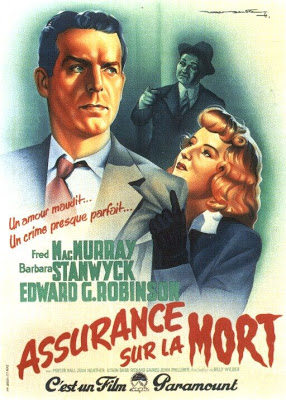
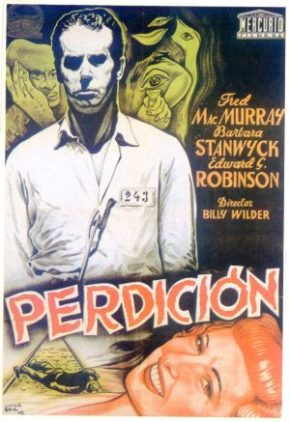
For a deeper dive, here are several interviews with Billy Wilder. He speaks vividly and with humor about writing and directing. He’s great to listen to. The interviews are followed by a selection of Double Indemnity posters, as well as an excellent video that examines Film Noir and this film in particular.

__________________________________________________
The Writer Speaks: Billy Wilder (Running time: 1:04:29)

______________________________________________
Portrait of a “60% Perfect Man”: Billy Wilder Interview – 1984 (58:13)

_________________________________________________

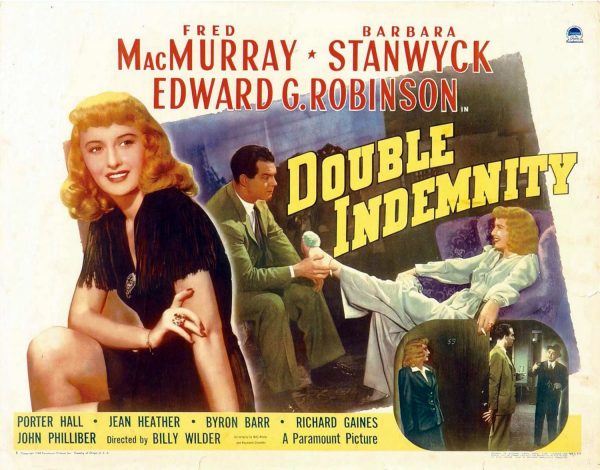
Oddly enough, this original poster for Double Indemnity makes it look like it might be a comedy.

____________________________________________
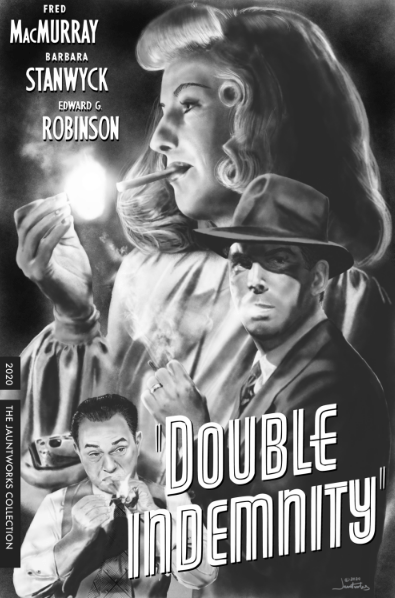
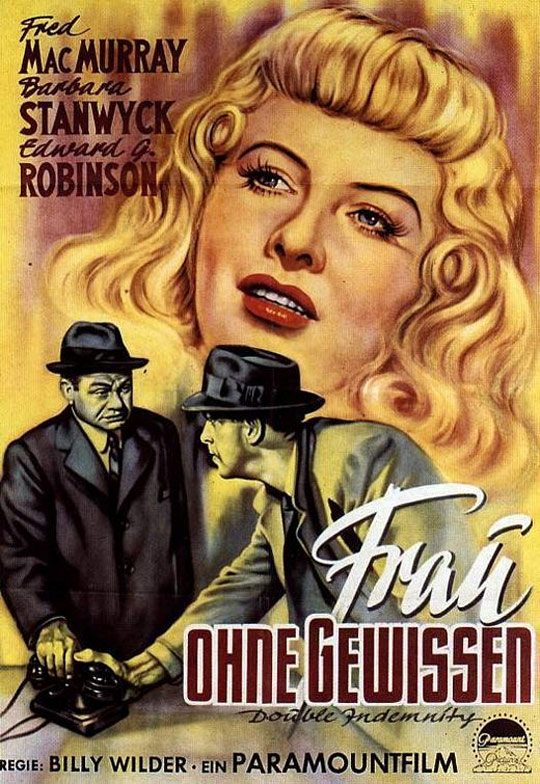
A beautiful German poster.

_________________________________________
French and Spanish posters.

___________________________________________

Here is an insightful breakdown of what identifies classic Film Noir, using Double Indemnity as a prime example. Once you get past a promo for MUBI at the start, it’s well worth watching. (14:55)

___________________________________________

That’s it for this one. See you next time. — Ted Hicks

____________________________________________

____________________________________________
Posted in Uncategorized | 2 Comments

Double Indemnity – “Straight Down the Line”

I saw this recently as part of Film Forum’s 3-week series of films written and directed by Billy Wilder (July 14 to August 3).  Double Indemnity (1944) is one of the greatest film noirs ever made. Though at the time, no one referred to the films that have come to be known as film noir by that name. The term was first coined by French critic Nino Frank in 1946 to describe certain Hollywood films. It wasn’t until the 1970s that the term became widely used in this country.

In the Spring 1972 issue of Film Comment, an important article by future film director Paul Schrader appeared titled “Notes on Film Noir.” It opens with this: “In 1946 French critics, seeing the American films they had missed during the war, noticed a new mood of cynicism, pessimism and darkness which had crept into American cinema. The darkening stain was most evident in routine crime thrillers, but was also apparent in prestigious melodramas.”

There’s still a debate about among film critics and historians as to whether film noir is a distinct genre or is it a filmmaking style? Whichever, I know it when I see it. And Double Indemnity is definitely it.

________________________________________________

The plot is Film Noir 101. Ordinary guy Walter Neff, an insurance salesman, meets bored housewife Phyllis Dietrichson. They conspire to kill her husband for the insurance money.  Phyllis is a scheming femme fatale. Walter is a wise-cracking cynic, but weak and out of his depth. Big surprise: it doesn’t work out. As Neff says in a Dictaphone confession to Barton Keyes, his friend and mentor and the company’s claims adjuster, “I killed him for money…and for a woman. And I didn’t get the money and I didn’t get the woman.” These words sum up how things work out  for most noir protagonists.

_______________________________________________

Barbara Stanwyck was Wilder’s first choice to play Phyllis Dietrichson. At the time, she was the highest-paid actress in Hollywood. Fred MacMurray, who was eventually signed to play Walter Neff, was the highest-paid actor in Hollywood in 1943. Wilder had trouble casting the Neff role. Reportedly, actors who turned it down included Alan Ladd, James Cagney, Spencer Tracy, Gregory Peck, and Frederic March. Per Wikipedia: “Wilder finally realized that the part should be played by someone who could not only be a cynic, but a nice guy as well. Fred MacMurray was accustomed to playing ‘happy-go-lucky good guys’ in light comedies, and when Wilder first approached him about the role, MacMurray said ‘You’re making the mistake of your life!’ MacMurray made a great heel and his performance demonstrated new breadths of his acting talent. ‘I never dreamed it would be the best picture I ever made,’ he said.”

Stanwyck, MacMurray, and Edward G. Robinson as Barton Keyes, the company’s claims adjuster and Neff’s friend and mentor, were at the top of their game in this film. Robinson is especially good. Watch him in this scene where he’s gone to Walter’s apartment to talk out his suspicions.

____________________________________________

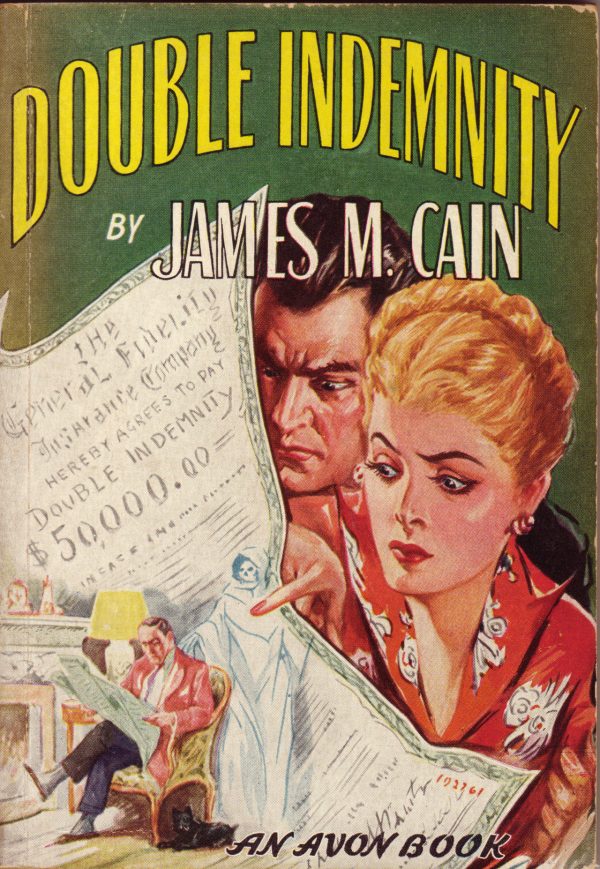
Double Indemnity was based on James M. Cain’s 1943 novel. Here are covers for some of the editions. I particularly like the first one.


Note that the cover at left replicates the following scene from the film.

_____________________________________________

Double Indemnity was scored by Miklós Rózsa, who had done the music for Wilder’s previous film, Five Graves to Cairo (1943). Wilder had liked his work and wanted to use him again. Rózsa went on to score a number of significant film noirs, including The Killers (1946), Brute Force (1947), The Naked City (1948), Criss Cross (1949), and The Asphalt Jungle (1950). He wrote music for many other films, such as Ben-Hur (1959) and El Cid (1961). His music for Double Indemnity is powerful and ominous. You can hear it accompanying this main title sequence, which leads into the first scene of Walter arriving at the insurance company building.

_______________________________________________

Double Indemnity was co-written by Wilder and Raymond Chandler. Chandler was a novelist new to Hollywood, but had already written The Big Sleep (1939), Farewell My Lovely (1940), and The Lady in the Lake (1943). They reportedly had a contentious relationship. Per Wikipedia: “To help guide him in writing a screenplay, Wilder gave Chandler a copy of his own screenplay for the 1941 Hold Back the Dawn to study. After the first weekend, Chandler presented 80 pages that Wilder characterized as useless camera instruction’; Wilder quickly put it aside and informed Chandler that they would be working together, slowly and meticulously. By all accounts, the pair did not get along during their four months together. At one point Chandler even quit, submitting a long list of grievances to Paramount as to why he could no longer work with Wilder. Wilder, however, stuck it out, admiring Chandler’s gift with words and knowing that his dialogue would translate very well to the screen.”

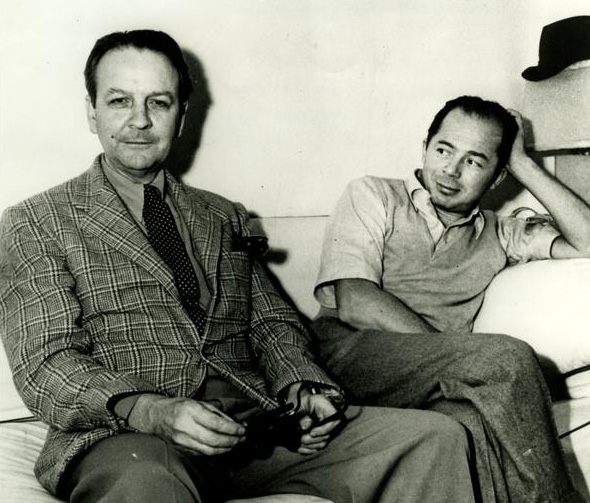
Raymond Chandler (at left) & Billy Wilder

There’s a very short scene early in the film where Chandler is seen sitting in a chair outside Keyes’ office as Walter leaves.  Apparently, very little film exists of Chandler in any capacity, so this is an interesting cameo.

________________________________________________

The original ending to Cain’s novel has Walter and Phyllis committing double suicide, one of the many aspects in the book forbidden at the time by the Motion Picture Production Code. Wilder wrote a different ending with Walter going to the gas chamber as Keyes watches. Per Wikipedia: “This scene was shot before the scenes that eventually became the film’s familiar ending, and once that final intimate exchange between Neff and Keyes revealed its power to Wilder, he began to wonder if the gas chamber ending was needed at all. ‘You couldn’t have a more meaningful scene between two men’, Wilder said. He later recounted: ‘The story was between the two guys. I knew it, even though I had already filmed the gas chamber scene … So we just took out the scene in the gas chamber,’ despite its $150,000 cost to the studio. Removal of the scene, over Chandler’s objection, removed Production Code head Joseph Breen’s single biggest remaining objection to the picture that regarded it as ‘unduly gruesome’ and predicted that it never would be approved by local and regional censor boards. The footage and sound elements are lost, but production stills of the scene still exist.” Below is one of the surviving stills of the discarded scene.

__________________________________________

Here is the scene Wilder opted to end with. It is intimate and powerful, with a great deal of feeling. When Keyes says, “Closer than that, Walter,” it’s very moving, a heartbreaking punch to the gut.

___________________________________________

Several times in the film, Walter and Phyllis state their commitment to each other and their plan to kill her husband by saying, “Straight down the line.” Of course, it turns out their line gets pretty crooked, not so straight. Here are two clips where we hear this. In the first, longer clip, the plan is hatched. (There’s a detail in this clip that I love. At the end, after Phyllis leaves Walter’s apartment, as he walks across the room he notices the corner of a rug flipped over. He pauses to flip it back with his foot. This is a totally ordinary, inconsequential detail, one that feels very real because of that.)

___________________________________________

Double Indemnity was nominated for seven Academy Awards in 1945, including one for cinematographer John Seitz, whose many credits, dating back to the silents, include The Lost Weekend (1945), Sunset Boulevard (1950), A Place in the Sun (1951), and Invaders from Mars (1953). His “venetian blind” lighting, with rays of light slashing through a room, creating angled bars of light and dark, became a standard look, and eventual cliché, for film noir and neo-noir.

________________________________________________
For my money, Double Indemnity is as close to perfect as you can get. It’s beautifully written, performed, and filmed. All the pieces matter, and all the pieces fit.

I think that about wraps it up. Stay safe. See you next time. – Ted Hicks

_________________________________________________

_______________________________________________
Posted in Uncategorized | 2 Comments

New York Stories – Four Great Films

___________________________________________

Last  week, from Sunday to Wednesday, I saw four movies at Film Forum in their ongoing program, “The City: Real and Imagined.” This series has over 60 films set in New York City and runs from May 12 to June 8. It was a deep pleasure to see four great films on four consecutive days. Here are my thoughts on those films.

____________________________________________

Easy Living (Mitchell Leisen, director. Preston Sturges, writer. 1937)  Of the four films, this is the only one I hadn’t seen before. I can blather on incessantly about film noir or classic horror movies, but I’m not as conversant when it comes to screwball comedies. I’ve seen It Happened One Night (1934), Bringing Up Baby (1938), The Lady Eve (1941), and Sullivan’s Travels (1941) among others, but I seldom seek them out. Interestingly, the last two were written and directed by Preston Sturges, who wrote Easy Living. Sturges throws a long shadow.

I hadn’t intended on seeing Easy Living. I was geared to see some of the more obvious titles, such as The French Connection and Serpico (and still will). But my wife was doing something with her sister that day, so I had a window, and this is what fit. As it turned out, I’m really glad I did. Easy Living is great! I loved it. Wall Street millionaire Edward Arnold throws his wife’s new sable fur coat out the window from their penthouse where it falls onto office clerk Jean Arthur, riding by in an open-air bus below. The writing is great, the plotting complex and head-spinning, the pace seldom lets up. As Samuel Wigley on the BFI website puts it, “…misunderstanding is piled on misunderstanding like an ever-more precarious house of cards.”

Here is a scene between Edward Arnold and a clueless Jean Arthur after he’s discovered that she has the sable coat.

_________________________________________________

Ray Milland, as Edward Arnold’s son, is trying to make it on his own. He’s working at an Automat, where a very hungry Jean Arthur shows up, hoping to have enough coins to buy some food. The sequence that ensues is, for me, a high point of the film as it turns into a hilarious food riot. Here’s the scene. It runs just over eight minutes and takes a little while for things to go crazy, but stay with it. Believe me, it’s worth it.

___________________________________________________
I hadn’t realized until after seeing Easy Living that Jean Arthur is in one of my all-time favorite films, George Stevens’ Shane (1953), a truly great movie.

________________________________________

The only source I can find for streaming Easy Living is on YouTube. This is the complete feature. The image quality is excellent, which surprised me a bit. Check it out when you’ve got the time. It runs just under 90 minutes.

________________________________________________
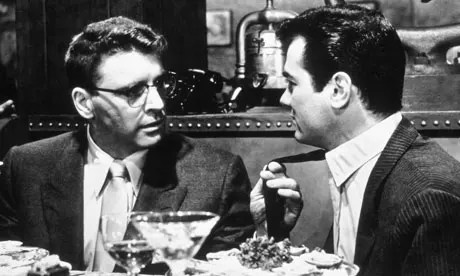
The Naked City (Jules Dassin, director, 1948)  Another great film by a great director. What stands out is that it was shot entirely on location in New York City, exteriors and interiors, all of it. This lends a documentary aspect, especially for the street scenes, which provides a look back at the city at that time. The significance of the location shooting in this film can’t be overestimated. As with the location work in Sweet Smell of Success, it lends a sense of reality that is felt as well as seen.

I’ve seen The Naked City numerous times, but this time it seemed even better to me than it had before. It all fits together, every element. This film is as nearly perfect as you’re likely to get. But I remember the first time I saw it, I didn’t like the voice-over narration by producer Mark Hellinger that opens the film and punctuates it throughout. His narration has a folksy, conversational style that seemed out of place for this film. Then I got used to it, and now it’s one more thing that sets this film apart. Here’s the opening, which will give you a sense of it.

______________________________________________

The Naked City is a police procedural that takes us step by step through the investigation of the murder that opens the film. Barry Fitzgerald plays Lt. Dan Muldoon, a homicide detective with something of a leprechaun in his manner, though he’s all business when he has to be, which is most of the time. His partner is Jimmy Halloran, a cop with far less experience, well played by Don Taylor. They make a good team. There’s humor in the film, along with a lot of pain.

_____________________________________________

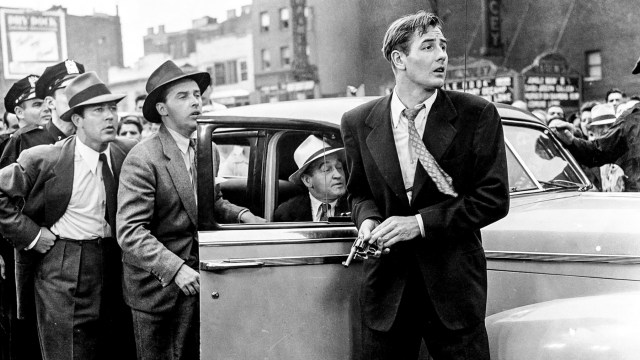
The shot below shows Don Taylor, with pistol, tie blowing, and Barry Fitzgerald in the passenger seat of the cop car. They’re in hot pursuit of the killer. The end is near.

________________________________________________

Below is a clip of the climax, a final foot chase and shootout on the Williamsburg Bridge. Mark Hellinger can be heard making very excited comments on the narration track.    **SPOILER ALERT** for anyone who hasn’t seen the film and doesn’t want to see the ending. It’s a knockout, but I understand.

_________________________________________________

The Naked City is available for streaming on Amazon Prime and Max (previously HBO Max).

Click here for an interview with Film Forum repertory programmer Bruce Goldstein on Jules Dassin and The Naked City. This is a deep dive, especially as concerns the location shooting.

___________________________________________________
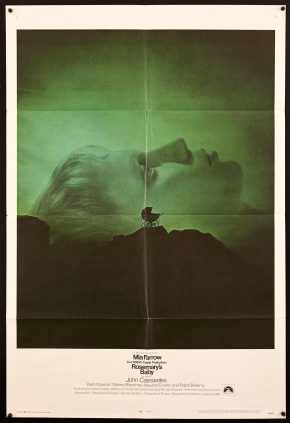
Rosemary’s Baby (Roman Polanski, director & writer, 1968)  I didn’t enjoy seeing Rosemary’s Baby last week in the same way I did the other three films in this post. I felt angry and irritated at how Mia Farrow’s character was being manipulated by those around her, that there was no way out for this woman as the film closed in around her. The only action left to her at the end is to rock the cradle holding Satan’s son. I’d seen it before, so I knew what was coming. I think my visceral response was a sign of the film’s effectiveness.

Film rights to Ira Levin’s novel were acquired by Robert Evans at Paramount even before the book was published in April 1967. Evans had read galley proofs and saw the commercial potential of a film version. Roman Polanski was hired to write as well as direct the film. They would work together again six years later with Chinatown, Polanski directing and Evans producing.

Exteriors for Rosemary’s Baby were shot in New York City, notably the iconic Dakota apartment on 72nd Street and Central Park West, which became the Bramford in the film. The bulk of principal photography was on sets in Los Angeles.

Rosemary’s Baby is a significant film. It’s part of our popular culture. For better or worse, it launched a wave of religion-based supernatural films such as The Exorcist (1973) and The Omen (1976). I doubt I’m the only one who remembers that great line of dialogue from The Exorcist: “Fuck me, I’m the Devil!” This is a bit of a digression, but the thing about all these films, including vampire movies (thanks to Bram Stoker), is that it’s a given that Christianity is the one true reality. This seems rather presumptuous to me. Just saying. But I’m always amused by the Jewish vampire in Polanski’s The Fearless Vampire Killers (1967) who’s unfazed by a cross.

______________________________________________
The cast is excellent. Prior to Rosemary’s Baby, Mia Farrow had only appeared in two feature films, though she had done a fair amount of television work, most significantly appearing in 263 episodes of the series, Peyton Place, so she wasn’t exactly unknown. She’s really the heart of Rosemary’s Baby. John Cassavetes, who plays Rosemary’s husband, Guy, always has a sinister look to me, which makes for effective casting in this case. This was Charles Grodin’s first feature, in a small part as Rosemary’s first doctor. Ruth Gordon received an Oscar for Best Supporting Actress as Minnie Castevet, Rosemary’s Satan-worshipping next-door neighbor. She’s a trip. Here’s a clip of her entrance in the film.

________________________________________________
I hadn’t seen this poster before. It’s an interesting, though not very subtle, variation on the more well-known poster design (seen at the top of this post).


________________________________________________
Main title sequence.

Rosemary’s Baby is available for streaming on Amazon Prime.

________________________________________________
Sweet Smell of Success (Alexander Mackendrick, director/co-writer; Ernest Lehman & Clifford Odets, co-writers, 1957)  Despite making Time magazine’s and the New York Harald Tribune’s 10-best list for 1957, Sweet Smell of Success was a commercial flop on its initial release. Per Sam Kashner in a piece on the film in the April 2000 Vanity Fair, the movie was just too cynical for the times. A film executive said it seemed to have been made “almost in defiance of the box-office.” We all know better now.  This is one of those films, like Kubrick’s Barry Lyndon (1975), that has only grown over time.

It is indeed cynical. There’s no one to like, really, excepting the Susan Harrison, Barbara Nichols, and Jeff Donnell characters, and even then it’s more like you just feel sorry for them. The two main characters are not very nice, to put it mildly. Burt Lancaster plays J. J. Hunsecker, a powerful newspaper columnist who inspires fear in most everyone around him. It’s a tightly controlled performance that radiates malevolence. Elmer Bernstein, the film’s composer, said this about Lancaster: “Burt was really scary. He was a dangerous guy. He had a short fuse. He was very physical. You thought you might get punched out.” Accurate or not, this quality certainly informs his performance.

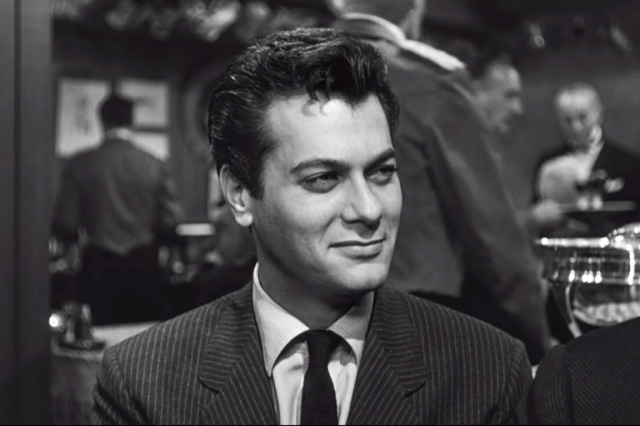
Tony Curtis plays Sidney Falco, a press agent and weaselly suck-up who won’t do anything without first calculating what’s in it for him. His charm and charisma somewhat mitigate the fact that he’s a real louse. Sidney’s livelihood depends on having items about his clients appear in the city’s newspaper columns. The most important of these is J. J. Hunsecker’s. Sidney is a constant supplicant at the table in “21” from which J. J. dispenses insults and sometimes favors. No humiliation seems too great for Sidney to endure. Curtis is really great in this film. His performance here proved he could act beyond his looks.

_________________________________________________

Sweet Smell of Success was shot by James Wong Howe, a terrific cinematographer whose many credits, which go back to silent films, include The Thin Man (1934), Hud (1963), and Hombre (1967). Sweet Smell takes place almost entirely at night. His crisp black & white photography shows a noirish view of New York City, streets wet with rain, reflections and shadows. Sam Kashner in Vanity Fair writes that it would have been impossible to get the sort of shots Howe wanted filming inside the “21” club, so interiors were filmed in Hollywood — they spent $25,000 just recreating “21,” with movable “wild walls” to make way for Howe’s camera. He smeared the walls with oil so they would gleam. (I love this detail.)

________________________________________________

One of the greatest things about this film for me is the music by  Elmer Bernstein. Though his iconic score for The Magnificent Seven (1960) is probably the one most people know, just a few of his previous scores include The Ten Commandments (1956), The Man with the Golden Arm (1955), To Kill a Mockingbird (1962), and The Great Escape (1963). His work here is the epitome of big city noir. Check it out in this clip.

_________________________________________________

The dialogue is blistering. I think a lot of this had to do with Clifford Odets’ contribution. He came on after Ernest Lehman had left the picture. When director Alexander Mackendrick expressed concern about the dialogue, Odets says he told him, “You’re probably worried that the dialogue is exaggerated and may sound implausible. Don’t be. Play it real fast — and play the scenes not for the words but for the situation. Play them ‘on the run’ and they’ll work just fine.” That they did.

Sweet Smell of Success didn’t have a final script when they started shooting. Odets was working under great pressure, grinding out scenes at the last minute so they could be shot. Odets was put with his typewriter in a prop truck on the set to work. At about three or four one morning (lots of night shoots), Tony Curtis joined him in the truck. Odets suddenly looked up and said, “Come here, kid, I want to show you something. Look at what I’m writing.” Per Curtis: “I see he’s just typed out, ‘The cat’s in the bag, and the bag’s in the river.’ It took my breath away.” This is my favorite line in the film.

______________________________________________

Sweet Smell of Success is available for streaming on Amazon Prime.

_________________________________________________

That’s all for now. See you next time. Stay safe. — Ted Hicks

__________________________________________________

Posted in Uncategorized | 1 Comment

“Invaders from Mars” – Dreams & Fears

_____________________________________________

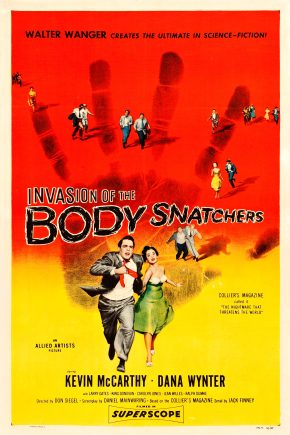
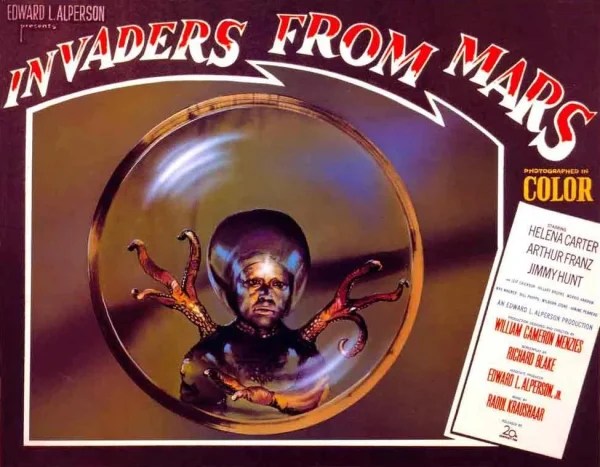
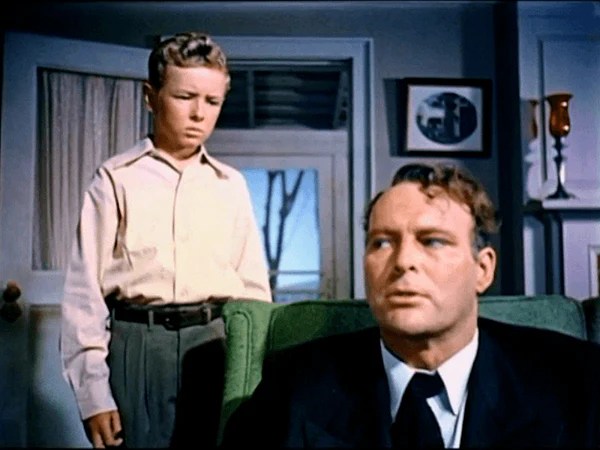
I was 8 years old when I first saw Invaders from Mars (1953), about the same age as the protagonist, David Maclean (Jimmy Hunt), a young boy who sees a flying saucer land in a sand pit behind his house and burrow into the ground. Martians begin taking over the local human population via implants in the back of the neck. David’s parents (Lief Erickson & Hillary Brooke) are among the victims. He’s the only one who has a sense of what’s going on, but who’s going to believe him? He’s just a kid. Eventually two scientists (Arthur Franz & Helena Carter), rather improbably do believe him and somehow, equally improbably, manage to mobilize the army to thwart the Martians. I’ve seen Invaders from Mars a number of times over the years. I have a great deal of nostalgic affection for the film, though it’s pretty weak in a lot of areas. But what still works is what worked then — having David’s parents, previously loving and supportive, become something “other.” The film exploits a fear that your parents, the police, and adults in general, are not who you thought they were. This had a lot of impact on kids of that age.  Invasion of the Body Snatchers would explore the theme of being taken over much more powerfully in 1956. But until then, this one did the job.

Invaders from Mars isn’t in the same league as ‘50s films such as The Day the Earth Stood Still (1951), The Thing from Another World (1951), The Incredible Shrinking Man (1957), Them (1954), and The War of the Worlds (1953). But at the time it probably engaged me more directly in a personal way because of my identification with David. I’m not alone in that. In a piece on the film in the Den of Geek website, Don Kaye reports that Steven Spielberg has said of Invaders from Mars that “It really turned my world around…It certainly touched a nerve in all the kids like myself who saw the film at a very young age.” He went back to the theater four more times to see it.

Per Joe Dante, director of The Howling (1981) and Gremlins (1984), “Invaders from Mars is a very Lewis Carroll, child’s eye view of a science fiction story.” John Landis, director of An American Werewolf in London (1981), says “My great affection for Invaders from Mars is partially because I saw it at the right age and was very frightened by it.” It’s an important film for the Famous Monsters of Filmland generation.

___________________________________________________

While it frequently has the look of a low-budget film, particularly in its extensive use of military stock footage to pad the running time, the filmmakers involved have a long list of impressive credits.

Invaders from Mars was directed by William Cameron Menzies (1896-1957). He began working on feature films in 1917. His work covered five decades. While he directed a number of films later in his career, he is best known as a production designer, a job title either invented by him or created for him, depending on your source. In 1936, he designed and directed Things to Come, notable for its futuristic sets. In 1939, he was production designer for Gone with the Wind, as well as directing the burning of Atlanta sequence. He received a special Academy Award for his work on that film. The last film he worked on was Around the World in 80 Days (1956). He died the following year at age 60.


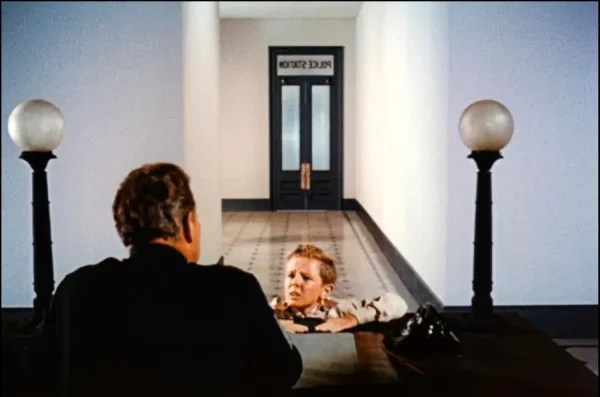
Per Don Kaye, Menzies’ work on Invaders from Mars included “…designing the sets so that they looked overly large and somewhat distorted—the way a child might view them from a much lower vantage point. The best example of this is the police station, which consists of an unusually tall desk situated at the end of a long, white hallway. The walls are stark, unadorned, and higher than normal, adding to the sense of dislocation that little David feels as he approaches the desk (Menzies also used a lot of low camera angles, again to replicate the POV of a child). Other sets fashioned in this way were the inside of the alien spacecraft and the observatory where David meets with Dr. Blake and Dr. Kelston (the scientists who believe him). Of course some of the minimalism of the sets (along with the obvious stock footage of army units on the move) was due to the tight budget, but they added to the surreal nature of the film.

Here is a shot set in the police station.

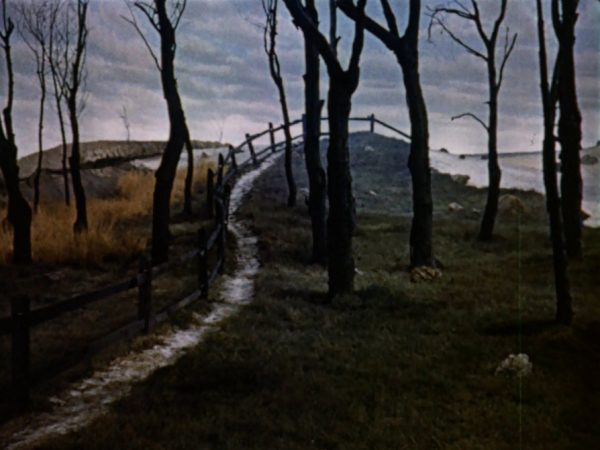
Below is a shot of the hill behind David’s home, a surreal set with its twisting fence, tortured trees, and winding pathway like something out of Grimm’s fairy tales or Fantasia.

_______________________________________________

Invaders from Mars was shot by John F. Seitz (1892-1979), a cinematographer I was unaware of by name, but I certainly knew his work. He began as a lab technician in 1909. By 1916 he’d become a lead cameraman, a few years later shooting the Rudolph Valentino film, The Four Horsemen of the Apocalypse (1921). Some of his many credits include Sullivan’s Travels (1941), Double Indemnity (1944), The Lost Weekend (1945), Sunset Boulevard (1950), and A Place in the Sun (1951). He was nominated for seven Academy Awards, which includes four nominations for films he shot for Billy Wilder. He died in 1979 at age 86.

___________________________________________________

Lief Erickson, as David’s father George Maclean, is a scientist working on a hush hush project to develop an atomic rocket. The Martians are here to destroy it. He’s introduced as a loving father who shares his son’s interest in astronomy. The most disturbing scene is when, after being taken over by the Martians, he gets angry at something David says and  backhands him across the face, knocking David to the floor. It’s frightening because it’s a very real moment in an otherwise fantastic narrative. A short clip of this scene can be seen in the two trailers further down.

_________________________________________

As far as I know, this was one of the first films to have a theme of people being taken over, or replaced. The name for believing this is happening is Capgras Syndrome, a.k.a. Imposter Syndrome, described as an irrational belief that someone you know has been replaced by an imposter. Though in case of Invaders from Mars and other films that utilized this theme, the belief is not irrational at all.

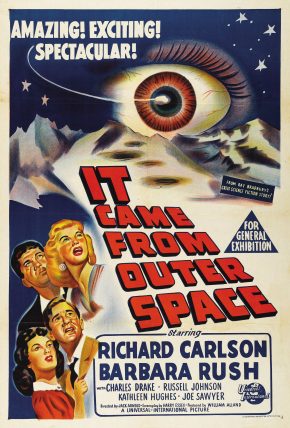
In It Came from Outer Space, also released in 1953, aliens have not come to invade. They’ve crashed on earth by mistake and mean no harm to humans. Because they know their real appearance would be too horrible for us to accept, they take the shape of people they encounter so they can walk among us while working to repair their ship. They just want to get the hell out of here. It’s not as paranoid as the original Invasion of the Body Snatchers, a truly great film, would be in 1956, but it’s unusually thoughtful for the genre at that time.

More recently, an Austrian film, Goodnight Mommy (2014), went deeper into the notion of replacement. Per a description from IMDb: “In a lonesome house in the countryside between woods and cornfields live nine-year-old twin brothers who are waiting for their mother in the heat of summer. When she comes home, her head completely wrapped in bandages after cosmetic surgery, nothing is like before. The children start to doubt that this woman is actually their mother.” This is an extremely creepy film.

________________________________________________

I most recently saw Invaders from Mars at Film Forum last month as part of their weekly Film Forum Jr. program. This is a Sunday morning series showing films that are not kids films per se. The intention is to make classic films of all types available to audiences of all ages. This was a 4K restoration done by Ignite Films. The original release trailer is below, followed by the restoration trailer. The difference in image quality is quite stunning. I think the second trailer gives a better sense of the film.

__________________________________________________

At the end of Invaders from Mars, David wakes up in his bed at home, relieved to realize  it’s all apparently been a bad dream. But maybe not, because then through the window he sees a space ship coming down behind their house as before, and it all begins again. Someone at IMBd calls this “…that wonderful ending when it seems that the nightmare will never end.”

At the Film Forum screening, I was sitting in front of a father and his son, who looked about the same age as I was when I first saw Invaders from Mars. When it was over, the father asked the boy how he’d liked it, who replied, “It was great! I loved it.” I got a kick out of that. Seventy years later, and it still works.

_________________________________________________

Supplemental

Some interesting connections in the cast.

Jimmy Hunt, who plays David, was 12 or 13 when Invaders from Mars was made, though he appears younger in the film. Born in 1939, he’d been appearing in features since 1947. He was in two more films after Invaders from Mars, then took a break from 1954 until 1986, when he played the sheriff in Tobe Hooper’s inferior remake of the film.

Leif Erickson, who plays David’s father George, was the patriarch of a ranching family on the Bonanza clone, High Chaparral, appearing in 97 episodes from 1967 to 1971. He also appeared in the Marlon Brando film, On the Waterfront (1954).

Arthur Franz, who plays Dr. Kelston, the scientist who believes David’s UFO story, was in the John Wayne movie, Sands of Iwo Jima (1949), The Caine Mutiny (1954), and Jack Arnold’s Monster on the Campus (1958).

Morris Ankrum, who plays Col. Fielding, was a judge in 22 episodes of Perry Mason from 1957 to 1964. He played another military character in Earth vs. the Flying Saucers (1956).

Milburn Stone, who plays Capt.Roth, appeared as Doc Adams in an astonishing 605 episodes of Gunsmoke from 1955 to 1975.

Barbara Billingsley (uncredited) as Dr, Kelston’s secretary, played the awesome June Cleaver on 235 episodes of Leave It to Beaver from 1957 to 1963.

Robert Shayne (uncredited) as a scientist working on the rocket project the Martians want to derail. He appeared as Inspector Henderson in 90 episodes of The Adventures of Superman from 1952 to 1958.

____________________________________________________

Here are deep dives into Invaders from Mars and its production.

Invaders from Mars: The Sci-Fi Classic that Inspired the Spielberg Generation by Don Kaye  

Invaders from Mars – article by Jann Wass

_____________________________________________________

That about wraps it up. See you next time. Until then, “Keep watching the skies.” — Ted Hicks

_____________________________________________________

_____________________________________________________

Posted in Uncategorized | 6 Comments

Best Documentaries 2022 – Supplemental

_____________________________________________

All That Breathes

New York Film Festival Q&A with Shauak Sen (21:22)

Doc NYC interview with Shaunak Sen (13:57)

_____________________________________________

All the Beauty and the Bloodshed

New York Film Festival Q&A with Laura Poitras & Nan Goldin (38:27)

______________________________________________

The Automat

Lisa Hurwitz interviewed at 2021 Hamptons Film Festival (17:15)

______________________________________________

Hallelujah: Leonard Cohen, a Journey, a Song

California Film Institute interview with Dayna Goldfine & Dan Geller (27:11)

______________________________________________

Los Angeles Plays Itself

Variety review by Scott Foundas, 2013 may be accessed here.

______________________________________________

Moonage Daydream

Brett Morgan interview (18:52)

_______________________________________________

Personality Crisis: One Night Only

New York Film Festival Q&A with David Johansen, Martin Scorsese & others (25:10)

_______________________________________________

“Sr.”

New York Film Festival Q&A with Chris Smith, Robert Dowey Jr. & others (18:22)

________________________________________________

Tales of the Purple House

Film Comment print interview with Abbas Fahdel may be accessed here.

________________________________________________

Turn Evry Page: The Adventures of Robert Caro and Robert Gottlieb

NYPL interview with Robert Caro, Robert Gottlieb & Lizzie Gottlieb (52:19)

________________________________________________

¡Viva Maestro!

Landmark Theaters interview with Gustavo Dudamel & Ted Braun (26:43)

________________________________________________

Okay, that’s it for these 2022 wrap-ups. Next up may or may not be my much delayed, much procrastinated, post on Bela Lugosi. Until then, stay safe. — Ted Hicks

________________________________________________

Posted in Uncategorized | 3 Comments

What I Saw Last Year – Best Documentaries 2022

All That Breathes (Shaunak Sen)  Powerful film concerning Nadeem Shehzad and Mohammad Saud, two brothers in New Delhi who run a clinic that treats black kite birds that frequently fall from the sky because of pollution and other environmental issues. They’ve treated 20,000 black kites during the last 20 years. Daniel Fienberg of The Hollywood Reporter wrote that the film “encapsulated a vision of New Delhi in which modern life, particularly pollution and overpopulation, have placed new strain on the balance between humans and nature.” Per director Shaunak Sen: “I am drawn by the subject of the interconnectedness of an ecosystem — one that humans are a part of, not apart from. How man, animals share space and become part of the whole.” All That Breathes is beautifully shot and edited, and deeply moving.

Available for streaming on HBO Max.

____________________________________________________

All the Beauty and the Bloodshed (Laura Poitras, director)  Nan Goldin is a photographer and activist. This excellent documentary covers her largely successful efforts to get museums, art galleries, universities, and other cultural institutions to refuse philanthropic donations from the Sackler family because of their connection to OxyContin and the opioid addiction crisis. The film spends a lot of time on Goldin’s life and career, so that by the time she begins her mission against the Sacklers, we have a good sense of who she is. Opioid addiction is still very much an issue, so the film is very relevant.

Not yet available for streaming.

____________________________________________________

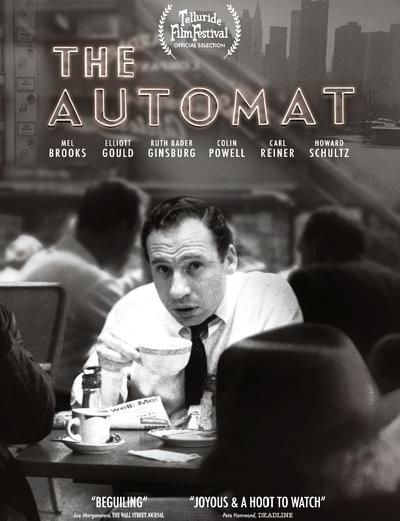
The Automat (Lisa Hurwitz, director)  Immensely entertaining history of the chain of Horn & Hardart Automats, vending machine restaurants that were located in Philadelphia and New York City from 1902 to 1991. I remember there was one on 42nd Street, maybe the last in Manhattan, though I don’t think I ever ate there. Too bad. Lisa Hurwitz had the great luck to involve Mel Brooks in the film. He jumped in with both feet and a lot of enthusiasm. The Automat is punctuated with lively testimonials from Brooks, Carl Reiner, Ruth Bader Ginsberg, Colin Powell, Elliott Gould, and others. It’s very well made and a lot of fun.

Available for streaming on HBO Max.

________________________________________________________

Hallelujah: Leonard Cohen, a Journey, a Song (Dayna Goldfine & Dan Geller, directors)  Who doesn’t love Leonard Cohen and this song? I was hooked from the first minute to the last. This film is full of feeling. Hard to resist, though why would you want to?

Available for streaming on Amazon Prime.

________________________________________________________

Los Angeles Plays Itself (Thom Andersen, director) 2003. Remastered.  I first saw this astonishing film in 2004 at Film Forum. Comprised of hundreds of film clips — either over 100 or over 200, depending on your source, in any event, a lot — that show how Los Angeles has been represented or misrepresented in feature films over the years. It’s a nearly three-hour feast for film buffs, of which I’m a proud member, and a fascinating, idiosyncratic history. Though for years, due to the overwhelming prospect of trying to clear the rights for all those clips, it could only be seen at museum showings and the like. In 2014, lawyers advised that the rights issue was not really an issue because of the fair use doctrine. A home video release followed. So why is it in this listing of best documentaries of 2022? Because I finally saw it again last July when it returned to New York City, this time at the IFC Center. I think it’s an important film and wanted to include it here.

Available for streaming on MUBI and YouTube.

_________________________________________________________

Moonage Daydream (Brett Morgan, director)  Edited comments from my previous blog post on this film:

“Calling Moonage Daydream a documentary doesn’t begin to cover it. I saw the film on opening day on an IMAX screen and was properly overwhelmed. Directed by Brett Morgan, the film is a dense overload of overlapping sound and image. It seldom slows down to let you catch your breath. It was hard at times for me to keep up with, to keep everything sorted. Finally I just gave up and let the film rush over me. Moonage Daydream takes us into Bowie’s life and work in a way that seems to randomly ricochet from one point to another, like a pinball game. It can feel chaotic, but I don’t think it’s random at all. This is far from a traditional movie biography As someone said, it’s not about facts and stats. There’s no narration, no on-screen titles or talking-head interviews to guide us. We hear Bowie in voice-over and clips from various interview shows over the years. He tells his own story. There’s a loose progression from the early years to the later, but it’s not strictly chronological. David Bowie was continually changing his appearance, persona, and musical styles. He’s been frquently called a chameleon. Moonage Daydream shows us Bowie as a writer, artist (painting and sculpture), actor, and most importantly, as a musician. There’s always been something otherworldly about Bowie, as though he was just visiting. That’s what made him perfect casting for The Man Who Fell to Earth (1976), in which  he was literally an alien from outer space.”

Available for streaming on Amazon Prime.

______________________________________________________

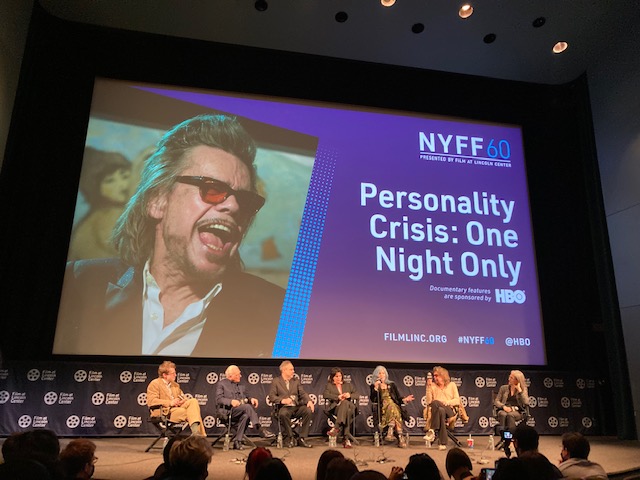
Personality Crisis: One Night Only (Martin Scorsese & David Tedeschi, directors)  I love David Johansen and saw him many times after moving here in 1977, usually at The Bottom Line. I was really looking forward to this film, which we saw at the New York Film Festival last October. We stayed for the Q&A after. You can see from the photo that it was quite an ensemble. Moderator Dan Sullivan opened by saying, “I can’t believe I’m on stage with David Johansen.” I find it amusing that he could say this while sitting directly next to Martin Scorsese. Pretty funny. The film is great. Performance and interview clips from Johansen’s career are interspersed with footage shot over two nights during his shows at the Cafe Carlyle in Manhattan. Johansen is quite a character, funny, witty, a terrific musician, and extremely entertaining. The energy of the performances is a rush, going back to his beginnings with the proto-punk New York Dolls and through a solo career that includes his alter ego, Buster Poindexter. Scorsese has a feel for the music and the personalities. He knows how to do this, as his previous films on Bob Dylan, George Harrison, and the Band have shown.

Not yet available for streaming, though the Q&A referenced above will be included in the supplemental post to follow.

________________________________________________________

“Sr.” (Chris Smith, director)  A funny, touching, and very loving portrait of filmmaker Robert Downey, orchestrated by his son, Robert Downey Jr. He’s probably best known for his film Putney Swope (1969), a jaw-dropping satire that deals with, among other things, race and advertising. It’s also incredibly funny (“How many syllables, Mario? How many syllables, Mario?”). If you’ve seen it, you know. Another of his films, which I haven’t seen, is Two Tons of Turquoise to Taos Tonight (1975), a great title and a triumph of alliteration. “Sr.” shows the full range of his accomplishments and his relationship with his son.

____________________________________________________

Tales of the Purple House (Abbas Fadel, director)  I’d seen two previous films by this director. The first was Yara (2018), a narrative feature I liked a great deal; the second was Bitter Bread (2019), a documentary showing daily life in a Syrian refugee camp in Lebanon. Fahdel is definitely a humanist. His films are a reflection of this. They bear witness to what he sees. Tales of the Purple House has been shown at numerous international film festivals over the last year, including the New York Film Festival, which is where I saw it last October. It’s three hours long and dense with mood and information. Here’s the NYFF description:

“…another extraordinary, expansive cinematic vision combining images of mundane observation with social and political upheaval. Filmed over more than two years, Tales of the Purple House centers on the experiences of Nour Ballouk, a Lebanese artist living in the house she shares with Fahdel (her husband, who stays off-screen) in the dramatic mountainous countryside outside of Beirut. As she works on her latest paintings, communes with stray cats, and bonds with Syrian refugee neighbors, the nation struggles with turmoil, from the breakout of the COVID pandemic to citizens protesting the corruption of the political elite to ongoing violent attacks from neighboring Israel; meanwhile, the vibrant beauty of their home and its surroundings provides solace and regeneration. With the simplest of brushstrokes, Fahdel’s meditative film captures the creation of art amidst pain, the ongoing hope for revolution, and the struggle to live in the present while constantly bearing witness to the past.”

Not currently available for streaming, but well worth seeing when you can.

_____________________________________________________

Turn Every Page: The Adventures of Robert Caro and Robert Gottlieb (Lizzie Gottlieb, director)  Terrific film about the relationship of author Robert Caro and Robert Gottlieb, his editor for 40 years. They began working together with Caro’s biography of Robert Moses, The Power Broker (1974), continuing through the first four volumes of his massive biography of Lyndon Johnson (over 3,000 pages total so far). Caro is still writing the fifth and final book. They both hope to finish before time runs out. Caro is age 87, Gottlieb is 91, so it’s a concern. This is a film for anyone interested in writing and how writers and editors work. It was directed by Robert Gottlieb’s daughter, Lizzie.

Not yet available for streaming, but it’s still showing in theaters.

_________________________________________________________

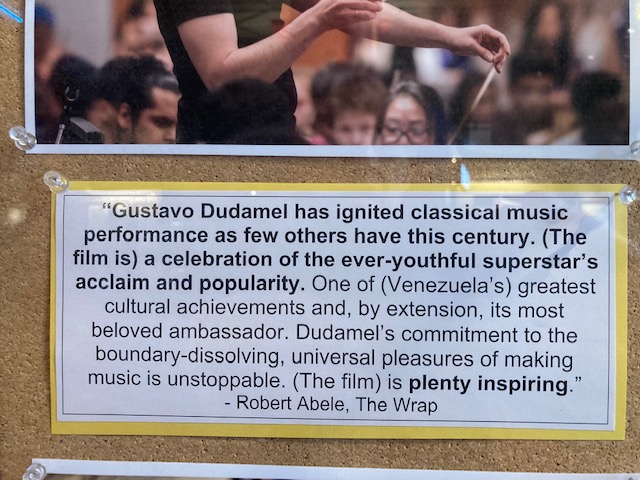
¡Viva Maestro! (Theodore Braun, director)  I barely knew who Gustavo Dudamel was before seeing this wonderful, life-affirming film. He’s one of the good guys. In the film, he’s a force of nature, incredibly energetic, a great musical talent with a humanist agenda. I’m excited by the recent news that he’s leaving the Los Angeles Philharmonic to lead the New York Philharmonic in 2026. That’s a few years away, but in the meantime, see this film. It’s a real rush.

Available for streaming on HBO Max.

________________________________________________________

That does it for this one. Next up: supplemental materials for the titles in this post. Meanwhile, stay safe. — Ted Hicks

_________________________________________________________

Posted in Books, Documentaries, Feature films, Film, Film posters, History, Home Video, Non-Fiction, Streaming, TV & Cable | Tagged , , , , , , , , , , , , , , , , , , , , , , , , , , , , , , , , , , , | 4 Comments

Best Feature Films 2022 – Supplemental

Here are interviews, clips, etc. for some of the films listed in Part 2 of this Best Films series.

___________________________________________________

After Yang

AFI interview with director Kogonada (5:50)

________________________________________________________

Decision to Leave

New York Film Festival interview with director Park Chan-wook  (20:52)

____________________________________________________

Hold Me Tight

New York Film Festival interview with director Mathieu Almaric & Vicky Krieps (43:46)

Angelika Film Center interview with Mathieu Almaric & Vicky Krieps (35:41)  Note: I was at this screening and following interview. I asked the second-to-last audience question at apparoximately 29:00, if you’re interested.

______________________________________________________

The Northman

New Yorker profile of director/writer Robert Eggers can be accessed here.

______________________________________________________

White Noise

New York Film Festival intrviews with cast & filmmakers (37:29)

Closing credits sequence (7:16)  This is pretty amazing.

________________________________________________________

RRR

Tiger fight scene (2:20)  SPOILER ALERT: I can’t resist including this, even though it’s probably something better discovered in the context of the film.

______________________________________________________

That’s it for this one. Next up: Best Documentaries 2022.  — Ted Hicks

_____________________________________________________

Posted in Uncategorized | 2 Comments