
 Last Friday I saw Alien Romulus, the seventh film in the series since 1979. I’d seen the trailer frequently in advance of the release date and was wondering what, if anything, could be different about this installment. I mean, each film from the start has one (or more) of these things getting loose in an enclosed space and scaring the hell out of everybody, killing most of them in the bargain. The humans are trying to kill it and just survive. Okay, there’s usually been more going on, but that’s what it basically comes down to. As it turns out, this one is pretty good.
As is usually the case in an Alien film, the final 30 minutes or so is a desperate race against time with tension being constantly cranked up until you’re out of breath just watching it. Just two days prior I’d seen Tobe Hooper’s The Texas Chain Saw Massacre at the Museum of Modern Art, and this felt very familiar. The last 30 minutes (or more) of that film were even more intensely brutal than Romulus, and felt more real. I’d seen Chain Saw for the first time in 1974 when it opened at the State Theater in Minneapolis, but had forgotten how extreme it is. Almost too much to take. It’s impossible to overestimate how influential this film and George Romero’s Night of the Living Dead (1968) have been on everything that followed. Chain Saw is so raw and direct, it’s like the movie was hammered out in a junkyard. That may be partly why it’s so effective, it’s not a polished studio production, it’s rough and ragged and you never saw these actors before. It’s still really disturbing after all these years, maybe even more so, right down to the final apocalyptic, iconic image of Leatherface whirling with his chainsaw against the rising sun.
 _______________________________________________
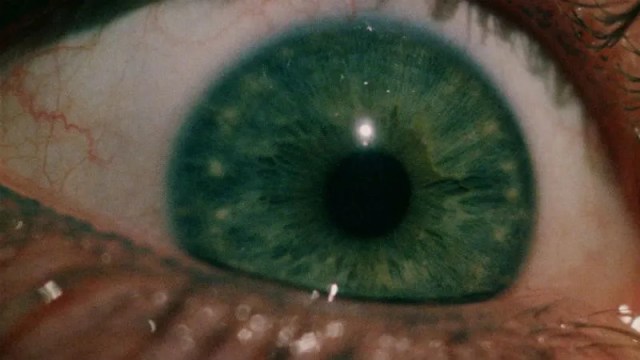
When the last surviving member of her group, Sally Hardesty (played by Marilyn Burns in what must have been an exhausting experience), starts screaming, basically nonstop, she doesn’t stop until she’s in the back of a pickup truck, covered in blood (hers), speeding away from Leatherface doing his chainsaw dance in the road. During the extended finale, we’re assaulted on the soundtrack by Sally’s terrified screams and the chainsaw engine revving in the background, while jump cuts get closer and closer to Sally’s bugged-out eyes. This collision of sound and image is really extreme. You just want it to be over. But for what it is, it’s really great.


 _________________________________________________
While Night of the Living Dead directly defined how zombies would be portrayed in films and TV thereafter, The Texas Chain Saw Massacre, perhaps less directly but no less significantly, established a template for how climactic sequences would be paced and structured in thrillers and horror films in general, not just in Alien movies. There’s nothing original about this; down-to-the-wire, race-against-time climaxes in movies go back to D.W. Griffith, but I think what sets Chain Saw apart is the level of raw, unrelenting intensity.
_____________________________________________________
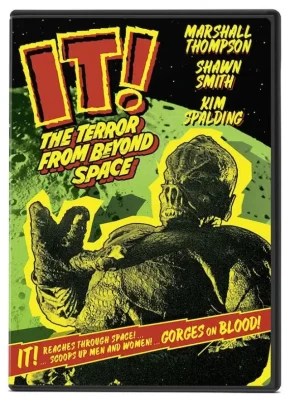
 Of course, the original Alien, which I first saw in 1979 at the Criterion Theater in New York was influenced by more than Chain Saw. Its DNA includes The Thing from Another World (1951), It! The Terror from Beyond Space (1958), and Mario Bava’s Planet of the Vampires (1960).


______________________________________________________________
In The Thing (directed by Christian Nyby with an assist from Howard Hawks), a murderous extraterrestrial is on the loose in the claustrophobic confines of an outpost at the North Pole. It’s a similar environment to spacecraft in the Alien films.

 _____________________________________________________
It! The Terror from Beyond Space has the title creature hiding on a spaceship and killing off crew members as they attempt to locate and kill it. Sound familiar? The connection with Planet of the Vampires is a bit more interesting.
Per Wikipedia:
Several critics have suggested that Bava’s film was a major influence on Ridley Scott’s Alien(1979) and Prometheus (2012), in both narrative details and visual design… One of the film’s most celebrated sequences involves the astronauts performing an exploration of an alien, derelict ship discovered in a huge ruin on the surface of the planet. The crewmembers climb up into the depths of the eerie ship and discover the gigantic remains of long dead monstrous creatures. In 1979, Cinefantastique magazine noted the remarkable similarities between this atmospheric sequence and a lengthy scene in the then-new Alien. However, both Alien‘s director Ridley Scott and screenwriter Dan O’Bannon claimed at the time that they had never seen Planet of the Vampires. Decades later, O’Bannon would admit: “I stole the giant skeleton from the Planet of the Vampires.”
_______________________________________________
Last Saturday, on the heels of just seeing The Texas Chain Saw Massacre and Alien Romulus, it seemed only logical to watch Blu-ray video discs of the original Alien and James Cameron’s sequel, Aliens (1986), back to back. Alien is a horror film, Aliens is a war movie. For me, Alien is much more effective, more contained and claustrophobic, more terrifying. Also, what a jolt the chestburster scene must have been for first-time audiences in 1979, not to mention how destabilizing it was when we slowly realized, along with Sigourney Weaver’s Ripley, that Ash (played by the great Ian Holm) was a robot, especially after he gets his head knocked off. Thanks to CGI, Holm, who died in 2020, turns up as another robot in Alien Romulus, one of the many nods and references to the original film.
 __________________________________________________
Two examples of artwork for Alien‘s alien, or Xenomorph, as it came to be called. The term was first used in Aliens to mean generic extraterrestrial lifeforms.

 __________________________________________________
Speaking of influences, Alien‘s is far-reaching. For example, when Paisley Abbey in Paisley, Scotland was restored in 1991, many of the original gargoyles were badly damaged and had to be replaced. It was someone’s great idea to have one of them be a Xenomorph. Here it is. Pretty cool, huh.
 _______________________________________________
I’ll wrap this up with the original poster for The Texas Chain Saw Massacre. “Who will survive and what will be left of them?” Whew! Can’t say they didn’t warn us.
Note: I’d originally spelled Chain Saw in the title as one word, Chainsaw. It’s that way in the poster below, so I thought I was right. Then I started seeing all these references where it was two words, so now I’ve changed it in this post. But what the hell, I guess however it’s spelled, we know what we’re talking about, right?
 __________________________________________________
I make no apologies for higher than usual film geek content in this post. See you next time. — Ted Hicks
__________________________________________________

 Films etc.
Ted!
This is great! Really great!
Your research impeccable.
The Xenomorph in/at Paisley Abbey in Scotland fascinates me.
Thank you again and again.
♥️
>
Thank you! Glad you liked it. Yeah, that Xenomorph gargoyle is pretty cool.